Weight on other planets is the gravitational pull on an object, calculated with the formula weight = mass × gravity (W = m × g). Your mass stays the same everywhere, but each world’s surface gravity g differs — 1.62 m/s2 on the Moon, 3.72 on Mars, 24.79 on Jupiter — so the same body weighs far more on some planets than others.
Step onto a bathroom scale on the Moon and the number would drop to about a sixth of what you see at home — not because you’ve lost anything, but because the Moon pulls on you far more gently than Earth does. Fly to Jupiter’s cloud tops and the same scale would read roughly two and a half times higher. You, unchanged, would be crushingly heavy.
That single idea — the you stays constant while the pull changes — is what makes weight on other planets one of the most intuitive ways into gravity. Below you’ll find the formula, a full solar-system comparison, worked examples, and the misconceptions that trip almost everyone up.
What Is Weight on Other Planets?
Weight on other planets is the force of gravity acting on a mass at that world’s surface, and it changes because each planet has its own gravitational strength. Weight is a force, measured in newtons (N), not a fixed property you carry around. It is the answer to “how hard is this world pulling me down right now?”
Mass is the constant. A 70 kg astronaut is 70 kg of matter on Earth, in orbit, on Mars, and adrift between the stars.
What shifts from place to place is how strongly gravity tugs on that matter — and that tug is what a scale actually reads. Keeping these two ideas apart is the whole game, which is exactly why the difference between weight and mass is worth nailing down first.
Think of it like this. Your mass is your bank balance; your weight is how heavy that balance feels when someone hands it to you in coins. On the Moon, an unseen cashier hands you the same money in a much lighter bag.
The Weight on Other Planets Formula
Weight on any planet is found by multiplying an object’s mass by that planet’s surface gravity. There is only one equation to learn, and it works for every world in the solar system.
Every symbol, with its SI unit:
| Symbol | Quantity | SI unit |
|---|---|---|
| W | Weight (the gravitational force) | newton (N) |
| m | Mass of the object (never changes) | kilogram (kg) |
| g | Surface gravity (gravitational field strength) | newton per kilogram (N/kg), equal to m/s2 |
Here is a detail worth pausing on: g can be read two ways that are numerically identical. It is the gravitational field strength in N/kg, and it is also the acceleration due to gravity in m/s2. On Earth that number is about 9.81 whichever way you read it.
W = m × g is really Newton’s second law (F = m × a) with gravity supplying the acceleration — which is why weight is measured in newtons, and why weight is a force, not a mass. To skip the arithmetic and compare worlds instantly, drop your mass into our Weight on Other Planets calculator and switch between planet presets.
Why Does Weight Change from Planet to Planet?
Your weight changes because a planet’s surface gravity depends on both its mass and its radius, and those two things vary enormously across the solar system. The surface gravity comes straight from Newton’s law of universal gravitation:
- G — the gravitational constant, 6.674 × 10⁻¹¹ N·m2/kg2 (the same everywhere in the universe).
- M — the mass of the planet, in kilograms (kg).
- r — the distance from the planet’s centre to its surface, i.e. its radius, in metres (m).
- g — the resulting surface gravity, in m/s2.
Notice what the equation is telling you. Pile on more mass and g climbs — but push the surface further from the centre, a bigger radius, and g falls off with the square of that distance.
Gravity is a tug-of-war between how much stuff a planet has and how spread out that stuff is.
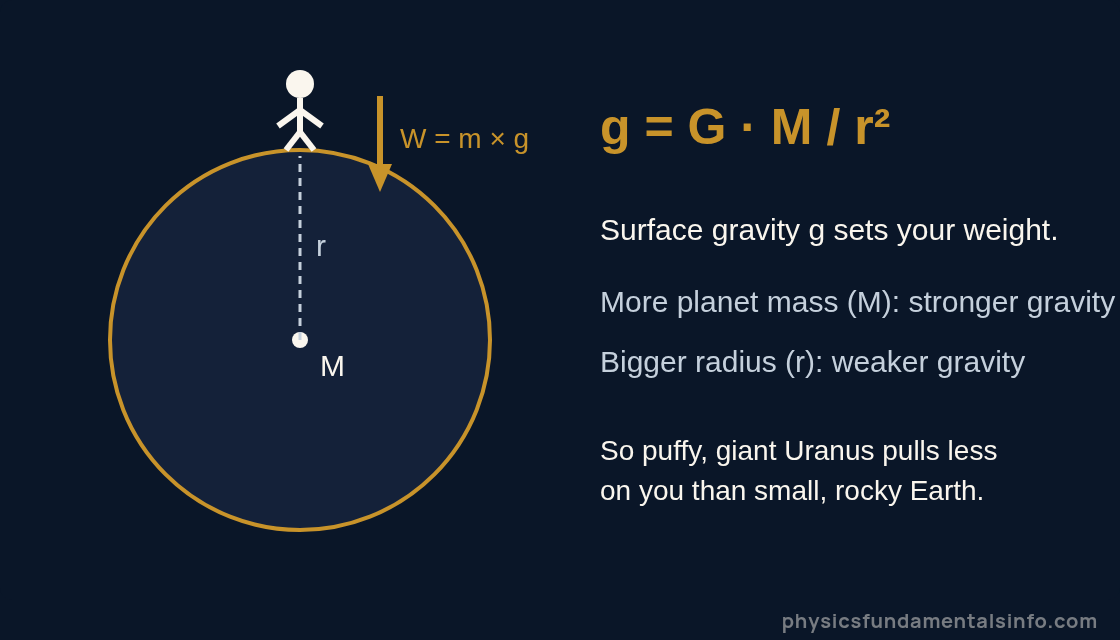
Surface gravity is a balance of a planet’s mass and its radius — which is why bigger isn’t always heavier.
The counter-intuitive part
Uranus has about 14.5 times Earth’s mass, yet you would weigh less standing at its cloud tops than at home. Its radius is roughly four times Earth’s, and squaring that (16×) more than cancels the extra mass.
Mercury and Mars land at nearly the same surface gravity too, despite Mars being the larger planet — Mercury is simply far denser. Size alone tells you almost nothing; what matters is how mass and radius combine.
Your Weight Across the Solar System
Here is what a 70 kg person would weigh on every major world in the solar system, using each body’s surface gravity. The final column shows what an ordinary bathroom scale — calibrated for Earth — would display, which is the figure most people are really asking about.
| World | Surface gravity g (m/s2) | Compared to Earth | Weight of a 70 kg person (N) | Earth scale would read |
|---|---|---|---|---|
| The Moon | 1.62 | 0.17× (about 1/6) | 113 N | ~11.6 kg |
| Mercury | 3.70 | 0.38× | 259 N | ~26.4 kg |
| Venus | 8.87 | 0.90× | 621 N | ~63.3 kg |
| Earth | 9.81 | 1.00× | 687 N | 70 kg |
| Mars | 3.72 | 0.38× | 260 N | ~26.5 kg |
| Jupiter* | 24.79 | 2.53× | 1,735 N | ~177 kg |
| Saturn* | 10.44 | 1.06× | 731 N | ~74.5 kg |
| Uranus* | 8.69 | 0.89× | 608 N | ~62.0 kg |
| Neptune* | 11.15 | 1.14× | 781 N | ~79.6 kg |
| Pluto | 0.62 | 0.06× | 43 N | ~4.4 kg |
| The Sun* | 274 | 27.9× | 19,180 N | ~1,955 kg |
*A note on the gas giants and the Sun: Jupiter, Saturn, Uranus, Neptune and the Sun have no solid surface to stand on, so “surface gravity” is measured at the 1-bar cloud level. The values above are mean surface gravities (matching this site’s calculator). NASA’s summary Planetary Fact Sheet lists slightly lower equatorial figures for the fast-spinning giants — about 23.1 for Jupiter and 9.0 for Saturn — because rapid rotation flings a little of your effective weight away at the equator.
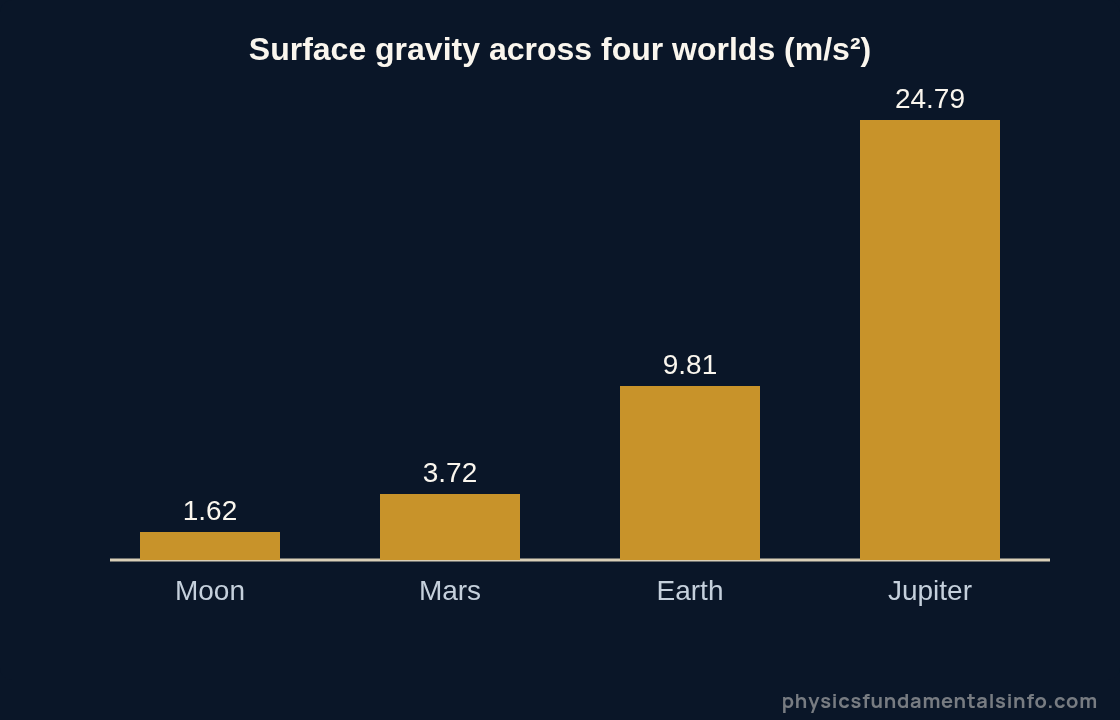
The Moon barely registers next to Jupiter — the same reason your Moon weight is tiny and your Jupiter weight is enormous.
Real-World Examples of Weight on Other Planets
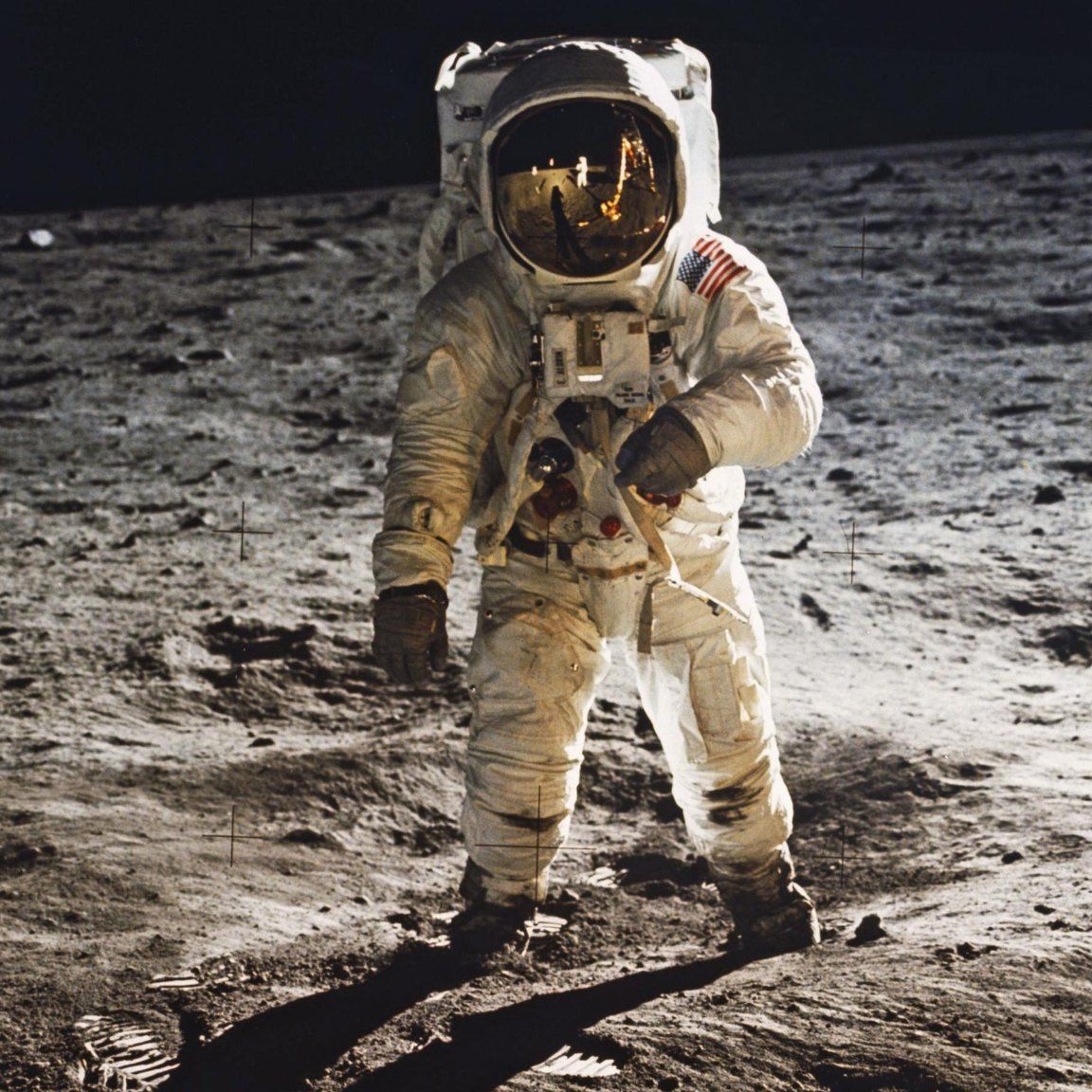
The clearest example is an Apollo astronaut on the Moon, who weighed about a sixth of their Earth weight. A suited astronaut and life-support pack topping 90 kg pressed on the lunar surface as though they weighed only about 15 kg — light enough to bound across the regolith in those famous kangaroo hops. NASA’s lunar science pages document just how differently the Moon behaves as a world.
Mars is the next frontier, and its 0.38 g reshapes the engineering. A 900 kg rover that would press down with almost 8,800 N on Earth weighs only about 3,350 N on Mars, which changes everything from parachute design to wheel loading. A future 70 kg astronaut would feel like a 26 kg version of themselves — easier on the joints, though bones and muscles quietly weaken without Earth’s full pull.
Jupiter is the cautionary tale. You can’t stand on it — there’s no surface, just deepening gas — but at the cloud tops its 2.53 g would make a 70 kg person feel like 177 kg, a suffocating heaviness. Saturn, oddly, is gentler: despite being 95 times Earth’s mass, its surface gravity is only about 6% stronger than ours, because it’s vast and so low-density it would float in a big enough bath.
Common Misconceptions About Weight on Other Planets
Most confusion around weight on other planets comes from mixing up weight with mass, or from misreading what “no gravity” actually means. Here are the four that cause the most trouble.
1. “My mass changes on the Moon”
It doesn’t. Your mass — the amount of matter in you — is identical on the Moon, on Mars, and in deep space. Only your weight changes, because weight is the local gravitational force on that mass. This is the single most common slip, and it’s why the mass–weight distinction matters so much.
2. “A bigger, heavier planet always means I weigh more”
Not necessarily. Surface gravity depends on mass and radius through g = G × M / r2, so a huge but spread-out planet can pull weakly. Uranus has over 14 times Earth’s mass, yet you’d weigh slightly less there because its radius is so large.
3. “Astronauts float because there’s no gravity in space”
There’s plenty of gravity where the Space Station orbits — roughly 90% of the surface value. Astronauts feel weightless because they, and their station, are in continuous free fall around Earth, forever falling and forever missing. Weightlessness is falling, not the absence of gravity.
4. “The kilograms on a bathroom scale are my weight”
True weight is a force in newtons; a scale measures the push against it and then assumes Earth’s gravity to display a mass in kilograms. Carry that same scale to Mars and it would still assume Earth’s g, so it would under-read your “kg” by more than half — reading a fiction, not your real mass.
How Weight on Other Planets Connects to Mass, Gravity and Free Fall
Weight on other planets sits at the crossroads of several core ideas, and seeing the links makes each one click. Because weight is a force, it obeys the same F = m × a logic as everything else in dynamics — gravity just plays the role of the acceleration.
Mass invariance is the foundation: your mass is fixed, your weight is local. That same g controls how fast things accelerate in free fall, which is why a hammer and a feather hit the lunar ground together — lower g slows the fall for both equally.
And because lifting a mass through a height depends on g, your gravitational potential energy (PE = m × g × h) shrinks on low-gravity worlds too. Change one planet’s g and a whole chain of physics quietly rescales.
Worked Problems
Show Solution
Solution:
Step 1: Use W = m × g.
Step 2: Substitute — W = 50 kg × 1.62 m/s2.
Step 3: W = 81 N.
Answer: 81 N (compared with 491 N on Earth).
Show Solution
Solution:
Step 1: Apply W = m × g with Mars gravity.
Step 2: W = 50 kg × 3.72 m/s2.
Step 3: W = 186 N.
Answer: 186 N — a little over twice their Moon weight, because Mars pulls more than twice as hard.
Show Solution
Solution:
Step 1: Find the mass first — rearrange W = m × g to m = W / g.
Step 2: m = 120 N / 9.81 m/s2 = 12.23 kg.
Step 3: Now weigh it on Jupiter — W = 12.23 kg × 24.79 m/s2 = 303 N.
Answer: about 303 N. Always convert to mass before switching worlds.
Show Solution
Solution:
Step 1: The scale reading scales with gravity — multiply the Earth reading by g(Moon)/g(Earth).
Step 2: Ratio = 1.62 / 9.81 = 0.165.
Step 3: Reading = 78 kg × 0.165 = 12.9 kg.
Answer: about 12.9 kg. Their true mass is still 78 kg — the scale is fooled because it assumes Earth’s gravity.
Show Solution
Solution:
Step 1: Use g = G × M / r2.
Step 2: Numerator = 6.674 × 10-11 × 6.42 × 1023 = 4.285 × 10¹³.
Step 3: Denominator = (3.39 × 10⁶)2 = 1.149 × 10¹³; so g = 4.285 × 10¹³ / 1.149 × 1013 = 3.73 m/s2.
Answer: g ≈ 3.73 m/s2 — these are Mars’s numbers, so this matches the accepted value of 3.72.
Show Solution
Solution:
Step 1: Find mass — m = 700 N / 9.81 m/s2 = 71.4 kg.
Step 2: Weight on Uranus — W = 71.4 kg × 8.69 m/s2.
Step 3: W = 620 N.
Answer: about 620 N — less than on Earth, even though Uranus has over 14 times Earth’s mass, because its large radius weakens its surface gravity.
Show Solution
Solution:
Step 1: Use W = m × g.
Step 2: W = 70 kg × 274 m/s2.
Step 3: W = 19,180 N, or about 19.2 kN.
Answer: roughly 19,200 N — nearly 28 times their Earth weight, the equivalent of a small car pressing down on them.
Show Solution
Solution:
Step 1: Multiply Earth weight by the ratio — W = 0.38 × 640 N.
Step 2: W = 243 N.
Step 3: Identify worlds with g ≈ 0.38 of Earth — Mercury (0.38×) and Mars (0.38×) both fit.
Answer: 243 N; planet X could be Mercury or Mars, which share almost the same surface gravity.
Frequently Asked Questions
How much would I weigh on the Moon?
What is the formula for weight on another planet?
Does my mass change on other planets?
Which planet would I weigh the most on?
Why is gravity different on each planet?
Can you actually stand on Jupiter or Saturn to be weighed?
How much would I weigh on Mars?
Every gravity value above is a standard planetary figure; the gas-giant and Sun values are measured at the 1-bar cloud level, as explained in the table note. If you’re revising, try the interactive lab and calculator to test your own numbers.