Types of forces in physics fall into two broad groups: contact forces, which act only when objects physically touch — friction, tension, the normal force, applied force, spring force, drag and buoyancy — and non-contact (field) forces, which act across a distance: gravity, electromagnetism, and the strong and weak nuclear forces. Force is measured in newtons (N) and obeys F = ma.
Right now, without lifting a finger, you are caught in a tug-of-war. Gravity drags you down into your seat, and the chair pushes back up with just enough force to hold you in place. Pick up your phone and your fingertips grip it through friction, your arm hauls it up against its weight, and the charging cable hangs under its own tension.
Forces are the hidden hands behind every push, pull, stretch and squeeze in the universe. The good news? Physics sorts that bewildering variety into a surprisingly short list. Learn the list, and the whole of mechanics starts to click into place.
What Is a Force in Physics?
Strip away the jargon and a force is simply a push or a pull. It is what one object does to another when it speeds it up, slows it down, changes its direction, or bends and squashes it out of shape.
More precisely, a force is any influence that can change an object’s motion or shape. Because a force has both a size and a direction, it is a vector — “10 newtons” is only half the story until you also say which way.
The unit is the newton (N), named after Isaac Newton. To get a feel for it, a medium apple resting in your palm pushes down with roughly one newton. Hold ten apples and you are feeling about ten.
One idea underlies everything that follows: a single object usually has several forces acting on it at once. What actually happens to it depends not on any one force, but on how they all add up.
The Two Main Types of Forces: Contact vs Non-Contact
The cleanest way to sort the types of forces is by one question: do the objects have to be touching?
Contact forces need physical contact. Friction, tension, the normal force, an applied push, a spring’s pull and air resistance all switch off the instant the surfaces separate.
Non-contact forces — also called field forces or “action-at-a-distance” forces — reach across empty space. Gravity holds the Moon in orbit across 384,000 km of vacuum, and a magnet tugs a paperclip before they ever meet.
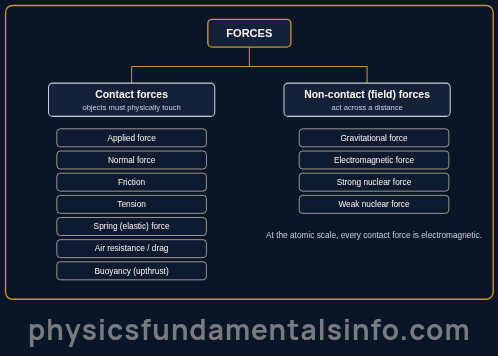
Figure 1: The two families of forces. Everyday contact forces (left) need touching; field forces (right) act across empty space. Remarkably, all contact forces trace back to one field force — electromagnetism.
Here is a summary you can scan in seconds. Note that weight is the odd one out in everyday physics — it is the only common force that is non-contact.
| Force | Type | Direction it acts | Formula | Everyday example |
|---|---|---|---|---|
| Weight (gravity) | Non-contact | Vertically downward | W = mg | A dropped ball falling |
| Normal force | Contact | Perpendicular to the surface | varies | A book resting on a table |
| Friction | Contact | Opposes relative motion | f = μN | Walking without slipping |
| Tension | Contact | Along a rope, pulling inward | varies | A cable holding a lift |
| Applied force | Contact | Direction of the push or pull | varies | Pushing a shopping trolley |
| Spring (elastic) | Contact | Opposes the stretch or squeeze | F = −kx | A stretched bungee cord |
| Air resistance (drag) | Contact | Opposes motion through the air | F = ½ρv2CdA | A skydiver slowing down |
| Buoyancy (upthrust) | Contact | Vertically upward | F = ρVg | A boat floating |
Contact Forces, One by One
Contact forces are the ones you meet every waking second. Let’s walk through the headline types.
Applied force
This is the most intuitive force of all: a direct push or pull from a person, a motor, or another object. Shoving a door, kicking a ball, towing a caravan — each is an applied force acting in the direction you push.
The normal force
Every surface you press on presses back. The normal force is that support push, and it always points perpendicular (“normal”) to the surface — straight up from a flat floor, but at an angle from a ramp. It is the reason you don’t sink through your chair.
Friction
Friction resists sliding wherever two surfaces meet. It comes in two flavours: static friction, which holds a stationary object in place up to a limit, and kinetic friction, which drags on an object already moving.
- f — friction force, in newtons (N)
- μ — coefficient of friction, a dimensionless number set by the two surfaces
- N — normal force pressing the surfaces together, in newtons (N)
For kinetic friction the relationship is an equals sign, f = μkN. For static friction it is a ceiling, f ≤ μsN, because static friction only pushes back as hard as it needs to. If you want the full picture, our deep dive into the physics of friction unpacks both cases.
Tension
Pull on a rope, chain or cable and the force transmitted along it is tension. It always pulls inward, away from the object and along the line of the rope. In an ideal massless rope the tension is the same at every point — a fact that makes pulley problems far easier than they look, as our guide to the tension force shows.
Spring (elastic) force
Stretch or compress a spring and it fights to return to its natural length. This restoring force is described by Hooke’s law.
- F — restoring force, in newtons (N)
- k — spring constant (stiffness), in newtons per metre (N/m)
- x — extension or compression from the natural length, in metres (m)
The minus sign is the whole point: the force always opposes the displacement, pulling a stretched spring back in and pushing a squashed one back out. The same idea is explored in our article on Hooke’s law.
Air resistance and buoyancy
Move through a fluid and it pushes back. Air resistance (drag) opposes motion and grows fast with speed — it is what lets a falling object eventually stop accelerating and reach terminal velocity. Buoyancy is the upward push a fluid gives a submerged object, and it is why steel ships float.
Non-Contact (Field) Forces
Some forces never touch the objects they move. Instead, each object sits in a field created by the other, and the field does the pushing or pulling. Two field forces dominate classical physics.
Gravity
Gravity is the mutual attraction between any two objects that have mass. Near Earth’s surface it shows up as weight — the downward force the planet exerts on you.
- W — weight (a force), in newtons (N)
- m — mass, in kilograms (kg)
- g — gravitational field strength, about 9.81 m/s2 (equivalently 9.81 N/kg) at Earth’s surface
Zoom out, and the same force keeps planets in orbit. Newton’s law of universal gravitation gives its strength between any two masses.
- F — gravitational force, in newtons (N)
- G — gravitational constant, 6.674 × 10⁻¹¹ N·m2/kg2
- m1, m2 — the two masses, in kilograms (kg)
- r — distance between their centres, in metres (m)
The electromagnetic force
The electromagnetic force acts between electric charges and magnetic poles. Like charges repel, opposites attract, and the strength between two point charges follows Coulomb’s law.
- F — electric force, in newtons (N)
- k — Coulomb constant, about 8.99 × 10⁹ N·m2/C2
- q1, q2 — the two charges, in coulombs (C)
- r — distance between them, in metres (m)
Notice how closely Coulomb’s law mirrors gravity: both fade with the square of distance. The electromagnetic force is the quiet workhorse of daily life — it holds atoms and molecules together, and, as we’ll see, it secretly powers every contact force in the table above.
The Four Fundamental Forces
Here is the twist that surprises most students. Friction, tension, the normal force, the push of your hand — none of them is truly “basic.” At the deepest level, physicists recognise just four fundamental forces, and everything else is one of them in disguise.
When your hand pushes a wall, the atoms never actually touch. The electrons on your skin electrically repel the electrons in the wall — so that “contact” push is really the electromagnetic force at microscopic range. Every contact force works this way.
| Fundamental force | Relative strength (approx.) | Range | Main role | Carrier particle |
|---|---|---|---|---|
| Strong nuclear | 1 (strongest) | ~10−15 m | Binds quarks; holds nuclei together | Gluon |
| Electromagnetic | ~10−2 (about 1/137) | Infinite | Acts between charges; binds atoms and molecules | Photon |
| Weak nuclear | ~10−6 | ~10−18 m | Drives radioactive (beta) decay | W and Z bosons |
| Gravitational | ~10−38 (weakest) | Infinite | Attracts all mass; shapes planets and stars | Graviton (hypothesised) |
Those strength figures are rough, scale-dependent comparisons, not exact constants — but the ranking is firm. Gravity feels powerful only because planets are enormous; particle for particle it is by far the weakest. For a deeper treatment of the carriers and ranges, Georgia State University’s HyperPhysics is an excellent reference.
The Force Formula: F = ma
If forces are the cause, motion is the effect — and one short equation links them. Newton’s second law states that the net force on an object equals its mass times its acceleration.
- F — net (resultant) force, in newtons (N)
- m — mass of the object, in kilograms (kg)
- a — acceleration produced, in metres per second squared (m/s2)
The word net is doing the heavy lifting. It is the single force left over after every individual force is added together as a vector — the topic of the next section.
This law also defines the newton itself: one newton is the force that gives a 1 kg mass an acceleration of 1 m/s2, so 1 N = 1 kg·m/s2. Rearranged as a = F/m, it tells you that more force means more acceleration, while more mass means less.
Need a number fast? Drop any two values into our Newton’s Second Law calculator to solve for the third. For the law in Newton’s own framing, NASA’s overview of Newton’s laws of motion is a clear, authoritative read.
How Forces Combine: Net Force and Free-Body Diagrams
Real objects rarely feel just one force. To predict what happens, you add every force as a vector to find the net force — and the simplest way to do that is to draw a free-body diagram.
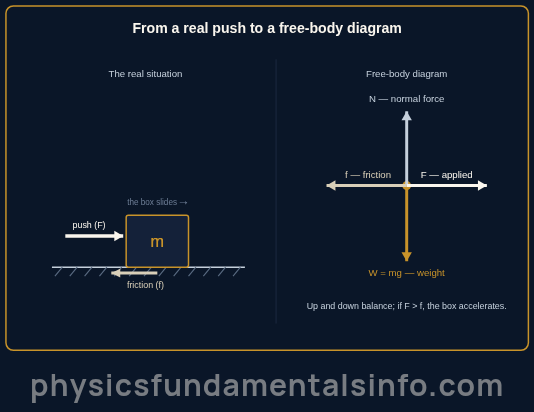
Figure 2: A real push (left) translated into a free-body diagram (right). The upward normal force and downward weight cancel vertically, while the applied force and friction compete horizontally.
This leads straight to one of the most useful ideas in mechanics:
- Balanced forces (zero net force) mean no change in motion — the object stays still or keeps a constant velocity. This is Newton’s first law.
- Unbalanced forces (a non-zero net force) cause acceleration in the direction of the net force, exactly as F = ma predicts.
So an object cruising at steady speed is not “force-free” — its forces simply cancel. To see how each force feeds into the result, it helps to know Newton’s three laws of motion as a set. Try it yourself below: change the applied force, mass and friction, and watch the net force change the acceleration in real time.
Real-World Examples of Forces
Forces stop being abstract the moment you spot them in action. Here are four that quietly run your day.
Walking
Every step is a friction story. Your shoe pushes back on the ground, and friction pushes you forward. Take it away — step onto sheet ice — and your foot slides uselessly while you go nowhere.
A rocket launch
Lift-off is a battle of three force types. The engine’s thrust (an applied force, and a textbook case of Newton’s third law) fights the rocket’s weight pulling it down and air resistance dragging on it. When thrust wins, the rocket accelerates skyward.

A floating boat
A steel hull weighs tonnes, yet it floats because buoyancy — the upward push of the displaced water — exactly balances its weight. Shift the balance, and the boat rises or sinks.
A fridge magnet
Stick a magnet to a fridge and you are watching a non-contact force hold steady against gravity. The electromagnetic force grips the steel door across a tiny air gap, with no mechanical contact doing the work.
Common Misconceptions About Forces
A few stubborn myths trip up almost every beginner. Clearing them out is half the battle.
“Motion needs a constant force.”
It doesn’t. An object moving at steady speed in a straight line has zero net force. Force changes motion; it isn’t needed to maintain it. In space, a probe coasts for years with its engines off.
“Heavier objects fall faster.”
Ignore air resistance and a feather and a hammer hit the ground together — astronauts proved it on the Moon. Gravity gives every object the same acceleration, about 9.81 m/s2, regardless of mass.
“The normal force always equals the weight.”
Only on flat ground with nothing else pushing vertically. Tilt the surface, press down, or pull up, and the normal force changes. This is the single most common slip in free-body problems.
“Centrifugal force flings you outward in a turn.”
What you feel as an outward push is really your own inertia. The genuine force in a turn is the centripetal force pointing inward; “centrifugal force” is a fictitious effect that only appears when you analyse motion from a spinning frame.
Worked Problems
Show Solution
Solution:
Step 1 — Use Newton’s second law: F = ma.
Step 2 — Substitute with units: F = (2 kg)(3 m/s2).
Step 3 — Multiply: F = 6 kg·m/s2.
Answer: F = 6 N
Show Solution
Solution:
Step 1 — Weight is a gravitational force: W = mg.
Step 2 — Substitute: W = (10 kg)(9.81 m/s2).
Step 3 — Multiply: W = 98.1 N.
Answer: W = 98.1 N (downward)
Show Solution
Solution:
Step 1 — On level ground the normal force equals the weight: N = mg = (5)(9.81) = 49.05 N.
Step 2 — Apply the friction formula: f = μN = (0.40)(49.05).
Step 3 — Multiply: f = 19.62 N.
Answer: f ≈ 19.6 N (opposing the motion)
Show Solution
Solution:
Step 1 — Find friction. N = mg = (8)(9.81) = 78.48 N, so f = μN = (0.25)(78.48) = 19.62 N.
Step 2 — Find the net horizontal force: Fnet = 40 − 19.62 = 20.38 N.
Step 3 — Apply F = ma: a = Fnet/m = 20.38 / 8.
Answer: a ≈ 2.55 m/s2 (in the direction of the push)
Show Solution
Solution:
Step 1 — Perpendicular forces add by Pythagoras: R = √(Fx2 + Fy2) = √(32 + 42).
Step 2 — Evaluate: R = √(9 + 16) = √25 = 5.0 N.
Step 3 — Find the direction: θ = tan−1(4/3) = 53° measured from east toward north.
Answer: R = 5.0 N, 53° north of east
Show Solution
Solution:
Step 1 — Use the magnitude of Hooke’s law: F = kx (the minus sign only gives direction).
Step 2 — Convert and substitute: x = 5.0 cm = 0.050 m, so F = (200)(0.050).
Step 3 — Multiply: F = 10 N.
Answer: F = 10 N (pushing back toward the natural length)
Show Solution
Solution:
Step 1 — Use Newton’s law of gravitation: F = Gm1m2 / r2.
Step 2 — Substitute: F = (6.674 × 10⁻¹¹)(5.0)(10) / (0.50)2 = (6.674 × 10⁻¹¹)(50) / 0.25.
Step 3 — Evaluate: F = (6.674 × 10⁻¹¹)(200) = 1.33 × 10⁻⁸ N.
Answer: F ≈ 1.3 × 10⁻⁸ N — about a hundred-millionth of a newton. That tiny value is exactly why you never feel pulled toward everyday objects; gravity only becomes noticeable when a mass is planet-sized.
Show Solution
Solution:
Step 1 — Split the weight. Component along the ramp: mg sinθ = (4.0)(9.81)(0.50) = 19.62 N. Normal force: N = mg cosθ = (4.0)(9.81)(0.866) = 33.98 N.
Step 2 — Friction opposes the slide: f = μN = (0.20)(33.98) = 6.80 N, so the net force down the ramp is Fnet = 19.62 − 6.80 = 12.82 N.
Step 3 — Apply F = ma: a = Fnet/m = 12.82 / 4.0.
Answer: a ≈ 3.2 m/s2 (down the ramp)