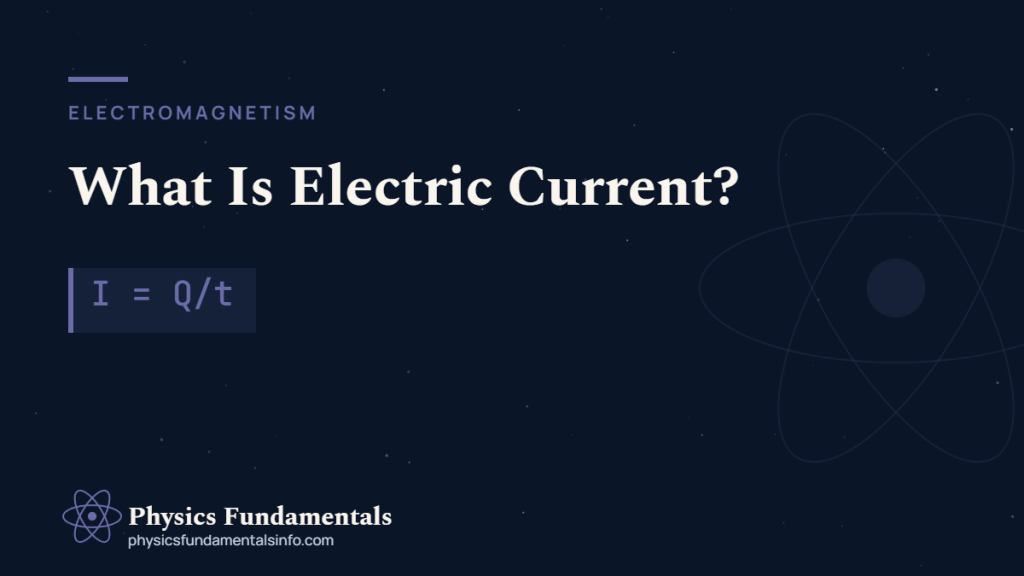
Electric current is the rate at which electric charge flows past a point in a circuit, measured in amperes (A). One ampere equals one coulomb of charge per second. In symbols, current equals charge divided by time (I = Q/t), so a larger charge moved in less time means a bigger current.
Flip a switch and the room floods with light before your finger has even left the plastic. Somewhere in that instant, something invisible surged through the copper in your walls — the same something that charges your phone, spins a washing machine and carries a jolt across a hospital defibrillator.
That something is electric current. It runs almost everything you touch, yet most people would struggle to say what it actually is. The answer turns out to be simpler — and stranger — than you might guess.
What Is Electric Current?
Electric current is the flow of electric charge — the movement of charged particles, usually electrons, through a material. Wherever charge moves in an organised stream, a current exists.
Picture water in a pipe. The wider and faster the flow, the more litres pass any point each second. Swap the water for electric charge and the pipe for a copper wire, and you have the right mental image. Current measures how much charge streams past a chosen point each second.
Those moving charges are not exotic. In a metal wire they are the loosely held outer electrons of the metal atoms, drifting along under an electric push. It is the same electric charge whose attractions and repulsions are captured by Coulomb’s law.
So current is not a “thing” stored in a battery, ready to be poured out. It is a process — charge on the move. Stop the motion and the current vanishes, even though the charges are all still there.
The Electric Current Formula: I = Q/t
The formula for electric current is charge divided by time. Move more charge, or move it in less time, and the current goes up.
Each symbol has a precise meaning and a matching SI unit:
- I = the electric current, measured in amperes (A)
- Q = the electric charge that flows, measured in coulombs (C)
- t = the time taken, measured in seconds (s)
The units lock together cleanly: one ampere is one coulomb per second (1 A = 1 C/s). If two coulombs of charge sweep past a point every second, the current is exactly 2 A.
Strictly, I = Q/t gives the average current over the time t. When the flow keeps changing — as it does in your mains supply — physicists use the instantaneous version, the rate of change of charge at a single moment. For steady currents, the simple formula is all you need.
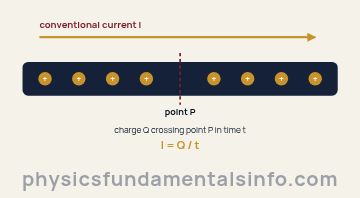
Electric current is the charge Q that passes a fixed point P in time t. Count the charge crossing each second and you have the current in amperes.
Where does the ampere itself come from? Since 2019, the official SI definition of the ampere is pinned to a fixed constant of nature — the elementary charge, e = 1.602176634 × 10⁻¹⁹ C. Turn that around and one coulomb is roughly 6.24 × 10¹⁸ electrons, so a 1 A current pushes about six billion billion electrons past a point every second.

Want to feel the formula move? The lab below lets you push charge past a point and watch the current respond.
How Electric Current Actually Works
Electric current works when an electric field pushes free charges through a conductor in a coordinated drift. No field, no push, no current — the charges just jiggle about randomly and get nowhere.
Connect a battery across a wire and you set up an electric field inside the metal. That field nudges every free electron, adding a slow, one-way crawl on top of their frantic random motion. It is the same electrostatic force described by Coulomb’s law, now applied to trillions of electrons at once. For a fuller treatment you can also browse Georgia State University’s HyperPhysics page on electric current.
Charge Carriers and Drift Velocity
Here is the surprise most people never hear: the electrons themselves barely move. Their steady, forward crawl — the drift velocity — is astonishingly slow. The relationship is:
- I = current, in amperes (A)
- n = number of charge carriers per cubic metre, in m-3
- A = cross-sectional area of the wire, in m2
- v = drift velocity, in metres per second (m/s)
- q = charge on each carrier, in coulombs (C)
Copper packs in roughly 8.5 × 1028 free electrons per cubic metre. Because n is so colossal, only a whisper of speed is needed to carry a big current.
Run the numbers for a 1 A current in a typical 1 mm2 copper wire and the drift velocity comes out at about 0.07 mm/s — slower than a strolling ant. At that pace, a single electron would take hours to shuffle from your light switch to the bulb.
So why does the light come on the instant you flick the switch? Because the electric field spreads through the wire at close to the speed of light. Every electron along the whole circuit starts drifting almost simultaneously — like a train of railway carriages that all lurch forward the moment the front one is tugged. The signal races; the electrons dawdle.
Conventional Current vs Electron Flow
Conventional current is defined as flowing from the positive terminal to the negative terminal — the direction a positive charge would move. The catch: in a metal, the actual movers are negative electrons, drifting the opposite way.
This mismatch is a historical accident. Long before the electron was discovered, Benjamin Franklin guessed a direction for “current” and picked the one we now call positive-to-negative. He had a fifty-fifty chance and, for metals, he chose the reverse of what really happens.
Does it matter? For nearly all circuit work, no. Treating current as positive charge flowing one way gives identical answers to negative charge flowing the other. Just remember: conventional current and electron flow point in opposite directions.
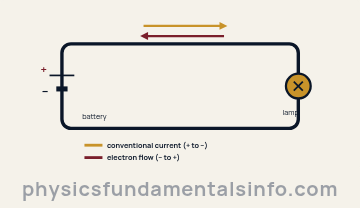
Conventional current (gold) runs from + to −. The electrons that actually carry it (wine) drift the other way, from − to +.
AC vs DC: The Two Types of Electric Current
Electric current comes in two forms: direct current (DC), which flows steadily in one direction, and alternating current (AC), which reverses direction many times per second. Both deliver energy; they just do it differently.
A battery gives DC — charge marches one way, from − to +, until the battery runs flat. Your wall socket gives AC — the charge sloshes back and forth, switching direction 50 or 60 times every second depending on where you live.
Why bother with a current that can’t make up its mind? Because AC is effortless to step up to high voltage for long-distance transmission and back down for safe home use, using transformers. That single advantage is why the grid runs on AC.
| Feature | Direct Current (DC) | Alternating Current (AC) |
|---|---|---|
| Direction of flow | Constant, one way | Reverses periodically (50–60 times/sec) |
| Typical source | Batteries, solar cells, USB ports | Wall sockets, power-station generators |
| Shape over time | Steady, flat line | Smooth sine wave, up and down |
| Everyday examples | Torch, phone internals, car electrics | Home lighting, the national grid |
| Best suited to | Electronics and energy storage | Long-distance transmission (easy voltage changes) |
Real-World Examples of Electric Current
Electric current spans an enormous range in everyday life — from the trickle through an LED to the torrent inside a lightning bolt. Seeing the numbers side by side builds a feel for what “a few amps” really means.
A Handful of Familiar Currents
A tiny indicator LED sips around 0.02 A. Your phone charger delivers a steady 1–2 A. A 3 kW kettle in a UK kitchen pulls about 13 A — which is exactly why British plugs carry a 13 A fuse.
Scale up and the figures leap. A car’s starter motor briefly gulps 100 A or more to crank the engine. A lightning strike peaks at roughly 30,000 A — the same I = Q/t idea, just with a vast charge dumped in a few millionths of a second.
| Device or situation | Typical current |
|---|---|
| LED indicator light | ~0.02 A (20 mA) |
| Smartphone charging | ~1–2 A |
| 3 kW kettle (UK, 230 V) | ~13 A |
| Car starter motor | ~100–200 A |
| Lightning strike (peak) | ~30,000 A |
Common Misconceptions About Electric Current
Electric current is one of the most misunderstood ideas in physics, partly because you can’t see it. Clearing up four common slip-ups makes everything that follows easier.
“Current gets used up as it goes round”
It doesn’t. In a simple series circuit, the current is exactly the same at every point — before the bulb, inside the bulb and after it. Charge is conserved; not a single electron is destroyed. What gets “used up” is energy, not current.
“Electrons zoom through the wire at the speed of light”
They crawl, as we saw — a fraction of a millimetre per second. Only the electric field, and so the effect, travels near light speed. Confusing the two is the single most common student error here.
“Current and voltage are the same thing”
They are partners, not twins. Voltage is the electrical push; current is the resulting flow of charge. You can have voltage with no current (an open switch) but you cannot have current without a voltage to drive it.
“Current is a vector like velocity”
Current has a direction along a wire, yet it is treated as a scalar, because at a junction currents add up as plain numbers, not as arrows. The true vector quantity is current density — current per unit area — not current itself.
How Current Connects to Voltage, Resistance and Power
Electric current never acts alone — it is bound to voltage, resistance and power by a few tidy relationships. Master these links and circuits stop feeling like magic.
The first is Ohm’s law: the current through many components equals the voltage across them divided by their resistance, V = IR. Raise the push, get more current; raise the resistance, get less.
The second is power. As charge flows, it transfers energy to whatever it passes through — heating a filament, spinning a motor, lighting a screen. Electrical power is simply current times voltage, P = VI, measured in watts.
Put them together and you can predict a whole circuit from a couple of readings. That is the quiet power of the humble ampere: know the current, and the behaviour of everything downstream starts to fall into place.
Key Takeaways
- Electric current is the rate of flow of electric charge past a point, measured in amperes.
- The defining formula is I = Q/t, where one ampere equals one coulomb per second.
- The charge carriers in a metal are electrons, which drift extremely slowly — around 0.07 mm/s for a typical current.
- The light comes on instantly because the electric field, not the electrons, travels near the speed of light.
- Conventional current runs from + to −, the opposite of real electron flow.
- Current is not “used up” in a circuit — it is the same all around a series loop; energy is what’s transferred.
- Direct current (DC) flows one way; alternating current (AC) reverses many times per second.
Worked Problems
Show Solution
Solution:
Step 1: Use the definition of current, I = Q/t.
Step 2: Substitute with units — I = 12 C ÷ 4 s.
Step 3: Divide — I = 3 C/s.
Answer: I = 3 A
Show Solution
Solution:
Step 1: Rearrange I = Q/t to make charge the subject: Q = I × t.
Step 2: Convert time to seconds — 2 minutes = 120 s.
Step 3: Substitute and solve — Q = 0.5 A × 120 s = 60 C.
Answer: Q = 60 C
Show Solution
Solution:
Step 1: Rearrange I = Q/t to make time the subject: t = Q/I.
Step 2: Substitute with units — t = 240 C ÷ 2 A.
Step 3: Divide — t = 120 s.
Answer: t = 120 s (2 minutes)
Show Solution
Solution:
Step 1: The number of electrons is the total charge divided by the charge on one electron, N = Q/e.
Step 2: Substitute — N = 60 C ÷ (1.60 × 10⁻¹⁹ C).
Step 3: Divide — N = 3.75 × 10²⁰.
Answer: N ≈ 3.75 × 10²⁰ electrons
Show Solution
Solution:
Step 1: First find the charge, Q = I × t, with time in seconds (1 hour = 3600 s).
Step 2: Substitute — Q = 2 A × 3600 s = 7200 C.
Step 3: Convert to electrons — N = Q/e = 7200 ÷ (1.60 × 10⁻¹⁹) = 4.5 × 10²².
Answer: N ≈ 4.5 × 10²² electrons
Show Solution
Solution:
Step 1: For charge, use Q = I × t with time in seconds (2 minutes = 120 s).
Step 2: Substitute — Q = 13 A × 120 s = 1560 C.
Step 3: For power, use P = V × I = 230 V × 13 A = 2990 W.
Answer: Q = 1560 C, and P ≈ 2990 W (about 3 kW)
Show Solution
Solution:
Step 1: Start from I = nAvq and rearrange for drift velocity: v = I/(nAq).
Step 2: Convert the area — 1 mm2 = 1 × 10⁻⁶ m2. Substitute — v = 1 ÷ (8.5 × 1028 × 1 × 10-6 × 1.60 × 10-19).
Step 3: The denominator is 1.36 × 10⁴, so v = 1 ÷ (1.36 × 10⁴) = 7.4 × 10⁻⁵ m/s.
Answer: v ≈ 7.4 × 10⁻⁵ m/s (about 0.07 mm/s — the electrons really do crawl)
Frequently Asked Questions
What is electric current in simple terms?
What is the SI unit of electric current?
Is electric current the flow of electrons or protons?
Why do lights turn on instantly if electrons move so slowly?
What is the difference between AC and DC current?
Does electric current get used up in a circuit?
Is electric current a vector or a scalar quantity?
This article is for educational purposes. Always treat mains electricity as dangerous and never experiment with household wiring.