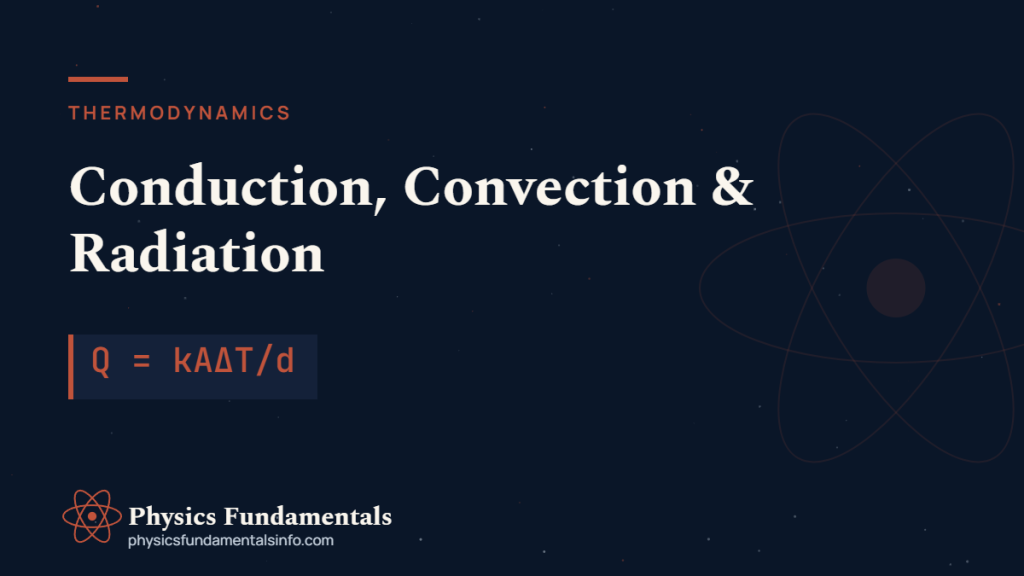
Conduction, convection, radiation: these three processes transfer heat. Conduction moves thermal energy through direct contact, convection carries it in the bulk motion of a heated fluid, and radiation sends it across empty space as electromagnetic waves. Conduction and convection need a medium; radiation does not.
Hold a metal teaspoon in a fresh cup of tea and within seconds the handle is too hot to grip. Step outside on a clear morning and the Sun warms your face long before the air does. Lift the lid off a simmering pot and a column of heat rolls straight up into your hand.
Those three everyday moments are not random. Each one is a different way that heat travels, and physicists call them conduction, convection and radiation. Learn to tell them apart and the warmth — and the chill — of the whole world starts to make sense.
What Are Conduction, Convection and Radiation?
Heat is energy on the move. It always flows from somewhere hotter to somewhere cooler, and it can make that journey in exactly three ways. Conduction, convection and radiation are simply the three mechanisms by which that thermal energy gets from A to B.
The diagram below shows all three at a glance. Keep coming back to it as we unpack each one.
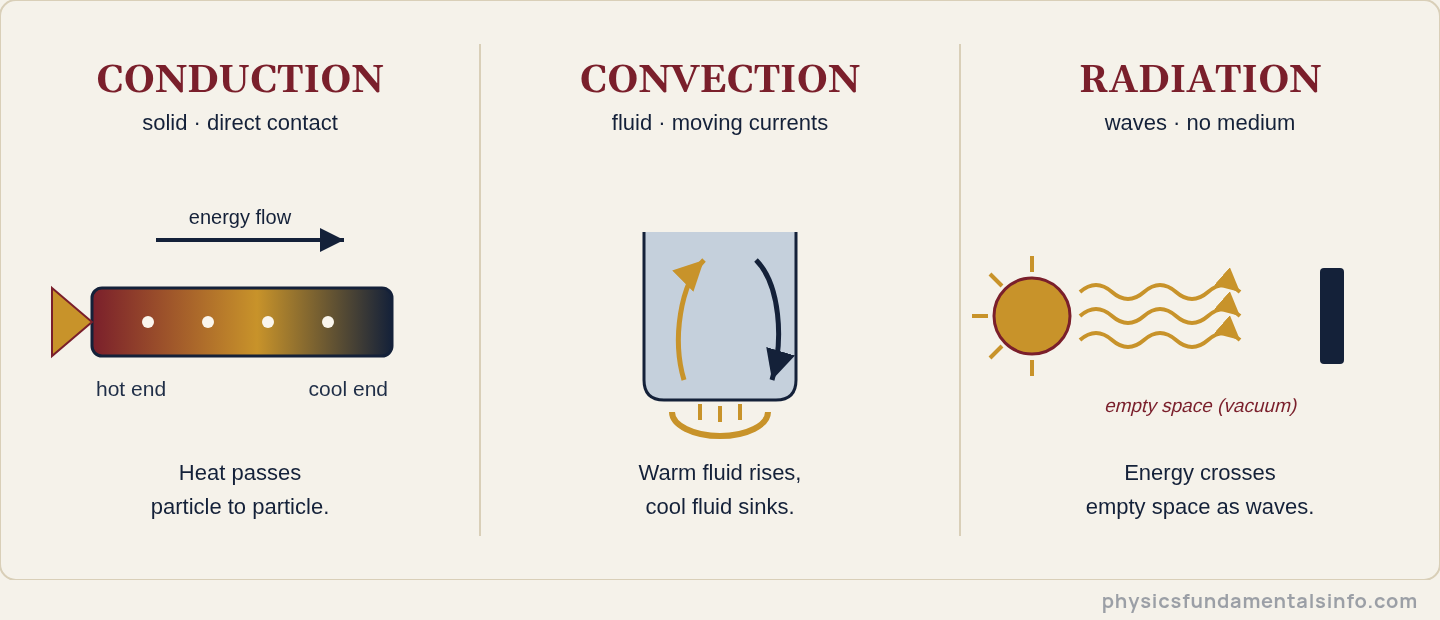
The three modes of heat transfer: conduction needs touching matter, convection needs a flowing fluid, and radiation needs nothing at all.
Conduction
Conduction is heat moving through a material without the material itself going anywhere. Energetic, fast-jiggling particles at the hot end knock into their slower neighbours, passing energy along like a whisper down a line. In metals, free electrons join in and carry energy fast — which is why a metal pan handle heats so quickly.
Convection
Convection only happens in fluids — liquids and gases — because it relies on the matter actually moving. Heat a fluid from below and it expands, becomes less dense, and rises; cooler, denser fluid sinks to take its place. That rolling loop is a convection current, and it physically carries warmth from one region to another.
Radiation
Radiation is the odd one out. Every object warmer than absolute zero gives off thermal radiation — electromagnetic waves, mostly infrared — and these waves carry energy with no particles required. That is why the Sun’s warmth reaches you across the vacuum of space, where conduction and convection simply cannot operate.
The Conduction, Convection and Radiation Formulas
Each mode has its own equation. Don’t memorise them in isolation — notice that every one is really answering the same question: how many joules of heat move per second? That rate is measured in watts (W).
The conduction formula (Fourier’s law)
For steady heat flow through a slab of material:
- Q/t — rate of heat transfer, in watts (W). Q is the heat energy in joules and t the time in seconds.
- k — thermal conductivity of the material (W/m·K).
- A — cross-sectional area the heat flows through (m2).
- ΔT — temperature difference across the material (K, the same size as a °C step).
- d — thickness, the distance the heat must travel (m).
Thicker material (bigger d) slows heat down; a bigger area or temperature gap speeds it up. That single relationship is the whole logic of home insulation. You can solve for any variable instantly with our Thermal Conduction Calculator.
The convection formula (Newton’s law of cooling)
For heat carried away from a surface by a moving fluid:
- Q/t — rate of heat transfer (W).
- h — convective heat transfer coefficient (W/m2·K). It bundles up how fast the fluid moves and what it is.
- A — surface area in contact with the fluid (m2).
- ΔT — temperature difference between the surface and the fluid (K).
A breeze raises h, which is exactly why blowing on hot soup, or a fan on a hot day, cools things so effectively.
The radiation formula (the Stefan-Boltzmann law)
For the power an object radiates from its surface:
- P — radiated power (W).
- ε (epsilon) — emissivity of the surface (a number from 0 to 1, no units). A perfect emitter has ε = 1.
- σ (sigma) — the Stefan-Boltzmann constant, 5.67 × 10⁻⁸ W/m2·K4.
- A — surface area (m2).
- T — absolute temperature of the surface, in kelvin (K). This must be in kelvin, never °C.
That power-of-four is dramatic: double an object’s absolute temperature and it radiates sixteen times as much energy. To find the net exchange with cooler surroundings at temperature Tsurr, use P = εσA(T4 − Tsurr4). You can work out the radiated power for any surface and temperature with our Stefan-Boltzmann Calculator.
How Each Mode of Heat Transfer Works
How conduction works
Picture the atoms in a solid as balls connected by springs. Heat the left side and those atoms vibrate harder. The springs tug their neighbours into vibrating too, and energy ripples rightward — no atom leaves home, but the agitation spreads.
Metals add a shortcut. Their loose “sea” of free electrons drifts through the lattice, ferrying energy far faster than vibration alone. High electrical conductors are therefore usually excellent thermal conductors as well.
How convection works
Convection is conduction plus transport. The fluid touching a hot surface warms by conduction first, then expands and grows buoyant, so it floats upward and bodily carries that energy away. Cooler fluid drops in behind it, gets heated in turn, and the cycle repeats.
This is natural convection, driven by gravity and density. Force the fluid along with a pump or fan and you get forced convection — faster, and the principle behind every car radiator, hairdryer and fan heater.
How radiation works
Inside any warm object, charged particles are constantly jostling, and accelerating charges emit electromagnetic waves. The hotter the object, the more energetic and shorter-wavelength those waves become. A radiator glows in invisible infrared; a stove ring climbs into visible red; the Sun’s surface blazes into white light.
Because these are electromagnetic (transverse) waves, they need no medium and travel at the speed of light. That is the secret of the vacuum flask, and the reason sunlight crosses 150 million kilometres of nothing to reach us.
Conduction, Convection, Radiation: The Key Differences
Here is the whole comparison in one view. If you remember just one column, make it the second one — whether a medium is needed is the cleanest line between the three.
| Feature | Conduction | Convection | Radiation |
|---|---|---|---|
| How heat moves | Particle collisions and free electrons | Bulk movement of a heated fluid | Electromagnetic (infrared) waves |
| Medium needed? | Yes — usually a solid | Yes — a liquid or gas | No — works in a vacuum |
| Key equation | Q/t = kAΔT/d | Q/t = hAΔT | P = εσAT4 |
| Matter moves? | No — energy only | Yes — the fluid itself flows | No — only waves travel |
| Where it dominates | Solids, metals, cookware | Boiling, weather, ocean currents | Sunlight, fire, deep space |
| Everyday example | A spoon heating up in hot tea | A radiator warming a whole room | Feeling the Sun on your skin |
Real-World Examples of Conduction, Convection and Radiation
Conduction in everyday life
Leave a metal spoon in a pot of soup and the handle soon burns your fingers — heat conducts up the metal. The same physics chills you when you grab a cold door handle: heat conducts out of your hand. Engineers exploit it deliberately too, bolting finned aluminium heat sinks onto computer chips to conduct heat away fast.
Convection in everyday life
Watch a pot of water reach the boil and you can actually see convection: currents churn the water as hot fluid rises and cool fluid tumbles down. On a larger scale, the same loop drives a hot-air balloon upward, circulates warm air from a radiator around a room, and powers the sea breezes that cool a coastline on a summer afternoon.
Radiation in everyday life
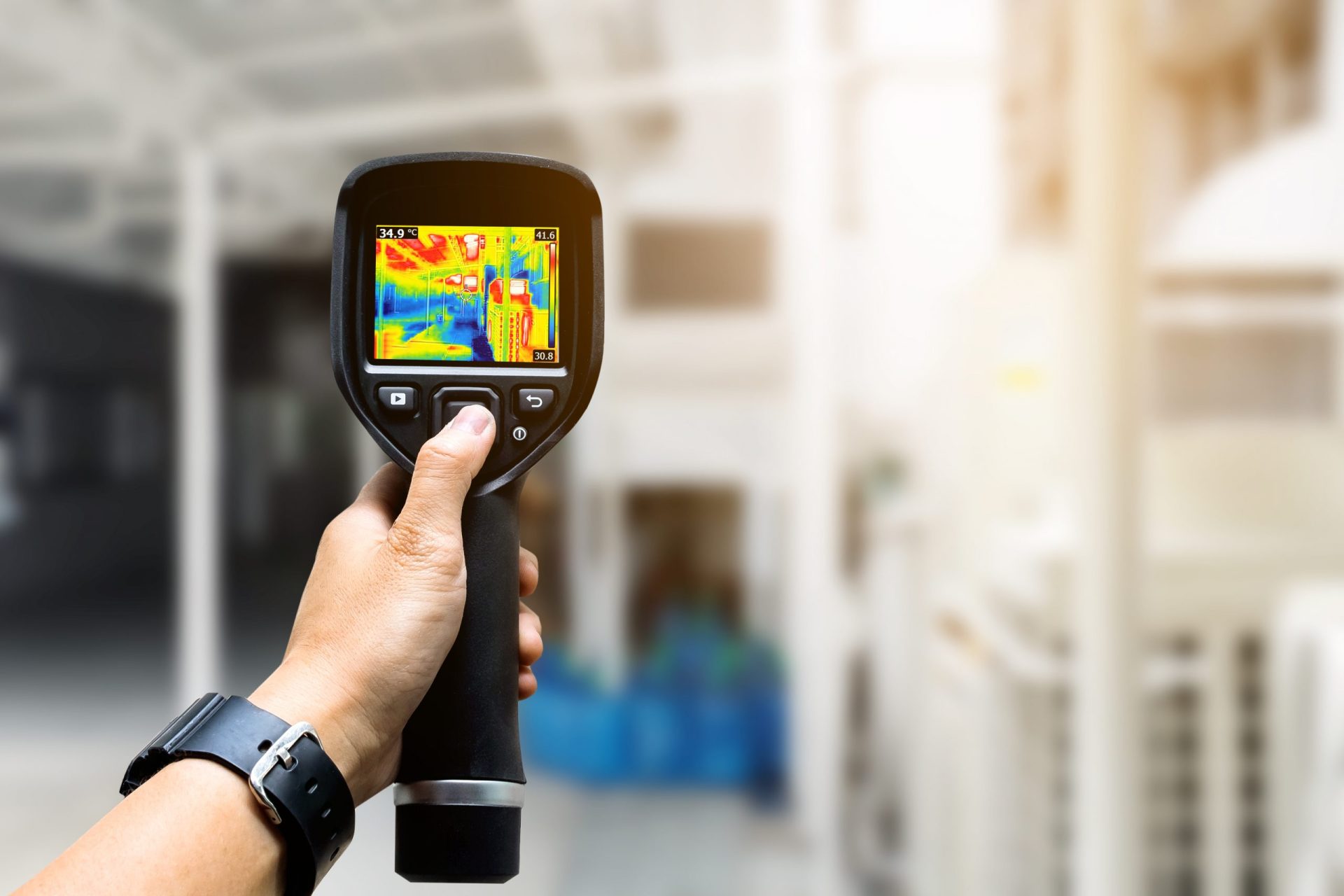
Stand near a bonfire and your face feels hot while your back stays cool — that is radiation reaching you in straight lines, not warmed air. A toaster’s glowing wires cook bread the same way. On the grandest scale, the entire climate runs on radiation: NASA’s account of the Earth’s radiation budget tracks how incoming sunlight and outgoing infrared keep the planet’s temperature in balance.
Common Misconceptions About Heat Transfer
“Heat and temperature are the same thing”
They are not. Temperature measures the average kinetic energy of particles; heat is the energy that flows because of a temperature difference. A spark at 1,000 °C carries far less heat than a warm bath, because the bath holds vastly more energy. If this trips you up, it is worth reading the full breakdown of heat versus temperature.
“Cold flows into warm objects”
Cold is not a substance that travels. There is only heat, and it always flows one way: from hotter to cooler. When an ice cube “makes your drink cold,” heat is actually leaving the drink and entering the ice — never the reverse.
“Metal is colder than wood”
Put a metal spoon and a wooden spoon in the same room and they sit at the very same temperature. Metal only feels colder because it conducts heat away from your warm skin much faster than wood. Your nerves sense the rate of heat loss, not the actual temperature.
“Radiation only happens when things are red-hot”
Every object above absolute zero radiates, including you, this page and a block of ice — just mostly in invisible infrared. Radiation also needs no medium whatsoever, which is precisely how it crosses the vacuum between the Sun and the Earth.
How Conduction, Convection and Radiation Relate to Thermodynamics
These three modes are the practical face of thermodynamics. Heat itself is best understood as energy in transit — none of conduction, convection or radiation creates energy; they only move it from place to place.
Their shared direction comes from the second law of thermodynamics. Heat spontaneously flows from hot to cold and never the other way by itself, whichever of the three modes is doing the carrying.
What happens once heat arrives is a separate question, answered by specific heat capacity: the same joules raise water’s temperature far less than they raise a metal’s, because water stores energy so readily.
And in the real world the three rarely act alone. A pot on a stove uses all three at once — conduction through its base, convection in the swirling water, and radiation from the glowing ring. A vacuum flask is the mirror image: its vacuum gap blocks conduction and convection, while a silvered, low-emissivity coating reflects radiation back. Beat all three and your coffee stays hot for hours.
Worked Problems
Show Solution
Step 1: Use Fourier’s law, Q/t = kAΔT/d.
Step 2: Find the values. ΔT = 21 − 5 = 16 K; A = 0.96 m2; d = 4.0 mm = 0.004 m.
Step 3: Q/t = (0.80 × 0.96 × 16) ÷ 0.004 = 12.288 ÷ 0.004 = 3072 W.
Answer: about 3.1 kW (3072 W). In practice a real window loses less, because thin films of still air on each face add insulation — but this shows why bare single glazing is such a poor barrier.
Show Solution
Step 1: Q/t = kAΔT/d.
Step 2: Convert the area: A = 4.0 cm2 = 4.0 × 10⁻⁴ m2. ΔT = 100 − 20 = 80 K; d = 0.50 m.
Step 3: Q/t = (385 × 4.0 × 10−4 × 80) ÷ 0.50 = 12.32 ÷ 0.50 = 24.64 W.
Answer: about 24.6 W.
Show Solution
Step 1: Use Newton’s law of cooling, Q/t = hAΔT.
Step 2: ΔT = 80 − 20 = 60 K; A = 0.25 m2; h = 15 W/m2·K.
Step 3: Q/t = 15 × 0.25 × 60 = 225 W.
Answer: 225 W.
Show Solution
Step 1: Use the Stefan-Boltzmann law, P = εσAT4.
Step 2: T is already in kelvin, so T4 = 5004 = 6.25 × 10¹⁰ K4.
Step 3: P = 1 × 5.67 × 10−8 × 0.50 × 6.25 × 1010 = 1772 W.
Answer: about 1.77 kW (1772 W).
Show Solution
Step 1: For a net exchange, P = εσA(T4 − Tsurr4). Both temperatures are already in kelvin.
Step 2: T4 = 3064 = 8.768 × 10⁹ K4; Tsurr4 = 2934 = 7.370 × 10⁹ K4. The difference is 1.398 × 10⁹ K4.
Step 3: P = 0.97 × 5.67 × 10−8 × 1.8 × 1.398 × 109 = 138 W.
Answer: about 138 W. That is comparable to a bright old-style light bulb — a big reason a cool room feels chilly even when the air is mild.
Show Solution
Step 1 (a): Q/t = kAΔT/d, with ΔT = 18 K. Q/t = (0.70 × 10 × 18) ÷ 0.10 = 1260 W.
Step 2 (b): Layers in series add thermal resistance, R = d ÷ (kA). Rbrick = 0.10 ÷ (0.70 × 10) = 0.0143 K/W. Rfoam = 0.050 ÷ (0.035 × 10) = 0.143 K/W.
Step 3 (b): Rtotal = 0.0143 + 0.143 = 0.157 K/W, so Q/t = ΔT ÷ Rtotal = 18 ÷ 0.157 = 115 W.
Answer: (a) 1260 W; (b) about 115 W. Just 5 cm of foam cuts the heat loss by a factor of roughly 11.
Show Solution
Step 1: Start from P = σAT4 and rearrange for temperature: T4 = P ÷ (σA).
Step 2: T4 = 1000 ÷ (5.67 × 10−8 × 0.20) = 1000 ÷ (1.134 × 10⁻⁸) = 8.82 × 10¹⁰ K4.
Step 3: Take the fourth root: T = (8.82 × 10¹⁰)1/4 = 545 K. Converting, 545 − 273 ≈ 272 °C.
Answer: about 545 K (roughly 272 °C).
Frequently Asked Questions
What is the difference between conduction, convection and radiation?
Conduction moves heat through direct contact between particles, convection moves it through the bulk motion of a heated fluid, and radiation moves it as electromagnetic waves. Conduction needs touching matter and convection needs a flowing liquid or gas, but radiation needs no medium at all — it even works in the vacuum of space.
Which mode of heat transfer is the fastest?
There is no single fastest mode; it depends on the situation. Radiation travels at the speed of light, so the Sun’s energy reaches Earth in about eight minutes. Yet over short distances a good conductor like copper moves heat extremely quickly, and in fluids convection often beats conduction because moving matter carries energy in bulk.
Why does metal feel colder than wood at the same temperature?
Metal and wood in the same room are at the same temperature, but metal feels colder because it conducts heat away from your warm hand far faster than wood does. Your skin senses the rate of heat loss rather than the actual temperature, so the fast-conducting metal feels chilly while the slow-conducting wood feels neutral.
Does radiation need a medium to travel?
No. Radiation is the only mode of heat transfer that needs no medium, because it travels as electromagnetic waves. This is why the Sun’s energy can cross roughly 150 million kilometres of empty space to warm the Earth, and why a vacuum flask uses a vacuum to stop conduction and convection while a silvered lining reflects radiation back.
Can conduction, convection and radiation happen at the same time?
Yes, and they usually do. A pot of water on a stove uses all three at once: conduction through the metal base, convection currents within the water, and radiation from the glowing hot element. Most real-world heating and cooling involves a mixture of the three modes working together rather than any one acting alone.
What is thermal conductivity?
Thermal conductivity (symbol k) measures how well a material conducts heat, in watts per metre per kelvin (W/m·K). Metals such as copper have high conductivity and move heat quickly, while air, wood and foam have low conductivity and make excellent insulators. It is the value k that appears in the conduction formula Q/t = kAΔT/d.