Weight vs mass comes down to one idea: mass is the amount of matter in an object — measured in kilograms and unchanging — while weight is the gravitational force pulling on that mass, measured in newtons and changing with gravity. They are linked by the formula W = mg, where g is the local gravitational acceleration.
Hold a one-litre bottle of water in your hand. The “heaviness” you feel is its weight; the actual matter inside that your hand is supporting is its mass. We treat the two words as synonyms, yet physics treats them as very different quantities.
Mix them up and the errors pile up fast — in exam answers, in engineering calculations, even in how we describe astronauts “floating” in orbit. So let’s pull the two apart properly, starting with what each one really is.
What Is Mass?
Mass is a measure of how much matter an object contains — roughly, how many atoms are packed into it and how heavy those atoms are. A bowling ball has far more mass than a beach ball of the same size because it is crammed with far more material.
Crucially, that amount of matter does not care where the object sits. Carry a 2 kg textbook up Everest, down to the seabed, or across to the surface of the Moon, and it is still 2 kg of matter. Mass is an intrinsic property: it travels with the object and never changes with location.
Mass is a scalar quantity — it has size but no direction — and its SI unit is the kilogram (kg). You measure it by comparison, which is why a traditional balance pits your object against known masses until the beam sits level.
Mass has a second face, too: it measures inertia, an object’s resistance to being accelerated. The more mass something has, the harder you must push to change its motion — a point we will see again the moment we reach the formula.
The kilogram itself was once a literal metal cylinder kept near Paris. In 2019 scientists redefined it using a fixed constant of nature, the Planck constant, so the unit no longer leans on a single lump of metal — a shift documented by NIST.
What Is Weight?
Weight is not stuff — it is a force. Specifically, weight is the pull of gravity on an object’s mass. When you stand on the ground, Earth’s gravity tugs on every kilogram of you, and the total of that downward pull is your weight.
Because weight is a force, it is a vector: it has a direction — straight down, toward the centre of the planet — as well as a size. Its SI unit is therefore the same as any other force, the newton (N), not the kilogram.
And here is the part that catches people out: weight depends on gravity. Stand somewhere gravity is weaker, and the same body is pulled less hard, so it weighs less. NASA’s educational note on weight and mass sums the whole thing up in one equation, W = mg.
You measure weight with a spring scale — bathroom scales, luggage scales and kitchen scales all work this way. A spring stretches or compresses in proportion to the force pressing on it, so it is literally reading a force, even when the dial is helpfully marked in kilograms.
Weight vs Mass: The Core Differences
So mass is the matter; weight is the gravitational force on that matter. One is a property of the object alone; the other is a relationship between the object and whatever world it happens to be resting on. The cleanest way to feel the difference is to picture two different instruments.
A beam balance reads mass and gives the same answer anywhere; a spring scale reads weight, so its reading falls on the Moon and rises on Jupiter.
A beam balance compares your object against known masses, so it gives the same answer anywhere in the universe — it reads mass. A spring scale measures how hard gravity is pulling, so its reading drops on the Moon and climbs on Jupiter — it reads weight. Here is the full contrast.
| Property | Mass | Weight |
|---|---|---|
| What it measures | Amount of matter in an object | Gravitational force on that matter |
| Type of quantity | Scalar (size only) | Vector (size and direction, downward) |
| SI unit | Kilogram (kg) | Newton (N) |
| Usual symbol | m | W (sometimes Fg) |
| Measured with | Balance (beam or electronic) | Spring scale or force meter |
| Changes with location? | No — constant everywhere | Yes — varies with gravity |
| Value in free fall / orbit | Unchanged | Effectively zero (weightless) |
| Formula | Fundamental property | W = mg |
The Weight Formula: W = mg
Every weight calculation comes back to one short equation. It says the gravitational force on an object is simply its mass multiplied by the local strength of gravity.
- W — weight, the gravitational force on the object, measured in newtons (N).
- m — mass of the object, measured in kilograms (kg).
- g — gravitational field strength (the acceleration due to gravity), measured in newtons per kilogram (N/kg), which is the same unit as metres per second squared (m/s²).
On the surface of the Earth, g is about 9.81 N/kg. So a 1 kg bag of sugar weighs roughly 9.81 N here — close to the downward pull you feel from a medium apple resting on your palm.
The formula rearranges in the obvious ways. Need the mass from a known weight? Use m = W / g. Trying to work out the gravity of a strange planet from a known mass and weight? Use g = W / m.
If this looks like Newton’s second law in disguise, that is because it is. Weight is just F = ma applied to the one acceleration every object on a planet shares — gravity’s. (Our full guide to Newton’s second law covers that parent equation.)
Prefer to skip the arithmetic? The Weight on Other Planets calculator turns your mass into your weight on the Moon, Mars and every planet in one step.
Real-World Examples: Your Weight Across the Solar System
The W = mg formula stops being abstract the instant you leave Earth. Your mass — all those atoms — comes with you unchanged. But g belongs to the world you are standing on, so your weight is rewritten at every stop.
The same 70 kg mass weighs about 113 N on the Moon but roughly 1,735 N on Jupiter (g shown in m/s²). Mass never changes; weight simply tracks gravity.
On the Moon, you would weigh about one-sixth as much
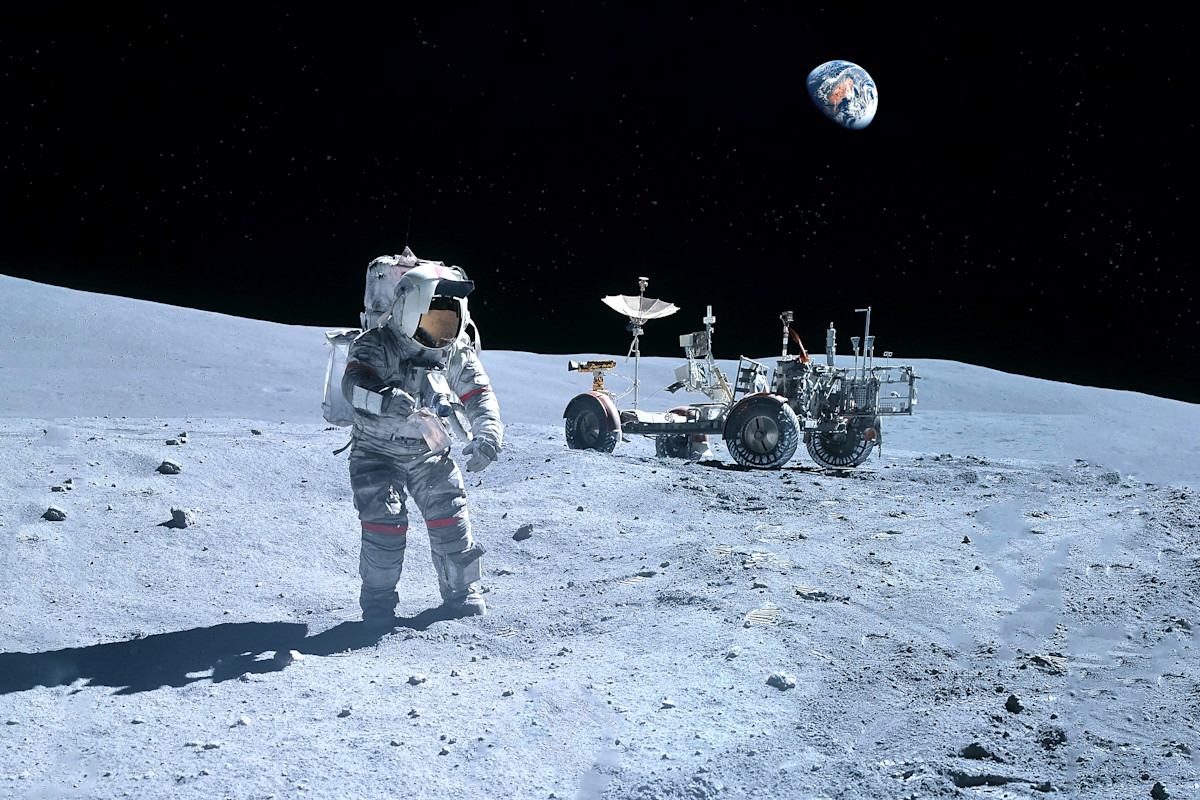
The Moon’s gravity is roughly 1.62 m/s², about a sixth of Earth’s. A 70 kg astronaut still has 70 kg of mass on the lunar surface, but their weight falls from about 687 N to just 113 N. That is why Apollo astronauts could bound across the ground in bulky suits — less weight to lift with each step, while their mass and momentum stayed every bit as real.
On Jupiter, the same body would feel crushing
Jupiter’s pull is about 24.79 m/s², two and a half times Earth’s. Our 70 kg traveller would weigh roughly 1,735 N — as though three of them were standing on Earth at once. The mass is identical; gravity has simply turned the dial up.
The bathroom scale that fibs a little
Step on a bathroom scale and it shows, say, 70 kg. Strictly, the scale measured a force — your weight pressing down — then quietly divided by Earth’s g to display a mass. Carry that same scale to the Moon and it would read about 11.5 kg, even though you have not lost a single atom. The scale is not broken; it just assumed Earth’s gravity.
Astronauts in orbit: weightless, never massless
Astronauts on the Space Station look weightless because they — and the station — are in continuous free fall around Earth, so nothing presses on a scale. Their mass has not vanished, though. To shove a floating 100 kg cabinet, an astronaut must still overcome all 100 kg of inertia, which is why nudging heavy gear in orbit is harder than it looks.
Common Misconceptions About Weight and Mass
“A kilogram is a unit of weight”
It is not — the kilogram measures mass. The mix-up is understandable, because shops and gyms label everything in kilograms, and on Earth a fixed mass always has a fixed weight. But the correct unit of weight is the newton. When a question says an object “weighs 5 kg”, it is loosely stating a mass; the actual weight is 5 × 9.81 ≈ 49 N.
“Heavier objects fall faster”
Drop a hammer and a feather in a vacuum and they hit the ground together. A heavier object does feel a larger gravitational force, but it also has more mass to accelerate, and the two effects cancel exactly. The acceleration due to gravity, g, is the same for all masses — a fact Apollo 15 famously demonstrated on the airless Moon.
“Weightless means massless”
Weightlessness only means nothing is pushing back on you, as in free fall or orbit. Mass is untouched. A wrench drifting inside the Space Station has zero weight but full mass — bump into it and you will feel every gram.
“Your mass changes when you travel into space”
Your weight changes; your mass does not. Unless you actually lose matter, the number of atoms in your body is identical on Earth, on Mars, or drifting between them. Only the gravitational pull on those atoms varies.
How Weight and Mass Connect to Other Physics
The whole idea rests on Newton’s foundations. His laws of motion tell us that a force changes an object’s motion, and weight is simply one such force — the force of gravity.
Weight also shapes everyday forces you might not link to gravity. On flat ground, a surface pushes up with a normal force equal to your weight, and that normal force sets how much grip you have — which is why friction depends on how heavy an object is.
When something falls through air, its weight pulls it down while drag pushes back. Once the two balance, the object stops speeding up — the idea behind terminal velocity.
And lifting anything means working against its weight. The energy you store by raising a mass is its gravitational potential energy, mgh — the very same m and g from the weight equation, now multiplied by height.