Work done in physics is the energy transferred to or from an object when a force moves it through a distance. The formula is W = F d cos θ — force times displacement times the cosine of the angle between them. Work is a scalar quantity measured in joules (J); one joule equals one newton-metre.
Push a broken-down car along a flat road and your aching arms are measuring something real: energy flowing out of you and into the car. Physics puts an exact number on that transfer, and the number is called work done.
Now lean on the same car for ten minutes without it moving an inch. You sweat, you strain — and in physics terms you have done precisely zero work. That gap between everyday effort and scientific work is the key to the whole topic.
What Is Work Done in Physics?
Think of energy as a currency and work as the transaction that moves it between accounts. Whenever a force acts on an object while the object moves, energy changes hands — and the work done tells you exactly how many joules were transferred.
The formal definition: work done is the product of the displacement and the component of the force acting along that displacement. A force pointing along the motion does work; a force at right angles to the motion does none, no matter how enormous it is.
Work is a scalar — it has a size and a sign, but no direction. Its SI unit is the joule (J): one joule is the work done when a one-newton force moves an object one metre in the direction of the force.
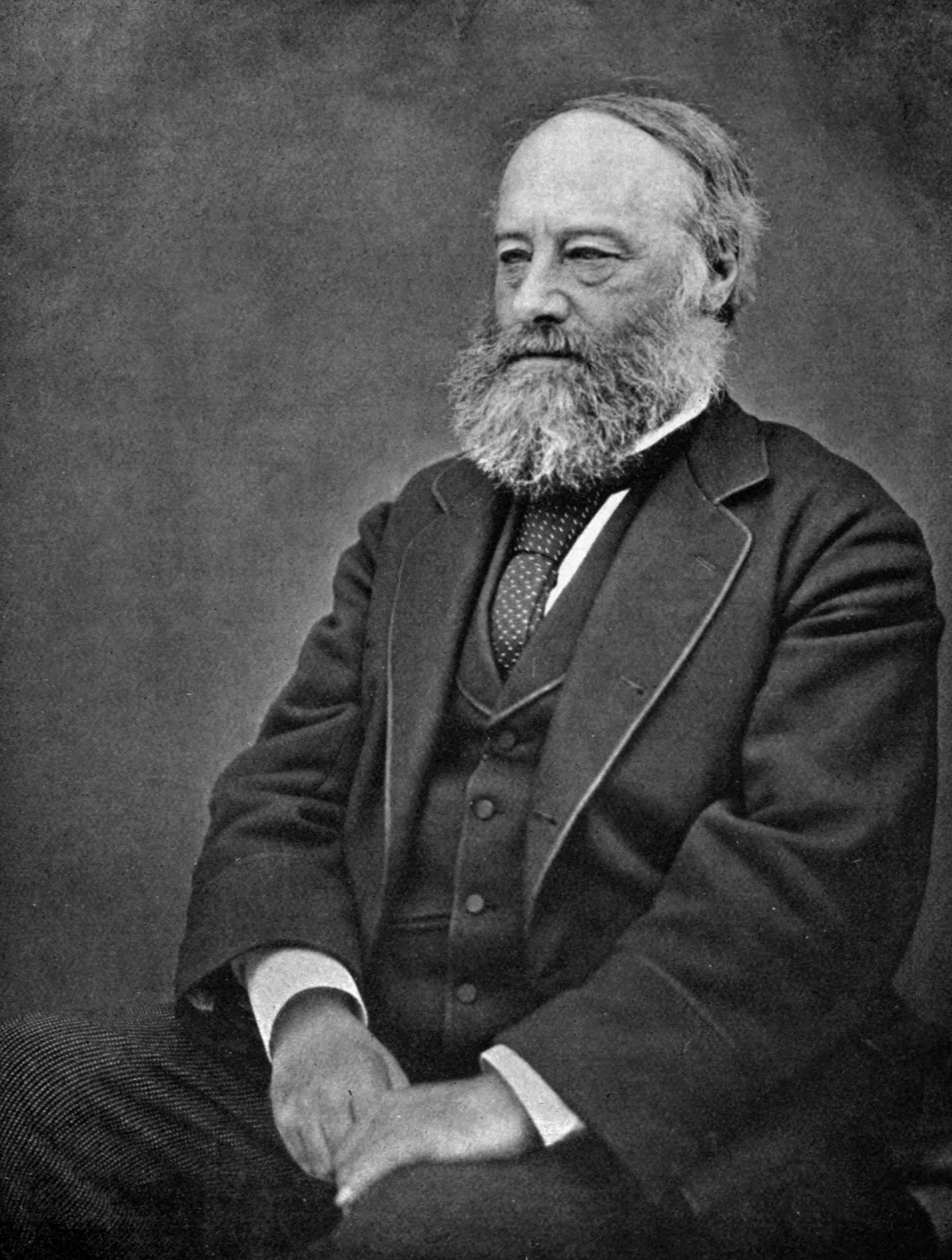
The unit honours James Prescott Joule, the Manchester brewer-turned-physicist whose painstaking experiments in the 1840s showed that mechanical work and heat are two forms of the same currency: energy.
The Work Done Formula: W = F d cos θ
One compact equation covers every constant-force situation you will meet at GCSE, A-level and first-year university.
- W — work done, in joules (J)
- F — the magnitude of the constant force, in newtons (N)
- d — the magnitude of the displacement, in metres (m)
- θ — the angle between the force and the displacement, in degrees or radians
When the force points exactly along the motion, θ = 0° and cos θ = 1, so the equation collapses to the simpler version most students meet first:
A quick unit check keeps everything honest: 1 J = 1 N × 1 m, and since a newton is 1 kg m/s2, a joule is 1 kg m2/s2. Kinetic energy, heat and electrical energy are all measured in joules too — that shared unit is the first hint that work and energy are one family.
Why the cos θ?
Pull a sledge with a rope angled upwards and the rope is doing two jobs at once. Part of the tension hauls the sledge forward; part of it lifts uselessly against gravity.
Only the forward part — the component F cos θ lying along the motion — actually transfers energy into the sledge’s movement. The cos θ in the formula is simply the mathematics of keeping the useful slice and discarding the rest.
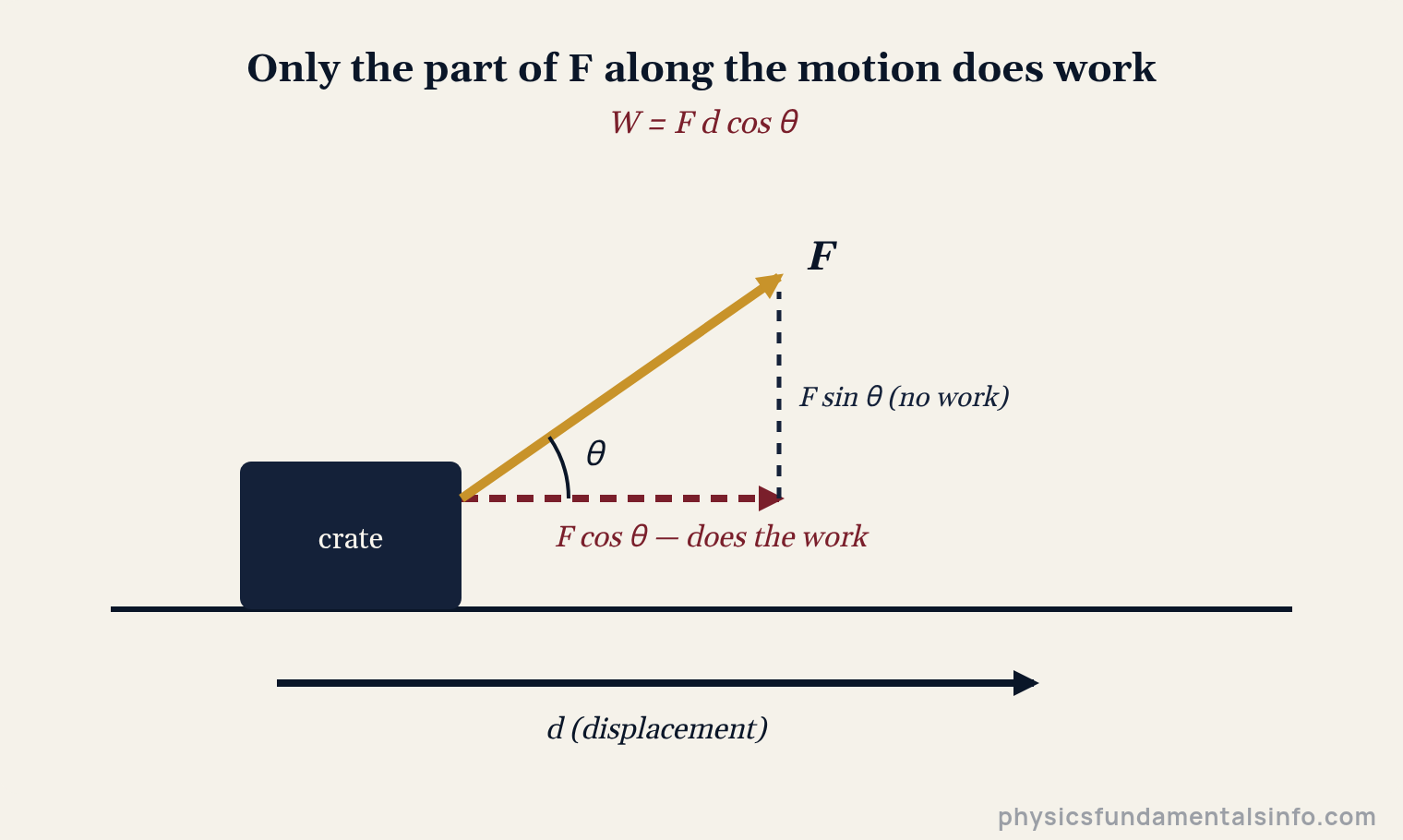
Figure 1: A force at angle θ to the motion. Only the component F cos θ along the displacement transfers energy.
What if the force is not constant?
W = F d cos θ assumes the force stays steady. When it varies — a spring stretching, say — the work done becomes the area under the force–displacement graph; at A-level that idea is written as an integral, and for a spring it gives the tidy result W = ½kx2. The constant-force formula is just the special case where that area is a simple rectangle.
Positive, Negative and Zero Work
Can work done be negative? Absolutely — and the sign is doing real physics, not bookkeeping. It tells you which way the energy flowed.
Positive work means the force has a component along the motion and is feeding energy in: an engine driving a car forward, you pushing a trolley. Negative work means the force has a component against the motion and is draining energy out — friction under a sliding crate, brakes gripping a disc, gravity tugging on a rising ball.
Zero work happens three ways: no force, no displacement, or a force at exactly 90° to the motion. Push a wall all afternoon (d = 0) or carry a bag at steady height across a room (support force at right angles to the motion) and the work done is nil.
| Angle θ | cos θ | Sign of work done | Example |
|---|---|---|---|
| 0° | +1 | Positive — maximum | Horizontal push on a trolley moving forward |
| 60° | +0.5 | Positive — reduced | Sledge rope held at a steep angle |
| 90° | 0 | Zero | Carrying a bag at constant height; a satellite in circular orbit |
| 180° | −1 | Negative — maximum | Friction on a sliding crate; a braking force |
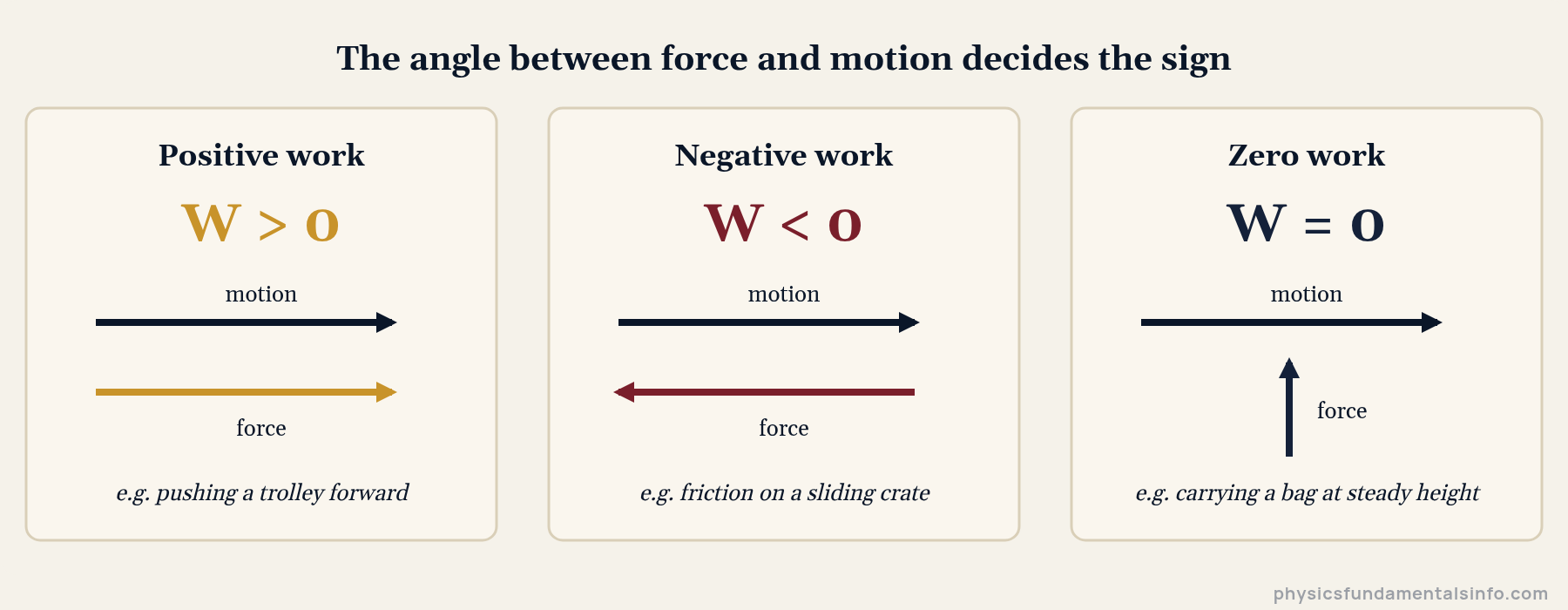
Figure 2: Positive, negative and zero work — same formula, three very different stories.
Want to feel the angle effect rather than read about it? The lab below lets you set the force, the angle and the distance, then watch the work done respond — including the moment it hits zero at 90° and turns negative beyond it.
How to Calculate Work Done in 4 Steps
Every constant-force problem yields to the same routine. Train the habit now and the harder questions later become mere bookkeeping.
- Identify the force. Write down its magnitude in newtons and the direction it acts. If several forces act, decide whose work the question wants — or whether it wants the net work.
- Identify the displacement. Magnitude in metres, plus direction. No displacement means no work — you can stop right there.
- Find the angle θ between them. Between the force and the displacement — not between the force and the vertical, which is a classic slip.
- Multiply and sign it. W = F d cos θ. Attach joules, and check the sign matches the physics: energy fed in should be positive, energy drained should be negative.
A common student slip is multiplying the full force by the distance when only a component acts along the motion. The rope-at-an-angle questions in the worked section below exist to break that habit.
Sanity-check your magnitudes, too. Lifting a one-litre bottle of water through one metre takes about 10 J, and a 70 kg person climbing one flight of stairs does roughly 2,000 J against gravity. If your answer for a pushed shopping trolley comes out at two megajoules, something has slipped.
Real-World Examples of Work Done
1. Pushing a supermarket trolley
A steady 20 N push along a 30 m aisle transfers W = 20 × 30 = 600 J into the trolley — most of it promptly stolen back by friction. Positive work in, quietly dissipating as gentle heat in the wheels and floor.
2. Lifting weights at the gym
Raising a 60 kg barbell through half a metre is W = mgh = 60 × 9.81 × 0.5 ≈ 294 J per lift. Lower it under control and gravity does +294 J on the bar while your muscles do negative work — which is why the lowering phase still burns.
3. A car braking
A 1,200 kg car at 13 m/s (about 47 km/h) carries roughly 100,000 J of kinetic energy. To stop it, friction at the brakes must do −100,000 J of work, turning all that motion into heat in the discs. Negative work is not a technicality — it is how every vehicle stops.
4. A crane lifting a steel beam
Hoisting a 2,000 kg beam 30 m to the top of a building takes W = 2,000 × 9.81 × 30 ≈ 590,000 J — about 590 kJ banked as gravitational potential energy. That energy has not vanished; release the beam and every joule comes back as kinetic energy.
5. A satellite in circular orbit
Earth’s gravity pulls on a satellite constantly, yet in a circular orbit the pull is always at 90° to the motion. Cos 90° = 0, so gravity does no work at all — which is exactly why the satellite’s speed never changes. A huge force, acting forever, transferring nothing.
The Work–Energy Theorem: What Work Actually Does
So far we have calculated work; the work–energy theorem tells you what it buys. The result is one of the most useful shortcuts in mechanics.
- W_net — the net (total) work done on the object by all forces, in joules (J)
- m — mass, in kilograms (kg)
- u — initial speed, in metres per second (m/s)
- v — final speed, in metres per second (m/s)
In words: the net work done on an object equals its change in kinetic energy. Positive net work speeds it up, negative net work slows it down, and zero net work leaves the speed untouched — however violent the individual forces are.
Where the theorem comes from
For a constant net force along the motion, Newton’s second law gives a = F/m, and the kinematic equation v2 = u2 + 2ad supplies the link to distance.
Rearrange the kinematics to a d = (v2 − u2)/2, then multiply Newton’s law by d: F d = m a d = ½mv2 − ½mu2. The left side is the net work; the right side is the change in kinetic energy. Two views of motion — forces and energy — joined by one line of algebra.
Work done by gravity and stored energy
Near Earth’s surface, gravity’s work depends only on the vertical height change: W = mgh, positive on the way down, negative on the way up, whatever route is taken. Forces with that path-independent property are called conservative.
Lift an object and the work you do against gravity is banked as gravitational potential energy, E_p = mgh. Let it fall and gravity pays the balance back as kinetic energy — and you can watch the exchange happen live below.
Set the drop height and follow the readouts: every joule of potential energy the object loses is a joule of work gravity has done on it, reappearing as kinetic energy. The total never wavers.
Work Done vs Power: What Is the Difference?
Work measures how much energy moved; power measures how fast it moved. Carry bricks upstairs in one trip or ten and the work against gravity is identical — the single trip simply demands far more power.
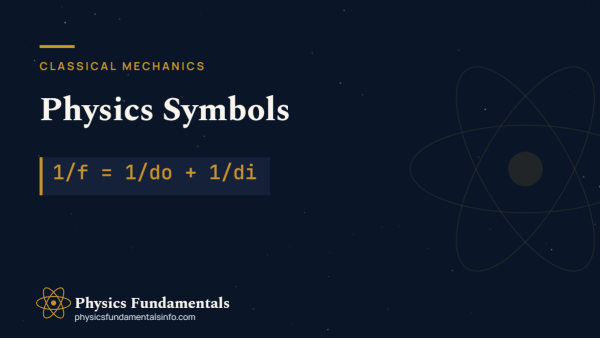
Here P is power in watts (W), W is the work done in joules and t is the time taken in seconds. One watt is one joule per second. And yes, physics reused the letter: an italic W in equations means work, while W after a number means watts.
For a 70 kg person climbing a 3 m flight of stairs, the work against gravity is about 2,060 J. Sprint it in 4 s and your useful power output is roughly 515 W; stroll it in 12 s and it drops to about 172 W. Same work, different power.
| Aspect | Work done | Power |
|---|---|---|
| Definition | Energy transferred by a force acting through a distance | Rate of transferring energy (work per unit time) |
| Formula | W = F d cos θ | P = W / t (or P = F v) |
| SI unit | joule (J) | watt (W), where 1 W = 1 J/s |
| Type | Scalar (can be negative) | Scalar |
| Asks | How much energy moved? | How quickly did it move? |
| Example | 2,060 J climbing a staircase | 515 W climbing it in 4 s |
Common Misconceptions About Work Done
“If I push hard, I am doing work”
Not unless something moves. Shove an immovable wall and the displacement is zero, so W = F d cos θ = 0, however hard you push. Your muscles burn chemical energy keeping their fibres firing — but none of it is transferred to the wall as mechanical work.
“Carrying a bag across a room does work on the bag”
Walk at steady speed and constant height, and the force you exert on the bag points straight up while the bag moves horizontally. That is a 90° angle, so your supporting force does zero work. Examiners adore this question precisely because intuition screams otherwise.
(Strictly, the small accelerations as you start, stop and bob do tiny bits of work — but for the steady walk, the textbook answer is zero.)
“A bigger force always means more work”
Only the component along the motion counts. A 1,000 N force at 90° to the displacement does nothing, while a 50 N force along it does plenty. Distance matters as much as strength: half the force over double the distance transfers exactly the same energy.
“Negative work means a mistake”
Negative work is physics working perfectly: it means energy is being removed from the object. Brakes, friction, air resistance and gravity-on-the-way-up all do negative work. Without it, nothing could ever slow down.
How Work Done Connects to the Rest of Physics
Work is the hinge between two great descriptions of motion. On one side sit forces and Newton’s laws, predicting acceleration instant by instant; on the other sits energy, tracking what the universe owes and is owed. Multiply a force by the distance it acts over and you cross from one picture into the other.
Follow the energy trail further and you reach thermodynamics. The negative work friction does on a sliding crate does not destroy energy — it converts ordered motion into the disordered jiggling we measure as heat. Energy is conserved; usefulness is not.
One contrast is worth memorising. Force × time is impulse, which changes momentum; force × distance is work done, which changes kinetic energy. Two different multiplications of the same force, answering two different questions.
If you enjoy exploring by concept map, Georgia State University’s HyperPhysics project links work outward to the whole of mechanics — a fine second telling of everything on this page.
Worked Problems
Work through these in order — each adds one new idea. Cover the solutions and attempt every problem cold first.
Show Solution
Solution:
Step 1: The force and the motion point the same way, so θ = 0° and cos θ = 1. Use W = F d.
Step 2: Substitute with units: W = 50 N × 4.0 m.
Step 3: Solve: W = 200 J.
Answer: W = 200 J (2.0 × 10² J to 2 significant figures)
Show Solution
Solution:
Step 1: The force is at an angle to the motion, so W = F d cos θ.
Step 2: Substitute with units: W = 80 N × 25 m × cos 30° = 2,000 J × 0.866.
Step 3: Solve: W = 1,732 J.
Answer: W ≈ 1.7 × 10³ J (about 1.7 kJ)
Show Solution
Solution:
Step 1: The supporting force is vertical (about mg ≈ 19.6 N upward); the displacement is horizontal.
Step 2: The angle between them is 90°, and cos 90° = 0.
Step 3: W = 19.6 N × 12 m × 0 = 0.
Answer: W = 0 J — a force at right angles to the motion does no work; the mass and distance are red herrings
Show Solution
Solution:
Step 1: Constant speed means the lifting force just balances the weight: F = mg = 12 kg × 9.81 m/s2 = 117.7 N.
Step 2: Force and motion are both vertically upward, so θ = 0°: W = F d = 117.7 N × 1.5 m.
Step 3: Solve: W = 176.6 J.
Answer: W ≈ 1.8 × 10² J (about 177 J), now stored as gravitational potential energy
Show Solution
Solution:
Step 1: On a level floor the normal force is N = mg = 6.0 kg × 9.81 m/s2 = 58.9 N.
Step 2: Friction force: f = μN = 0.25 × 58.9 N = 14.7 N, acting opposite the motion, so θ = 180° and cos θ = −1.
Step 3: W = 14.7 N × 8.0 m × (−1) = −117.7 J.
Answer: W ≈ −1.2 × 10² J (about −118 J) — the negative sign shows friction removed energy from the crate, which became heat
Show Solution
Solution:
Step 1: The theorem: W_net = ½m(v2 − u2).
Step 2: Substitute with units: W_net = ½ × 1,200 kg × ((25 m/s)2 − (10 m/s)2) = 600 kg × (625 − 100) m2/s2.
Step 3: Solve: W_net = 600 × 525 = 315,000 J.
Answer: W_net ≈ 3.2 × 10⁵ J (about 315 kJ)
Show Solution
Solution:
Step 1: Work by the applied force: W_F = F d cos θ = 90 N × 10 m × cos 25° = 900 × 0.906 = 815.7 J.
Step 2: Normal force (the upward pull lightens the crate): N = mg − F sin 25° = 147.15 N − 38.0 N = 109.1 N.
Step 3: Friction: f = μN = 0.20 × 109.1 N = 21.8 N opposing motion, so W_f = −21.8 N × 10 m = −218.2 J.
Step 4: Gravity and the normal force act at 90° to the motion and do zero work, so W_net = 815.7 − 218.2 = 597.5 J.
Step 5: Work–energy theorem with u = 0: ½mv2 = W_net, so v = √(2 × 597.5 J / 15 kg) = √79.7 = 8.9 m/s.
Answer: (a) W_net ≈ 6.0 × 10² J (about 598 J); (b) v ≈ 8.9 m/s
Frequently Asked Questions
What is work done in physics?
What is the SI unit of work done?
Can work done be negative?
Why is no work done when you hold a heavy bag still?
Is work done a scalar or a vector quantity?
What is the difference between work done and power?
How is work done related to energy?
Work done is the quiet bookkeeping behind every push, lift, brake and orbit: a force, a distance, an angle, and energy on the move. Master the sign convention and the component idea, and the rest of energy physics opens up from here.