Transverse vs longitudinal waves describe the two ways a wave can vibrate relative to its direction of travel: in a transverse wave the medium oscillates perpendicular to the wave’s motion, while in a longitudinal wave it oscillates parallel to it. Both transfer energy without moving matter, and both obey v = fλ (speed equals frequency times wavelength).
Pluck a guitar string and watch it blur up and down — yet the note itself travels outward, across the room, into your ear. Clap once in a long tunnel and a moment later the sound races back. Both are waves. Neither is built the same way.
The split between transverse and longitudinal waves is one of the first real forks in physics, and a surprising amount hangs off it. Get it straight once and light, sound, earthquakes, ripples on a pond, and that slinky tumbling down the stairs all start to make the same kind of sense.
What Are Transverse and Longitudinal Waves?
Every wave is a travelling disturbance — a wobble that hands energy from one place to the next while the stuff it moves through mostly stays where it is. So the question that sorts every wave into one of two families is almost embarrassingly simple. Which way does the medium wobble, compared with the way the wave goes?
In a transverse wave, the medium moves at right angles to the wave’s path. Flick a rope and a hump runs along it — but your hand, and every scrap of rope, only travels up and down. The energy goes sideways; the rope goes nowhere.
In a longitudinal wave, the medium moves back and forth along the same line the wave travels. Push the end of a slinky and a squeeze of coils shoots forward, while each individual coil just shuffles a short distance and springs back.
Here is the part most beginners miss: in both cases, the particles never travel with the wave. They oscillate about a fixed home position. Only the pattern — and the energy it carries — moves on.

A transverse wave forms crests and troughs as the medium moves up and down; a longitudinal wave forms compressions and rarefactions as it moves back and forth. In both, the wave travels left to right while the medium only vibrates in place.
The Wave Equation: v = fλ (Both Wave Types)
Here’s the reassuring bit. However different they look, transverse and longitudinal waves share the same master equation. Speed, frequency, and wavelength are locked together the same way for sound, light, water, and everything else.
- v — the wave speed, measured in metres per second (m/s).
- f — the frequency, measured in hertz (Hz): the number of complete oscillations passing a point each second.
- λ (lambda) — the wavelength, measured in metres (m): the length of one full cycle.
A second relationship ties frequency to the time for a single cycle, the period:
Here T is the period in seconds (s). Frequency and period are simply reciprocals — double the frequency and each cycle takes half as long. You can read more in our guide to the frequency formula.
One thing trips people up constantly, so it is worth saying plainly. A wave’s speed is set by the medium, not by how you shake it. Raise the frequency and the wavelength shrinks to keep v = fλ balanced — the speed itself barely budges.
What the formula does — and doesn’t — tell you
The equation says nothing about whether a wave is transverse or longitudinal. It treats both identically. That is exactly why a single relationship can describe a guitar string (transverse) and the sound it launches into the air (longitudinal) in the very same breath.
How the Two Wave Types Actually Move
Picture a single particle in each wave and freeze everything else. In a transverse wave that particle bobs straight up, pauses, falls back through its starting point, bottoms out, and rises again — a tidy vertical oscillation, completely sideways to the wave’s direction.
In a longitudinal wave the same particle creeps forward, crowds against its neighbour, then drifts back and opens a gap behind it. Crowd, gap, crowd, gap. Those crowded zones are compressions; the stretched-out zones are rarefactions.
Both motions, by the way, are textbook simple harmonic motion — each particle behaves like a tiny mass on a spring. Chain millions of those little springs together and a wave is born.
Watch both side by side below. The frequency, wavelength, and speed are identical for the two waves — only the direction of the vibration changes.
Transverse vs Longitudinal Waves: Side-by-Side Comparison
If you remember one table from this page, make it this one. It captures every difference that exam questions love to probe.
| Feature | Transverse wave | Longitudinal wave |
|---|---|---|
| Vibration vs wave direction | Perpendicular (at 90°) | Parallel (same line) |
| Shape / features | Crests and troughs | Compressions and rarefactions |
| Travels through a vacuum? | Yes, if electromagnetic (e.g. light) | No — always needs a medium |
| Through a gas or liquid interior? | Mechanical type: no (solids/surfaces only) | Yes |
| Can it be polarised? | Yes | No |
| Everyday examples | Light, radio, string waves, seismic S-waves | Sound, ultrasound, seismic P-waves, a pushed slinky |
| Speed equation | v = fλ | v = fλ (identical) |
That polarisation row is the secret test. Because a transverse wave can vibrate up–down or left–right, you can filter it to a single plane — which is exactly how polarising sunglasses cut glare. A longitudinal wave only vibrates one way (along its travel), so it can never be polarised. Mechanical transverse waves also can’t push through the inside of a gas or liquid, because fluids offer nothing to resist a sideways shove (HyperPhysics, Georgia State University).
Real-World Examples of Transverse and Longitudinal Waves
The fastest way to lock this in is to take the four classics — light, sound, water, and a slinky — and decide each one’s type, with a reason. Then a fifth example that hides both.
Sound and music — longitudinal
When a speaker cone pushes outward, it shoves air molecules together into a compression; pulling back leaves a rarefaction. Those pressure pulses ripple to your ear along the direction of travel. The air moves back and forth, not side to side, so sound is longitudinal — and it can’t cross the vacuum of space.
Light, radio, and Wi-Fi — transverse
Light is an electromagnetic wave: oscillating electric and magnetic fields, both at right angles to the direction it travels. That perpendicular wobble makes it transverse, and it’s why light can be polarised. Crucially, it needs no medium at all — sunlight crosses 150 million kilometres of empty space to reach us.
Ocean and water waves — a combination (but visibly transverse)
This is the honest one. Watch a floating gull and it rises and dips as crests pass, which looks purely transverse. Yet the water actually traces small circles, mixing up–down and back–forth motion, so surface water waves are really a combination of both. At beginner level we call them transverse because the visible motion is perpendicular — just know the full story is richer.

A slinky — it can be either
A slinky is the ultimate teaching toy because you choose the wave type. Shake one end side to side and a transverse pulse snakes along it. Push and pull it lengthwise instead and a longitudinal squeeze races down the coils. Same spring, same equation, two completely different waves — decided entirely by the direction you drive it.
Earthquakes — both at once
A quake sends out two body waves together. P-waves (primary) are longitudinal, compressing the rock along their path; S-waves (secondary) are transverse, shaking it sideways. P-waves travel faster and arrive first (USGS) — and because S-waves can’t pass through liquid, their absence on the far side of Earth is how we know the outer core is molten.
Common Misconceptions About Transverse and Longitudinal Waves
“The medium travels along with the wave”
It doesn’t. A cork on rippling water bobs in place; it isn’t carried to the shore by the wave. Particles oscillate around a fixed point while energy and the wave pattern move on. Confusing the two is the single most common wave error.
“Sound is a transverse wave”
Sound is longitudinal — full stop. The confusion comes from how we draw it. That smooth sine curve isn’t the literal shape of the air; it’s a graph of pressure against position. High points on the graph are compressions, low points are rarefactions, as the diagram below shows.
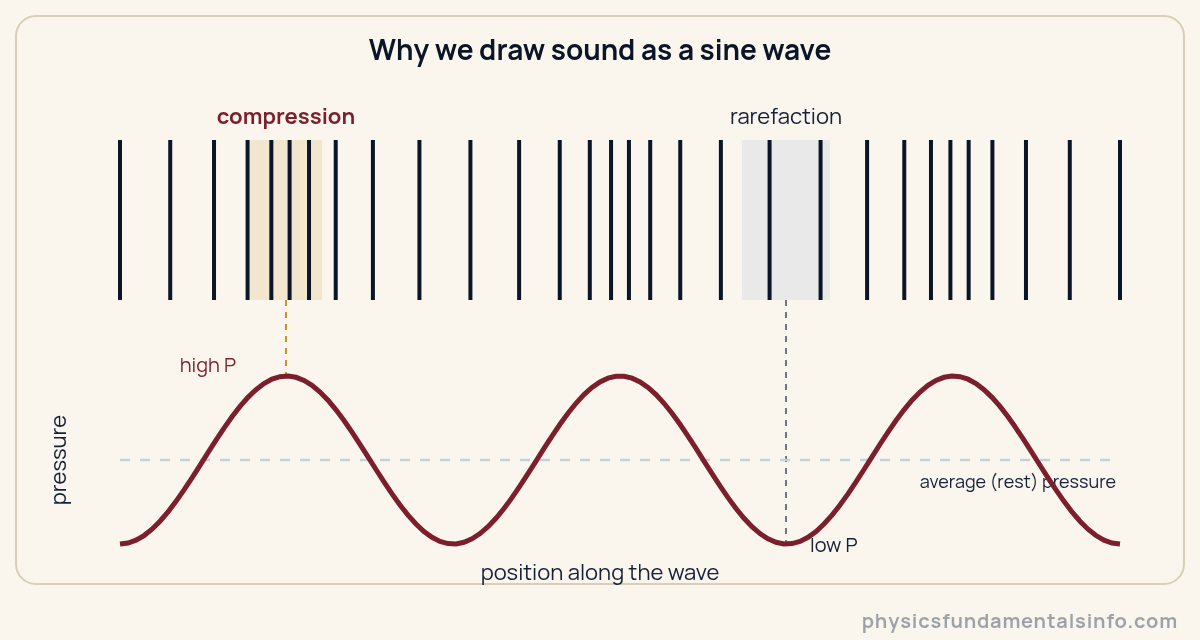
Sound itself is longitudinal (top). The familiar sine curve (bottom, in red) is a graph of air pressure: peaks line up with compressions, troughs with rarefactions.
“All waves need something to travel through”
Mechanical waves do — sound, water, slinky pulses all need matter. But electromagnetic waves, which are transverse, sail straight through a vacuum. Light, X-rays, and radio reach Earth from across the galaxy with no medium whatsoever.
“A bigger wave travels faster”
Amplitude sets how much energy a wave carries — loudness for sound, brightness for light — not its speed. In a given medium the speed is fixed. Shout louder and your voice doesn’t outrun a whisper; both arrive together.
How Transverse and Longitudinal Waves Connect to Other Wave Ideas
Once the two types click, the rest of wave physics opens up quickly. The frequency formula shows how f, period, and v = fλ interlock for either type, and it’s the natural next step from this page.
Frequency also drives the Doppler effect — the rise and fall in pitch as an ambulance passes. It works for both families: a longitudinal shift in sound, a transverse shift in light (the cosmological “redshift”).
And underneath every wave sits oscillation. Each particle in a transverse or longitudinal wave performs simple harmonic motion, so understanding one springy oscillator is understanding the building block of them all.
Worked Problems
Show Solution
Solution:
Step 1: Use the wave equation v = fλ, rearranged for wavelength: λ = v / f.
Step 2: Substitute with units: λ = 343 m/s ÷ 256 Hz.
Step 3: Solve: λ = 1.339… m.
Answer: λ ≈ 1.34 m
Show Solution
Solution:
Step 1: Convert the wavelength to metres: 550 nm = 550 × 10−9 m = 5.50 × 10⁻⁷ m.
Step 2: Rearrange v = fλ for frequency: f = c / λ = (3.00 × 10⁸) ÷ (5.50 × 10⁻⁷).
Step 3: Solve: f = 5.4545 × 10¹⁴ Hz.
Answer: f ≈ 5.45 × 10¹⁴ Hz
Show Solution
Solution:
Step 1: Apply v = fλ directly — no rearranging needed.
Step 2: Substitute with units: v = 12 Hz × 0.25 m.
Step 3: Solve: v = 3.0 m/s.
Answer: v = 3.0 m/s
Show Solution
Solution:
Step 1: Convert the period: 2.0 ms = 2.0 × 10⁻³ s. Then f = 1 / T = 1 ÷ (2.0 × 10⁻³).
Step 2: (a) f = 500 Hz.
Step 3: (b) λ = v / f = 343 ÷ 500 = 0.686 m.
Answer: f = 500 Hz; λ ≈ 0.69 m
Show Solution
Solution:
Step 1: Frequency is set by the source, so f = 1000 Hz in both media. Use λ = v / f.
Step 2: In air: λ = 343 ÷ 1000 = 0.343 m. In water: λ = 1480 ÷ 1000 = 1.48 m.
Step 3: The wave speeds up in water, so its wavelength stretches; frequency stays the same.
Answer: λ(air) ≈ 0.34 m, λ(water) ≈ 1.48 m; frequency unchanged, speed and wavelength increase
Show Solution
Solution:
Step 1: Convert the frequency: 98.5 MHz = 98.5 × 10⁶ Hz = 9.85 × 10⁷ Hz.
Step 2: Rearrange v = fλ: λ = c / f = (3.00 × 10⁸) ÷ (9.85 × 10⁷).
Step 3: Solve: λ = 3.045… m. Sanity check: FM wavelengths really are a few metres — reasonable.
Answer: λ ≈ 3.05 m
Show Solution
Solution:
Step 1: Travel time is distance ÷ speed, so the lag is Δt = t_S − t_P = d(1/v_S − 1/v_P).
Step 2: Substitute: 1/v_S − 1/v_P = 1/4.5 − 1/8.0 = 0.2222 − 0.1250 = 0.09722 s/km.
Step 3: Solve for d: d = Δt ÷ 0.09722 = 30 ÷ 0.09722 = 308.6 km. The faster longitudinal P-wave arrives first, which is why we measure S-minus-P.
Answer: d ≈ 3.1 × 10² km (about 310 km)