Free fall physics describes any motion in which gravity is the only force acting on an object, so every object accelerates downward at the same rate g — about 9.81 m/s2 on Earth — no matter how heavy it is. Distance fallen from rest equals half g times time squared; speed equals g times time. Air resistance must be negligible.
Hold a coin in one hand and your phone in the other, then open both hands at the same instant. They hit the floor together — and some part of you still expects the phone to win, because it is roughly forty times heavier.
That instinct is ancient, and it is wrong. Settling it took two thousand years, a set of grooved wooden ramps, and eventually an astronaut standing on the Moon with a hammer in one glove and a falcon feather in the other. The physics that explains all of it fits into two short equations.
What Is Free Fall in Physics?
Free fall is motion in which gravity is the only force acting on an object. Nothing else — no air resistance, no rope, no table, no thrust — is allowed to push or pull on it.
Notice what that definition does not say. It says nothing about moving downward, and nothing about starting from rest.
A ball you throw straight up is in free fall from the moment it leaves your fingers until the moment you catch it — rising, hanging, and dropping. Its speed changes constantly, but throughout that whole flight only gravity acts on it, so it qualifies. The everyday word “falling” is a poor guide here; the physics test is simply what forces are acting?
And free fall is defined by an acceleration, not a speed. An object in free fall does not fall at 9.81 m/s. It falls with its speed increasing by 9.81 m/s during every second it keeps falling — a very different claim, and the one students most often garble in an exam.
Run any scenario through the single test below and the answer falls out.
| Scenario | Forces acting | Free fall? |
|---|---|---|
| Ball dropped inside a vacuum tube | Gravity only | Yes — the textbook case |
| Ball thrown straight up, still in the air | Gravity only | Yes — rising counts too |
| Astronaut orbiting inside the ISS | Gravity only | Yes — permanently falling |
| Skydiver in the first moment after jumping | Gravity, plus a tiny drag force | Near enough, briefly |
| Skydiver at steady terminal velocity | Gravity balanced by drag | No — zero acceleration |
| Feather drifting down through air | Gravity, and drag almost as large | No — drag dominates |
| Apple sitting on a table | Gravity balanced by the normal force | No — not even moving |
The free-fall test: strip away every force except gravity. If anything is left, it is not free fall.
The Free Fall Formulas
Free fall from rest is described by three equations, and each one answers a different question. Start with the distance fallen after a given time:
Then the speed reached after that time:
And the one that skips time entirely, when you know the height but not the clock:
Every symbol, with its SI unit:
- h — distance fallen from the release point, in metres (m). Not the height of the building: the distance actually covered.
- v — speed at that moment, in metres per second (m/s).
- t — time since release, in seconds (s).
- g — acceleration due to gravity, in metres per second squared (m/s2). Take g = 9.81 m/s2 on Earth unless a question says otherwise.
Two conditions are baked into all three. The object must start from rest, and air resistance must be negligible — break either one and the formulas quietly stop being true.
If the object does not start from rest — you threw it rather than dropped it — swap in the general constant-acceleration forms with initial speed u:
These are simply the SUVAT equations with the acceleration set to g. Free fall is not a special branch of physics; it is ordinary constant-acceleration motion that happens to have gravity supplying the acceleration.
One sign convention saves enormous grief: pick a positive direction before you substitute anything, then stay loyal to it. Call down positive and a dropped stone gives all-positive numbers, while a thrown ball starts with a negative u. Get this backwards and the algebra will still run — it will simply hand you a confident wrong answer. If you would rather check a result than grind it out, our Free Fall Calculator solves for distance, speed, time or gravity from whichever two you already know.
How Free Fall Works: Why the Mass Cancels
Mass disappears from free fall because the force pulling an object down and the inertia resisting that pull both scale with mass by exactly the same factor. Here is the whole argument in three lines.
The gravitational pull on a mass m — its weight — is:
And Newton’s second law says that whatever net force acts produces an acceleration:
In free fall, weight is the net force. So set them equal:
The mass cancels. Not approximately, not for most objects — it cancels exactly, and it cancels for every object.
Think about what that means physically. A bowling ball is pulled toward Earth far harder than a marble, and that extra pull should win. But the bowling ball is also far more stubborn: it takes proportionally more force to shift it.
Double the mass and you double the pull and double the reluctance, in the same breath. The two effects divide out perfectly, and everything falls at the same rate.
That perfect cancellation is not a coincidence, and physicists have never treated it as one. It requires that the mass appearing in W = mg (how strongly gravity grabs you) is identical to the mass in F = ma (how strongly you resist being pushed). There is no obvious reason those two properties should be the same number — yet every experiment ever performed says they are, to extraordinary precision. That fact is the seed Einstein grew general relativity from.
So the honest answer to “why does a hammer fall as fast as a feather?” is not really about hammers. It is that gravity, uniquely among forces, cares about mass in exactly the way inertia does — so mass never gets a vote.
The picture below is what that looks like second by second.
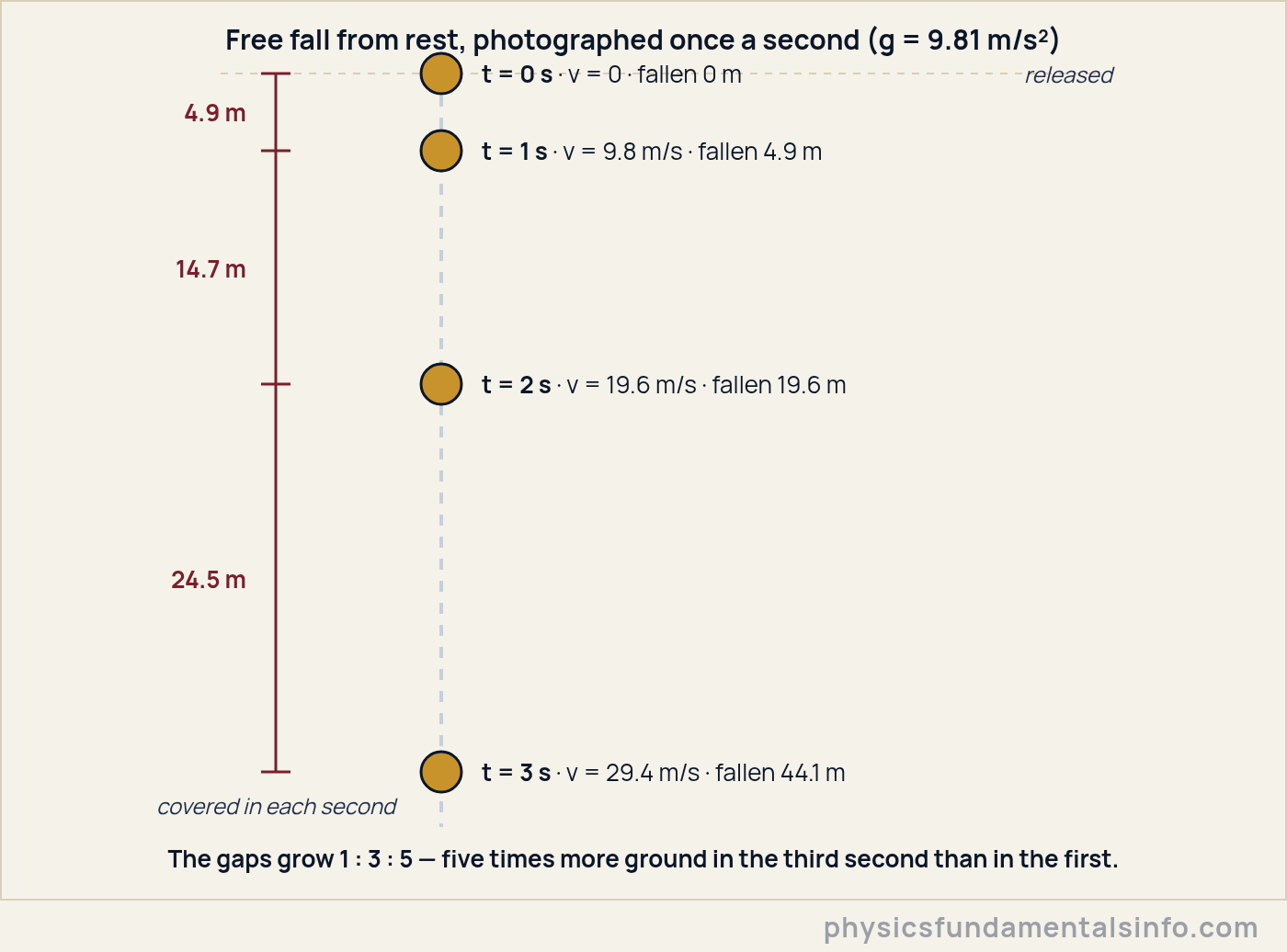
Free fall physics in one image: equal time steps, wildly unequal distances. That widening is the t2 in h = ½gt2.
Look at the gaps rather than the ball. In the first second it covers 4.9 m; in the third, 24.5 m. The speed is climbing at a steady, boring 9.81 m/s every second — but distance depends on t2, so it snowballs. This is exactly why a fall from 40 m is far more than twice as dangerous as a fall from 20 m.
Plot the same fall two ways and the split personality is obvious.
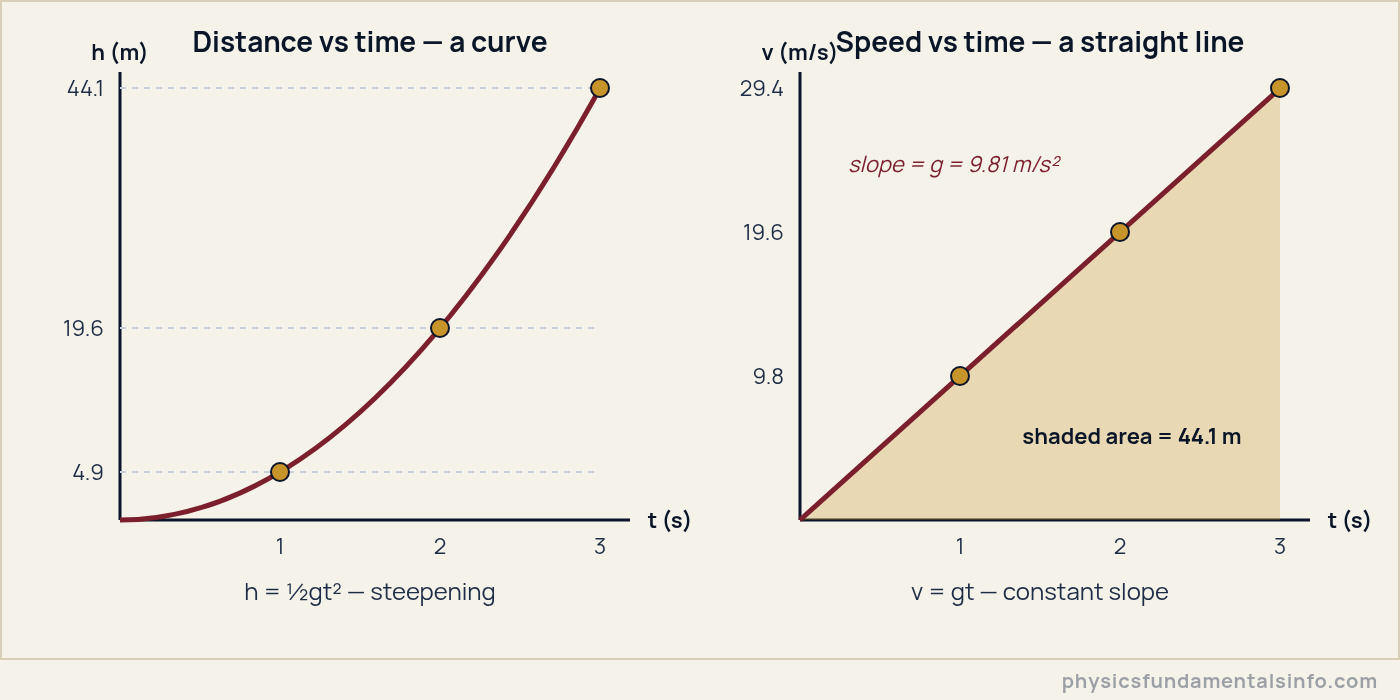
The same three seconds, two views. Speed rises in a straight line; the area beneath that line is the distance fallen.
The right-hand graph carries a bonus. The area under a speed–time line always equals the distance travelled, and here that area is a triangle: ½ × 3 s × 29.43 m/s = 44.1 m. That is h = ½gt2 falling out of pure geometry — no calculus required.
Drop the two masses in the lab below and watch the readouts. The weights differ. The fall times refuse to.
Free Fall Physics in the Real World
True free fall is rarer than the textbooks imply — Earth’s atmosphere spoils almost every case. These five are the ones worth knowing.
1. A hammer and a feather on the Moon
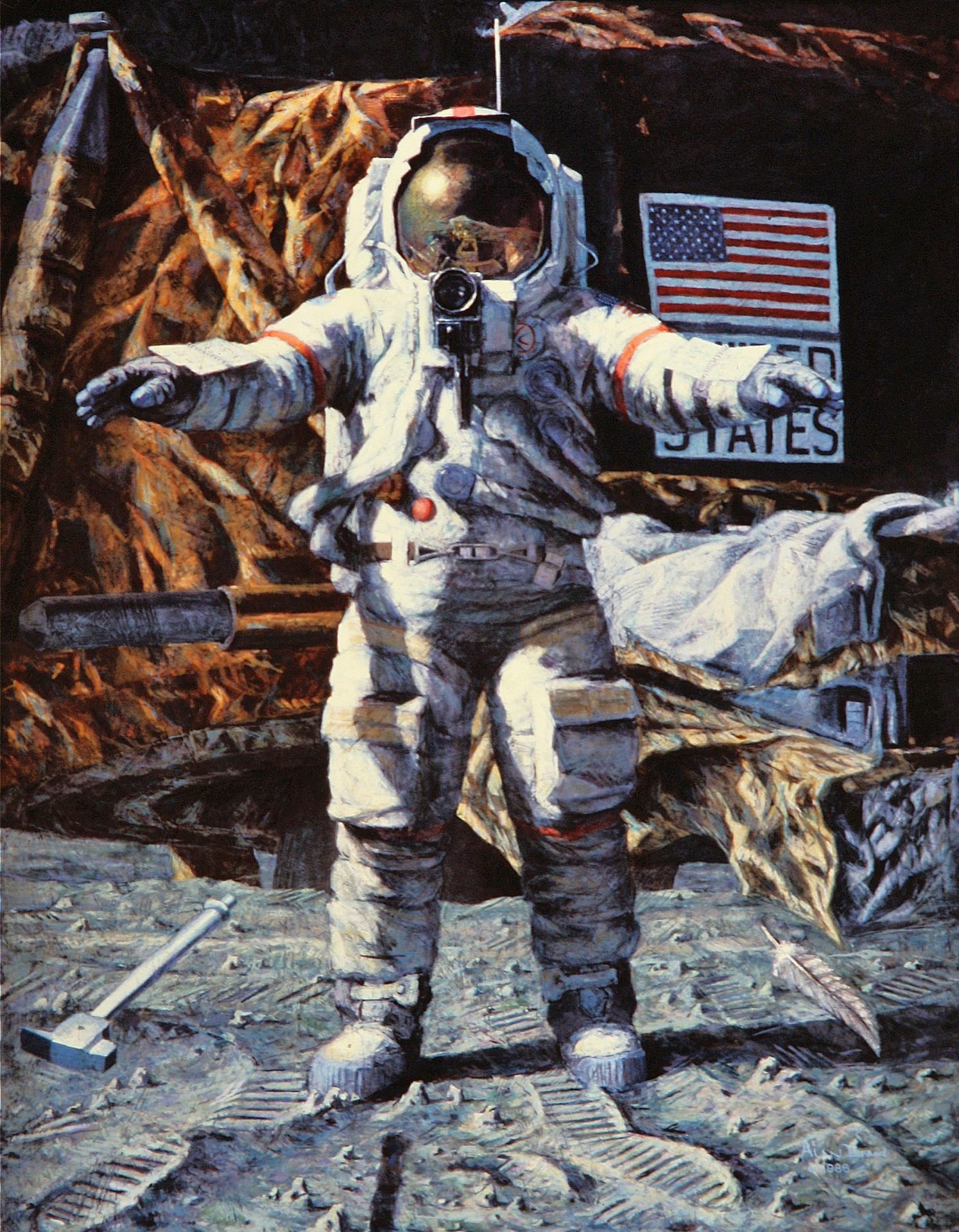
At the end of the final Apollo 15 moonwalk in 1971, Commander David Scott held out a geology hammer and a falcon feather and let go of both. NASA’s account records a 1.32 kg aluminium hammer and a 0.03 kg feather released from roughly 1.6 m, which struck the surface together.
The hammer outweighed the feather forty-four times over. With no lunar atmosphere to interfere, that counted for precisely nothing.
2. The ruler-drop reaction test
Have someone hold a ruler vertically, hover your fingers at the zero mark, and catch it the instant they release. The distance it fell tells you your reaction time, because a free-falling ruler is a clock.
Catch it at 18 cm and your reaction time was about 0.19 s. It is the cheapest free-fall experiment in existence, and problem 5 below works the number through.
3. The first second of a skydive
Step out of the aircraft and, for a brief moment, you genuinely are in free fall — drag needs speed to build, and at the instant you leave you have none. After one second you are falling at about 9.8 m/s and have dropped roughly 4.9 m, near enough exactly what the formulas predict.
The agreement then rots. Drag climbs with the square of your speed, and within a few seconds it is large enough that the equations on this page no longer describe you.
4. Astronauts on the space station
Everyone on the ISS is in free fall, all the time. That is the whole reason they float — not an absence of gravity, which at roughly 400 km up is still about 88% as strong as at ground level.
The station is moving sideways so fast that its constant fall toward Earth keeps missing. Astronauts, station and floating pens all fall together at the same rate, so nothing presses on anything else, and everything drifts.
5. A stone dropped down a well
Drop a stone, count until the splash, and h = ½gt2 hands you the depth. Two seconds implies about 19.6 m.
In practice that answer is a little too deep, and here is the experience note most sources skip: your 2.0 s includes the time the sound took to climb back out. Solve it properly and the stone falls for 1.95 s to a depth of 18.6 m, with the remaining 0.05 s spent on the noise travelling up. The naive answer overshoots by about 1 m — around 6%.
Common Misconceptions About Free Fall
Myth 1: Heavier objects fall faster
In free fall they do not — mass cancels out of the equations entirely, as the derivation above shows. Yet the myth survives because everyday experience appears to confirm it every single day.
Drop a hammer and a feather in your kitchen and the hammer does win. The mistake is in the diagnosis. What you are watching is not gravity favouring the heavy object; it is air resistance punishing the light one. Gravity is treating them identically, and always was.
Where mass sneaks back in is drag. A heavy, compact object has more weight to overcome the same drag force, so it holds its acceleration for longer. That is a story about air — not about gravity — and it belongs to terminal velocity, not to free fall.
Myth 2: Free fall means moving downward
Free fall means gravity is the only force acting — direction is irrelevant. A ball rising after you throw it is in free fall; so is one hanging momentarily at the top of its arc.
The trap at that top point is worth spelling out, because examiners love it. At the peak the ball’s velocity is zero, and students duly write a = 0. But acceleration is not velocity. Gravity has not paused for the ball — the acceleration there is still 9.81 m/s2 downward, which is precisely why the ball does not hover.
Myth 3: Astronauts float because there is no gravity in space
There is plenty of gravity in orbit — around 88% of surface strength at the ISS — and that gravity is exactly what holds the station in its orbit rather than letting it drift off into the solar system.
Half the confusion lives in the word itself. Weight is a force, not a property you carry around: NIST defines weight as the force that gives a body the local acceleration of free fall, and measures it in newtons. Your mass, in kilograms, does not change by a single gram on the way to orbit.
So weightlessness is not the absence of gravity. It is the absence of everything else. You feel your weight only because a floor shoves up at you; remove the floor and let gravity act alone, and the sensation vanishes. Astronauts are not escaping gravity — they are in permanent free fall, which is the closest thing to a physics demonstration that lasts for years.
Myth 4: Galileo proved it by dropping balls off the Leaning Tower of Pisa
The tower story is almost certainly a legend, and it is worth retiring. Historians have long been sceptical that the famous drop ever happened; the tale traces mainly to a biography written by Galileo’s assistant decades later.
His real evidence was cleverer. Falling bodies were far too quick for a 16th-century clock, so he rolled balls down gently inclined ramps instead — diluting gravity until the motion was slow enough to time by hand. Same physics, stretched out. From the ramps he extracted the pattern that distance grows with the square of time, which is h = ½gt2 in disguise.
Free Fall on Other Worlds: g Changes Everything
Mass does not affect a free fall, but gravity certainly does — and g is a local number, not a universal one. Drop the same object from 10 m on four different worlds and you get four different answers.
| World | g (m/s2) | Time to fall 10 m | Impact speed |
|---|---|---|---|
| Moon | 1.62 | 3.51 s | 5.69 m/s |
| Mars | 3.72 | 2.32 s | 8.63 m/s |
| Earth | 9.81 | 1.43 s | 14.0 m/s |
| Jupiter* | 24.79 | 0.90 s | 22.3 m/s |
Same 10 m drop, same object, four worlds. *Jupiter has no solid surface; its g is quoted at the cloud tops.
Notice the asymmetry. Jupiter’s gravity is fifteen times the Moon’s, but the fall is only about four times quicker — because t = √(2h/g) puts g under a square root. Quadruple the gravity and you halve the time, no more.
Even Earth’s own g is not one number. The standard acceleration of gravity is defined as exactly 9.80665 m/s2 — a convention agreed by committee, not a measurement of anywhere — while the real local value runs from roughly 9.78 m/s2 near the equator to about 9.83 m/s2 at the poles. You are marginally heavier in Oslo than in Singapore. For schoolwork, 9.81 m/s2 is close enough for every problem on this page.
How Free Fall Relates to Terminal Velocity, Projectiles and SUVAT
Free fall is the idealised centre of a family of topics, and each neighbour is what you get by adding one ingredient back.
Add air resistance and you get terminal velocity. Drag grows as the falling object speeds up until it exactly balances weight; the net force hits zero, acceleration stops, and the fall settles at a constant speed. Everything on this page describes the first seconds of that story — the terminal-velocity article describes how it ends. Together they cover the whole drop.
Add sideways motion and you get projectile motion. Throw a stone horizontally instead of dropping it and the vertical half of the problem is unchanged: it still falls 4.9 m in the first second. Horizontal and vertical motion simply do not talk to each other, which is why a bullet fired level and a bullet dropped from the same height land at the same moment. Free fall is projectile motion with the horizontal component set to zero.
Zoom out and you get SUVAT. Free fall is the constant-acceleration equations with a = g — no new physics, just a value substituted in.
Take the energy route and you get the same answers. Gravitational potential energy mgh converts into kinetic energy ½mv2, so mgh = ½mv2, and the m cancels again to give v = √(2gh). That is v2 = 2gh arriving by a different road — a useful cross-check when a problem gives you height but no time.
Worked Problems
Eight problems, increasing in difficulty. Take g = 9.81 m/s2 and ignore air resistance throughout.
Show Solution
Solution:
Step 1: Dropped from rest, so use h = ½gt2.
Step 2: Substitute — h = ½ × 9.81 m/s2 × (2.0 s)2 = ½ × 9.81 × 4.0 m.
Step 3: Solve — h = 19.62 m.
Answer: h = 19.6 m (3 s.f.)
Show Solution
Solution:
Step 1: Speed from time in free fall uses v = gt.
Step 2: Substitute — v = 9.81 m/s2 × 3.0 s.
Step 3: Solve — v = 29.43 m/s.
Answer: v = 29.4 m/s (3 s.f.), directed downward
Show Solution
Solution:
Step 1: Rearrange h = ½gt2 for time — t = √(2h/g).
Step 2: Substitute — t = √(2 × 45 m ÷ 9.81 m/s2) = √(9.174 s2).
Step 3: Solve — t = 3.029 s.
Step 4: Now the speed — v = gt = 9.81 × 3.029 = 29.71 m/s.
Step 5: Check it independently with v2 = 2gh = 2 × 9.81 × 45 = 882.9 m2/s2, so v = 29.71 m/s. The two routes agree.
Answer: t = 3.03 s and v = 29.7 m/s (3 s.f.)
Show Solution
Solution:
Step 1: Check whether mass appears in t = √(2h/g) or v = √(2gh). It does not — so the two objects must behave identically.
Step 2: Time to fall — t = √(2 × 20 ÷ 9.81) = √(4.077 s2) = 2.019 s, for both.
Step 3: Impact speed — v = √(2 × 9.81 × 20) = √(392.4 m2/s2) = 19.81 m/s, for both.
Step 4: Sanity-check the difference. Their weights are wildly unequal — 1.47 N versus 71.6 N — but so are their inertias, in the same ratio of about 49:1. The accelerations come out equal.
Answer: neither lands first — both take t = 2.02 s and arrive at v = 19.8 m/s (3 s.f.)
Show Solution
Solution:
Step 1: The ruler starts from rest, so t = √(2h/g). Convert first: 18 cm = 0.18 m.
Step 2: Substitute — t = √(2 × 0.18 m ÷ 9.81 m/s2) = √(0.03670 s2).
Step 3: Solve — t = 0.1916 s.
Step 4: Sanity-check the magnitude — typical human reaction times are around 0.15–0.25 s, so this is believable.
Answer: t = 0.19 s (2 s.f.)
Show Solution
Solution:
Step 1: It does not start from rest, so use the general forms. Take up as positive, making the acceleration −9.81 m/s2.
Step 2: At the highest point v = 0. Use v2 = u2 + 2ah — 0 = (12)2 + 2(−9.81)h.
Step 3: Solve — h = 144 ÷ 19.62 = 7.339 m.
Step 4: Time to the top from v = u + at — 0 = 12 − 9.81t, so t = 1.223 s.
Step 5: The rise and the fall are mirror images, so the round trip is 2 × 1.223 s = 2.446 s.
Answer: it rises 7.34 m and returns after 2.45 s (3 s.f.)
Show Solution
Solution:
Step 1: Non-zero start again, and this time down is positive, so u = +5.0 m/s. Use h = ut + ½gt2.
Step 2: Substitute — 30 = 5.0t + 4.905t2, giving the quadratic 4.905t2 + 5.0t − 30 = 0.
Step 3: Apply the quadratic formula — t = [−5.0 + √(25 + 588.6)] ÷ 9.81 = (−5.0 + 24.77) ÷ 9.81.
Step 4: Solve — t = 2.015 s. (The negative root is discarded: it describes a time before the throw.)
Step 5: Impact speed from v2 = u2 + 2gh = 25 + 588.6 = 613.6 m2/s2, so v = 24.77 m/s.
Answer: t = 2.02 s and v = 24.8 m/s (3 s.f.)
Show Solution
Solution:
Step 1: The hammer’s mass is not needed — free fall never uses it. Use t = √(2h/g).
Step 2: On the Moon — t = √(2 × 1.6 ÷ 1.62) = √(1.975 s2) = 1.406 s.
Step 3: On Earth — t = √(2 × 1.6 ÷ 9.81) = √(0.3262 s2) = 0.5711 s.
Step 4: Take the ratio — 1.406 ÷ 0.5711 = 2.46. Confirm it algebraically: the ratio must be √(gEarth/gMoon) = √(9.81/1.62) = √6.056 = 2.46. It matches.
Answer: 1.41 s on the Moon against 0.571 s on Earth — about 2.5 times longer (3 s.f.)