Angular momentum is the rotational counterpart of linear momentum: an object’s moment of inertia multiplied by its angular velocity, L = Iω, or for a single mass circling an axis, mass times speed times radius, L = mvr. It is measured in kg·m²/s and stays constant while no net external torque acts about the axis.
Sit on an office chair, get someone to spin you with your legs stuck out, then tuck them in. You did not push against the floor, the walls or anybody in the room, and you sped up anyway.
Nothing about that is a quirk of the chair. It is the one thing a spinning system refuses to give up, and once you can put a number on it you can predict your new spin rate before you tuck.
What Is Angular Momentum?
Angular momentum is the amount of rotation a body carries about a chosen axis: its moment of inertia multiplied by its angular velocity. Write it down and you have L = Iω.
The phrase “about a chosen axis” is doing real work in that sentence. There is no such thing as the angular momentum of an object full stop — only its angular momentum about some stated line in space, and choosing a different line gives a different number for exactly the same motion.
Three things fix the value, and only three.
- How much mass there is. Double the mass, double the angular momentum, all else held still.
- How far that mass sits from the axis. This one counts twice over, because the distance enters the moment of inertia squared. Moving a mass from 0.20 m out to 0.80 m multiplies its contribution by sixteen.
- How fast it is turning. The angular velocity enters once, in radians per second.
Why bother defining such a thing? Because it survives. Left alone by any outside twist, a spinning system can rearrange itself as violently as it likes and this one number will not move, which makes it the rotational member of the same family as energy and linear momentum — the trio that MIT’s OpenCourseWare classical mechanics course introduces together as the conservation approach to solving problems.
There is something unusual about this topic worth flagging early. Nothing in the angular momentum relations needs a constant of nature: every number below is built from the definitions of mass, length, time and angle alone, so there is next to nothing to look up and nothing to get out of date. The one exception is problem 6, where g = 9.81 m/s² appears only to turn a force in newtons into the weight of a familiar mass.
The Angular Momentum Formula, and the Two Ways to Write It
The standard form is the moment of inertia about the axis multiplied by the angular velocity about that same axis.
For one mass travelling round a circle, the same quantity is usually written a different way: mass, times speed along the circle, times the radius from the axis.
Those are not two laws. They are one quantity wearing two hats, and a single line of substitution shows it. A mass on a circle has v = ωr, so mvr becomes m(ωr)r, which regroups as (mr²)ω — and mr² is precisely what “moment of inertia” means for a point mass at radius r.
That regrouping is worth staring at for a moment, because it explains the whole topic. A real spinning body is a crowd of little masses at a crowd of different radii; add up every mr² and you get the single number I. Shift material outward and I climbs as the square of the distance, which is why a small movement of your arms changes your spin so much more than you expect.
| Symbol | What it is | SI unit | Worth knowing |
|---|---|---|---|
| L | angular momentum, about one stated axis | kg·m2/s | the same unit may be written N·m·s or J·s; all three are identical combinations of the base units |
| I | moment of inertia about that same axis | kg·m2 | depends on shape as much as on mass; a point mass at radius r has I = mr2 |
| ω | angular velocity, the spin rate | rad/s | convert revolutions per minute or degrees per second before multiplying anything |
| m | the mass of the one object going round | kg | only the point-mass form uses it; the I form has already swallowed every mass in the body |
| v | its speed along the circle | m/s | tied to the spin rate by v = ωr, which is what makes the two formulae one |
| r | radius from the axis out to that mass | m | measured from the axis you are quoting, never from anywhere else |
The unit is where a lot of marks go missing. Angular momentum comes out in kg·m²/s, built from nothing but the kilogram, the metre and the second, three of the seven SI base units. It is also, written differently, N·m·s and J·s — which is a nice piece of bookkeeping rather than a deep truth, so do not read a quantum claim into the fact that it happens to be the unit of the Planck constant.
If you would rather not grind through the arithmetic twice, the angular momentum calculator takes either set of inputs — a moment of inertia and a spin rate, or a mass, a speed and a radius — and returns L. Enter a known L instead, alongside one or two of the others, and it works backwards to give you ω, I or v.
The lab below puts that algebra in motion. It carries two equal masses on a turntable and shows, as you slide them in or out, how the total splits between what the turntable carries and what the masses carry.
Why a Spinning Skater Speeds Up
A skater speeds up because pulling the arms in cuts the moment of inertia, and with nothing outside exerting a torque the product Iω has to stay where it was, so ω rises in exactly the proportion that I fell.
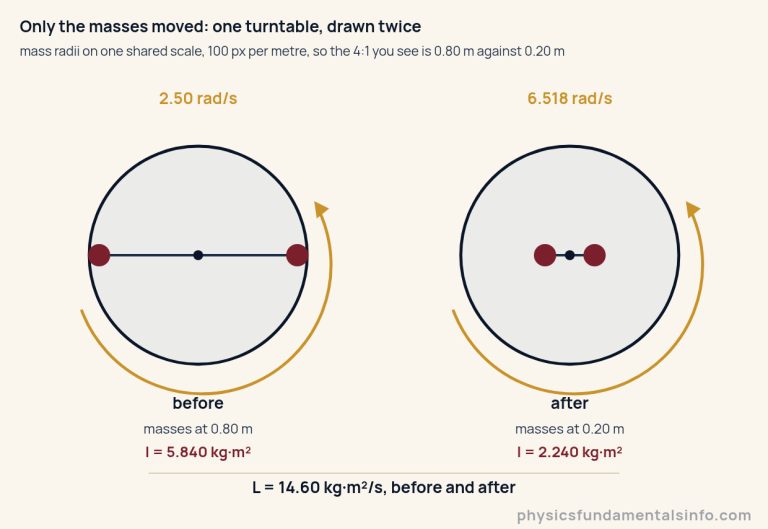
Numbers make it concrete. Take a turntable of moment of inertia 2.00 kg·m² about its axis, carrying two 3.00 kg masses, one on each side, at a radius of 0.80 m, turning at 2.50 rad/s.
| Reading | Arms out, masses at 0.80 m | Arms in, masses at 0.20 m |
|---|---|---|
| Moment of inertia I | 5.840 kg·m2 | 2.240 kg·m2 |
| Spin rate ω | 2.50 rad/s | 6.518 rad/s |
| Angular momentum L (the one that holds still) | 14.60 kg·m2/s | 14.60 kg·m2/s |
| Rotational energy | 18.25 J | 47.58 J |
| Speed of each mass | 2.000 m/s | 1.304 m/s |
| m v r for one mass alone | 4.800 kg·m2/s | 0.7821 kg·m2/s |
| Both masses together | 9.600 kg·m2/s | 1.564 kg·m2/s |
| The turntable’s own share | 5.000 kg·m2/s | 13.04 kg·m2/s |
| Inward pull needed on each mass | 15.00 N | 25.49 N |
Read down the third row and nothing happens. Read down any other row and something does — the inertia falls by a factor of 2.607, the spin rate rises by the same 2.607, and the two cancel in the product.
One caution about arithmetic on that table, because it catches people out. Every computed cell is rounded to four significant figures for display — only the 2.50 rad/s you set is printed as typed — and the shares behave accordingly: 5.000 + 9.600 comes to exactly 14.60, while 13.04 + 1.564 comes to 14.604. The physics is not drifting; the display is.
It helps to watch where the angular momentum is actually stored. With the masses out at 0.80 m they carry 9.600 kg·m²/s of the total and the turntable carries 5.000 kg·m²/s. Bring them in and the masses carry only 1.564 kg·m²/s, while the faster-turning turntable now carries 13.04 kg·m²/s.
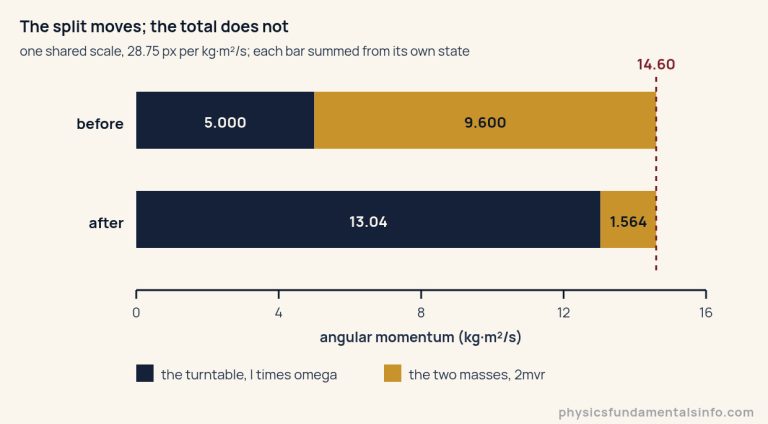
That is the whole trick, drawn. The split moves wholesale from the masses to the turntable, and the far end of the bar does not budge.
Where the Extra Energy Comes From
The extra rotational energy is work done on the system. Something has to haul each mass in towards the axis, and hauling it inward while it strains outward on you is work by any definition. Nothing is created and nothing is free.
The rotational kinetic energy of a spinning body is ½Iω², which can be rewritten as ½Lω. Hold L still and the energy simply tracks ω — so the 2.607-fold speed-up costs a 2.607-fold rise in energy, from 18.25 J to 47.58 J.
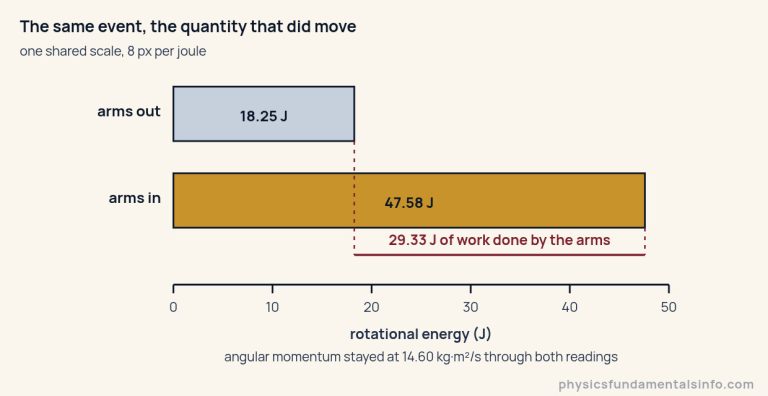
Where did 29.33 J come from? Each mass was being held on its 0.80 m circle by an inward pull of 15.00 N, and something had to drag it in to 0.20 m against a pull that never once turned outward. Force through a distance is work, and that work went straight into the rotation.
That pull is not steady on the way in, and it does not simply grow. Each mass needs F = mω²r to stay on its circle, and as it comes in the spin rate climbs, which asks for more force, while the radius shrinks, which asks for less. Put ω = L / I into that, with I = 2.00 + 2mr², and the two effects balance where 6mr² matches the turntable’s own 2.00 kg·m² — that is, at r = sqrt(2.00/18) = 0.3333 m, where the two masses between them hold a third of the turntable’s inertia.
So the pull climbs from 15.00 N at 0.80 m to a peak of 29.98 N at that radius, then eases back to 25.49 N by 0.20 m — still well above where it started, and still pointing inward the whole way. Every stage of the journey takes work in, which is why the 29.33 J came out positive.
Push the masses back out and the accounting runs backwards: the spin falls, the energy falls, and your arms take the energy out again. Problem 5 below works that case through and the answer comes out negative, which is the sign telling you the direction of the transaction.
So angular momentum is conserved here and energy is not — and there is no contradiction in that. Conservation of angular momentum is a statement about torques; conservation of energy is a statement about a closed system, and a pair of arms doing work is not one.
Common Misconceptions About Angular Momentum
Four beliefs cause most of the trouble on this topic, and all four are worth naming.
“It is just momentum, going round in a circle”
It is not. Linear momentum is kg·m/s and angular momentum is kg·m²/s, so the two cannot even be added, let alone equated. They are analogues, not the same quantity, and the parallel between them is the most useful map in rotational mechanics.
| Straight-line quantity | Rotational partner | Conserved when? |
|---|---|---|
| mass m (kg) | moment of inertia I (kg·m2) | never: I changes the instant the shape changes, which is the whole point |
| velocity v (m/s) | angular velocity ω (rad/s) | never: it is free to move, and it does |
| momentum p = mv (kg·m/s) | angular momentum L = Iω (kg·m2/s) | p with no net external force; L with no net external torque about the axis |
| force F = ma (N) | torque τ = Iα (N·m) | neither: these are the things that change the momentum |
| kinetic energy ½mv2 (J) | rotational energy ½Iω2 (J) | only while no work is done on the system |
Read that third row across and the two conservation rules fall out side by side. Conservation of linear momentum needs no net external force; its rotational twin needs no net external torque about the axis you chose.
“Angular momentum and torque are the same thing”
They are related the way momentum and force are related, which is to say they are not the same at all. Torque is the rate at which angular momentum changes, so a torque of zero means L is flat, not that L is zero.
A common slip follows from that. Students see “no torque” and conclude “nothing is happening”, when in fact a great deal may be happening — as the skater case shows, the system can be tearing through a dramatic rearrangement while the conserved quantity sits perfectly still.
“Angular momentum is always conserved”
Only when the net external torque about the axis is zero. Your office chair has bearings that rub, a skater has a blade on ice and a body moving through air, and in both cases an outside torque is quietly bleeding angular momentum away the entire time.
The honest version is conditional: L holds still because nothing outside twists the system about that axis. Assume the condition and you can predict the new spin rate; forget it and you will be surprised when a real wheel coasts to a stop.
“The heavier object must have more angular momentum”
Not necessarily, because where the mass sits matters more than how much of it there is. Mass enters once and radius enters squared, so a light rim at a large radius can easily beat a heavy hub at a small one.
In practice this is why a bicycle wheel, with nearly all its metal out at the rim, is so much harder to spin up than a solid disc of the same mass and radius. The material that counts is the material furthest from the axle.
Angular Momentum Depends on the Axis You Measure About
Quote an angular momentum without naming an axis and you have said nothing. The same motion, measured about two different lines, gives two different numbers — and one of them may well be zero.
Take the cleanest case there is. A ball sails past you in a perfectly straight line at constant speed, with no rotation at all. About a point off to one side of its path it has a real, non-zero angular momentum of mvr, where r is the perpendicular distance from that point to the line of travel. About any point actually on the line, r is zero, and so is L.
Nothing about the ball changed between those two statements. Only the axis did. That is why every worked answer on this page names the axis it belongs to, and why a problem that hands you a moment of inertia about the centre of mass and a radius from the pivot is a trap rather than a question.
The same discipline applies in circular motion generally: pick the axis first, measure every radius from it, and do not change your mind halfway through.
Where You Meet Angular Momentum
The pattern to look for is a system that changes its own shape, or spins one part to steer another, with nothing outside twisting it.
- A skater or a diver. Tuck in mid-rotation and the spin rises; open out and it falls. The shape is the control, and the conserved quantity does the rest.
- A helicopter’s tail rotor. It exists because the airframe would otherwise take up the main rotor’s angular momentum and turn the other way underneath it.
- A spacecraft’s reaction wheel. Spin a heavy wheel inside the craft one way and the craft turns the other, with no fuel spent and no external torque involved — the principle behind the reaction wheels used for spacecraft pointing control.
- A flywheel. Here the interest is the energy stored in the spin rather than the angular momentum itself, but the same I and the same ω set both.
- The planets. Gravity pulls a planet straight towards the Sun, which exerts no torque about the Sun, which is why orbital angular momentum is conserved and the orbit keeps its plane.
Notice what all five have in common. None of them adds rotation from outside; each one only moves rotation about, between parts of a system that was already turning.

Where Conservation Breaks Down
Conservation of angular momentum is exact under one condition and approximate under real ones, and five limits are worth stating plainly.
- Friction and drag. A real chair, a real wheel and a real skater all slow down, because bearings rub and air pushes back. Treat a conserved L as the idealisation it is, and check whether the outside torque is genuinely negligible over the time you care about.
- L = Iω is the scalar shortcut. In general angular momentum is a vector, defined as r × p, it need not point along the rotation axis at all, and I is a tensor rather than a number. The scalar form used throughout this page is the special case of rotation about a symmetry axis, which covers most school and first-year problems and not much beyond them.
- The axis is part of the answer. As above: change the axis and you change the number. An L quoted without its axis is not wrong so much as meaningless.
- Point masses are an idealisation. Treating a held mass as a point at radius r ignores the moment of inertia it has about its own centre. For a compact object at a large radius that is a small error; for a long bar held close in, it is not.
- Extreme arrangements describe machines, not people. Push the numbers hard enough and the inward pull runs into the thousands of newtons, as problem 6 shows. The arithmetic stays correct; what it is describing has stopped being a person on a chair.
One more caution about where the numbers on this page come from. The turntable’s own moment of inertia is a figure chosen for the worked cases, not a measurement of any real chair, stool or skater — nothing here measures a person, and no page should attach a number to one.