The spring constant (k) is a measure of a spring’s stiffness: the force in newtons needed to stretch or compress it by one metre. It is calculated as k = F/x — applied force divided by extension — and measured in newtons per metre (N/m). Stiffer springs have larger k values.
Click the top of a retractable pen and your thumb squashes a small steel spring by about seven millimetres. The push you feel — roughly two newtons — is set by a single number built into that spring.
That number is the spring constant, and it quietly runs daily life: how firm your mattress feels, how a car soaks up potholes, how a weighing scale turns stretch into kilograms. This guide shows you how to measure k for any spring, what realistic values look like, and how to read the number the way an engineer does.
What Is the Spring Constant?
The spring constant, written k, is the force needed to stretch or compress a spring by one unit of length — in SI units, the newtons required per metre of extension. It is a single number that captures how stiff one particular spring is.
Think of k as a price list. A soft spring charges you almost nothing per centimetre of stretch; a stiff one demands a serious push for the same distance. Two springs can look identical on the bench and still have wildly different constants.
One boundary before we start: k comes from the proportional relationship between force and extension, which our guide to Hooke’s law covers in depth — the law itself, its discovery, and where it breaks down. This article stays on the constant: measuring it, typical values, and what it tells you.
The Spring Constant Formula: k = F/x
To calculate the spring constant, divide the applied force by the extension it produces.
- k — spring constant, in newtons per metre (N/m)
- F — applied force, in newtons (N)
- x — extension or compression, in metres (m): the change from the spring’s natural length, never the spring’s total length
The formula rearranges both ways: F = kx gives the force for a chosen stretch, and x = F/k predicts how far a spring gives under a known load. You can also skip the algebra and get any of the three instantly with our Spring Constant Calculator, which solves for k, F, or x from the other two.
A note on units. Newtons per metre follows directly from the SI system of units, since k is a force divided by a length. Engineers usually call the same quantity a spring rate and quote it in N/mm or lb/in — handy conversions are 1 N/mm = 1,000 N/m and 1 lb/in ≈ 175 N/m.
How Do You Measure a Spring Constant?
Measure a spring constant by hanging known weights from the spring, recording the extension each load produces, plotting force against extension, and taking the slope of the best-fit straight line — that slope is k. A second, independent route uses timing: set a mass bouncing on the spring and calculate k from the oscillation period.
Method 1: The Load–Extension Graph (Static Method)
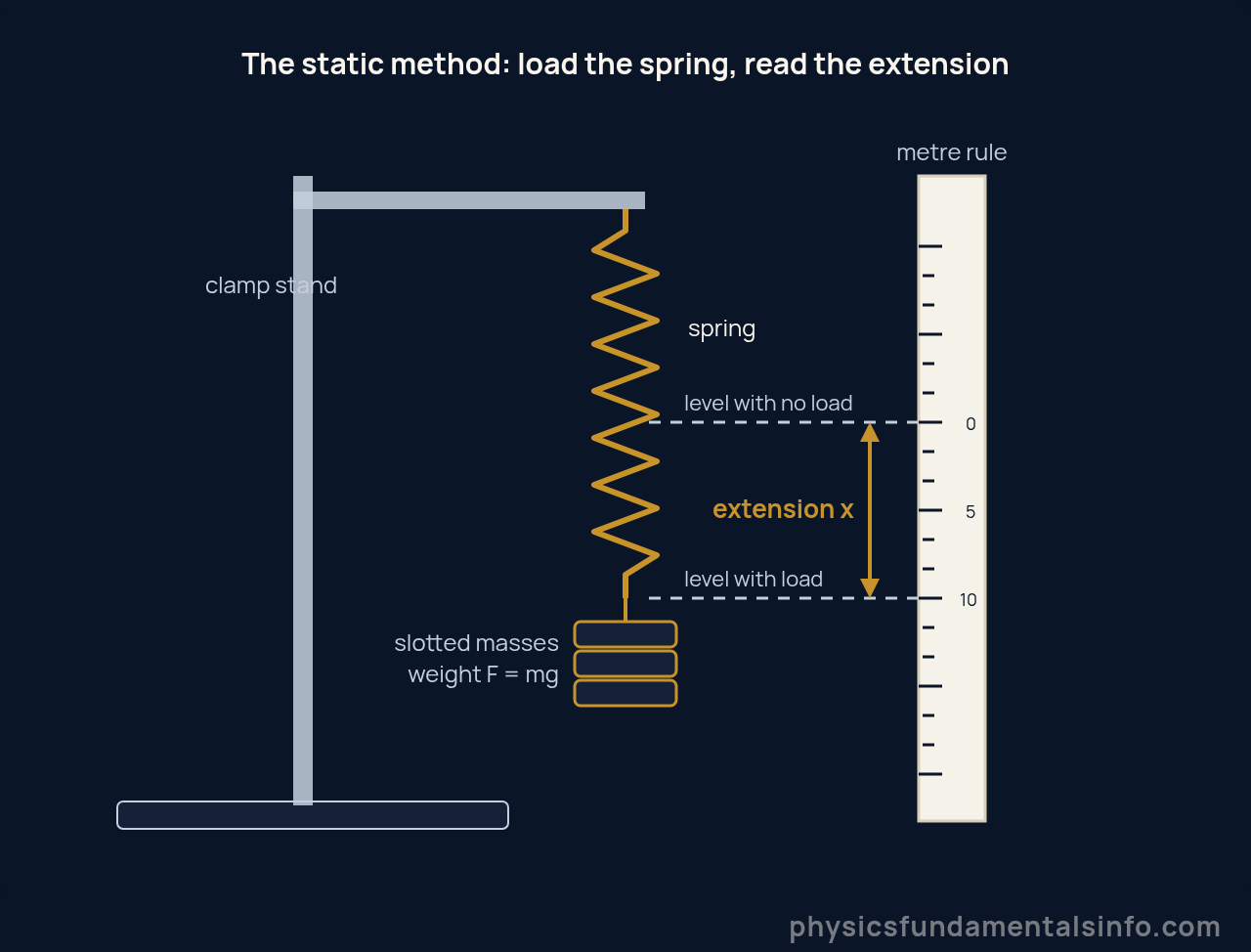
The static method: each added mass raises the stretching force by F = mg, and the metre rule records the matching extension x.
This is the classic school practical, and done carefully it gives k to within a few percent. You need a clamp stand, the spring, a metre rule, and a set of slotted masses.
- Hang the spring and note the ruler reading of its lower end with no load.
- Add a known mass and convert it to force using F = mg — the distinction matters, as our guide to weight vs mass explains, because the spring feels newtons, not grams.
- Record the new reading and subtract the unloaded reading to get the extension x.
- Repeat for five or six loads, then remove the masses one by one and record the readings again on the way down.
- Plot force F on the vertical axis against extension x on the horizontal axis.
- Draw the best-fit straight line through the origin. Its slope is the spring constant.
Why bother unloading? It is a built-in honesty check. If the unloading readings sit above the loading ones, the spring has been permanently stretched and the later data points are worthless.
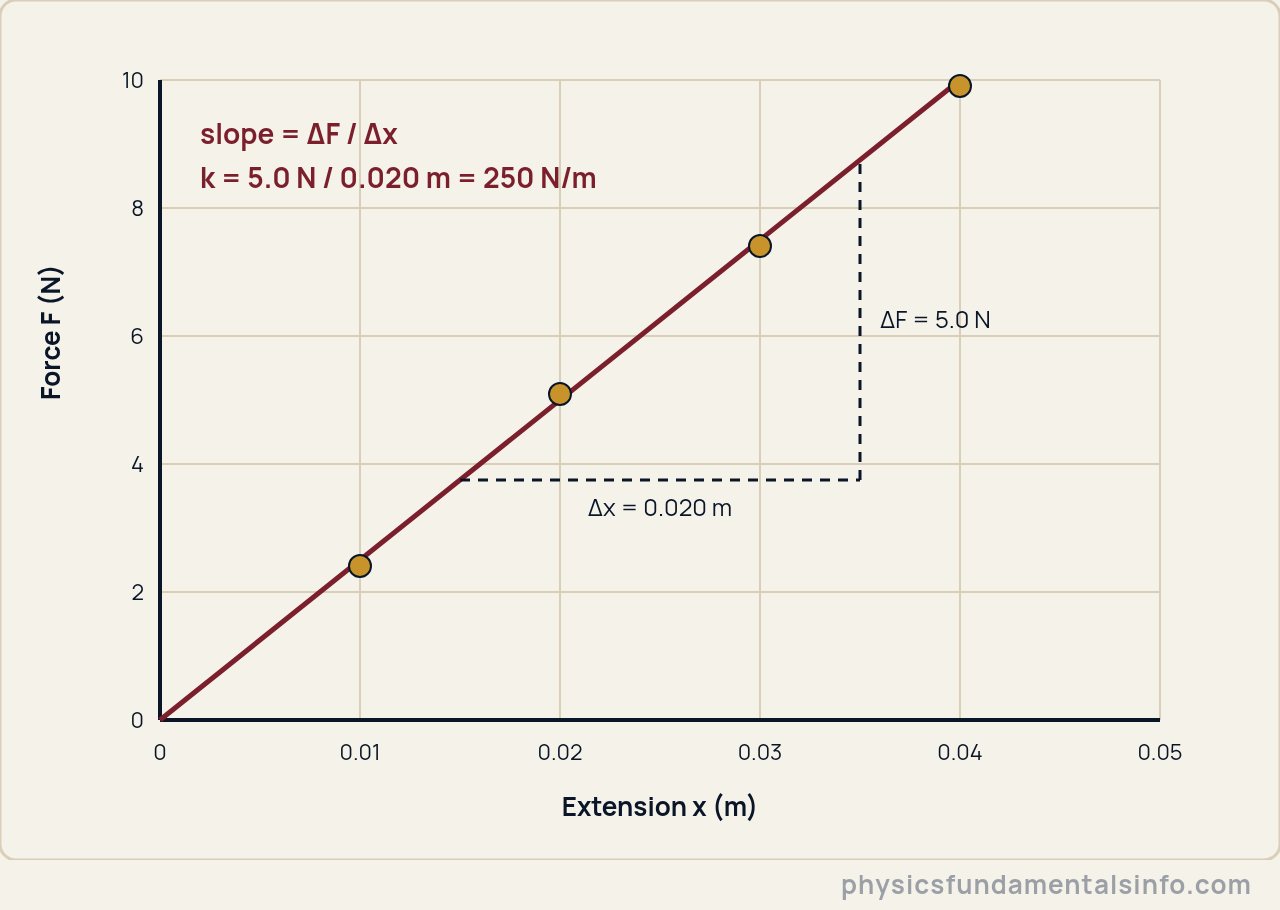
The spring constant is the slope of the force–extension graph. Here k = (5.0 N)/(0.020 m) = 250 N/m.
Take the slope from two well-separated points on the line, never from a single raw data point. The best-fit line averages out reading errors; one point carries them all.
Method 2: The Oscillation (Dynamic) Method
Hang a known mass on the spring, pull it down a centimetre or two, release it, and time the bouncing. The period T links directly to k:
Time 20 complete oscillations with a stopwatch and divide by 20 to get T — a common student slip is timing a single bounce, which makes the human reaction-time error enormous. The mass on a spring is a textbook case of simple harmonic motion, which is exactly why this shortcut works.
In practice the dynamic method often beats the ruler. A stopwatch over 20 cycles is a far more forgiving instrument than a millimetre scale read by eye, and the two methods agreeing within a few percent is the strongest evidence you can offer that your value of k is right.
Want to rehearse the whole experiment before touching real apparatus? Load the virtual spring below, pin your readings, and watch the slope build.
Typical Spring Constant Values for Everyday Springs
Everyday spring constants span nearly five powers of ten, from about 1–2 N/m for a slinky to well over 60,000 N/m for a car or mountain-bike suspension spring. The table below gives typical, order-of-magnitude values — real parts vary, and manufacturers quote an exact spring rate for each one.
| Spring | Typical spring constant k | What that feels like |
|---|---|---|
| Slinky | ≈ 1–2 N/m | ≈ 0.01–0.02 N per cm — it stretches under its own weight |
| School newton meter (0–10 N tube) | ≈ 100 N/m | ≈ 1 N per cm, by design: 10 N spread over a 10 cm scale |
| Retractable pen spring | ≈ 200–400 N/m | ≈ 2–4 N per cm — the firm click under your thumb |
| Mattress pocket coil (single) | ≈ 1,000–5,000 N/m | ≈ 10–50 N per cm; firmness grades vary widely |
| Car suspension coil (per corner) | ≈ 20,000–60,000 N/m | ≈ 200–600 N per cm — like resting a 20–60 kg load on it |
| Mountain-bike coil shock spring | ≈ 60,000–95,000 N/m | ≈ 600–950 N per cm; sold as “350–550 lb/in” |
Here is a sanity check worth memorising: divide any k in N/m by 100 and you get newtons per centimetre. A 30,000 N/m car spring therefore takes about 300 N — a 30 kg load — to squash by a single centimetre, which is exactly why you can barely compress one by hand.
Notice the surprise in the last two rows. A bike’s shock spring is stiffer than a car’s, even though the bike is far lighter, because the rear linkage levers the wheel’s force onto the spring at roughly two-to-three times its size. The spring never knows how heavy the vehicle is — it only feels the force actually delivered to it.
What Does the Spring Constant Actually Tell You?
The spring constant tells you how much force a spring returns for every metre you deform it — a compact statement of its stiffness, and the slope of its force–extension graph. A steep graph is a stiff spring; a shallow graph is a soft one.
Crucially, k belongs to the whole spring, not just its material. Wire thickness matters enormously (stiffness grows with the fourth power of wire diameter), while a wider coil or extra turns make a spring softer — the full geometry is worked through in this Physics LibreTexts treatment of the spring constant and spring geometry. Two steel springs can differ in k by a factor of a thousand.
Springs in Series and Parallel
Combine springs and the constants combine in opposite ways. Side by side (parallel), they share the load and the stiffnesses simply add: ktotal = k1 + k2.
End to end (series), the combination is softer: 1/ktotal = 1/k1 + 1/k2. Why? Each spring in the chain carries the full pull — the same principle that governs tension in a rope — so every spring stretches fully and the extensions stack up.
Why Cutting a Spring in Half Doubles k
Chop a spring in half and each half becomes twice as stiff. The full spring is effectively two half-springs in series, so under a given force each half supplies only half the total stretch.
Apply the same force to one half alone and you get half the extension — and F divided by half of x is double the original k. Counter-intuitive, easy to test, and a favourite exam twist.
Real-World Examples of the Spring Constant
Once you can read k, spring numbers start appearing everywhere — here are four places engineers choose them deliberately.
Car Suspension Tuning
Each corner of a family car sits on a coil of roughly 20,000–60,000 N/m. Softer constants soak up bumps but let the body wallow and roll; stiffer ones sharpen handling at the cost of comfort.
Run the numbers yourself: a 350 kg corner load (about 3,400 N) on a 40,000 N/m spring sags around 8.5 cm at rest. That “static sag” is a real quantity suspension tuners measure with a tape.
Spring Scales and Newton Meters
A spring scale is just k made visible. Because force and extension stay proportional, the maker can print an evenly spaced scale and let the pointer convert stretch straight into newtons or kilograms. If k drifted with load, the markings would bunch up and the instrument would lie.
Mattress Firmness
A pocket-sprung mattress is hundreds of small springs in parallel, so its overall feel is the per-coil constant multiplied up by coil count. “Zoned” mattresses go further, fitting stiffer coils under the hips and softer ones under the shoulders — different k values doing different jobs in one product.
Keyboard Switches and Pen Clicks
The springs under keyboard keys and pen buttons run at a few hundred newtons per metre, tuned so a fingertip force of about half a newton gives a satisfying couple of millimetres of travel. Change k by a fraction and typists genuinely feel the difference — switch makers sell the same design in several spring weights for exactly this reason.
Common Misconceptions About the Spring Constant
“x is the spring’s total length”
No — x is the extension: the change from the spring’s natural, unloaded length. If a 20 cm spring stretches to 26 cm, x is 0.06 m, not 0.26 m. This single slip is the most common cause of wildly wrong k values in student work, throwing the answer off by a factor of four or more.
“A heavier load changes the spring constant”
It doesn’t. Doubling the load doubles the extension, and the ratio F/x — which is k — stays put. The constant only genuinely shifts if you overload the spring so far that it deforms permanently and stops behaving linearly.
“A bigger spring is always a stiffer spring”
Size and stiffness are different things. A slinky is huge yet scores barely 1 N/m, while the tiny spring in a pen sits near 300 N/m. Wire thickness, coil diameter, and turn count decide k — overall size alone tells you almost nothing.
“The spring constant is a property of the material”
Steel doesn’t have a spring constant; a particular steel spring does. As covered above, geometry dominates — the same wire wound differently gives a completely different k.
How the Spring Constant Relates to Other Physics Concepts
The constant k is the gateway number for everything a spring can do. Stretch a spring by x and it stores energy equal to half of k times x squared — the subject of our guide to elastic potential energy — which is why doubling the stretch quadruples the stored energy.
Set a mass bouncing and k reappears in the oscillation: a stiff spring snaps its load back quickly, giving the short period that the dynamic method in this article exploits. That timing behaviour is the core of simple harmonic motion, one of the most important models in all of physics.
And behind it all sits the proportionality between force and extension itself — Hooke’s law — including the elastic limit beyond which the neat straight line fails. For materials rather than springs, the equivalent stiffness idea is Young’s modulus, which strips geometry away and describes the substance alone.
Worked Problems
Show Solution
Solution:
Step 1: Use k = F / x, converting the extension to metres: x = 4.8 cm = 0.048 m.
Step 2: Substitute: k = 12 N / 0.048 m.
Step 3: Solve: k = 250 N/m.
Answer: k = 250 N/m (3 s.f.)
Show Solution
Solution:
Step 1: Rearrange to F = k x, with x = 2.5 cm = 0.025 m.
Step 2: Substitute: F = 45,000 N/m × 0.025 m = 1,125 N.
Step 3: The supported mass is m = F / g = 1,125 N / 9.81 m/s2 = 114.7 kg.
Answer: F = 1,130 N and m = 115 kg (3 s.f.)
Show Solution
Solution:
Step 1: The stretching force is the weight: F = m g = 0.250 kg × 9.81 m/s2 = 2.4525 N.
Step 2: Convert the extension: x = 3.5 cm = 0.035 m.
Step 3: Apply k = F / x = 2.4525 N / 0.035 m = 70.07 N/m.
Answer: k = 70.1 N/m (3 s.f.)
Show Solution
Solution:
Step 1: Plot F against x; the points scatter slightly about a straight line through the origin, so take the slope between two well-separated points that sit on the best-fit line: (0.008 m, 1.0 N) and (0.033 m, 4.0 N).
Step 2: Compute the slope: k = ΔF / Δx = (4.0 N − 1.0 N) / (0.033 m − 0.008 m) = 3.0 N / 0.025 m.
Step 3: Solve: k = 120 N/m. Using any single data point instead would carry that point’s full reading error.
Answer: k = 120 N/m (best-fit slope, 2 s.f.)
Show Solution
Solution:
Step 1: In parallel the constants add: ktotal = 320 N/m + 320 N/m = 640 N/m.
Step 2: The load is F = m g = 4.0 kg × 9.81 m/s2 = 39.24 N.
Step 3: Extension: x = F / k = 39.24 N / 640 N/m = 0.0613 m = 6.13 cm.
Answer: ktotal = 640 N/m; x = 6.1 cm (2 s.f.)
Show Solution
Solution:
Step 1: In series the reciprocals add: 1/ktotal = 1/320 + 1/320 = 2/320, so ktotal = 160 N/m.
Step 2: The load is unchanged: F = 39.24 N.
Step 3: Extension: x = F / k = 39.24 N / 160 N/m = 0.245 m = 24.5 cm — four times the parallel case, since the combination is four times softer.
Answer: ktotal = 160 N/m; x = 24.5 cm (3 s.f.)
Show Solution
Solution:
Step 1: Find the period: T = 12.6 s / 20 = 0.63 s.
Step 2: Use k = 4π2m / T2 with T2 = (0.63 s)2 = 0.3969 s2.
Step 3: Substitute: k = (4 × 9.8696 × 0.50 kg) / 0.3969 s2 = 19.739 / 0.3969 = 49.7 N/m.
Answer: k = 49.7 N/m, i.e. about 50 N/m (3 s.f.)