Scalar and vector quantities are the two basic kinds of physical quantity in physics. A scalar has only magnitude — a size with a unit, like 10 kg or 25 °C. A vector has both magnitude and direction, like 50 km/h north, so vectors must be added geometrically, not simply by adding the numbers.
Tell a friend to walk “500 metres” and they will look at you blankly — 500 metres which way? But tell them the room is “25 °C” and no direction is needed; warm is just warm. That small difference is one of the most useful ideas in all of physics.
Some quantities care about direction and some don’t. Temperature, mass and energy are perfectly well described by a single number. Force, velocity and displacement are useless until you say which way they point. Sorting quantities into these two boxes — scalars and vectors — is the first real tool you pick up in mechanics, and it quietly underpins everything that follows.
What Are Scalar and Vector Quantities?
A scalar quantity is one that is fully specified by a magnitude (a size) and a unit. Nothing else is needed. Your mass is 70 kg whether you face north or south; the value does not change with direction.
A vector quantity needs two things to be complete: a magnitude and a direction. “A force of 20 newtons” is only half an answer — pushing a door at 20 N towards the hinge does nothing useful, while 20 N at the handle swings it open. Same size, different direction, completely different result.
Here is the cleanest way to feel the split. Ask one question of any quantity: “Does it have a direction?” If yes, it’s a vector. If no, it’s a scalar. That single test will carry you a remarkably long way. For more context, see Physics LibreTexts’ scalars and vectors overview.
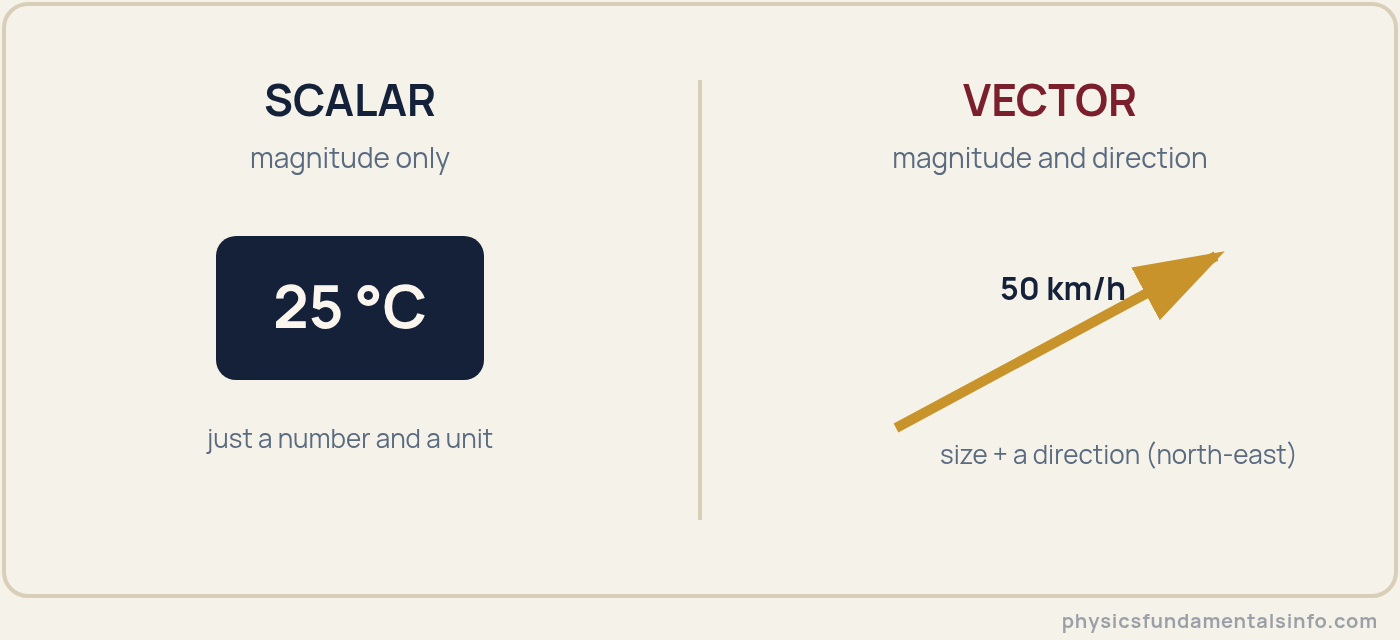
A scalar is a number with a unit; a vector is a number, a unit and an arrow.
Scalar vs Vector Quantities: The Key Difference
The whole distinction comes down to one extra ingredient — direction — and that ingredient changes how the quantities behave when you combine them. Scalars add like ordinary numbers. Vectors do not, and that is where most early mistakes live.
| Property | Scalar quantity | Vector quantity |
|---|---|---|
| What it has | Magnitude (size) only | Magnitude and direction |
| Fully specified by | A number and a unit | A number, a unit and a direction |
| How they combine | Ordinary arithmetic (add the numbers) | Vector addition (tip-to-tail or by components) |
| Meaning of a minus sign | Below a reference value (e.g. −5 °C) | Reverses the direction along an axis |
| Usual notation | Plain symbol: m, t, E | Bold or arrow: v, v⃗, F⃗ |
| Typical examples | Mass, time, temperature, energy, distance, speed | Displacement, velocity, acceleration, force, momentum |
Notice the trickiest row: the minus sign. A negative scalar (−5 °C) just means “five below zero.” A negative on a vector component means “the other way.” Same symbol, two different jobs — and we’ll come back to it under misconceptions.
The Vector Magnitude and Resultant Formulas
Because a vector lives in space, we usually break it into perpendicular pieces called components — how far it reaches along the x-axis and along the y-axis. The magnitude is then recovered with Pythagoras’ theorem.
- |A| — the magnitude (size) of the vector. Its SI unit is whatever the quantity is: metres (m) for displacement, m/s for velocity, newtons (N) for force.
- Ax — the component along the x-axis, in the same unit as |A|.
- Ay — the component along the y-axis, in the same unit as |A|.
To combine two vectors that meet at an angle, you find the resultant — the single vector that does the same job as both together. When the angle between them is θ, the resultant’s magnitude follows from the law of cosines.
- R — magnitude of the resultant vector (same unit as A and B).
- A, B — magnitudes of the two vectors being added (e.g. m, m/s, N).
- θ — the angle between the two vectors, measured in degrees (°) or radians (rad).
The resultant’s direction — the angle φ it makes with vector A — comes from:
One special case is worth memorising. When the two vectors are perpendicular, θ = 90°, cos θ = 0, and the formula collapses to the familiar R = √(A2 + B2). That’s the case in the diagram below.
How Do You Add Vectors?
Forget plain arithmetic for a moment. To add two vectors by hand, you draw the first one, then start the second from the tip of the first — “tip-to-tail.” The resultant is the arrow from the very start to the very end.
Walk it through with a classic example. Move 3 metres east, then 4 metres north. You have not travelled 7 metres from where you started — you’ve ended up √(32 + 42) = 5 metres away, on a slanted line. The journey was 7 m; the displacement is 5 m. That gap is the whole point of vectors.
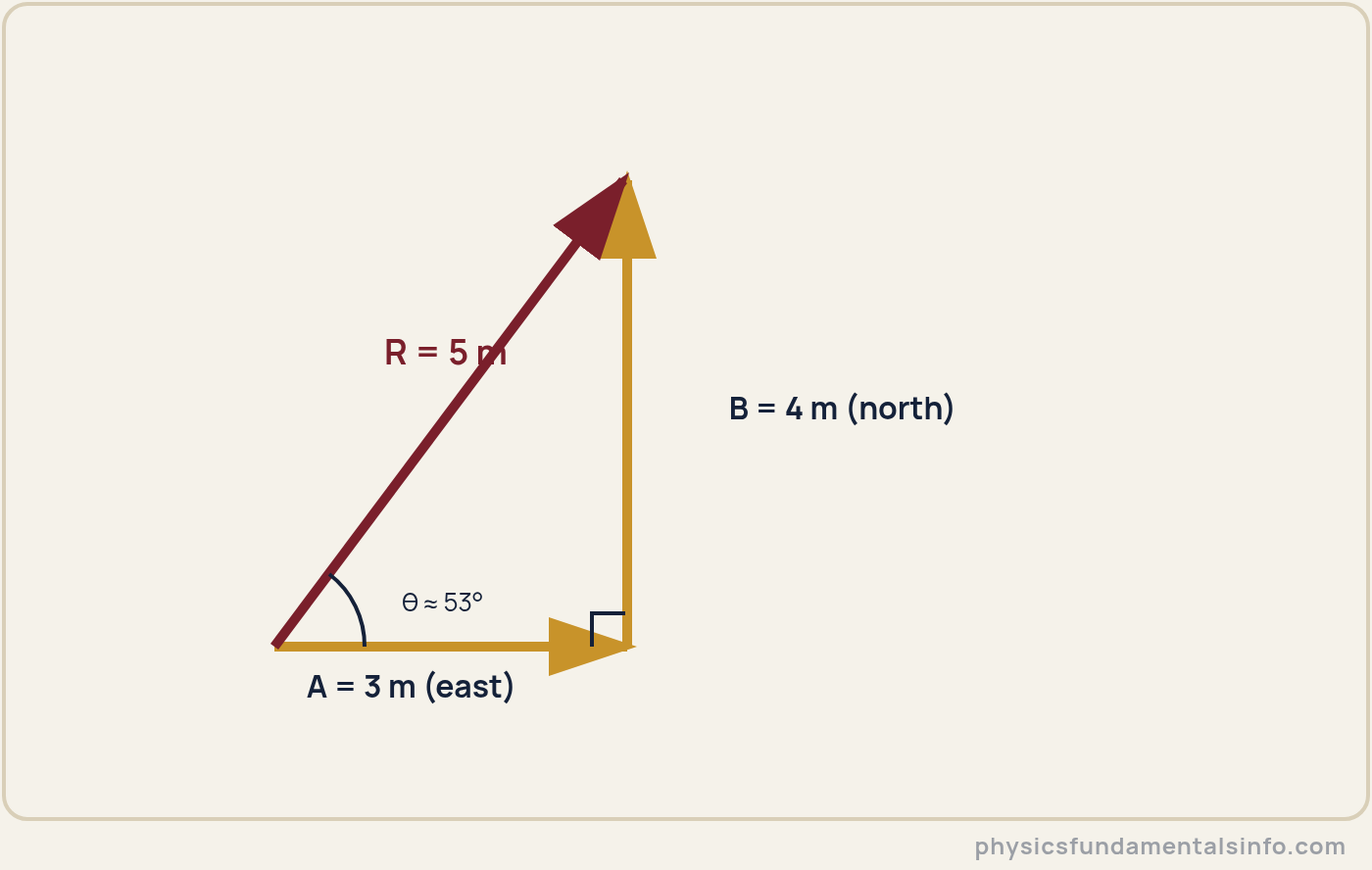
Tip-to-tail addition: 3 m east plus 4 m north gives a 5 m resultant, not 7 m.
For more than two vectors, or for awkward angles, the neat method is by components: add all the x-pieces to get Rx, add all the y-pieces to get Ry, then use Pythagoras and a little trigonometry to recover the size and direction. For a detailed walkthrough of the component method, see NASA’s guide to vector addition. The interactive lab below lets you drag two vectors around and watch the resultant update live.
Real-World Examples of Scalar and Vector Quantities
The fastest way to make this stick is to classify the quantities you already use. Pairs are especially clarifying, because each pair shares a magnitude but only one member carries a direction.
Distance and displacement. Run one lap of a 400 m track and the distance you covered is 400 m, but your displacement is zero — you finished where you began. Distance is a scalar; displacement is a vector. We unpack this fully in our guide to distance vs displacement.
Speed and velocity. A car’s speedometer reads 50 km/h — that’s a scalar, the magnitude only. Its velocity is 50 km/h heading north. Speed is, by definition, the size of the velocity vector. The full contrast is in velocity vs speed.
Mass and weight. Mass (a scalar) is how much matter you contain — 70 kg on Earth or the Moon. Weight is a force, a vector, pulling you toward the planet’s centre; it shrinks on the Moon because gravity is weaker there.
The table below sorts the quantities students meet most often, with a quick reason for each verdict.
| Quantity | Scalar or vector? | Why |
|---|---|---|
| Distance | Scalar | Path length only; no direction |
| Displacement | Vector | Straight line from start to end, with direction |
| Speed | Scalar | A rate with no direction attached |
| Velocity | Vector | Speed plus a direction |
| Mass | Scalar | Amount of matter; same in every direction |
| Weight | Vector | A force directed toward the planet’s centre |
| Temperature | Scalar | A single value; “warm” has no direction |
| Energy | Scalar | Counted in joules; carries no direction |
| Force | Vector | A push or pull in a specific direction |
| Acceleration | Vector | Rate of change of velocity, with direction |
| Momentum | Vector | Mass × velocity, so it inherits direction |

Common Misconceptions About Scalar and Vector Quantities
A handful of slips trip up almost everyone. Clearing them early saves a lot of lost marks later.
“Speed and velocity are the same thing.”
They share a number, but velocity carries a direction and speed does not. Two cars both doing 30 m/s have the same speed; if one heads north and one south, their velocities are different — and that difference matters the instant they interact. In practice, exam questions punish students who write “velocity” when they mean “speed.”
“Vectors add up like ordinary numbers.”
Only when they point the same way. Add 3 and 4 along the same line and you do get 7; add them at right angles and you get 5. Point them in opposite directions and 3 + 4 gives just 1. The angle between vectors decides the answer, every time.
“A minus sign means it’s a vector.”
Not so — scalars can be negative too. A temperature of −8 °C and a change in energy of −20 J are perfectly good negative scalars; the minus just means “below the reference.” On a vector, by contrast, a minus sign reverses the direction.
“Distance and displacement are always equal.”
They match only for motion in a straight line that never doubles back. The moment the path bends or reverses, the distance travelled grows while the displacement can shrink — and for a round trip the displacement is zero even though you’ve clearly moved.
How Scalar and Vector Quantities Relate to Other Physics Concepts
This single distinction quietly organises the rest of mechanics. Once you can spot a vector, the big equations stop being a jumble of letters and start telling a story about direction.
Acceleration is a vector — the rate at which velocity changes — which is why a car going round a bend at constant speed is still accelerating (its direction is changing). See acceleration in physics for the full picture.
Force is a vector, and Newton’s laws are really vector statements: the net force and the resulting acceleration always point the same way. That’s the heart of Newton’s laws of motion.
Momentum (mass × velocity) is a vector too, which is exactly why it is conserved direction by direction in a collision — a subtlety explored in momentum and impulse.
And on the other side of the fence sits energy, a scalar. You can add the kinetic energies of several objects with simple arithmetic, no angles required — see the kinetic energy formula. That contrast — momentum adds as vectors, energy adds as numbers — is one of the most powerful ideas a first-year physicist owns.
Worked Problems
Show Solution
Solution:
Step 1: Apply the test — does it state a direction?
Step 2: (a) 10 kg → mass, no direction → scalar. (b) 5 m/s east → has direction → vector. (c) 30 °C → temperature, no direction → scalar. (d) 20 N downward → force with direction → vector. (e) 8 J → energy, no direction → scalar.
Answer: scalars = (a), (c), (e); vectors = (b), (d).
Show Solution
Solution:
Step 1: Distance is the total path length (a scalar) = 400 m.
Step 2: Displacement is the straight line from start to finish (a vector). Start and finish are the same point, so the straight-line gap is zero.
Answer: distance = 400 m; displacement = 0 m.
Show Solution
Solution:
Step 1: The two legs are perpendicular, so use R = √(A2 + B2) with A = 6 m, B = 8 m.
Step 2: R = √(62 + 82) = √(36 + 64) = √100 = 10 m.
Step 3: Direction north of east: tan φ = 8 / 6 = 1.333, so φ = tan−1(1.333) = 53.1°.
Answer: displacement = 10 m at 53.1° north of east.
Show Solution
Solution:
Step 1: Use the law of cosines: R = √(A2 + B2 + 2AB·cos θ), with A = 4 N, B = 3 N, θ = 60°.
Step 2: R = √(42 + 32 + 2 × 4 × 3 × cos 60°) = √(16 + 9 + 24 × 0.5) = √(16 + 9 + 12).
Step 3: R = √37 = 6.08 N.
Answer: resultant ≈ 6.08 N.
Show Solution
Solution:
Step 1: Resolve the vector: vx = v·cos θ, vy = v·sin θ, with v = 20 m/s and θ = 30°.
Step 2: vx = 20 × cos 30° = 20 × 0.866 = 17.3 m/s.
Step 3: vy = 20 × sin 30° = 20 × 0.5 = 10.0 m/s.
Answer: horizontal = 17.3 m/s; vertical = 10.0 m/s.
Show Solution
Solution:
Step 1: Velocity is a vector, so Δv = v_final − v_initial, done by components. Take east = +x, north = +y: v_initial = (20, 0), v_final = (0, 20).
Step 2: Δv = (0 − 20, 20 − 0) = (−20, 20) m/s.
Step 3: |Δv| = √((−20)2 + 202) = √(400 + 400) = √800 = 28.3 m/s.
Answer: the velocity changed by 28.3 m/s, even though the speed did not change at all.
Show Solution
Solution:
Step 1: The plane’s velocity and the wind are perpendicular, so R = √(A2 + B2), with A = 200 km/h, B = 50 km/h.
Step 2: R = √(2002 + 502) = √(40000 + 2500) = √42500 = 206.2 km/h.
Step 3: Direction north of east: tan φ = 50 / 200 = 0.25, so φ = tan−1(0.25) = 14.0°.
Answer: ground velocity ≈ 206.2 km/h at 14.0° north of east.
Frequently Asked Questions
What is the difference between scalar and vector quantities?
Is speed a scalar or a vector?
Is force a scalar or a vector?
Can a scalar quantity be negative?
Is time a scalar or a vector?
How do you add two vector quantities?
Is distance a scalar and displacement a vector?
For an authoritative overview, NASA Glenn Research Center’s note on scalars and vectors groups common physical quantities into the two categories.