Newton’s second law states that the net force on an object equals its mass times its acceleration (F = ma). The greater the force, the greater the acceleration; the greater the mass, the smaller the acceleration for the same force. Force is measured in newtons (N), where one newton equals one kilogram-metre per second squared.
Give an empty shopping trolley a shove and it darts forward. Load it with a week’s groceries, shove just as hard, and it barely creeps.
You’ve just felt Newton’s second law at work. Force, mass and acceleration are bound together by one tidy equation — and once you see how, you can predict the motion of almost anything, from a kicked football to a rocket clearing the launch pad.
What Is Newton’s Second Law?
Why does a loaded trolley fight back harder than an empty one? Because how much something accelerates depends on two things at once: how hard you push, and how much mass you’re pushing.
Newton’s second law states that the acceleration of an object is directly proportional to the net force acting on it, and inversely proportional to its mass. Double the net force and you double the acceleration. Double the mass and you halve it.
There’s a subtle point hiding in that sentence. Forces don’t keep things moving at a steady speed — they change motion. A constant net force produces a constant acceleration, which means the object keeps speeding up for as long as the force keeps acting.
In short, this is the law that turns a vague “push harder” into a number you can calculate.
The Newton’s Second Law Formula (F = ma)
The law condenses into one of the most useful equations in physics:
Each symbol carries a precise meaning and a fixed SI unit:
- F — the net force on the object, measured in newtons (N).
- m — the mass of the object, measured in kilograms (kg).
- a — the acceleration produced, measured in metres per second squared (m/s2).
So what exactly is a newton? One newton is the force needed to accelerate a one-kilogram mass at one metre per second squared. That’s why 1 N = 1 kg·m/s2 — the unit is simply the equation in disguise.
The same equation answers three different questions, depending on what you already know:
- Find the force: F = ma
- Find the acceleration: a = F / m
- Find the mass: m = F / a
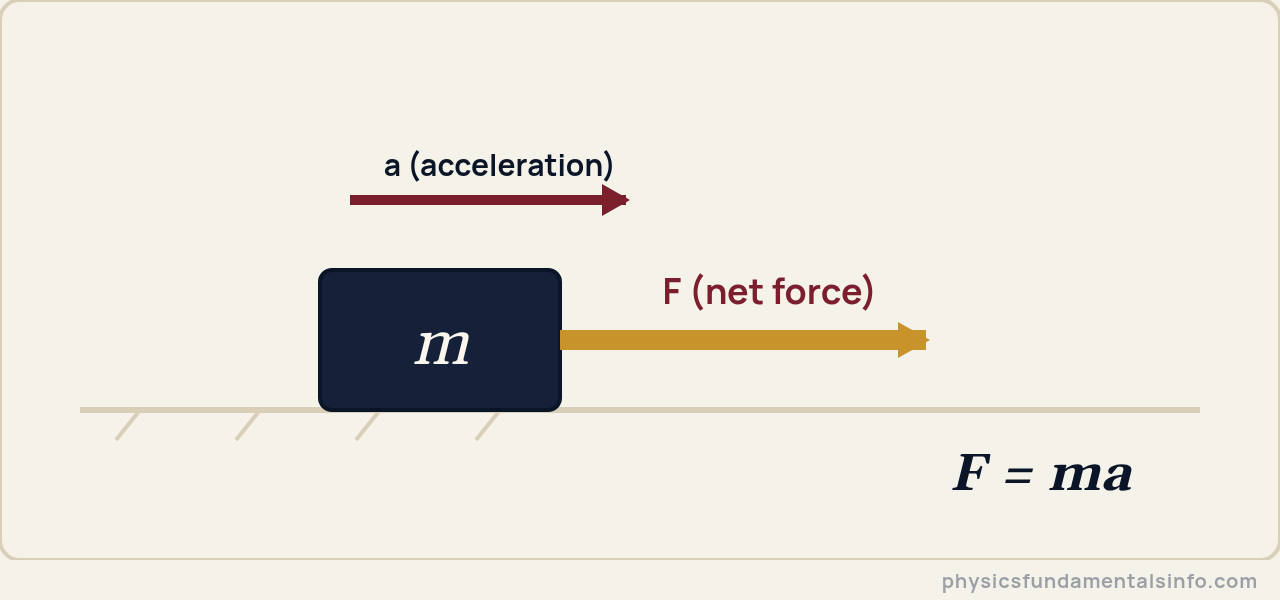
A net force on a mass produces an acceleration in the same direction. Bigger force means bigger acceleration; bigger mass means smaller acceleration.
How Newton’s Second Law Works
The whole law turns on one small word: net. The “F” in F = ma is never just one push — it is the vector sum of every force acting on the object at the same instant.
To find it, add the forces that help the motion, subtract the ones that oppose it, and respect their directions. Whatever is left over — the net force — is what actually drives the acceleration.
Direction matters just as much as size. Acceleration always points the same way as the net force: push a sledge north and it accelerates north, even if it’s still drifting east for a moment.
And when the forces cancel? The net force is zero, so the acceleration is zero. The object doesn’t vanish — it simply carries on doing what it was already doing, whether sitting still or coasting at constant velocity.
Drag the force and mass sliders in the lab below and watch the acceleration vector update live.
Notice what happens when you grow the mass but leave the force alone: the acceleration arrow shrinks. That inverse link is the heart of a = F / m.
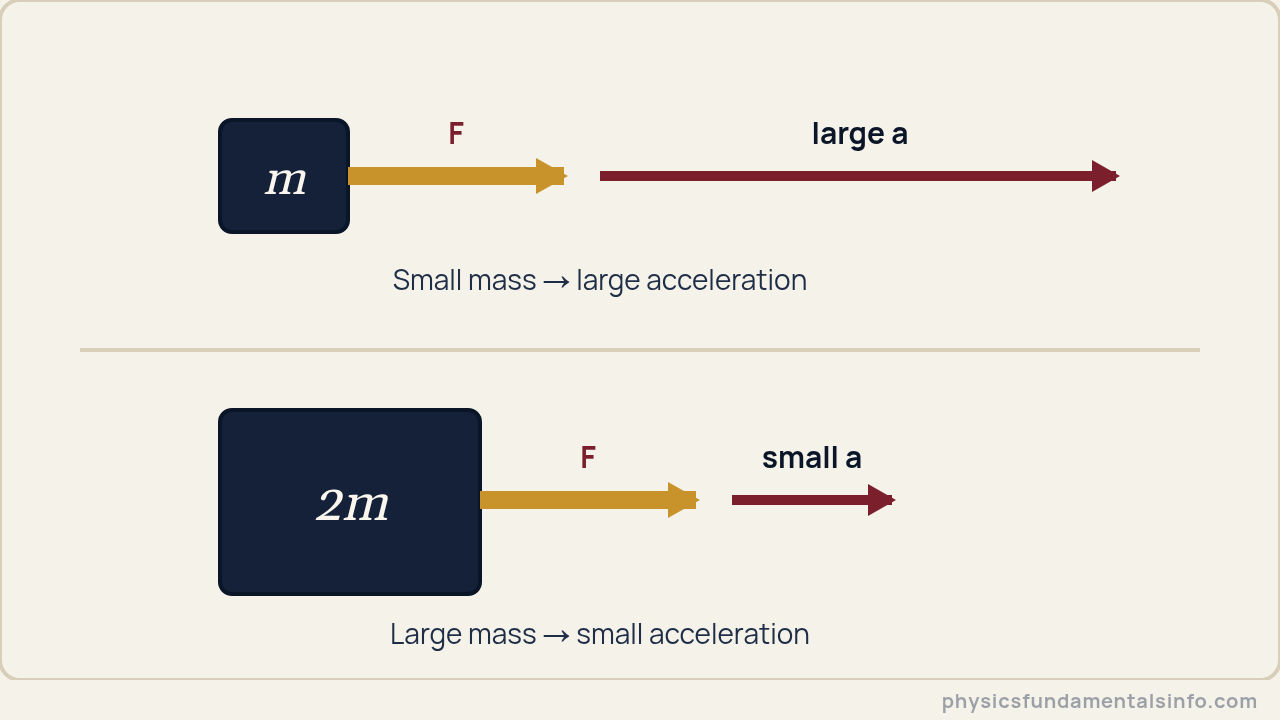
The same net force on a heavier mass gives a smaller acceleration, because a = F / m.
Real-World Examples of Newton’s Second Law
Once you know what to look for, F = ma turns up everywhere.
Kicking a football
A football has little mass, so even a modest force from your boot produces a big acceleration — the ball leaps away. The same kick aimed at a medicine ball would barely shift it.
Braking a car
The brakes apply a force backwards, against the motion, so the acceleration points opposite to the car’s velocity and it slows. Load that same car with passengers and luggage and its mass rises, so the identical braking force produces a gentler deceleration — and a longer stopping distance.
A rocket at lift-off
A rocket’s engines push with enormous, near-constant thrust while it burns through tonnes of fuel. As the mass drops, a = F / m climbs, so the rocket accelerates harder the higher it rises.
Same engine, different load
An empty delivery van pulls away briskly. Fill it with parcels and the engine’s force hasn’t changed, but the mass has — so it accelerates more sluggishly and takes longer to reach speed.
Common Misconceptions About Newton’s Second Law
A handful of stubborn myths trip up almost every beginner.
“You need a force to keep something moving”
Not so. A force is needed to change motion, not to maintain it. An ice-hockey puck on near-frictionless ice glides on with no forward force at all — that’s the first law in action. In everyday life, the only reason you must keep pushing is to cancel friction.
“Heavier objects fall faster”
Drop a hammer and a feather in a vacuum and they hit the ground together. In free fall, every mass accelerates at g ≈ 9.81 m/s2. A heavier object feels more gravitational force, but it also has more inertia to overcome, and the two effects cancel exactly.
“Mass and weight are the same thing”
Mass (in kilograms) is how much matter an object contains; weight (in newtons) is the gravitational force on it, given by W = mg. Your mass is unchanged on the Moon, but your weight there is about one-sixth of your Earth weight.
“If a force is applied, the object must accelerate”
Only the net force causes acceleration. Lean hard on a heavy crate that won’t budge and your push is balanced by friction, so the net force — and the acceleration — is zero, even though you’re clearly applying a force.
Mass vs Weight — and How They Fit Into F = ma
The single most common slip in any F = ma problem is confusing mass with weight. They aren’t the same quantity, they don’t share a unit, and each plays a different role in the equation.
| Property | Mass | Weight |
|---|---|---|
| What it is | Amount of matter in an object | Gravitational force on that matter |
| Symbol | m | W (or Fg) |
| SI unit | kilogram (kg) | newton (N) |
| How it’s found | A fundamental property — measured directly | Calculated: W = mg |
| Changes with location? | No — the same everywhere | Yes — depends on local gravity g |
| On the Moon (g ≈ 1.62 m/s2) | Unchanged | About one-sixth of Earth weight |
| Role in F = ma | It is the m | It is one possible F — the force of gravity |
So weight is just one specific force you might drop into the equation as F — exactly what you do in free-fall and “hanging mass” problems.
How Newton’s Second Law Relates to the Other Laws (and Energy)
Newton’s three laws work as a single toolkit, not three separate facts.
The first law describes what happens when the net force is zero: objects stay at rest or coast in a straight line. It’s really just F = ma with F set to zero.
The second law, F = ma, is the quantitative core — it tells you exactly how much a given net force changes an object’s motion. The third law adds that forces always come in equal, opposite pairs, and it’s those interaction forces you tally up to find the net force in the first place. Georgia State University’s HyperPhysics offers a concise overview of all three together at HyperPhysics: Newton’s Laws.
Force is also the gateway to energy. When a net force acts over a distance it does work, and that work changes an object’s kinetic energy — which is why a bigger, sustained force builds more speed. You can follow that thread in our guide to energy in physics.
Worked Problems
Show Solution
Solution:
Step 1: Apply Newton’s second law: F = ma.
Step 2: Substitute the values: F = 1500 kg × 3 m/s2.
Step 3: Multiply: F = 4500 kg·m/s2.
Answer: F = 4500 N (4.5 kN).
Show Solution
Solution:
Step 1: Rearrange F = ma to a = F / m.
Step 2: Substitute: a = 12 N ÷ 4.0 kg.
Step 3: Divide: a = 3.0 m/s2.
Answer: a = 3.0 m/s2, in the direction of the force.
Show Solution
Solution:
Step 1: Rearrange F = ma to m = F / a.
Step 2: Substitute: m = 50 N ÷ 2.5 m/s2.
Step 3: Divide: m = 20 kg.
Answer: m = 20 kg.
Show Solution
Solution:
Step 1: Weight is the force of gravity: W = mg.
Step 2: Substitute: W = 9.0 kg × 9.81 m/s2.
Step 3: Multiply: W = 88.29 N.
Answer: W ≈ 88 N (2 significant figures).
Show Solution
Solution:
Step 1: Find the net force: F = 30 N − 12 N = 18 N to the right.
Step 2: Apply a = F / m: a = 18 N ÷ 6.0 kg.
Step 3: Divide: a = 3.0 m/s2.
Answer: a = 3.0 m/s2 to the right.
Show Solution
Solution:
Step 1: Find the net force: F = 25 N − 25 N = 0 N (the forces balance).
Step 2: Apply a = F / m: a = 0 N ÷ 40 kg.
Step 3: Divide: a = 0 m/s2.
Answer: a = 0 m/s2 — the cart’s velocity does not change, even though two forces are acting.
Show Solution
Solution:
Step 1: Find the acceleration first: a = Δv ÷ Δt = (27 − 0) m/s ÷ 9.0 s = 3.0 m/s2.
Step 2: Apply Newton’s second law: F = ma = 1200 kg × 3.0 m/s2.
Step 3: Multiply: F = 3600 kg·m/s2.
Answer: F = 3600 N (3.6 kN).
Frequently Asked Questions
What does F=ma mean?
What are the units of force?
How does mass affect acceleration?
What is net force?
Can acceleration be zero when a force is applied?
Is weight the same as mass?
Why is Newton's second law important?
Further Reading
Keen to go deeper? Forces and motion lead straight into the idea of energy in physics, where you’ll see how a sustained force builds an object’s kinetic energy. Master F = ma and the rest of mechanics starts to click into place.