Waves & Optics
Refractive Index (n = c/v): Formula & Table
The refractive index n = c/v tells you how much a material slows light. Get the full table of 15 values from air to diamond, plus worked examples and an interactive lab.
15 min readEvery piece we've published, sorted by date. Each ends with worked problems and a FAQ.
The refractive index n = c/v tells you how much a material slows light. Get the full table of 15 values from air to diamond, plus worked examples and an interactive lab.
15 min read
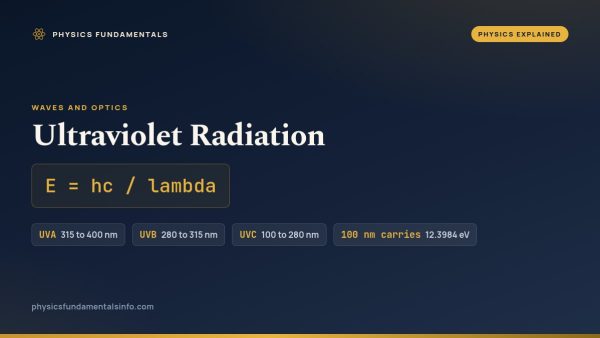
The photon energy formula E = hf links a photon's energy to the frequency of its light. See both forms of the equation, real examples from radio to gamma rays, and eight fully worked problems.
13 min read
Center of mass is the mass-weighted average position of a system — the point where all its mass acts as one. Learn the formula, six worked examples, and how to find it.
13 min read
E=mc² explained in plain English: what Einstein's famous formula means, why mass and energy are the same thing, and worked examples showing the huge energy locked inside even a single gram of matter.
12 min read
Your weight changes from world to world even though your mass never does. Learn the W = mg formula and see what you'd weigh on the Moon, Mars, Jupiter and beyond.
13 min read
A pendulum's period depends on just two things: length and gravity — mass never matters. Learn the T = 2π sqrt(L/g) formula, what changes on the Moon, and how to solve exam problems step by step.
14 min read
Momentum is conserved in every collision, but kinetic energy is not. That single test separates an elastic collision from an inelastic one, and the coefficient of restitution turns it into a dial you can measure.
21 min read
Inclined plane physics splits an object's weight into mg sinθ down the slope and mg cosθ into the surface. Here is the 5-step method, plus 8 worked ramp problems.
20 min read
Free fall is motion under gravity alone. Learn the h = 0.5gt² and v = gt formulas, why every object falls at the same rate, and how to solve free-fall problems step by step.
18 min read
A complete physics formula cheat sheet: every core equation grouped into ten branches, with each symbol and its SI unit defined, plus worked examples and the constants that go with them.
24 min read
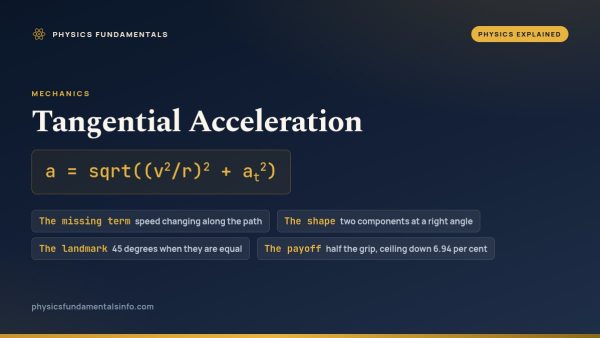
Circular motion physics explains why an object moving in a circle at constant speed is still accelerating: its direction changes every instant. This guide covers the a = v²/r formula, five real examples, four common misconceptions and seven worked problems.
14 min read
AC reverses direction 100 times a second; DC flows steadily one way. Here are the 7 key differences, the RMS formula behind the 230 V on your plug, and why the grid runs on AC while everything plugged into it runs on DC.
18 min read