Magnetic flux is the total magnetic field passing through a surface: the flux density multiplied by the area and by the cosine of the angle between the field and the surface’s normal. Its SI unit is the weber, and one weber is one tesla square metre. Turn the surface edge-on and the flux is zero.
Stand a bicycle wheel in a doorway and ask how much wind blows through it. Square to the gust, the whole wheel catches it; turn the rim into the wind and nothing goes through at all. Magnetic flux asks that question of a magnetic field, and the answer is a number in webers.
The formula is short. All of the difficulty sits in one letter: θ is not the angle between the field and the surface, it is the angle between the field and the line sticking straight out of the surface. Confusing those two is the single commonest way a flux calculation goes wrong, and this page works both answers out so you can see the size of the gap.
What Is Magnetic Flux, and What Does the Weber Measure?
Magnetic flux is a count of how much magnetic field threads a given surface, and the weber is the unit that count comes in: one weber is one tesla of flux density spread over one square metre.
Picture the field as a bundle of parallel lines running through space. The flux through a loop is, loosely, how many of those lines pass through the hole. Loosely, because lines are a drawing convention rather than countable objects — but the intuition is exactly right, and it is why a bigger loop, a stronger field or a squarer orientation all give you more flux.
Two quantities are easy to run together here. B is the flux density, measured in tesla, and it describes the field at a single point; our guide to the magnetic field covers where B comes from and what it does to a moving charge. Φ is the flux, measured in webers, and it is a total over a whole surface.
Why does anyone want the number at all? Because a flux that changes is what drives a current round a circuit — that is Faraday’s law, and the Faraday’s law formula owns that relation in full. Nothing on this page changes with time, so no voltage is computed here; the flux is the ingredient, not the dish.
The weber, three ways
- 1 Wb = 1 T m2 — a flux density of one tesla spread over one square metre. This is the form you use for every calculation on this page.
- 1 T = 1 Wb/m2 — the same identity read backwards, which is why B is called a flux density.
- 1 Wb = 1 V s — a unit identity that comes from Faraday’s law. It is true, and deriving it is that page’s job, not this one’s.
School-sized loops in school-sized fields land in the milliweber range, so expect answers with “m” in front of the unit. A microweber or two is perfectly ordinary for a small coil in a weak field.
The Magnetic Flux Formula and Every Symbol in It
For a flat surface in a uniform field, the whole of magnetic flux is one line of algebra.
- Φ — the magnetic flux through the surface, in webers (Wb).
- B — the magnetic flux density, in tesla (T). One tesla is enormous as fields go; the magnet on a fridge door manages a few millitesla.
- A — the area of the flat surface, in square metres (m2). Square centimetres must be converted first.
- θ — the angle between the field and the normal to the surface, in degrees or radians. Zero means the surface faces the field square on.
There is no physical constant in that equation, which is unusual and rather pleasant: every answer is exact arithmetic on your own three numbers, with nothing to look up. If you would rather have the arithmetic done and the rearrangements handled for you, our Magnetic Flux Calculator solves the same relation for the flux, the flux density, the area or the angle, and prints the working.
Why the angle is measured from the normal
The normal is the line sticking straight out of the surface, at right angles to it. Measure θ from there and the cosine does what you want: cos 0 = 1 when the loop faces the field square on, and cos 90 = 0 when it is edge-on and nothing gets through.
Measure the angle from the loop’s own plane instead and you have the complement. A loop square across the field reads 90 degrees rather than 0, the sine appears where the cosine belongs, and every answer comes out wrong by a factor you cannot spot from the units. Worked problem 2 below does it both ways on the same loop.
Sweeping the angle by hand is the fastest way to make the cosine stop feeling like a fudge factor. Hold the field and the loop fixed in the simulator below, drag the tilt from 0 through 90 and on to 180, and watch the flux fall to nothing and come back the other way. The same sim has its own page at the magnetic flux simulator if you would rather open it full width.
How to Work Out a Magnetic Flux in Three Steps
Three steps, in this order, and the units are the only place it ever goes wrong.
- Get the area into square metres. Square centimetres divide by 10,000, not by 100 — so 120 cm2 is 0.0120 m2. For a circle, work out πr2 first, with r in metres.
- Find the angle from the normal. If the problem gives you the tilt from the loop’s plane, subtract it from 90 before you do anything else. Draw the normal if you are not sure.
- Multiply, then name the sense. Φ = B A cos θ gives you webers. A negative answer is not an error — it means the field is threading the surface the other way relative to the normal you chose.
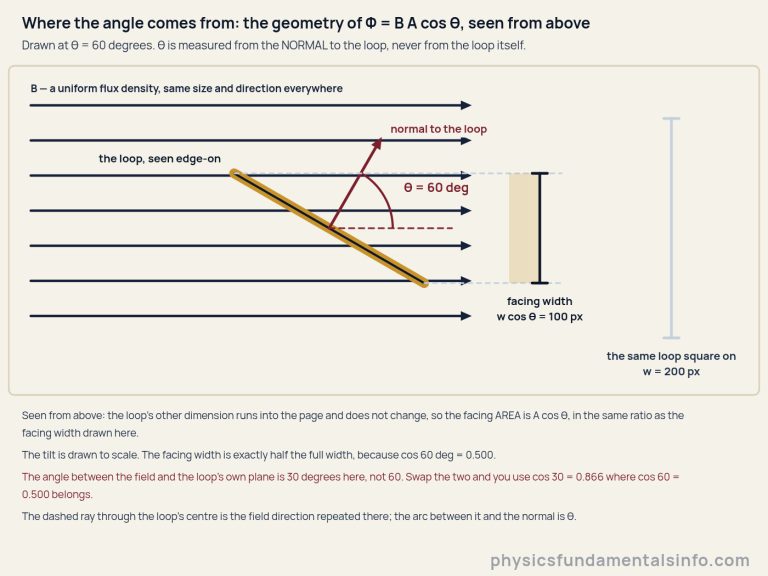
One sanity check costs nothing and catches most slips. The biggest flux this loop could possibly carry is B A, with the loop square on; if your answer is larger than that, the cosine has been applied upside down. The solenoid is the usual source of a genuinely uniform field to feed into step three, because the field along the inside of a long winding is very nearly constant.
Flux or Flux Density? The Difference That Trips Everyone Up
Flux density is a field at a point; flux is a total through a surface. The tesla and the weber are not two names for the same measurement, and 1 T = 1 Wb/m2 is the bridge between them.
Here is the test that settles it. Take the same 1.2 mWb and push it through a loop of 30 cm2, then through a loop of 120 cm2. The flux is identical in both cases, by construction.
The density is not. It comes out at 0.400 T for the small loop and 0.100 T for the large one — a quarter of the area, four times the density. Worked problem 6 does the arithmetic.
Which one a problem wants is usually obvious from the unit it asks for, and occasionally obvious from nothing at all. If a question says “the field is 0.30 T” it has handed you a density; if it says “the flux through the coil is 1.8 mWb” it has handed you a total. Our magnetic field calculator works out the flux density inside a solenoid from its winding and current, which is frequently the number you then bring to this formula.
One more distinction worth stating plainly. A coil of N turns does not change the flux through the hole — winding the wire round twice does not make more field pass through it. Multiply that flux by N and you have the quantity the Faraday’s law page calls the flux linkage, which is used for a different purpose. The flux itself belongs to the surface, not to the wire.
What Happens When You Tilt the Loop Past 90 Degrees?
Past 90 degrees the flux changes sign, because the field now arrives at the back of the surface rather than the front; the cosine goes negative and the flux follows it.
That sign is a bookkeeping choice, not a fact about the field. Choosing a normal is choosing which face of the loop you are calling the front. Flip your choice and every sign in your working flips with it — which is why two textbooks can disagree about a sign and both be right.
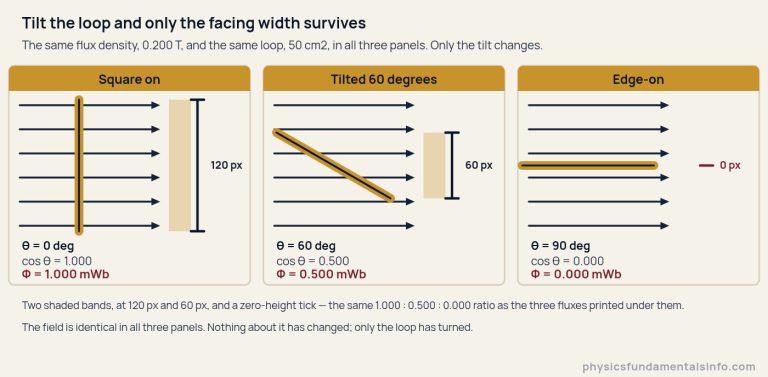
Turn the loop right over, to 180 degrees, and you recover the same size of flux with the opposite sign. At exactly 90 degrees the field runs along the surface instead of through it, nothing threads the loop, and the flux is zero while the flux density is completely unchanged. That last pair is the clearest proof that a flux and a flux density are different animals.
Here is the whole sweep, at the fixed flux density and loop area the simulator above opens with.
| Angle from the normal | Cosine | Area facing the field | Flux | Which way it threads |
|---|---|---|---|---|
| 0 deg | 1.000 | 50.00 cm2 | 1.000 mWb | out of the loop |
| 30 deg | 0.866 | 43.30 cm2 | 0.866 mWb | out of the loop |
| 45 deg | 0.707 | 35.36 cm2 | 0.707 mWb | out of the loop |
| 60 deg | 0.500 | 25.00 cm2 | 0.500 mWb | out of the loop |
| 90 deg | 0.000 | 0.00 cm2 | 0.000 mWb | none |
| 120 deg | -0.500 | 25.00 cm2 | -0.500 mWb | into the loop |
| 150 deg | -0.866 | 43.30 cm2 | -0.866 mWb | into the loop |
| 180 deg | -1.000 | 50.00 cm2 | -1.000 mWb | into the loop |
Every row is B A cos θ with B = 0.200 T and A = 50 cm2, so B A = 1.000 mWb and the flux column is simply that number times the cosine. The “area facing the field” column is the size of A cos θ, which is why it reads the same at 60 and at 120 degrees while the flux does not.
Why Is the Net Magnetic Flux Through a Closed Surface Zero?
The net flux out of any closed surface is zero because magnetic field lines never begin or end: every line that enters a closed box leaves it again somewhere else.
Electric charges do not behave like this. Put a positive charge inside a closed box and electric field lines stream outwards through the walls, because the charge is where they start; our guide to the electric field covers that case. Magnetism has no equivalent — no isolated north pole has ever been found — so magnetic field lines close on themselves and the books always balance.
This is Gauss’s law for magnetism, and it is one of Maxwell’s four equations. In words: the total magnetic flux out of any closed surface is exactly zero, always, whatever is inside it. Worked problem 5 checks it on a cube, face by face, and the sum comes to nothing because the two end faces cancel and the four sides contribute zero each.
It also explains something you may have noticed about bar magnets. Cut one in half hoping to isolate a pole and you get two shorter magnets, each with a north and a south. The field lines have nowhere to start from.
Where Magnetic Flux Is Actually Measured
Flux earns its keep wherever a surface has to carry a field rather than merely sit in one.
Transformer and motor cores
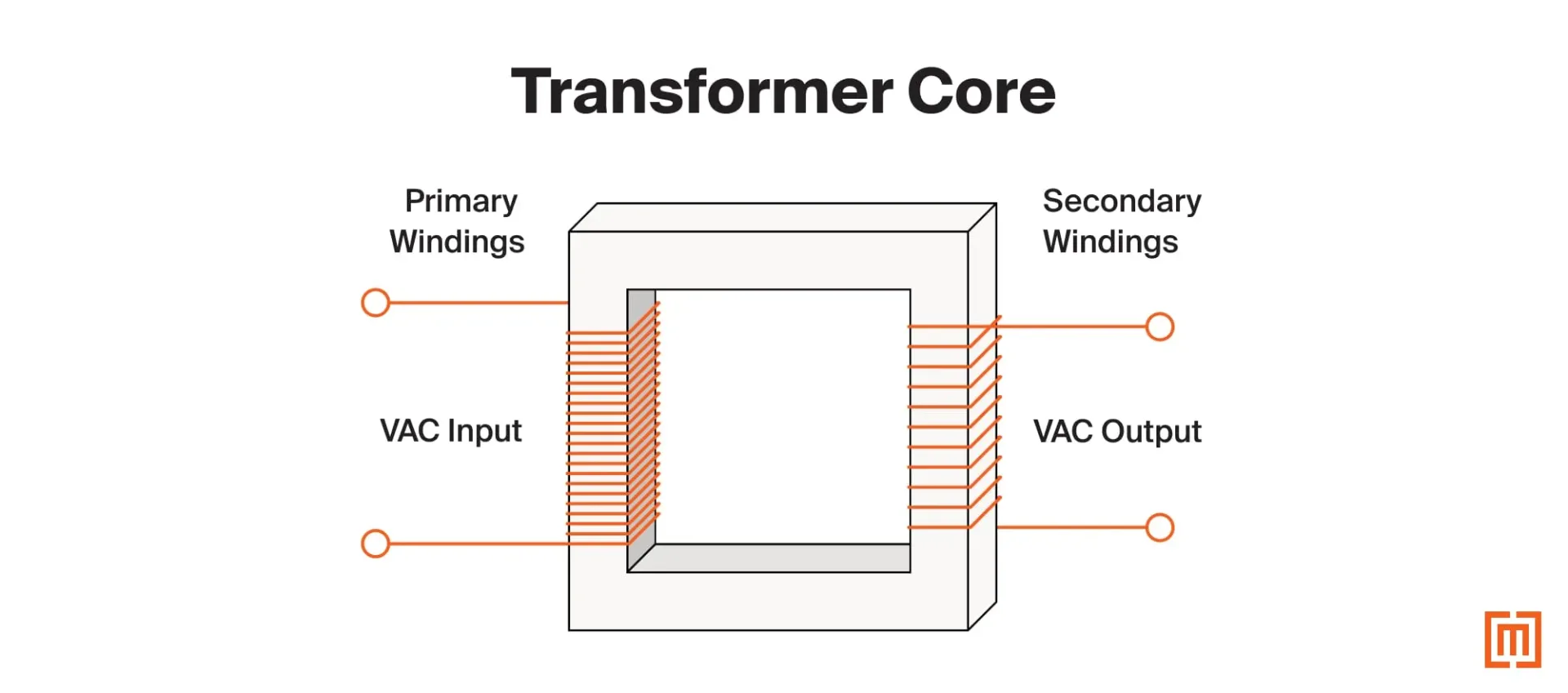
Iron goes into these machines to give the field an easy route, and the designer has to keep two separate figures in view at once. One is the total flux the magnetic circuit carries, quoted in webers. The other is how hard that flux is being pushed through each square metre of steel, quoted in tesla, because beyond a certain density the iron saturates and stops helping.
Dividing the first by the cross-sectional area gives the second, which is this page’s arithmetic applied to a stack of laminations. The limit itself shifts with the alloy, the lamination thickness and the temperature, so no single number belongs here — verify before use.
MRI scanners
An MRI magnet is specified by its flux density, because that is what sets the resonance. The flux matters for everything around it: the force on a steel trolley, the screening the room needs, and the signal picked up by the receiver coils, each of which is a surface with a field through it.
Geomagnetic surveys
A survey instrument reads one component of the Earth’s field, and tilting it away from the field direction costs exactly the cosine of the misalignment. Run the tilted-loop arithmetic backwards and that tilt drops out of an arccosine, which is what worked problem 4 does.
Checking your own answer
Two quick tests catch most wrong answers without recalculating anything. Compare your flux against the B A ceiling from step three, and treat anything above it as a cosine applied upside down. Then read the unit: webers measure a total and tesla measure a density, so a flux offered in tesla went wrong well before the arithmetic did.
Common Mistakes When Calculating Magnetic Flux
1. Taking the angle from the loop instead of the normal
This is the big one, and at the 55-degree tilt of worked problem 2 it changes the answer by about 43 per cent. A problem that says “the loop is tilted at 55 degrees” is ambiguous unless it says to what. If the 55 degrees is measured from the plane of the loop, the normal is at 35 degrees and the cosine is 0.8192, not 0.5736. Read the question twice and draw the normal.
2. Leaving the area in square centimetres
One square metre is 10,000 square centimetres, not 100 — the conversion squares. Forget it and your flux is out by four orders of magnitude, which at least makes the mistake easy to spot once you know the milliweber range to expect.
3. Treating a negative flux as an error
A negative flux is a direction, not a mistake. It says the field threads the surface opposite to the normal you chose. The only genuine error here is quoting a sign without ever saying which way the normal points.
4. Expecting a flux to tell you about a current
A steady flux induces nothing at all. It takes a changing flux to drive a current, and which way that current runs is Lenz’s law, while the size of the voltage belongs to electromagnetic induction. Nothing on this page changes with time, so nothing on this page produces a volt.