Ultraviolet radiation is the 100 to 400 nm region of the electromagnetic spectrum, invisible light just beyond violet, whose photons carry between 3.0996 and 12.3984 eV. Convention divides it into three bands: UVA at 315 to 400 nm, UVB at 280 to 315 nm and UVC at 100 to 280 nm. Photon energy is hc divided by wavelength.
Stand outside on a clear day and something is landing on you that you cannot see and cannot feel. You find out about it hours later, when the back of your neck starts to sting.
The strange part is how small the step is. At 400 nm the longest ultraviolet and the deepest violet the eye can catch carry exactly the same 3.0996 eV, yet everything shorter than that line gets filed as radiation and everything longer as light. This page follows the physics across the line: the three bands, what each photon carries, which of them reaches the ground, and where the tidy picture stops being true.
What Is Ultraviolet Radiation?
Ultraviolet radiation is electromagnetic radiation with a wavelength between 100 and 400 nm: shorter than violet light, longer than X-rays, and invisible because the eye carries no receptor that responds below about 400 nm.
The name describes a position, not a property. Violet is the shortest wavelength a person can register, and ultra-violet is whatever lies past it. Nothing about the wave itself changes at that point — it is the same oscillating electric and magnetic field that carries a radio broadcast, differing only in wavelength.
Wavelength is what decides how much energy each photon delivers, and that single fact drives everything else on this page. Longer waves hand over less per photon; shorter waves hand over more. Our guide to the electromagnetic spectrum lays out the full run of bands that ultraviolet sits inside.
What earns ultraviolet its own page is where it sits. It occupies the stretch where photon energies become big enough to rearrange molecules but stay below the energies that strip electrons off atoms outright — a narrow strip, and almost every practical fact about UV follows from it.
One habit is worth picking up straight away. If a lamp, a warning label or a study says only “UV”, the description is incomplete: a 365 nm black light and a 254 nm germicidal tube are both ultraviolet, and they do entirely different things to whatever is in front of them.
The Ultraviolet Radiation Formula: Energy from Wavelength
A photon’s energy is the Planck constant multiplied by the speed of light, divided by its wavelength.
- E — the photon energy, in joules (J). Quoted in electronvolts (eV) on this page, where 1 eV = 1.602176634 × 10⁻¹⁹ J.
- h — the Planck constant, 6.62607015 × 10⁻³⁴ J·s, exact by definition since 2019.
- c — the speed of light in vacuum, 299,792,458 m/s, also exact by definition.
- λ — the wavelength, in metres (m). Ultraviolet is quoted in nanometres by universal habit, and 1 nm = 10−9 m.
Nobody works it in those units. Fold the constants together, divide through by the charge on an electron and measure the wavelength in nanometres, and the whole thing collapses to one division: the energy in electronvolts is 1239.842 divided by the wavelength in nanometres. If you would rather not divide, our ultraviolet radiation calculator takes a wavelength, an energy or a frequency and returns the other two with the band named.
Why a photon’s energy should depend on its frequency at all is a separate question, and it is answered in our photon energy formula guide. Here the relation is a tool. It gets used, not re-derived.
Worth committing to memory in place of the formula: multiply any photon’s energy in electronvolts by its wavelength in nanometres and you get 1239.842, every single time. It turns checking somebody else’s figures into a two-second job.
| Wavelength (nm) | Photon energy (eV) | Photon energy (J) | Frequency (Hz) | Band | Energy (kJ/mol) |
|---|---|---|---|---|---|
| 100 | 12.3984 | 1.9864 × 10⁻¹⁸ | 2.9979 × 10¹⁵ | UVC | 1196.3 |
| 180 | 6.8880 | 1.1036 × 10⁻¹⁸ | 1.6655 × 10¹⁵ | UVC | 664.6 |
| 200 | 6.1992 | 9.9322 × 10⁻¹⁹ | 1.4990 × 10¹⁵ | UVC | 598.1 |
| 254 | 4.8813 | 7.8207 × 10⁻¹⁹ | 1.1803 × 10¹⁵ | UVC | 471.0 |
| 280 | 4.4280 | 7.0944 × 10⁻¹⁹ | 1.0707 × 10¹⁵ | UVB | 427.2 |
| 300 | 4.1328 | 6.6215 × 10⁻¹⁹ | 9.9931 × 10¹⁴ | UVB | 398.8 |
| 315 | 3.9360 | 6.3062 × 10⁻¹⁹ | 9.5172 × 10¹⁴ | UVA | 379.8 |
| 365 | 3.3968 | 5.4423 × 10⁻¹⁹ | 8.2135 × 10¹⁴ | UVA | 327.7 |
| 400 | 3.0996 | 4.9661 × 10⁻¹⁹ | 7.4948 × 10¹⁴ | UVA | 299.1 |
| 550 | 2.2543 | 3.6117 × 10⁻¹⁹ | 5.4508 × 10¹⁴ | Not UV (green light) | 217.5 |
| 700 | 1.7712 | 2.8378 × 10⁻¹⁹ | 4.2827 × 10¹⁴ | Not UV (red light) | 170.9 |
The last two rows are green and red light, and they are in the table deliberately. They are the comparison the rest of this page keeps returning to. The Band column uses the three divisions set out in the next section.
Read the energy column downwards and the shape of the relation is unmistakable. The 100 nm end of ultraviolet carries exactly four times the energy of the 400 nm end, 12.3984 eV against 3.0996 eV, because a quarter of the wavelength means four times the energy.
The lab below puts that single division on a slider. Drag one wavelength between 100 and 400 nm and watch the photon energy, the band name and the effect on a chosen metal move together.
UVA, UVB and UVC: Who Drew the Lines, and Where
The World Health Organization splits the ultraviolet range into UVA at 315 to 400 nm, UVB at 280 to 315 nm and UVC at 100 to 280 nm.
Those three numbers are an agreement, not a discovery. Nothing measurable changes as a wave crosses 315.0 nm; the atmospheric absorption and the biological response that the boundaries stand for both vary smoothly through the range, and another committee could reasonably have put the lines a few nanometres away. They are vocabulary — extremely useful vocabulary, but vocabulary.
Any convention still needs a rule for its own edges, or two sources will file 280 nm differently. On this page, and in the lab and calculator built alongside it, each band owns its short edge and not its long one. So 280 nm counts as UVB, 315 nm counts as UVA, and 400 nm is the last wavelength that is ultraviolet at all.
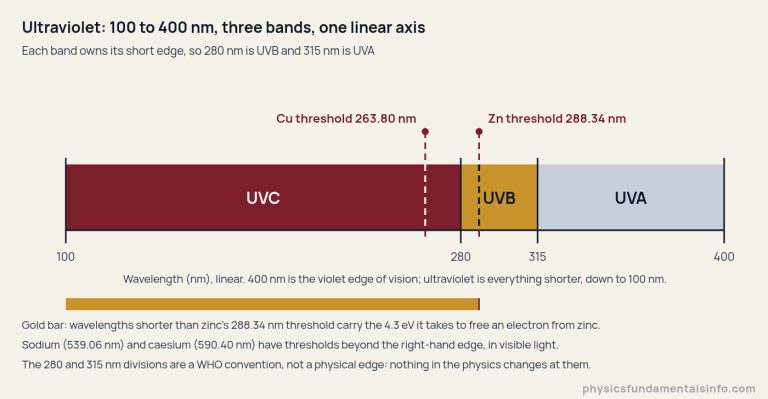
Two extra markers sit on that axis, and they belong to a section further down: they are the wavelengths at which copper and zinc give up an electron. They are drawn here because the whole value of a single linear axis is that everything has to live on it.
Draw the bands to scale and one thing jumps out. UVB is a sliver, 35 nm wide, squeezed between a UVC band of 180 nm and a UVA band of 85 nm — yet that sliver does most of the biological work at ground level.
In photon energy the gap is wider still, not narrower. UVC covers 7.9704 eV, from 4.4280 up to 12.3984; UVB covers 0.4920 eV and UVA 0.8364 eV. So UVC is a little over five times UVB’s width in nanometres and 16.2 times its width in electronvolts — equal steps in wavelength are never equal steps in energy, because one goes as the reciprocal of the other.
Which Types of UV Reach the Ground?
UVA reaches the surface, most UVB does not, and UVC never does at all, because the atmosphere removes the shortest wavelengths first and removes them most completely.
WHO states the split plainly. UVA accounts for approximately 95 per cent of the ultraviolet arriving at the Earth’s surface; most solar UVB is filtered out on the way down; and UVC is filtered completely, so none of it reaches the ground. Four gases in the air above you do the absorbing: ozone, water vapour, oxygen and carbon dioxide.
Line that up against the band edges and the pattern is exactly the one the energy column predicts. The more energy a photon carries, the more readily something in the atmosphere absorbs it — which is a large part of why the bands were drawn where they were in the first place.
There is a practical consequence hiding in it. The germicidal wavelength every microbiology laboratory relies on, 254 nm, is UVC, so no amount of standing in sunlight will ever supply it. That wavelength has to be manufactured, and a lamp that makes it is doing something sunlight at ground level simply cannot.
Ozone is the piece of this that moves. Because it controls how much UVB gets through, the ozone column overhead is watched continuously from orbit: NASA’s page on ultraviolet waves describes the Ozone Monitoring Instrument aboard the Aura satellite, which maps atmospheric ozone in Dobson Units so the ultraviolet arriving at the surface can be estimated.

Why Ultraviolet Does Things Visible Light Cannot
The effects that matter have a threshold rather than a slope: below a certain energy per photon nothing happens at all, no matter how bright the source, and ultraviolet photons clear thresholds that visible photons cannot reach.
Metals make the cleanest demonstration, and this site already publishes the numbers it needs. Prising an electron out of a metal surface costs at least that surface’s work function, and a photon either brings that much on its own or the electron stays put. Four work functions, four threshold wavelengths, calculated from the same 1239.842:
| Metal | Work function (eV) | Threshold wavelength (nm) | Band that threshold falls in |
|---|---|---|---|
| Caesium (Cs) | 2.1 | 590.40 | Not UV — orange light |
| Sodium (Na) | 2.3 | 539.06 | Not UV — green light |
| Zinc (Zn) | 4.3 | 288.34 | UVB |
| Copper (Cu) | 4.7 | 263.80 | UVC |
Now set the most energetic visible photon there is against that column. At 400 nm it carries 3.0996 eV. Caesium at 2.1 eV and sodium at 2.3 eV sit below that, so ordinary visible light frees electrons from both of them.
Zinc at 4.3 eV and copper at 4.7 eV sit above it. No visible photon — no colour, no lamp, no brightness, ever — will free a single electron from either. Zinc needs 288.34 nm or shorter, which is UVB; copper needs 263.80 nm or shorter, which is UVC.
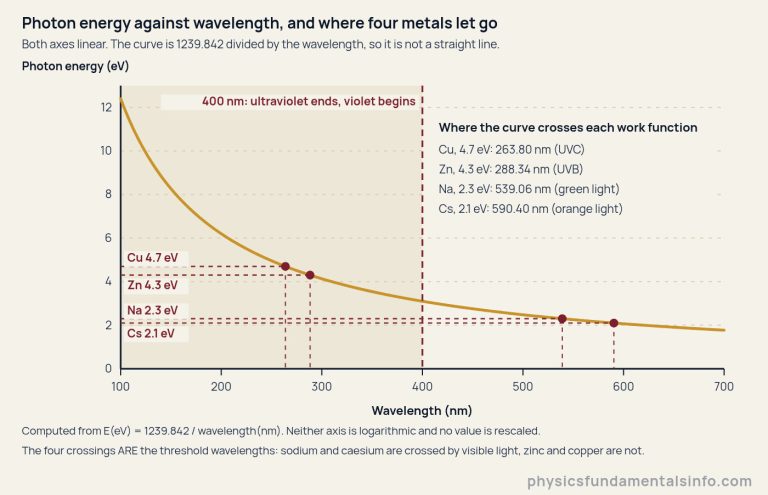
The surprise is in the top of the table rather than the bottom. Caesium lets go at 590.40 nm and sodium at 539.06 nm, both of them comfortably inside visible light, so the photoelectric effect is not an ultraviolet phenomenon in general. It becomes one the moment the metal is an ordinary one, which is why the classic experiment is taught with a UV lamp; the experiment itself belongs to our photoelectric effect guide.
That is the honest version of “ultraviolet is more damaging”. Not stronger, not hotter, not more abundant — simply above a bar that visible light never gets over.
Chemical bonds work the same way. Ultraviolet photons carry enough energy to break many of them where visible photons generally do not, which is why sunlight yellows plastic and perishes rubber while a bright reading lamp leaves both alone. WHO attributes delayed tanning, burning, skin ageing and a significant contribution to skin cancer to UVB specifically.
Where Ultraviolet Radiation Turns Up in Real Life
Five places, and the wavelength matters in every one of them.
Sunlight on skin
Roughly nineteen parts in twenty of the ultraviolet reaching you outdoors is UVA, on WHO’s figure of approximately 95 per cent. WHO describes UVB as unable to penetrate beyond the superficial skin layers while being very biologically active there, and UVA as reaching the deeper layers and producing the immediate tanning effect.
Black lights and fluorescence
A black light emits at 365 nm, well inside UVA, and what you actually see is never the ultraviolet. Detergent residues, tonic water, scorpions and the security threads in a banknote all absorb those photons and re-emit the energy at longer, visible wavelengths. The glow is the object’s answer, not the lamp’s output.
Germicidal lamps
A low-pressure mercury tube emits strongly at 254 nm, deep in UVC, and 254 nm photons carry 4.8813 eV — enough to wreck the chemistry that a micro-organism needs in order to copy itself. Those lamps also explain why UVC is handled so carefully: it is the one band sunlight at ground level never delivers, so nobody has any everyday experience of it to calibrate against.
Ultraviolet astronomy
The hottest stars radiate most strongly at wavelengths the atmosphere refuses to pass, which is why ultraviolet astronomy is done from orbit rather than from a mountain top. A telescope on the ground is looking through the same filter that protects the biosphere.
Checking documents and materials
Passports, banknotes and event wristbands carry inks that are invisible under room lighting and obvious under 365 nm. Forensic and conservation work uses the same trick, because many organic residues fluoresce at wavelengths their surroundings do not.
Common Misconceptions About Ultraviolet Radiation
“Ultraviolet is ionising radiation”
Not at the bar that phrase is usually set against. Stripping the electron from a hydrogen atom takes 13.6 eV, which is a photon at 91.16 nm — shorter than the 100 nm point where ultraviolet even begins. At the 100 nm edge of the range, where ultraviolet is at its most energetic, a photon carries 12.3984 eV: 91.16 per cent of the way there.
Be careful with the reverse claim too. Some molecules give up an electron more easily than a hydrogen atom does, so “ultraviolet never ionises anything” would be overstating it in the other direction. What is safe to say is that UV sits below the threshold the term is normally defined against, and that its damage is done by breaking bonds. Radiation that ionises reliably starts with X-rays and gamma rays.
“UVC is what burns you at the beach”
No UVC arrives at the beach. WHO is unambiguous that it is completely filtered by the atmosphere and does not reach the Earth’s surface, and burning is UVB’s work. The only UVC anyone meets is made by a lamp.
“Ultraviolet is just stronger light”
Strength, in the everyday sense, means photons per second. The threshold cares about energy per photon, and the two are independent. Flood a room with green light at 550 nm and 2.2543 eV and not one electron leaves a zinc surface; a feeble UVC source at 254 nm frees them at once.
“Ultraviolet is the hot part of sunlight”
The warmth on your face outdoors is mostly infrared, the band on the long-wavelength side of visible. Ultraviolet is the part you cannot feel arriving at all, which is precisely what makes it worth understanding: there is no sensation to tell you when you have had enough.
Where the Simple Picture Breaks Down
Everything above is accurate and none of it is the whole story. Four places are worth flagging before anyone leans on this page too hard.
The band names are labels. A source at 316 nm and one at 314 nm behave almost identically, and they are given different band names. Anything that seems to change abruptly at 280 or 315 nm is an artefact of how the categories were drawn.
“Filtered” is not a switch. Real atmospheric transmission is a smooth function of wavelength that shifts with the ozone column above you, your altitude and how high the sun is sitting. WHO’s three verdicts summarise that; they do not calculate it. Nothing here predicts how much ultraviolet arrives at a given place and time, and no dose, exposure or UV index figure appears anywhere on this page.
A work function belongs to a surface. The 4.3 eV quoted for zinc is a textbook figure for a clean face of the metal, and real surfaces oxidise, adsorb gas and get handled. Move the work function and the threshold wavelength moves with it, so 288.34 nm is the right answer to the calculation rather than a property you could rely on in a laboratory.
One photon, one event. A threshold says whether a single photon can do a job, never how often the job gets done. Damage depends on how many photons arrive as well as on what each one carries, and that is where dose lives — a different quantity, deliberately absent from this page.