Right hand rule physics is the set of hand rules that turn a cross product into a direction. Lay the fingers of your right hand along the first vector, curl them towards the second, and your thumb gives the third: the magnetic force on a moving charge, the field circling a current, or the north end of a coil.
Almost every direction question in magnetism arrives in the same shape. You are handed two things that point somewhere — a velocity and a field, a current and a place to stand, a current and a coil — and asked for a third that sits at right angles to both. The algebra alone cannot finish the job, because a plane has two perpendicular sides and the equations treat them identically.
So fix the axes once, before a single direction word is used: x counts positive to your right across the screen, y counts positive upwards, and z counts positive straight out of the page towards your eye. Into the page is therefore negative z. Assume the opposite sense of z and every answer on this page comes out backwards, which is the single commonest way this topic goes wrong.
What Is the Right-Hand Rule in Physics?
The right-hand rule is a convention for reading the direction of a cross product off your own hand: fingers along the first vector, curled towards the second, thumb along the product.
That is the whole mechanism. What makes it feel like three separate tricks is that physics keeps writing cross products with different letters in them, and each version has picked up its own name and its own folklore.
It is worth being clear about what this page does and does not do. For what a magnetic field actually is, how it bends a charge onto a circle, and the whole of the F = qvB sinθ arithmetic, read our guide to the magnetic field, which answers how big; if you already have a speed, a field and the angle between them and simply want newtons, our Magnetic Force Calculator does that sum. This page answers which way.
Three rules, one piece of physics
- The force rule. A charge moving through a magnetic field feels a push at right angles to both its velocity and the field.
- The grip rule. A current in a straight wire wraps a magnetic field round itself in circles.
- The coil rule. A current running round a coil makes one end of it a north pole.
All three are the same cross product wearing different clothes, and your hand is simply how you read a cross product off a flat page. Learn one properly and the other two cost you nothing.
The Right-Hand Rule Formula and What Every Symbol Means
The force rule is one equation, and it is a cross product rather than an ordinary multiplication.
The cross is doing real work there. Written out one component at a time, the product of the velocity and the field is three separate subtractions, and that expansion is what a direction answer is actually made of.
Doing those three subtractions by hand is where marks get lost, so if you only want the answer you can hand both vectors to our Right-Hand Rule Calculator, which returns the force vector, its size and its direction in words. The other two rules have their own one-line formulae for the size of the field.
And the motor rule, the force on a current-carrying wire, is the force rule again with the charge-times-velocity replaced by the current times the length of wire in the field.
| Symbol | Meaning | SI unit | Values used on this page |
|---|---|---|---|
| F | force on the charge or on the wire, a vector | newton, N | 1.923 × 10⁻¹³ N on a proton; 0.450 N on a wire; 0.200 N in problem 7; exactly 0 N wherever v lies along B |
| q | charge, with its sign kept | coulomb, C | +1.602176634 × 10⁻¹⁹ C for a proton, minus that for an electron, and 2.0 × 10⁻⁶ C in problem 7 |
| v | velocity of the charge, a vector | metre per second, m/s | 3.0 × 10⁶ m/s, and the off-axis (3.0 × 10⁵, 4.0 × 10⁵, 0) m/s in problem 7 |
| B | magnetic flux density, a vector | tesla, T | 0.40 T, 0.60 T, 0.20 T, 40.0 µT, 2.5133 mT, 5.0265 mT |
| I | conventional current, positive the way positive charge would flow | ampere, A | 10 A in a wire, 2.0 A in a coil, 3.0 A in a motor wire |
| L | length of wire inside the field, pointing the way the current runs | metre, m | 0.25 m |
| r | distance from the wire to the point you are standing at | metre, m | 0.050 m |
| n | turns per metre along the coil | per metre, /m | 1000 /m and 2000 /m |
| μ0 | magnetic constant, the permeability of free space | tesla metre per ampere, T·m/A | 4π × 10-7 T·m/A |
One caution about that last row. Since the 2019 revision of the SI, μ0 is a measured quantity rather than a defined one, and 4π × 10-7 T·m/A agrees with the measured value to within about a part in 109. The bound is deliberately loose, because the measured figure has shifted between data releases and no value was sourced for this page; use 4π × 10-7, but do not call it exact.
How to Point Your Hand: the Three Rules in Order
Hold your right hand flat, fingers together, thumb stuck out sideways at ninety degrees to them: that one shape, turned to face the problem, solves all three rules.
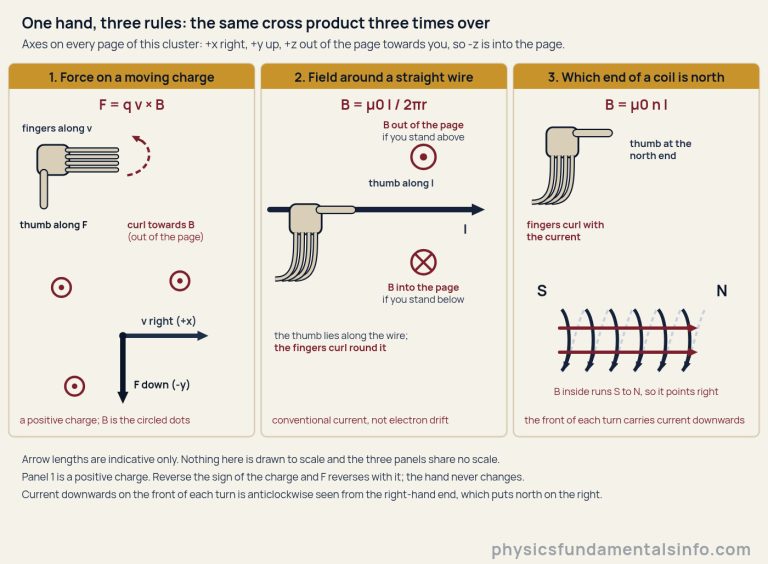
Rule 1: the force on a moving charge
Point the fingers of your right hand the way the charge is moving, curl them towards the field, and your thumb now lies along the force on a positive charge. Keep the hand exactly as it is for a negative charge and simply reverse the answer at the end.
Work the standard case. A proton moving to your right through a field coming out of the page: fingers right, curl them towards you, and the thumb drops. The force is downwards, and nothing you do with your left hand will make it any more downwards.
Rule 2: the field around a straight wire
Grip the wire with your right hand so that your thumb lies along the conventional current, and your curled fingers now run the way the field circles the wire. Read the field at any point by seeing which way your fingers are heading as they pass it.
Conventional current is the one that matters here, and it runs the opposite way to the drift of the electrons that are really moving. Get that backwards and the field circles the wrong way; see our guide to electric current for why the convention is the way round it is.
Rule 3: which end of a coil is north
Wrap your right hand round the coil with your fingers curling the way the current runs round the turns, and your thumb sticks out of the north end. That is all there is to a solenoid: a bar magnet you can switch off, with its poles set by which way you wound it.
The size of the field inside a long coil needs no hand at all, only the turns per metre and the current, and our Magnetic Field Calculator will do that arithmetic for you.
The three rules side by side
All three rules differ only in which part of the hand you set and which part you read back off, which is why one grid holds them all. Notice that the input and the output swap places between the second rule and the third: the thumb is what you set for a wire, and what you read for a coil.
| Rule | The thumb | The fingers | Formula | What you read off |
|---|---|---|---|---|
| Force on a moving charge | Lies along the force when the charge is positive | Set along the velocity, then curled towards the field | F = q v × B | The thumb: which way the charge is pushed. Turn the answer round if q is negative. |
| Field around a straight wire | Set along the conventional current in the wire | Wrapped round the wire, so they trace the field circles | B = μ0 I / 2πr | The fingers: which way the field heads as it passes the point you chose. |
| North end of a coil | Sticks out of whichever end is north | Curled in the sense the current circulates round the windings | B = μ0 n I | The thumb: which end of the coil is north, and so which end is south. |
The formula column is there to show that the size is a separate question with a separate answer. No hand position produces a number, and nothing in those three formulae tells you a direction.
Three ways to hold the same hand
You will meet the force rule in at least three forms, and students sometimes think they contradict each other. They do not: they are three ways of pointing the same hand.
- Fingers then curl. Fingers along v, curl them towards B, thumb along F. The form used throughout this page.
- Flat hand. Fingers along v, palm facing the way B points, thumb along F. Quicker once the field is coming straight at you.
- Three fingers. Thumb along v, first finger along B, second finger along F, all three held at right angles. That is the same right-handed set as the x, y and z axes themselves, which is where the hand came from in the first place.
Fleming’s left-hand rule belongs in the same list, and it is the one place the hand genuinely changes. It assigns the thumb to the force, the first finger to the field and the second finger to the current — the three fingers above with two of them swapped over — and swapping two members of a right-handed set makes it left-handed, so it needs the other hand to come out right. A cyclic shuffle would have left it right-handed; this one is not cyclic.
The answers are identical either way. Fleming’s rule is a different mnemonic for the motor case, not a different physics, and nothing on this page contradicts it.
The Six Directions, and the 36 Pairs They Make
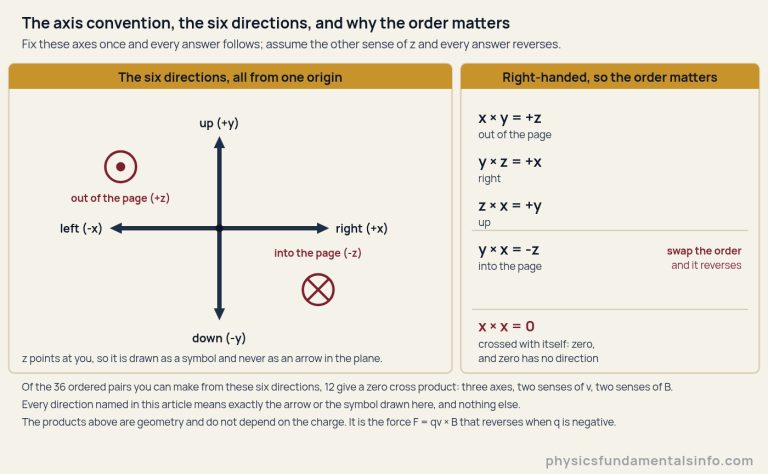
Restrict the velocity and the field to those six directions and there are 36 ordered pairs to consider. The table below gives the force direction for every one of them, for a positive charge.
| v points | B right (+x) | B left (-x) | B up (+y) | B down (-y) | B out of the page (+z) | B into the page (-z) |
|---|---|---|---|---|---|---|
| right (+x) | no force | no force | out of the page (+z) | into the page (-z) | down (-y) | up (+y) |
| left (-x) | no force | no force | into the page (-z) | out of the page (+z) | up (+y) | down (-y) |
| up (+y) | into the page (-z) | out of the page (+z) | no force | no force | right (+x) | left (-x) |
| down (-y) | out of the page (+z) | into the page (-z) | no force | no force | left (-x) | right (+x) |
| out of the page (+z) | up (+y) | down (-y) | left (-x) | right (+x) | no force | no force |
| into the page (-z) | down (-y) | up (+y) | right (+x) | left (-x) | no force | no force |
Two things in that table are worth more than the individual cells. The first is that 12 of the 36 pairs give no force at all — three axes, two senses of the velocity and two senses of the field. It is a third of the table, not a sixth, and the count catches people out because it is easy to forget that each axis can be travelled along in two directions.
The second is the symmetry. Every cell is reversed by reversing the sign of the charge, so one table serves for electrons too: read the cell, then turn the answer round. The simulator above is restricted to these same six directions on purpose, which keeps it a direction trainer; anything off-axis belongs in the calculator, and problem 7 below works one through by hand.
Why a Cross Product Needs a Hand
Two vectors can be combined in two quite different ways, and the difference is the whole of this topic. A dot product returns a number and does not care about the order. A cross product returns a vector perpendicular to both, and the order decides which of the two perpendicular ways it points.
That last sentence is the problem in miniature. Take any two vectors that are not parallel; they define a plane, and the plane has two faces. Nothing in the arithmetic of components prefers one face over the other — the preference has to be put in by hand, and it is put in by the right hand.
Done consistently in a left-handed coordinate system the left hand would serve just as well, and every answer would come out the same. The hand is bookkeeping about the axes, not a fact about hands, which is why it appears identically in torque and in angular velocity, neither of which involves magnetism at all.
Why the force never does any work
Because F is a cross product of v with something, it can never have a component along v. Over all 36 axis pairs the dot product F · v is exactly zero, with no rounding involved. The dot product is the honest way to put it, because in the 12 pairs where the force vanishes there is no angle to take the cosine of.
That has a consequence worth holding on to: a magnetic field can bend a charge’s path but can never change its speed. It is the same point our magnetic field guide makes when it says a field steers but never accelerates in the everyday sense.
A charge released into a steady uniform field therefore travels at constant speed round a circle, and a magnetic field can sort particles by bending them while leaving their kinetic energy untouched.
Crossing is not adding
One last distinction, because it trips people who are new to vectors. Adding two vectors gives you something that lies between them; crossing them gives you something that lies outside their plane altogether, perpendicular to both.
If what your problem actually wants is a resultant rather than a perpendicular, you need a different tool and a different idea — our Vector Addition Calculator handles that case, and the difference between the two is covered in our guide to scalar and vector quantities.
Common Mistakes With the Right-Hand Rule
Four mistakes account for most wrong answers, and three of them are about signs rather than about the hand.
Mistake 1: guessing the sense of z
A field drawn as a grid of crosses is going into the page and must be entered as a negative z component; a grid of dots is coming out at you and is positive. Swap those two and every direction you work out comes back reversed, which is why this page fixes the convention before it names a single direction.
Mistake 2: switching to the left hand for an electron
Changing hands for a negative charge happens to give the right answer, and that is exactly what makes it dangerous: it works until it is combined with another sign change, and then it quietly fails. Use the right hand always, then reverse the result once because q is negative.
Mistake 3: using electron flow instead of conventional current
The grip rule and the coil rule are both stated for conventional current, which flows from the positive terminal round to the negative. Electrons drift the other way. Trace the electrons with your thumb and you will get the field circling backwards and the coil’s poles swapped.
Mistake 4: thinking six of the 36 pairs give zero
Three axes suggests three zero cases, and remembering that parallel and antiparallel both count suggests six. The real figure is 12, because the velocity has two senses and the field has two senses, and 3 × 2 × 2 = 12. Count the italic cells in the table above if you want to check.
Where the Right-Hand Rule Breaks Down
The hand itself never breaks down — a cross product is a cross product. What has limits is the physics the three formulae describe, and it is worth knowing where those limits sit.
A zero force has no direction, and that is an answer
When the charge, the velocity or the field is zero, or when the velocity lies exactly along the field, the cross product is the zero vector. There is no axis to name and no angle to quote, so the honest output is the cause rather than an invented direction. Any tool that prints a direction here is telling you something it cannot know.
The straight-wire formula assumes an infinitely long wire
B = μ0 I / 2πr is derived for a wire of infinite length, and a real wire departs from it near its ends. The direction the grip rule gives is unaffected; it is the size that drifts, and only close to where the wire stops.
The solenoid formula is the ideal long-coil interior
B = μ0 n I is the field well inside a long, tightly wound coil. Near the ends it falls away, and for a short fat coil it is wrong everywhere. Which end is north does not depend on any of that — only the number does.
One charge, one uniform field, no relativity
Every figure on this page treats a single charge in a field that is the same everywhere, moving slowly enough that no relativistic correction is needed. At 3.0 × 10⁶ m/s a charge is at about one per cent of the speed of light, where that is comfortably true.
There is also no electric field anywhere in these problems. The complete force on a charge is the Lorentz force, of which the magnetic half is what the hand gives you; if your problem has an electric field as well, its contribution has to be added separately, and unlike the magnetic part it does do work.
Where the Right-Hand Rule Is Actually Used
This is not a rule you learn and then file away. It decides which way real things move, and getting it backwards is the difference between a motor that spins and a motor that spins the wrong way.
Motors, and the direction a shaft turns
A motor is a loop of wire carrying current across a magnetic field, and the force on each side of the loop comes straight from F = I L × B. The two sides carry current in opposite directions, so the forces on them point opposite ways, and the loop turns. Which way it turns is the right-hand rule, applied twice.
Reading the sign of the carriers in a Hall probe
Push a current through a thin strip in a transverse field and the moving carriers pile up on one edge. Which edge depends on the sign of the carriers, so measuring the voltage across the strip tells you whether the charge doing the moving is positive or negative. That is a direction question answered with a direction rule.
Electromagnets, relays and the pole you need
Any coil you wind becomes a magnet with its poles decided by the direction you wound it, and relays, solenoid valves and lifting magnets all depend on getting that right. Reverse the current and the poles swap, instantly.
Induction, and which way the induced current runs
When a field through a loop changes, the loop pushes back: the induced current runs the way that opposes the change, and the right-hand rule is how you turn “opposes” into an actual direction round the loop. Our guide to electromagnetic induction works that argument through. If you want to go further with the trainer above, the right-hand rule simulator page covers what each control changes and which preset to load first.
Worked Problems
Every problem below asks for a direction first and a size second, and every figure is quoted from the same physics contract the simulator and the calculator are both built against. Axes as before: +x right, +y up, +z out of the page.