Energy conversion examples are the everyday chains in which one named form of energy becomes another: chemical to thermal in a flame, electrical to radiant in a lamp, gravitational to kinetic in anything falling. The joules themselves are never created or destroyed. They are only renamed, and some of them always end up as heat.
Switch a kettle on and listen. That rising roar is electrical energy arriving down a copper wire and leaving again as heat in the water, a little sound, and a faint warmth in the plug. Nothing in your kitchen has made any energy; the grid has simply handed some over.
Every device you own is a link in a chain like that one. Trace any of them far enough back and you arrive at sunlight or a nucleus; trace them far enough forward and you arrive at warm air. This page follows seven of those chains from one end to the other, counting the joules at every step.
What Is Energy Conversion?
Energy conversion is the change of energy from one named form into another, with the total unchanged: the joules that enter a device are the same joules that leave it, wearing different names.
The word doing the work there is named. Nothing physical happens to a joule when it converts; what changes is the label a physicist puts on it. A joule of chemical energy sitting in a battery and a joule of light leaving an LED are the same amount of the same quantity, described by where it is and what it is doing.
Two neighbouring ideas are worth keeping separate from the start. What energy is — the quantity, the joule, the forms it comes in — belongs to our guide to what energy actually is. That the running total never moves is conservation of energy, with its own equation and its own problems. This page asks the narrower question: what becomes what, and in which order?
The One Equation Behind Every Energy Conversion
There is no single energy conversion formula, because conversion is not one process with one equation of its own. What every conversion does obey is a bookkeeping line, and this is it.
- Ein — the energy supplied to the device, in joules (J).
- Euseful — the part that leaves in the form you wanted, in joules (J).
- Ewaste — the part that leaves in a form you did not want, nearly always heat, in joules (J).
That is an equals sign, not an approximation. It is also the only check a conversion problem needs: add the outputs and the input must come back, to the last joule.
Useful and wasted are human words rather than physical ones. The heat pouring off a filament lamp is wasted if you wanted light and useful if you are warming a chick brooder, and the joules are identical in both rooms.
Putting a number on any of those three terms means reaching for the equation that belongs to the form being counted. Five of them cover nearly every example on this page.
| Form being counted | Equation | What you have to know |
|---|---|---|
| Electrical | E = V I t | potential difference in volts, current in amps, time in seconds |
| Thermal | Q = m c ΔT | mass in kg, specific heat capacity in J/kg/K, temperature rise in K |
| Gravitational | E = m g h | mass in kg, g = 9.81 m/s2 near the ground, height in m |
| Kinetic | E = ½ m v2 | mass in kg, speed in m/s |
| Radiant, arriving on a surface | P = A G | area in m2 and irradiance in W/m2; this one gives a power, in watts |
Only the last of those returns a power rather than an energy. Multiply it by a time in seconds and you are back in joules. One unit bridge is worth committing to memory as well, because meters and bills are written in it: 1 kWh is exactly 3.6 MJ.
The Energy Conversions You Meet Most Often
Nearly every conversion you meet is one of about a dozen, and they all share a shape: one named form goes in, a different named form comes out, and a slice of heat leaves at the join.
The table below is the spine of this page. Read a row from left to right and you have a sentence — electrical energy becomes radiant energy in a lamp, and what you notice is that the room lights up while the lamp gets warm.
| Converts from | Into | Where it happens | What you notice |
|---|---|---|---|
| Chemical | Thermal | a gas ring, a bonfire, a struck match | the room warms and the fuel runs down |
| Chemical | Electrical | a torch cell, a car battery, a fuel cell | the cell slowly goes flat |
| Chemical | Kinetic | your legs on a hill, a petrol engine | you speed up, and you get hot |
| Electrical | Radiant | a filament lamp, an LED, a laser pointer | the room lights up and the lamp warms |
| Electrical | Thermal | a kettle, a toaster, an immersion heater | the water boils and the flex warms |
| Electrical | Kinetic | a washing-machine motor, a fan, a drill | it spins, it hums, and it gets warm |
| Electrical | Chemical | charging a phone, splitting water by electrolysis | the battery fills, or bubbles form at the electrodes |
| Gravitational | Kinetic | anything falling, a reservoir down a penstock | it speeds up as it drops |
| Kinetic | Electrical | a bicycle dynamo, a wind turbine, an alternator | it becomes harder to turn |
| Kinetic | Thermal | brake discs, a rope running through your hands | the surfaces get hot and the motion stops |
| Radiant | Electrical | a solar cell, a photodiode, a light meter | a current appears with nothing moving |
| Radiant | Chemical | photosynthesis in a leaf or in algae | the plant gains mass out of thin air |
| Nuclear | Thermal | a reactor core, the centre of the Sun | the coolant gets hot with nothing burning |
| Elastic | Kinetic | a released spring, a drawn bow, a catapult | it flies off and the spring goes slack |
Two things hold for every one of those fourteen rows. The “into” column is never the whole story, because each row also produces heat; and several rows run in both directions, which is why a motor and a generator are the same machine wired differently.
Notice what the table has no row for. There is no row that destroys energy and none that makes any, because every arrow in it is a rename.
The gravitational-into-kinetic row is the one you can watch happen. The lab below holds a 1 kg ball on a smooth curved track with nothing to rub against: set Drop Height anywhere between 0.5 m and 5.0 m, press Release Ball, and read the two cards that carry the form names. Potential (PE) empties while Kinetic (KE) fills, which is one named form becoming another in front of you, a tenth of a joule at a time.
Problem 7 at the foot of this page reads all four of its cards at two points on the same drop. Keep one habit in mind while you play with it: the cards round every energy to one decimal place, so they will not always appear to add up on screen.
How to Read an Energy Conversion Chain
A conversion chain is the list of forms the joules wear, in order, with one arrow for each conversion — and every arrow leaks.
Write a chain like this: chemical -> thermal -> kinetic -> electrical. That is a coal-fired power station in four words, in the order the joules actually travel, which is why it beats a paragraph of description.
Now the part the notation hides. Drawn as a line, a chain implies that all of the joules reach the far end, and they do not. At every arrow some of them peel off sideways as low-grade heat, so the honest picture is a tree with a short branch at each joint.
That branching is not a fault in the machine. Some of it is friction, some is the resistance of a wire, and some is unavoidable for reasons that have nothing at all to do with how well the thing was built.
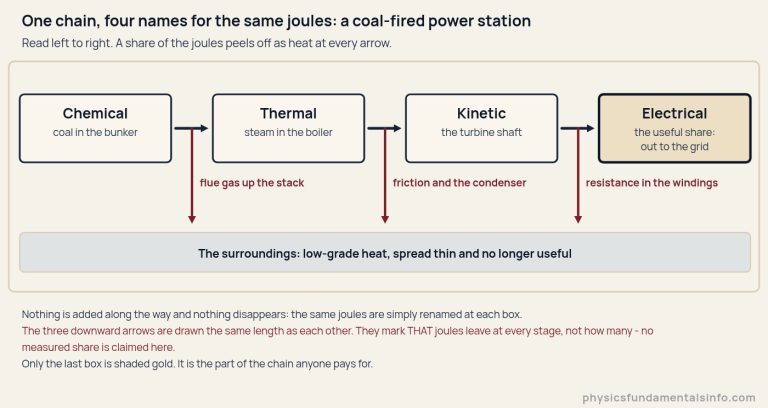
One habit makes a chain far more useful: write down what leaves at each branch, not merely that something does. Flue gas up the stack and resistance in the windings are two completely different engineering problems, and lumping them together as “losses” throws away the only information you had.
Energy Conversion Examples in Everyday Life
Five ordinary objects, five chains, each traced from the thing holding the joules to the thing that finally carries them away.
A torch
chemical -> electrical -> radiant. The cell’s chemistry drives a current, the current drives an LED, and the LED throws light across the room. Problem 1 below puts figures on it: of 720 J delivered by the cell in five minutes, a slice leaves as light and the remainder warms the torch body in your hand.
An electric kettle
electrical -> thermal, and that is the whole chain. There is almost nowhere else for the joules to go, because the element sits in the water; what escapes does so through the warm body, the warm flex and the steam. Boiling 1.5 kg from 18 °C needs 514 kJ, as problem 2 works out, which is 0.143 kWh of energy into the water; the meter that bills you records a little more than that, because the three escapes just named are paid for too.
A car, from tank to tarmac
chemical -> thermal -> kinetic. Petrol burns, the hot gas shoves a piston, the piston turns a crankshaft. The US Department of Energy puts the share of a tank that actually moves a conventional car down the road at only about 12% to 30%, depending on the drive cycle, with most of the rest leaving the engine as heat.
Then you brake, and the chain does not stop — it turns a corner. The kinetic energy you have just bought with petrol becomes heat in four steel discs, and problem 4 puts a temperature rise on it.
Breakfast to the top of a hill
chemical -> gravitational, with a very large branch. Your muscles take the chemical energy in food and lift your weight against gravity, and only some of those joules end up as height; the rest is why you are hot and out of breath at the top. Problem 5 does the sum for a 320 m climb on one cereal bar.
A phone charging, then discharging
electrical -> chemical on the charger, then chemical -> electrical -> radiant and kinetic when you use it. One chain run forwards and then backwards is the clearest everyday proof that many conversions are reversible. Both directions warm the phone, which is why it is never quite cool at either end of the day.
Energy Conversion in Power Generation
Every power station on the grid ends in the same place — electrical energy leaving a terminal — and they differ almost entirely in how many stages it takes them to get there.
Coal and gas take the long route: chemical -> thermal -> kinetic -> electrical. Fuel burns, water becomes steam, steam spins a turbine, the turbine spins a generator. Four named forms, three conversions, and heat leaving at every one of them.
Hydro drops a stage: gravitational -> kinetic -> electrical. Water held behind a dam has height, the penstock trades that height for speed, and the turbine takes it from there. Problem 3 runs the figures for 450 m3 of water a second falling 110 m.

Wind writes as three boxes but carries only two named forms: kinetic -> kinetic -> electrical. The air hands its motion to the rotor without the energy being renamed at all, which is a transfer rather than a conversion; only the generator on the end does any converting.
Solar PV is the interesting one, because it has no moving stage whatsoever: radiant -> electrical, in a single step inside the cell. No boiler, no shaft, no gearbox — which is why a panel has nothing to lubricate at the place where the conversion actually happens.
Nuclear starts somewhere unfamiliar and then joins the coal route: nuclear -> thermal -> kinetic -> electrical. Nothing burns; the nucleus itself gives up energy, and how a reactor turns that into heat is a chain worth following on its own. From the boiler onwards it is indistinguishable from a coal station.

One thing that figure does not show is worth saying out loud. Fewer boxes does not mean more joules arrive — a short chain and a long one can both shed a great deal at the stages they do have, and nothing about the drawing implies otherwise.
Where the “Lost” Energy Actually Goes
Every branch drawn on this page ends in the same place: low-grade heat, in the air of the room, the casing of the device and the bench underneath. The joules that peeled off sideways at each joint are all still there, spread across so many atoms that no single one of them gained much.
Two words there carry the idea. Spread, because the joules are no longer in one place you could reach; and low-grade, because heat already at room temperature is the one form of energy nobody can collect and send round again. Why the spreading only ever runs one way is the subject of entropy.
Problem 4 below makes it concrete. A car stopping from 27 m/s pushes 510 kJ into four brake discs and lifts them by about 113 K; the moment those discs cool back to the temperature of the air, the same 510 kJ are still in the world and completely out of reach. A mechanics energy balance records that 510 kJ as a single loss term rather than as something the car still has, and that term is exactly what the Conservation of Energy calculator returns when you ask it for the energy lost to friction.
None of this makes a device faulty and none of it is a loophole in the counting. How much of the input arrives in the form you wanted is what efficiency measures, and that question has a page of its own.
One last thing is worth saying about the word “lost”. Follow the heat far enough and it leaves the planet altogether: warm air, warm water and warm ground radiate to space, which is the final link of every chain on this page.
Common Misconceptions About Energy Conversion
The four beliefs below all come from the same place: reading a conversion as something that uses energy up, rather than as something that passes it on under a new name.
“Waste heat means something has gone wrong”
Usually it means the opposite: the device is behaving exactly as physics requires. Any conversion involving a moving part, a current or a flame produces heat, and a machine that produced none has never been built. Warm is normal. Hot in an unexpected place is the fault worth investigating.
“A well-enough built device would convert all of it”
No device manages it, and better engineering is not the obstacle. Branches can certainly be trimmed — better bearings, thicker cable, more insulation — but the branch never closes, and anything that works by moving heat around runs into a ceiling set by temperatures rather than by workmanship.
“A conversion chain only runs one way”
Plenty of them run backwards perfectly well. A motor turned by hand is a generator, a battery run flat is its charging chain in reverse, and a heat pump pushes heat in the direction heat does not naturally go. What never reverses is the heat that left at each branch, which is why the return journey is never free.
“Heat is the only thing that ever goes to waste”
Sound, light and vibration leave a conversion chain too. A kettle makes a noise, a motor hums, a projector leaks light out of its cooling vents, and a bouncing ball squashes slightly on every impact. All of those finish as heat eventually, but counting only the heat at the device itself misses joules that were still in play.
Worked Problems
Show Solution
Show Solution
Show Solution
Show Solution
Note the assumption in the question: a real car sends some of this heat straight into the air, the hub and the tyres, so 113 K is an upper limit.