Escape velocity is the launch speed at which an unpowered projectile coasts away from a world for good, its speed falling towards zero only at infinite distance. It is sqrt(2GM/r): the body’s mass and the distance from its centre decide it, and nothing about the projectile does. Earth’s surface figure is 11.18 km/s.
Throw a ball straight up and it comes back. Throw it harder and it comes back later, from higher up. Keep going and you reach a speed — one particular speed — past which it never comes back at all.
That speed has a value, and for Earth it is 11.18 km/s, about 40,000 km/h. Nothing you can throw will get near it, which is part of why the idea feels abstract. This page makes it concrete: where the formula comes from, what it is for five real worlds, and why launching at half of it leaves you nowhere near halfway.
What Is Escape Velocity?
Escape velocity is the speed at which an unpowered object’s kinetic energy exactly cancels the gravitational potential energy holding it to a body, so it coasts outward for ever and never turns round.
Two ideas in that sentence carry the whole topic. The first is unpowered: the object is released, and after that gravity is the only thing acting on it. The second is for ever — escaping is not about getting far away, it is about never coming back.
Gravity has no outer edge. Newton’s law of universal gravitation makes the pull weaken with distance, but it never switches it off, so there is no altitude at which a planet lets go. What the threshold buys is not freedom from the pull. It is a path that never reverses.
So the mental picture of something punching through an invisible gravity ceiling is wrong. A projectile at exactly escape velocity keeps slowing down the whole way out, for ever; its speed tends to zero as its distance tends to infinity. It arrives nowhere, infinitely slowly, and that is the definition.
One sanity check is worth carrying from here on. If you are given an escape velocity without being told the radius it belongs to, the figure is incomplete — escape velocity is a property of a place, not of a planet.
The Escape Velocity Formula and Where It Comes From
At a distance r from the centre of a body of mass M, the escape velocity is the square root of twice GM divided by r.
- vesc — the escape velocity, in metres per second (m/s). Quoted in kilometres per second throughout this page.
- G — the gravitational constant, 6.674 × 10⁻¹¹ N·m²/kg² here.
- M — the mass of the body being left, in kilograms (kg).
- r — the distance from the centre of that body, in metres (m). At the surface, r is the body’s radius.
The derivation runs to two lines. Release an object of mass m at radius r with kinetic energy ½mv², where its gravitational potential energy is −GMm/r. Escaping means still moving outward at infinite distance, where both of those terms have fallen to zero, so their sum at launch must be zero or greater.
Take the marginal case and set the sum to exactly zero. That gives ½mv² = GMm/r, and the object’s own mass m sits on both sides and divides straight out. Cancel it, multiply both sides by two, take the square root, and the formula above is what is left.
Read that derivation again and notice the shape of it: escape velocity is really a statement about kinetic energy dressed up as a statement about speed. Rearranged, the same equation answers a designer’s questions rather than a student’s — what mass gives a required escape speed at a known radius, or how far out a known mass drops to a target speed. Our escape velocity calculator runs it in all three directions and prints the substitution line as it goes.
One caveat on precision, stated once. This page uses G = 6.674 × 10⁻¹¹ N·m²/kg², the value the calculator uses; CODATA 2018 gives 6.67430 × 10⁻¹¹. For Earth those two produce 11.18473 and 11.18498 km/s, so the disagreement sits in the fourth significant figure and nothing here is quoted more tightly than that.
The lab below turns the formula into a threshold you can walk up to. Choose a world, set the launch speed as a percentage of that world’s escape velocity, and watch where a straight-up launch stops climbing as the percentage approaches 100.
Escape Velocity Across the Solar System: Real Numbers for Five Worlds
Computed from each body’s mass and radius, the surface escape velocities are 2.375 km/s for the Moon, 5.028 for Mars, 11.18 for Earth, 60.23 for Jupiter and 617.8 for the Sun.
| Body | Mass M (kg) | Radius r (m) | v_esc computed (km/s) | NASA published (km/s) | Difference |
|---|---|---|---|---|---|
| Moon | 7.35 × 10²² | 1.74 × 10⁶ | 2.37453 | 2.4 | −1.06 % |
| Mars | 6.42 × 10²³ | 3.39 × 10⁶ | 5.02777 | 5.0 | +0.56 % |
| Earth | 5.97 × 1024 | 6.37 × 10⁶ | 11.1847 | 11.19 | −0.05 % |
| Jupiter | 1.90 × 1027 | 6.99 × 10⁷ | 60.2346 | 59.5 | +1.23 % |
| Sun | 1.99 × 1030 | 6.96 × 10⁸ | 617.775 | 617.6 | +0.03 % |
The computed column is sqrt(2GM/r) worked from the mass and radius printed beside it. The published column is NASA’s own, from the Planetary Fact Sheet and the Sun Fact Sheet.
Moon and Mars differ by rounding alone, because NASA publishes those two to two significant figures. Jupiter’s +1.23 % is a different animal, and it is the most interesting row in the table.
Jupiter is visibly squashed. NASA’s Jupiter Fact Sheet lists an equatorial radius of 71,492 km, a polar radius of 66,854 km and a volumetric mean radius of 69,911 km — a spread of more than 4,600 km between the largest and the smallest.
So “the escape velocity of Jupiter” is not a single number until you say from where. The 59.5 km/s almost everyone prints is the equatorial figure; the mass and radius in the table above are the volumetric mean, and they give 60.23. Problem 6 below does both calculations line by line.
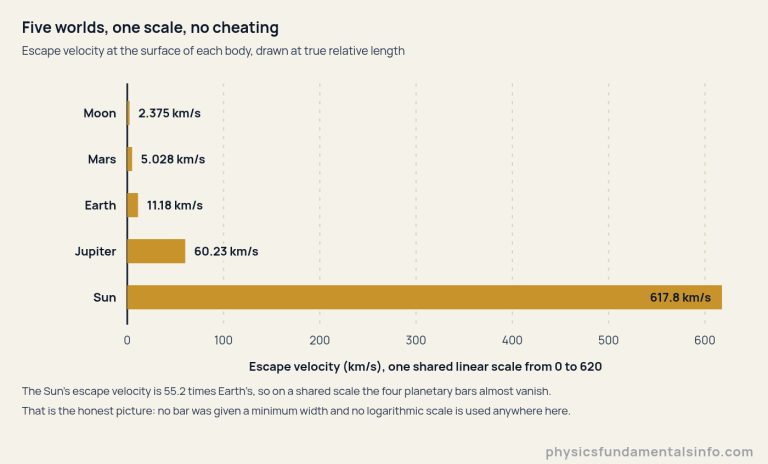
Mass alone does not decide the ranking. The Sun holds a third of a million Earth masses, yet its escape velocity is only 55.2 times ours, because the speed follows the square root of M divided by r and the Sun’s radius is vast as well as its mass.
Two scalings follow straight from that and are worth memorising. Quadruple a world’s mass at fixed radius and its escape velocity doubles. Move out to four times the radius from a fixed mass and the escape velocity halves.
Escape velocity is not surface gravity, either. Surface gravity is g = GM/r², which falls away as the inverse square of the distance where escape velocity falls only as one over its square root, so the two quantities tell you different things about the same world. If it is the pull underfoot you want rather than the speed to leave, our guide to weight on other planets is the companion piece.
Why Half the Escape Speed Buys Only a Third of a Radius
Launch straight up at exactly half a world’s escape velocity and the projectile stops one third of a radius above the surface — 2,123.33 km for Earth, 580.000 km for the Moon, 1,130.00 km for Mars.
That result comes from the same energy balance, stopped one step earlier. Instead of sending the object to infinity, send it to the highest point it reaches, where its speed is momentarily zero.
- rmax — the apogee measured from the body’s centre, in metres (m). The height above the surface is rmax − R.
- R — the launch radius, in metres (m); the body’s own radius for a surface launch.
- v — the launch speed, in metres per second (m/s), straight up, with no atmosphere and no thrust after release.
- vesc — that body’s escape velocity at radius R, in metres per second (m/s).
Everything on the right except v is fixed by the world you are standing on. All the behaviour lives in that one bracket: as v climbs towards vesc, the bracket shrinks towards zero, and dividing by something that is shrinking towards zero is exactly what “runs away to infinity” means.
| v / v_esc | Launch speed (km/s) | Apogee from the centre (m) | Height above the surface |
|---|---|---|---|
| 0.25 | 2.7962 | 6,794,670 | 424.667 km |
| 0.50 | 5.5924 | 8,493,330 | 2,123.33 km |
| 0.7071 | 7.9088 | 12,740,000 | 6,370 km, exactly one radius |
| 0.90 | 10.0663 | 33,526,300 | 27,156.3 km |
| 0.99 | 11.0729 | 320,101,000 | 313,731 km |
| 1.00 | 11.1847 | unbounded | escapes |
Earth throughout, with R = 6,370 km and vesc = 11.1847 km/s. The last row is not a very large height; it is no height at all, which is a different kind of answer.
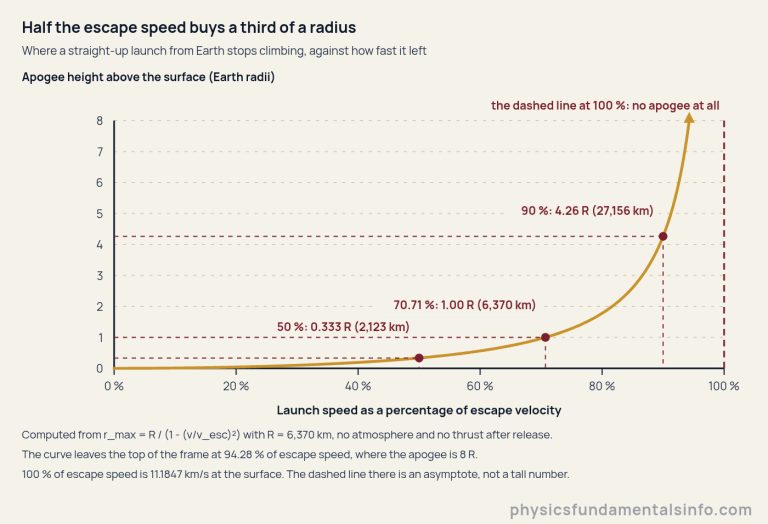
Two of those rows are exact for every body, not just for Earth. At half escape speed the bracket is 1 − 0.25 = 0.75, so rmax = 4R/3 and the height is exactly R/3, whatever R happens to be. At 70.71 %, one over the square root of two, the bracket is exactly 0.5, rmax is 2R, and the height is exactly one radius.
That second fraction is not a coincidence: sqrt(2) is also the factor between a body’s escape velocity and the speed of a circular orbit skimming its surface, which is why 70.71 % keeps appearing in this subject.
The practical lesson is that the last few per cent are the expensive ones. Going from 90 % to 99 % of escape speed costs about 1 km/s of launch speed and lifts the apogee from 27,156.3 km to 313,731 km — more than eleven times higher, for a launch speed only 10 % greater.
Does the Escaping Object’s Mass Matter?
No — the escaping object’s mass cancels out of the energy balance and does not appear in the formula at all, so a grain of dust and a loaded freighter need the same speed from the same place.
You can watch it disappear in the algebra. Kinetic energy is ½mv² and gravitational potential energy is −GMm/r, and both carry exactly one factor of the escaping mass m. Set them equal and m divides out of the equation before you ever reach a number.
There is a physical reason underneath that piece of algebra, and it is the familiar one. A heavier object is harder to accelerate and is also pulled harder, in the same proportion. The two effects are the same m, and they cancel — which is why two objects of different mass fall at the same rate in a vacuum.
One caveat, and it concerns the other mass. The formula treats M as fixed and unmoved, which is excellent for a pebble leaving Earth and poor for two bodies of comparable mass, where both move and a full two-body treatment replaces this one-line result.
Escape Velocity in the Real World: Atmospheres, Rockets and Black Holes
Escape velocity decides which worlds keep an atmosphere, fixes the energy every launch has to pay for, and — taken to its limit — gives the size of a black hole.
Start with the air. A world keeps a gas only if its escape velocity comfortably exceeds the speeds its molecules actually reach, and molecular speeds are a distribution with a long fast tail, so “comfortably” means several times over rather than merely above.
The Moon’s 2.375 km/s is not comfortable for anything light. Earth’s 11.18 km/s is, which is the difference between a world with weather and a world with a vacuum at its surface. The escape velocity of a world is, in a real sense, the reason it looks the way it does.
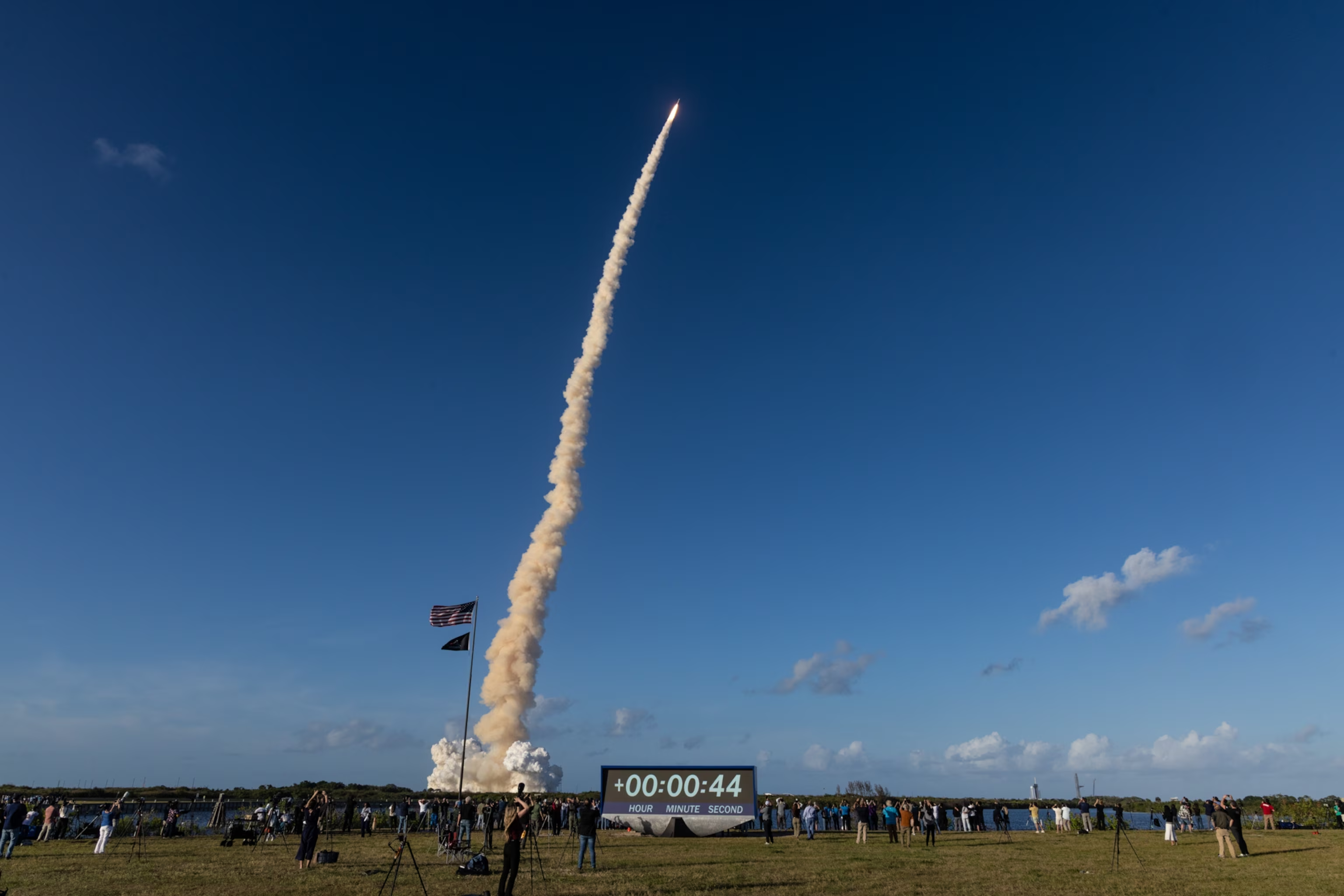
Which brings us to rockets, and to the thing this page exists to correct. A launch vehicle is never unpowered: it burns for minutes, climbing through thinning air, and can leave at whatever speed its engines can sustain. Escape velocity is not a speed limit it must break.
What the number does set is the energy scale, and that is unavoidable. Escaping from Earth’s surface costs 62.5 megajoules for every kilogram you take with you — the value of GM/R there — and no amount of clever flying reduces it. Thrust only lets you pay the bill slowly instead of all at once.
The same product GM that fixes escape velocity also fixes how long anything takes to go round; it is the constant hiding inside Kepler’s laws. One quantity, two very different-looking results.
Now push the formula until it breaks. Set vesc equal to the speed of light, c = 299,792,458 m/s, and rearrange for the radius: r = 2GM/c². That is the Schwarzschild radius, the size of a black hole of mass M, and for Earth’s mass it comes to about 8.87 mm.
Treat that agreement with care. The Newtonian route reaches the right algebraic expression, but light does not slow down and fall back the way a stone does, and the honest account of a horizon needs general relativity rather than this equation. It is a superb mnemonic and a poor derivation.
Common Misconceptions About Escape Velocity
Myth 1: “a rocket must reach 11.2 km/s to leave Earth”
It must not. That figure is the release speed for an object that is then left alone, and a vehicle with engines still burning is not left alone. Climb at a steady walking pace, if you can afford the propellant, and you will still get away.
The error comes from reading a threshold for coasting as a requirement for climbing. What genuinely binds a real launch is the energy, and energy can be delivered over ten minutes as easily as in one instant.
Myth 2: “escape velocity means escaping gravity”
Nothing ever escapes gravity. An object at escape velocity is being pulled at every instant of its journey, and it is slowing down the whole time. What has changed is only that the slowing never quite brings it to a halt, so it never turns around.
Myth 3: “you have to launch straight up”
For an airless, non-rotating body, the threshold does not depend on direction at all. Escape velocity comes from an energy balance, and kinetic energy depends on speed alone and not on which way the velocity points, so any direction that clears the surface escapes at the same speed. Straight up is simply the easiest case to picture, which is why this page and the simulator use it.
Myth 4: “leaving Earth means leaving the Sun”
It does not. Earth’s 11.18 km/s is the threshold for Earth alone, and the Sun carries on pulling; its own surface escape velocity is 617.8 km/s. A probe that has escaped Earth is still firmly bound to the Sun unless it has separately been given enough speed to escape that as well.
Where the Simple Model Breaks Down
The one-line formula assumes a single spherical non-rotating body, no atmosphere, and nothing pushing after release. Loosen any one of those and the number moves.
- No air. Anything actually launched from the ground at 11.18 km/s would be fighting drag from the first metre, and the formula has nothing whatever to say about that loss. This is a vacuum result, which is why it describes a released spacecraft well and a ground-fired projectile badly.
- No rotation. The surface at the equator is already moving eastward, so an eastward launch starts with part of the job done. That is a real effect and a real reason launch sites sit where they do, and this formula knows nothing about it.
- One body only. The Moon and the Sun pull on anything leaving Earth, and the two-body idealisation quietly ignores them both.
- A point mass. The derivation treats all of M as sitting at the centre, and r is measured from there. For a uniform sphere that is exact; for an oblate spinning planet it is an approximation, which is what Jupiter’s row in the table is really telling you.
- The planetary data is rounder than the constant. Swapping G for the CODATA 2018 value moves Earth’s figure from 11.18473 to 11.18498 km/s. Swapping the mass and radius above for NASA’s own moves it from 11.1847 to 11.1859 km/s, which is nearly five times further. The uncertainty on this page lives in the planetary data, not in G.
None of that makes the formula a bad one. It makes it a first answer that lands within 1.3 % of the published figure for every world in the table above, and that is a good return on two lines of algebra.