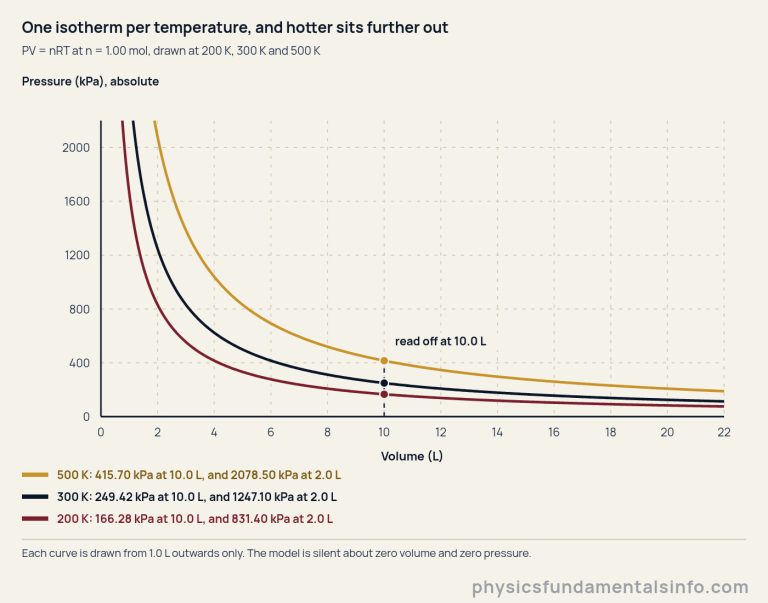
An isothermal process is a change that takes place at constant temperature, held there by contact with a heat reservoir. For an ideal gas the path is PV = nRT = constant, and the work done is the area under that curve: W = nRT ln(V2/V1). Internal energy depends only on temperature, so the heat always equals the work.
Push a bicycle pump down slowly, with your hand wrapped around the barrel, and the air inside barely warms. Push it down fast and the barrel gets hot enough to notice. Same pump, same air, same final volume — and two completely different amounts of effort.
The slow one is what thermodynamics calls isothermal, and it is the cleanest process in the subject. Hold the temperature still and the gas has no internal energy left to change, which means every joule you put in has to go somewhere else. Following that joule is what this page is about.
What Is an Isothermal Process?
An isothermal process is any change in which the temperature of the system stays constant from start to finish, held there by something large enough to absorb or supply heat without changing its own temperature.
The word is Greek bookkeeping: iso for same, therme for heat. What matters is that constant temperature is a constraint imposed from outside, not something the gas does by itself. Let a gas push a piston with nothing feeding it and it cools as it works. Something has to keep supplying the energy — a water bath, a thermostatted block, a room, the sea.
For an ideal gas, that one constraint fixes the whole route. Hold T fixed in PV = nRT and the whole right-hand side is a constant, so pressure and volume are locked into inverse proportion and the state point has to travel along a hyperbola. That curve is called an isotherm, and it is where the gas laws and thermodynamics meet.
Here is the distinction that this page turns on. Boyle’s law tells you where the gas ends up: squeeze it to half the volume and the pressure doubles. It says nothing at all about what the journey cost you.
An isothermal process is the journey itself — the whole curve, traced point by point, slowly enough that the gas has a single well-defined pressure the entire way. That last condition is not decoration. It is what makes the work calculable, and later on this page you will see exactly what happens when it fails.
The Isothermal Process Formula
The work a gas does while expanding at constant temperature is fixed by three things: how much gas there is, how hot it is, and the ratio of the two volumes.
- W — work done by the gas on its surroundings, in joules (J). A negative W means work was done on the gas, which is what a compression is.
- n — the amount of gas, in moles (mol), held fixed throughout.
- R — the molar gas constant, 8.314 J/(mol K). Every figure computed on this page, in the lab below it and in the calculator it links to uses that rounded value, because it is the figure most textbooks and exam data sheets print. R itself is fixed exactly in the present SI, and NIST gives that defined constant to ten figures as 8.314462618 J/(mol K), about 56 parts per million above the value used here.
- T — the absolute temperature, in kelvin (K). Never degrees Celsius, for a reason worth its own section below.
- V1, V2 — the volumes before and after, in any unit you like, provided both are in the same one. Only their ratio reaches the answer.
Two companions come free with it, and both are used later on this page.
Q is the heat absorbed by the gas, in joules, and ΔS is its entropy change, in joules per kelvin. Notice what is missing from the second one: no temperature. The entropy change of an isothermal expansion depends on the amount of gas and the volume ratio, and on nothing else.
Because P1V1 = P2V2 along the curve, the volume ratio can be swapped for the pressure ratio and the formula reads W = nRT ln(P1/P2) — handy when a problem gives you pressures and no volumes at all. If you would rather not rearrange anything by hand, the isothermal process calculator solves the same relation for the work, either volume, the amount of gas or the temperature, and prints the heat and the entropy change beside the answer.
Take one mole at 300 K and let it double its volume from 10.0 L to 20.0 L. Then nRT = 2494.2 J and ln 2 = 0.6931472, so W = 1728.8 J. That single number is the anchor for the rest of this page.
The lab below draws the isotherm for whatever gas amount, temperature and pair of volumes you set, shades the region under the curve between them, and reads out the work, the heat, the entropy change and both pressures. There is also a button that switches the same two end states onto a completely different route — and when you press it the curve and the shading disappear, which is the most honest thing the picture does.
How the Work Becomes a Logarithm
Work is force times distance, and for a gas pushing a piston that becomes pressure times change in volume, added up over the whole stroke: W = the integral of P dV.
Each slice of the stroke contributes a little rectangle of area, P multiplied by the sliver of volume swept out. Add the slivers and you have the area under the curve on a pressure-volume plot. Our guide to work done in physics sets out the force-times-distance version this is built on.
The isothermal case is what happens when you put P = nRT/V into that sum. Adding up 1/V as V grows is the one integral everybody remembers from school, and it gives a logarithm. Pull the constants out and W = nRT ln(V2/V1) drops out with no approximation anywhere.
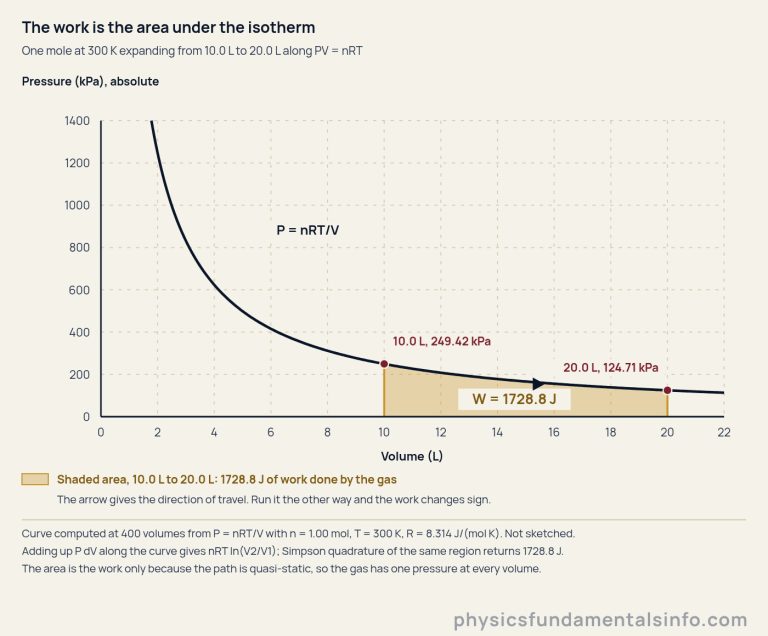
Now for the part that is an actual check rather than a restatement. Measure that shaded area numerically — chop it into panels, weight them by Simpson’s rule, add them up — and you get 1728.8 J, which is what the closed form gives. Those are genuinely different computations: one is a weighted sum of hundreds of reciprocals, the other is a single call to a logarithm.
And the agreement is earned, not automatic. Run the same quadrature over a twentyfold expansion with only eight panels and it is 3.98 per cent wrong; sixteen panels cuts that to 0.70 per cent, and 128 panels to about five parts in a million. A formula has no panel count, so watching the error fall as the panels multiply is a real test of the algebra.
What is not a test: noticing that PV comes out the same at both ends. Both pressures were worked out as nRT/V in the first place, so their products are nRT by construction. It is the curve being named, not evidence for anything, and on a screen full of rounded figures it does not even multiply out reliably.
The logarithm also controls how the payback shrinks. Doubling the volume gives 1728.8 J; a fourfold expansion gives 3457.7 J, which is exactly twice as much — not a surprise, since ln 4 is exactly 2 ln 2. Go to twenty times the volume, though, and the work is 7472.0 J, only 4.3219 times the doubling figure rather than ten times it. To double the work you have to square the ratio.
Heat, Entropy and What the Temperature Controls
Every joule of work an ideal gas does at constant temperature is paid for by a joule of heat flowing in, because there is nothing else for it to come from.
The reasoning is two lines. For an ideal gas the internal energy depends on temperature and on nothing else, so freezing the temperature freezes the internal energy: ΔU = 0, by identity rather than by luck. The first law then says 0 = Q − W, which leaves Q = W.
That is the first law with one term deleted, not a coincidence the arithmetic turned up. It also has a physical meaning worth pausing on: the heat is not an afterthought that arrives at the end, but a flow that has to keep pace with the piston the whole way. Stop supplying it and the process stops being isothermal. If you have the heat and want the energy ledger balanced, the first law of thermodynamics calculator is the tool for that job; this page’s formula is for when you have the volumes instead.
Entropy behaves differently, and the difference is instructive. Divide the reversible heat by the temperature and the T cancels straight out, leaving ΔS = nR ln(V2/V1). Our guide to entropy covers what the quantity means; here the point is which variables it does and does not contain.
Watch what that does to one mole doubling its volume. At 100 K the work is 576.3 J, at 300 K it is 1728.8 J, and at 800 K it is 4610.3 J — a factor of eight between the ends. The entropy change is 5.763 J/K in all three.
So the volume ratio decides how much more room the molecules have, and the temperature decides how expensive that room is. Both answers come from the same logarithm; only one of them cares how hot the gas is.
Reversible or Free: When the Same Expansion Costs Nothing
Take that same mole of gas from 10.0 L to 20.0 L a second way — by opening a tap into an empty vessel of equal size — and the work is not 1728.8 J but exactly zero.
Nothing about the end states has changed. Same gas, same temperature, same starting and finishing volumes. What changed is the route, and work is a property of routes rather than of end points.
The reason is almost embarrassingly simple: in a free expansion there is nothing on the other side of the gas to push. Work needs an opposing force, and a vacuum does not supply one. No work means no energy leaves, so no heat needs to come in either — Q is zero as well, and the internal energy is unchanged, which for an ideal gas is why the temperature holds.
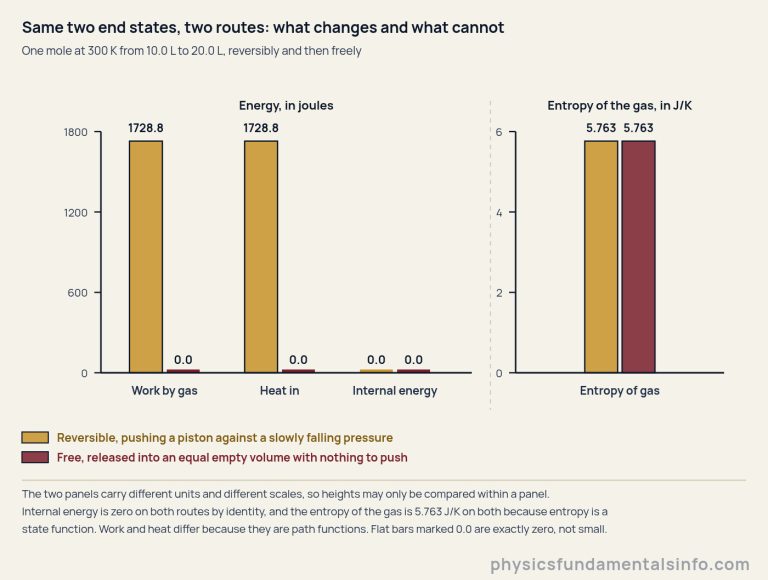
The entropy change is the one quantity that refuses to budge. Because entropy is a state function, its change between two states is whatever it is, and you are entitled to compute it along any convenient reversible route even when the real process was nothing like reversible. Both routes give 5.763 J/K for the gas.
Both halves of the entropy story have to be told, or the second law looks broken. On the reversible route the reservoir loses exactly the entropy the gas gains, so the universe comes out at zero. On the free route nothing anywhere gives up any entropy, so the universe gains the whole 5.763 J/K — and that is precisely what makes the free expansion irreversible.
The waste can be enormous. Five moles at 800 K expanding from 1.0 L to 20.0 L do 99626.1 J of work along the curve; released into a vacuum between the identical two states, they do none of it. Nothing is destroyed — the energy never left the gas — but the opportunity is gone for good.
One limitation, stated rather than glossed. A free expansion stays at constant temperature only because the gas is ideal. A real gas cools or warms as it expands into a vacuum, because its internal energy depends on volume as well as temperature.
That is the Joule effect, the free-expansion cousin of the Joule-Thomson cooling seen when a gas is throttled through a valve. No number on this page describes any particular real gas, because none was measured for it.
Why the Temperature Must Be in Kelvin
In this formula the temperature stands in front of the logarithm as a multiplier, so the 273.15 between the Celsius and kelvin scales never gets a chance to cancel.
That makes the consequences of typing the wrong scale far sharper than a vague loss of accuracy. Here is one mole doubling from 10.0 L to 20.0 L at eight temperatures, worked correctly and then worked with the Celsius number dropped straight into the formula.
| Temperature (°C) | T (K) | Correct W (J) | W from the Celsius number (J) | Error |
|---|---|---|---|---|
| −10 | 263.15 | 1516.5 | −57.6 | −103.80 % |
| 0 | 273.15 | 1574.1 | 0.0 | −100.00 % |
| 1 | 274.15 | 1579.9 | 5.8 | −99.64 % |
| 25 | 298.15 | 1718.2 | 144.1 | −91.61 % |
| 27 | 300.15 | 1729.7 | 155.6 | −91.00 % |
| 100 | 373.15 | 2150.4 | 576.3 | −73.20 % |
| 300 | 573.15 | 3303.0 | 1728.8 | −47.66 % |
| 500 | 773.15 | 4455.5 | 2881.4 | −35.33 % |
The error column is not a sample of anything. Substituting t for T multiplies the answer by t/T, so the fractional error is exactly −273.15/T — reproducible from the kelvin column alone, and independent of the gas, the volumes and the ratio.
Two of those rows do something no ratio-based gas law can manage. At 0 °C the shortcut returns exactly zero work, which looks like a statement about the gas and is nothing of the kind; NIST’s note on the SI temperature scales puts it plainly that zero degrees Celsius is 273.15 K, not zero. Below that, the sign reverses, and a perfectly good expansion is reported as a compression.
Nor does the error ever become small. It shrinks as the gas gets hotter, but across the 100 K to 800 K range this topic is usually taught in it never falls below 34.14 per cent, reached at the very top of that range. The shortcut is always wrong, not usually wrong.
There is a structural point hiding in the arithmetic. In a law written as a ratio, both temperatures are shifted by the same 273.15 and some of the mistake cancels; how much depends on the two figures, so the damage varies. Here there is nothing to cancel against, so the damage is one clean, predictable fraction — which is at least easy to spot once you know to look.
Two bookkeeping habits go with it. Pressures in any of these formulae are absolute pressures, not gauge readings, so an atmosphere has to be added to a gauge figure first. And the amount of gas is held fixed throughout, so a leak or a phase change puts you outside the model entirely.
Where You Meet Isothermal Processes
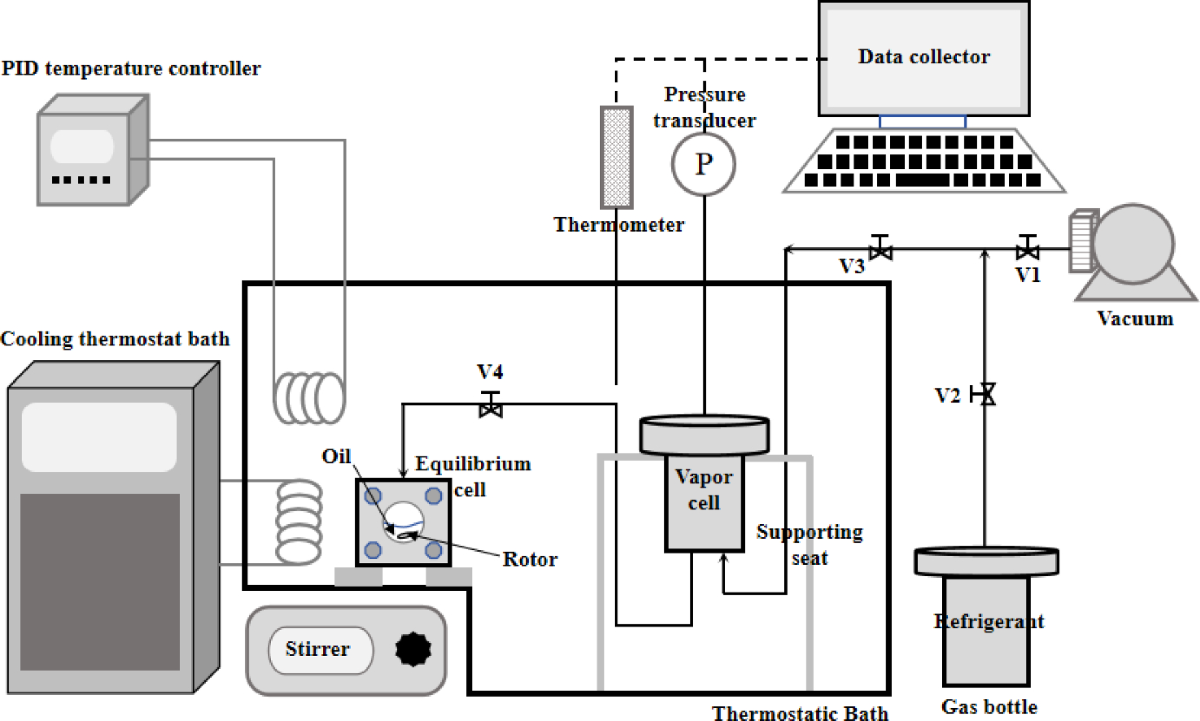
The laboratory bath. A cylinder of gas standing in a stirred water bath, its piston released a little at a time, is as close as anyone gets to the idealisation. The bath is enormous compared with the gas, so it hands over the heat without cooling measurably, and the change is slow enough that the gas is never far from equilibrium.
Compressor design. Squeezing a gas warms it, and warm gas pushes back harder, so any quick compression costs more than the same compression done slowly enough to stay at the starting temperature. That makes the isothermal figure a floor rather than an estimate. Intercoolers between the stages of a real compressor exist to claw the process back towards it.
The engine cycle. A Carnot cycle is two isothermal legs joined by two insulated ones, and all of the heat exchange with the outside world happens on the isothermal pair. Working out either leg is one application of the formula above at that reservoir’s temperature; the Carnot efficiency that follows is a separate and much shorter calculation.
Dilution and osmosis. The same nRT ln(ratio) governs the minimum work to concentrate a solution and the maximum work available from letting it spread out, because both are counting how many more places a particle has to be. Swap the volume ratio for a concentration ratio and the algebra is unchanged.
Slow leaks and long pipes. Gas seeping through a wall over hours, or drifting along a buried pipeline, has all the time in the world to exchange heat with its surroundings. A fast change tends towards the adiabatic limit and a slow one in good thermal contact towards the isothermal one; most real changes sit between the two, which is worth remembering before quoting either as fact.
One caution about the word itself. Melting ice at 0 °C and boiling water at 100 °C are isothermal too, and plenty of heat flows during both — but the substance is not an ideal gas, so none of the formulae on this page apply to them.
Common Misconceptions About Isothermal Processes
“Constant temperature means no heat flows.” It means the opposite. Temperature and heat are different quantities, and holding one of them still generally means moving the other. The process with no heat flow is the adiabatic one, where the temperature is free to move instead.
“PV staying constant proves the process was isothermal.” It is the definition of the curve, not evidence about the process. Anything that starts and finishes on the same isotherm satisfies it, including a free expansion that never had a defined pressure in between. Worse, on a screen of rounded figures the products do not reliably agree anyway, so multiplying them out is a check that fails about 6 per cent of the time even when the physics is perfect.
“Zero internal energy change means nothing happened.” The volume changed, the pressure changed, the entropy changed, and in the anchor example 1728.8 J crossed the boundary in each direction. What did not change is one specific quantity, for one specific reason: an ideal gas keeps its internal energy in its temperature and nowhere else.
“Ten times the room gives ten times the work.” It gives 4.3219 times, whatever the gas and whatever the temperature, because the factor is ln 20 divided by ln 2. A logarithm rewards the first factor of two generously and the twentieth barely at all. Doubling the ratio from 2 to 4 does exactly double the work — but that is an identity of logarithms rather than a sign of proportionality, and it stops looking like one the moment you try 4 to 8.
“Slow means isothermal.” Slowness is necessary and nowhere near sufficient. A gas expanding slowly inside a perfectly insulated cylinder is quasi-static and steadily cooling. Without something to supply the heat there is no isothermal process, however patient you are.
Where the Isothermal Model Breaks Down
The algebra above is exact. Everything that goes wrong comes from applying it to a gas that is not ideal, a route that is not quasi-static, or a temperature that is not really being held.
The gas has to be ideal for ΔU = 0. A real gas has molecules that attract one another, so its internal energy depends on volume as well as temperature, and a real isothermal expansion does not have exactly equal work and heat. Close, for a dilute gas well above its boiling point. Not exact.
The path has to be quasi-static for the area to be the work. Release the piston suddenly against a lower pressure and the gas does less work than the curve says, because it is pushing against less; release it against nothing and it does none. The area under the curve is an upper bound on what any route between those two states can deliver.
Something has to keep up with the heat. A reservoir that cannot supply energy as fast as the gas needs it leaves the gas cooling, and the real answer then lands somewhere between this calculation and an adiabatic one, matching neither.
Precision has its own small print. This page uses R = 8.314 J/(mol K); with the SI value the opening example returns 1728.9 J rather than 1728.8 J, so a textbook disagreeing in the last digit has probably just used a different constant. And figures printed to a few decimals do not always reproduce each other: the numerically measured area and the closed form can differ in the last printed digit in about 0.015 per cent of states, which is a property of quadrature rather than a fault.
Finally, be clear about what has and has not been demonstrated here. That PV is equal at both ends, that Q equals W, and that ΔU is zero are all consequences of the definitions and cannot fail. What is genuinely shown is that the area under the curve and the closed-form logarithm agree when computed two different ways, and that two routes between identical end states give identical entropy and wildly different work. Everything on this page is a statement about an ideal gas; to watch it move, the isothermal process simulator has the same sim on a page of its own.