Wave particle duality is the principle that light and matter each behave as a spread-out wave in some experiments and as a localised particle in others. A single relation ties the two faces together: an object of momentum p has a wavelength equal to the Planck constant h divided by p.
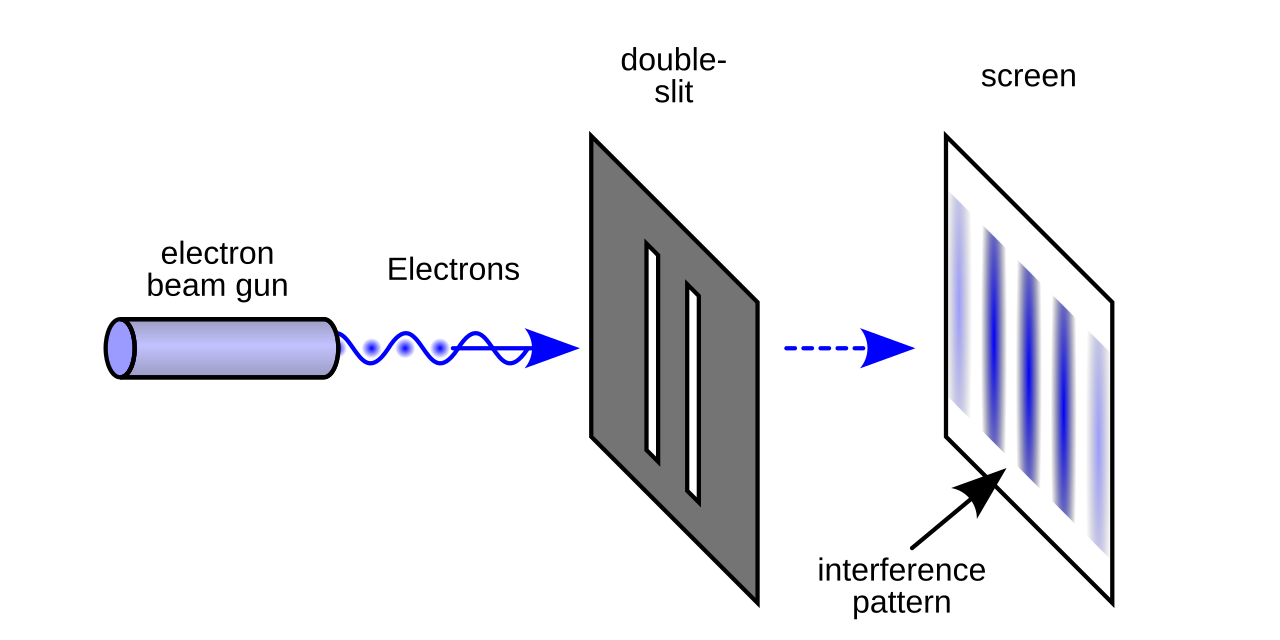
Fire electrons at a barrier with two narrow openings in it, one electron at a time, and every single one arrives at the far screen as a dot. Nothing smeared, nothing half-landed. Leave it running and those dots stack up into a striped pattern that only a wave could have drawn.
Each electron crossed the apparatus alone, so there was nothing for it to interfere with except itself. That is wave-particle duality in one experiment, and the rest of this page takes it apart: the relation linking momentum to wavelength, what the stripes are worth in micrometres, and what becomes of them the moment you try to find out which opening was used.
What Is Wave-Particle Duality?
Wave-particle duality is the rule that a quantum object carries both descriptions at once: it travels like a wave and it is detected like a particle, and which face you meet depends on what the apparatus asks of it.
The word doing the work is and. Textbooks that say light “sometimes behaves as a wave and sometimes as a particle” make it sound like a costume change, as though the electron decides en route which to be. It does not. One description governs the journey, the other governs the arrival, and both are in force for every electron.
Detection is where this stops being philosophy. An electron is never half-detected: the screen records one localised hit, at one position, carrying the whole of the electron’s charge. The wave does not arrive; it sets the odds on where the hit lands.
So the honest sentence is this one. The wave tells you where the particle is likely to turn up, and only a great many arrivals make it visible — a single dot tells you almost nothing, while ten thousand dots draw the wave in full.
None of this is special to electrons. Photons, neutrons and whole atoms have all been sent through two-path interferometers and have all produced fringes, and one piece of arithmetic covers every one of them. Our guide to quantum mechanics places duality alongside the other ideas it belongs with.
The Evidence on Both Sides: Quanta of Light, Waves of Matter
Duality earns its name because the evidence runs in both directions: light, modelled as a wave for a century, delivers its energy in indivisible lumps, and matter, modelled as particles for rather longer, diffracts.
Light arrives in quanta
Shine light on a clean metal surface and electrons come off — but whether any come off at all depends on the colour of the light, not on how bright it is. A wave of any frequency should eventually deliver enough energy if you wait long enough. It does not work that way.
Light hands over its energy in fixed packets, and a packet either does the job or it does not. The experiment, its threshold and its arithmetic belong to our photoelectric effect guide; all this page needs from it is the conclusion that light arrives in quanta.
Matter diffracts
The other direction took longer to test, because the wavelengths involved are minute. Send a beam of electrons at a crystal, though, and it emerges in sharp spots and rings — the signature of a wave meeting a regular array of scatterers rather than of pellets bouncing off it.
The Nobel Prize in Physics 1937 was awarded jointly to Clinton Joseph Davisson and George Paget Thomson for their experimental discovery of the diffraction of electrons by crystals. Our guide to the de Broglie wavelength works through the matter-wave relation and its arithmetic in detail; this page takes it as given and builds an experiment on top of it.
The Wave-Particle Duality Formula: Wavelength from Momentum
One equation carries the whole idea. The wavelength of any object is the Planck constant divided by that object’s momentum.
- λ — the wavelength, in metres (m). Electron wavelengths on this page are quoted in picometres, and 1 pm = 10−12 m.
- h — the Planck constant, 6.62607015 × 10⁻³⁴ J·s, exact by definition since the 2019 revision of the SI.
- p — the momentum, in kilogram metres per second (kg m/s). Well below the speed of light, p = mv.
Read the equation again and notice what is missing from it. Nothing on either side asks what the object is made of, whether it has mass, or whether it has charge — momentum goes in, wavelength comes out. Problem 4 below gives a photon and an electron the same momentum and gets the same wavelength from both. If you would rather have the number than the arithmetic, our De Broglie Wavelength Calculator takes a mass and a speed and returns the wavelength.
For an electron gun the momentum arrives as a voltage rather than a speed. Accelerate an electron from rest through a potential difference V and all the work done on it, eV, ends up as kinetic energy p2 / (2 me), which rearranges to a single square root.
- V — the accelerating potential difference, in volts (V).
- e — the elementary charge, 1.602176634 × 10⁻¹⁹ C, also exact since 2019.
- me — the electron mass, taken here as 9.109 × 10⁻³¹ kg so that every figure on this page matches the calculator linked above.
Put 100 V through that and the electron comes out with a wavelength of 122.6 pm. Problem 1 does the arithmetic line by line. Hold on to the magnitude: a tenth of a nanometre is the same order as the spacing between neighbouring atoms in a solid, which is the single fact that makes electron diffraction a laboratory technique rather than a curiosity.
The lab below runs the whole experiment. Choose the accelerating voltage, the gap between the openings, how wide they are and how far away the screen sits, then let the stream run and watch the pattern assemble itself out of single detections — or send one electron at a time and watch it land as a single dot.
If you would rather take the controls one at a time, with worked settings to copy, the wave-particle duality simulator has a page of its own.
The Double Slit, One Electron at a Time
Two openings, one particle in the apparatus at a time, and a pattern that needs both openings to exist: that is the experiment, and it is why this page is not simply an essay about a formula.
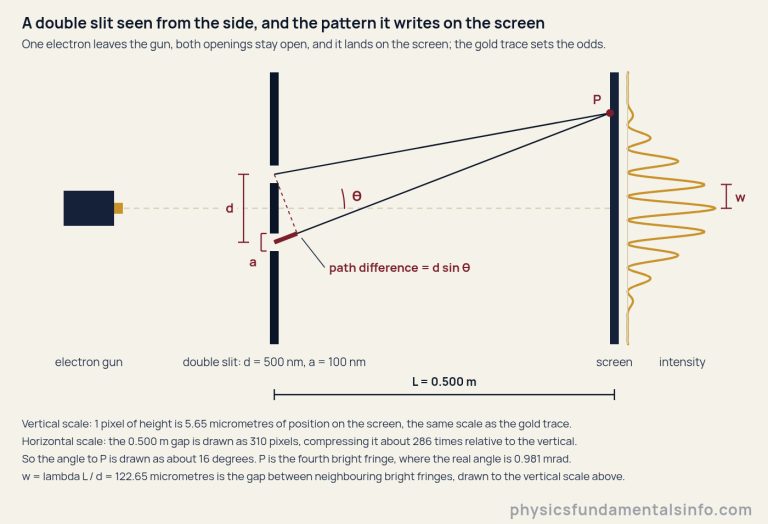
Three lengths set everything. The openings are a distance d apart, each one is a width a across, and the screen sits a distance L beyond the barrier. Bright fringes land wherever the two paths differ by a whole number of wavelengths, which is the condition d sinθ = mλ for integer m.
At the angles involved here, sinθ and tanθ agree to better than one part in a million, so the fringes come out evenly spaced and their separation has a one-line formula.
- w — the fringe spacing, the distance on the screen between neighbouring bright fringes, in metres (m).
- L — the distance from the barrier to the screen, in metres (m).
- d — the separation of the two openings, centre to centre, in metres (m).
Those 122.6 pm electrons through openings 500 nm apart, onto a screen half a metre away, give a fringe spacing of 122.65 µm — about an eighth of a millimetre. Problem 2 works it through, and problem 3 runs it backwards to recover d from a measured spacing.
Why the fringes are not all equally bright
Each opening on its own spreads the beam, which is ordinary diffraction, and that spreading sets an envelope the fringes have to live inside. The envelope first falls to zero where a sinθ = λ, and the fringes fade as they climb towards it.
| Order m | Position from the centre (µm) | Relative intensity | What it is |
|---|---|---|---|
| 0 | 0.00 | 1.000 | central maximum, the brightest fringe |
| 1 | 122.65 | 0.875 | first fringe, one fringe spacing out |
| 2 | 245.29 | 0.573 | already visibly dimmer |
| 3 | 367.94 | 0.255 | a quarter of the centre |
| 4 | 490.58 | 0.055 | the faintest fringe inside the envelope |
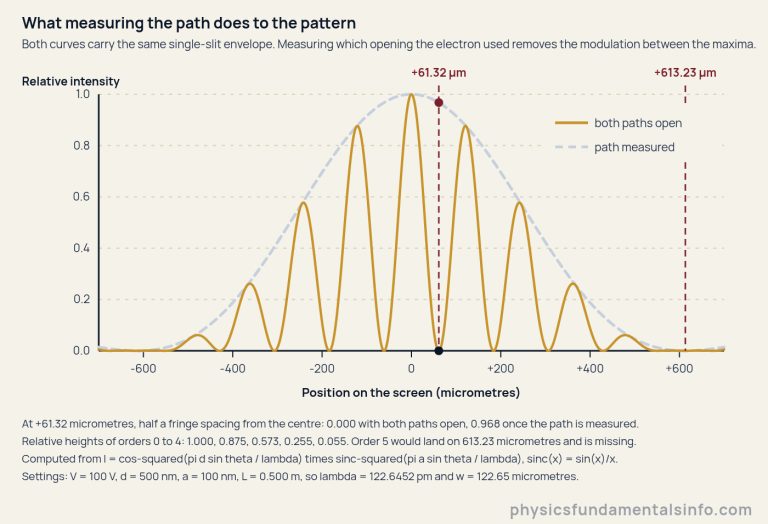
| 5 | 613.23 | 0.000 | missing order: it lands exactly on the envelope’s first zero |
Every figure in that table is for 100 V electrons with d = 500 nm, a = 100 nm and L = 0.500 m, and every position appears on both sides of the centre. Four bright fringes survive on each side before the envelope closes them out.
Order 5 is the interesting row. Because d is exactly five times a here, the fifth fringe would arrive precisely where the single-opening envelope has already fallen to zero, so it never appears at all — a missing order. Change the ratio d/a and a different order goes missing; problem 5 works out which.
Watching the pattern assemble
Start the stream and the first few dozen detections look like nothing at all: scattered dots, no structure, no sign of a fringe. The pattern is a statement about probability, and probability needs a sample.
By a few hundred the stripes begin to show through. By ten thousand the histogram of dot positions traces the intensity curve closely enough that you could read the fringe spacing off it with a ruler. Nothing changed about any individual electron on the way — only the number of them.
One caveat about any simulation of this, including the one above. The arrival positions come from a seeded pseudo-random generator: it is a model of quantum randomness, not a sample from a quantum source, and no classical computer can supply the real thing.
What Happens When You Ask Which Slit?
The fringes disappear. Any measurement that records which opening the electron went through destroys the interference pattern and leaves only the broad single-opening spread behind.
This is the result that makes duality more than a turn of phrase. The pattern is not a property of the electron; it is a property of the experiment. Leave both paths open and unexamined and you get fringes. Learn the path and you get a smooth hump.
The standard way to put a number on it is fringe visibility, which compares the brightest and darkest points of the pattern.
Fringes at full contrast, with genuinely dark gaps between them, give a visibility of 1.00. No fringes at all gives 0.00. In the idealised model used on this page and in the lab above, switching on a perfect which-way measurement moves the visibility from one of those values straight to the other.
The halfway point between two bright fringes makes the contrast concrete. With both paths open that position is a dark line — the two paths cancel there. Measure the path and the same position reads 0.968 of the central intensity: almost as bright as the middle of the pattern.
There is a reason the trade is so unforgiving. Working out which opening was used means localising the electron at the barrier, and localising it there costs you knowledge of its sideways momentum, which is exactly what fixed the fringe positions. Our guide to the Heisenberg uncertainty principle handles that exchange in general.
Why Everyday Objects Show No Fringes
They obey the same relation; their fringes are simply far too fine for anything to resolve. Momentum sits in the denominator of λ = h / p, so an everyday momentum drives the wavelength, and with it the fringe spacing, down past any length that means anything.
Problem 7 runs the numbers for a thrown ball through a pair of metre-wide openings. The fringe spacing comes out around 10−33 m — smaller than an atomic nucleus by a factor of roughly 1018.
So the line between quantum and classical is not a size. It is a comparison: the wavelength against the scale of the apparatus. An electron at 122.6 pm meeting openings 500 nm apart has a wavelength worth about a four-thousandth of the gap, and that is already enough to make fringes you can measure in micrometres.
Push the wavelength down far enough relative to the apparatus and the fringes crowd together until they blur into the smooth, featureless distribution that classical physics predicts. Nothing switches off. The pattern just stops being resolvable.
Where Wave-Particle Duality Turns Up in Real Experiments
Wherever a wavelength of about 100 pm is useful, matter waves are the practical way to get one. Four places where that pays off:
Electron microscopy
Resolution is limited by wavelength, and visible light runs out at a few hundred nanometres. A 100 V electron at 122.6452 pm has a wavelength about 4,500 times shorter than green light at 550 nm, which is why an electron beam reaches detail an optical microscope can never touch. Real instruments use far higher voltages and shorter wavelengths still.
Electron diffraction from crystals
Atoms in a solid sit a few hundred picometres apart, and a wave only diffracts usefully from a structure comparable to its own wavelength. Electrons at tens to hundreds of volts land in exactly that range, so a crystal acts on them as a three-dimensional grating — the effect the 1937 Nobel Prize recognised.
Surface science
Low-energy electrons scatter strongly and so penetrate only the top few atomic layers. That makes low-energy electron diffraction a tool for the surface specifically rather than the bulk, which is a hard thing to get at any other way.
Neutron diffraction
Neutrons are uncharged, so they pass deep into a sample instead of stopping at its surface, and they scatter from nuclei rather than from electron clouds. Facilities such as the NIST Center for Neutron Research exist to supply beams with the right wavelengths for the job.
Common Misconceptions About Wave-Particle Duality
“The electron travels as a wave and turns into a particle at the screen”
Nothing turns into anything. There is one object with one quantum description, and that description predicts both the spreading and the single localised detection. The two-stage story is a mental crutch that fails the moment you ask when the change is supposed to happen.
“Observing it means a person has to look”
No consciousness is involved. What destroys the fringes is any interaction that leaves a record of the path — a stray photon scattering off the electron, a detector coupled to one opening, a gas molecule in a poor vacuum. Whether a human ever reads that record makes no difference at all.
“The fringes come from electrons bumping into each other”
This was a reasonable guess, and it is straightforward to rule out. Send the electrons through so sparingly that only one is ever in the apparatus, and the same fringes appear, just more slowly. Each electron interferes with itself.
“Duality is really only about light”
It cuts both ways, and the matter half is the half that surprised people. Light behaving as particles was startling enough; electrons, neutrons and atoms behaving as waves is the same statement read backwards, and it is the half that turned into working laboratory equipment.
Where This Model Stops Being Exact
Everything above is correct for the regime it describes, and the regime has edges. Five of them are worth stating plainly.
The which-way switch is idealised. Visibility 1.00 with both paths open and 0.00 with the path measured are the two limits of the intensity equation, not readings from any apparatus. Partial which-way information gives partial decoherence and an intermediate visibility, and quantifying that for a real apparatus is a measurement, not an application of this page.
The electrons here are treated non-relativistically. That is justified rather than assumed: from 20 V to 600 V, v/c runs from 0.0088 to 0.0485, so the Lorentz factor exceeds 1 by only 1.18 × 10⁻³ at the top of that range. The relativistic correction to λ is about eV / (4 me c2), which is 0.03 per cent at 600 V — below the precision anything on this page is quoted to.
The small-angle fringe formula is safe here, not everywhere. Across every setting in the lab above, the angle to the first maximum stays under 0.914 mrad, so w = λL/d and the exact L tanθ agree to better than one part in a million. Open the geometry up to larger angles and that stops being true; the small-angle form is a convenience of this apparatus, not a general licence.
Simulated randomness is not quantum randomness. The dots in the lab above are placed by a seeded pseudo-random generator chosen to reproduce the intensity curve. It models quantum randomness faithfully in distribution and is not a quantum random source.
Plenty is left out. There is no space charge between electrons, no detector inefficiency, no scattering off the edges of the openings, no stray field and no vibration. Real electron interferometers also magnify the pattern with electron optics, because fringes tens to hundreds of micrometres apart are not something you look at directly.