Heat flux units are watts per square metre, W/m², because a heat flux is a power spread over an area. The flux q is the heat energy Q divided by the area A it crossed and the time t it took, so one watt per square metre means one joule per second through every square metre of surface.
Put your hand flat on an outside wall in January. Slide it along to a wider stretch of the same brick and nothing changes — the wall does not feel colder for being bigger. Yet that bigger stretch is undeniably losing more heat in total. Both of those things are true at the same time, and the only way to hold them both is to stop using one number for two different quantities.
That is what this page is about. A heat flux is the figure that stays put when a surface grows; a heat transfer rate is the figure that grows with it. Heat flux units are what keep the two apart on paper, and mixing them up is the quietest way a thermal calculation goes wrong.
What Is Heat Flux?
Heat flux is the rate at which heat energy crosses a surface, counted per square metre of that surface. It is a power per unit area, not a power, and the symbol for it on this page is a lowercase q.
Think of it as a measure of how hard a surface is working rather than how much work it does. Two walls can be shifting very different amounts of energy per second and still be under identical thermal pressure, because one of them simply has more square metres to do it through. The flux is what survives that comparison.
Heat is energy in transit, which is why the quantity on top of the formula is an energy and not a temperature — a distinction our guide to heat against temperature settles properly. A flux tells you how fast that transit is happening across a given face, and nothing at all about how hot either side of it is.
The Unit of Heat Flux: Watts per Square Metre
The SI unit of heat flux is the watt per square metre, written W/m2. Nothing else is the SI unit, though seven other units are in daily use and the whole of the conversion table further down exists for them.
Unpack it and the unit explains itself. A watt is a joule per second, so a watt per square metre is a joule per second through each square metre: W/m2 = J/(s·m2). Push it down to SI base units and it collapses to kg/s3, with the metres cancelling out entirely — a result that looks wrong until you notice it is just a watt, which already carries m2, divided by m2 again. Our guide to SI units in physics sets out where derived units like this come from.
The quantity travels under several names, and it is worth recognising all of them. The standard reference on heat flux gives heat flux density, heat-flow density and heat-flow rate intensity as alternative names for the same thing — a flow of energy per unit area per unit time — and records its SI units as watts per square metre. None of those names describes a different quantity. If a paper hands you a heat flux density in W/m2, it has handed you a heat flux.
One further property, stated once because it matters and then left alone. A heat flux has a direction as well as a magnitude, since energy crosses a surface one way rather than the other, which makes it formally a vector quantity. Everything on this page is its magnitude through one surface; the sign convention and the surface integral are a separate subject.
The Heat Flux Formula
The heat flux formula is q = Q / (A t): the heat energy that crossed, divided by the area it crossed and the time it took. The same relation reads as the heat transfer rate divided by the area, which is often the quicker route.
Every symbol, with the unit it has to be in before anything is divided by anything:
| Symbol | What it is | SI unit | Value in this page’s figures |
|---|---|---|---|
| q | Heat flux: the power crossing one square metre of the surface. Lowercase, always | watt per square metre, W/m2 | 250 W/m2 in the worked anchor; 90 W/m2 for the brick wall |
| Q | The heat energy that crossed. Uppercase, and a total rather than a per-square-metre figure | joule, J | 1800000 J, which is 1.8 MJ |
| A | The area the heat crossed, measured across the flow rather than along it. Strictly positive | square metre, m2 | 2 m2 in the anchor; 1 m2 and 12 m2 in Figure 1 |
| t | The time over which that energy crossed. Strictly positive | second, s | 3600 s, which is one hour |
| Q/t | Heat transfer rate through the whole surface: the flux multiplied by the area. A different quantity, in a different unit | watt, W | 500 W in the anchor; 90 W and 1080 W in Figure 1 |
Settle the letters now rather than being ambushed later, because physics is not consistent about them and nor is this site. Here lowercase q is the flux and uppercase Q is the energy, which is the convention our specific heat calculator keeps; our water heating calculator, though, uses a lowercase q for the heat energy itself, in joules, and so does the reaction-enthalpy one. Check which quantity a copied figure is, not just which unit it is in.
Three of the four quantities are yours to supply and the fourth drops out, so the line rearranges four ways: Q = q A t, A = Q / (q t) and t = Q / (q A). The Heat Flux Calculator runs any of those four directions and prints the answer in all eight flux units at once, which is the fastest way through a question that arrives in kWh and wants an answer in BTU. The energy on top is usually the thing that was actually measured, and our guide to specific heat capacity is where that Q comes from if you have to work it out first.
One limit, stated once, because it is the honest boundary of the formula. Dividing by A assumes the flux is the same everywhere over that area, and dividing by t assumes it held steady for the whole period. What q = Q / (A t) returns is therefore an average over both — which is exactly right for a uniform surface and merely a reasonable summary for a patchy one.
The simulator below is the quickest way to feel what the formula does and does not depend on. Drag the area slider and watch the first readout card, Heat flux q (W/m²), sit perfectly still while the watts move with it; then click through the five material buttons, Aerogel 0.015, Wool 0.040, Wood 0.13, Brick 0.72 and Copper 401, and watch the flux span four orders of magnitude without the area changing at all.
Heat Flux vs Heat Transfer Rate
A heat transfer rate is the power crossing a whole surface, measured in watts; a heat flux is that power per square metre of the surface, measured in W/m2. One is a total, the other is a density, and the area is what converts between them.
For a wall the flux can be written straight from the material rather than from a measured energy. That relation is Fourier’s law in flux form, and it belongs to our guide to Fourier’s law of heat conduction, which derives it and carries the conductivity table; it is stated here once, for the one purpose of pinning a flux down while the area changes, and not developed.
Look at what is missing from that first line. There is no A in it — just the conductivity k, the temperature difference ΔT and the thickness d. So for a given material at a given temperature difference and thickness, the flux is fixed before anyone has said how big the wall is.
Take brick, k = 0.72 W/(m·K), with ΔT = 20 K across d = 0.160 m. The flux is 90 W/m2, and it is 90 W/m2 for a stamp-sized patch and for the gable end of a house. The rate is what tells them apart: 90 W through one square metre, 1080 W through twelve of them.
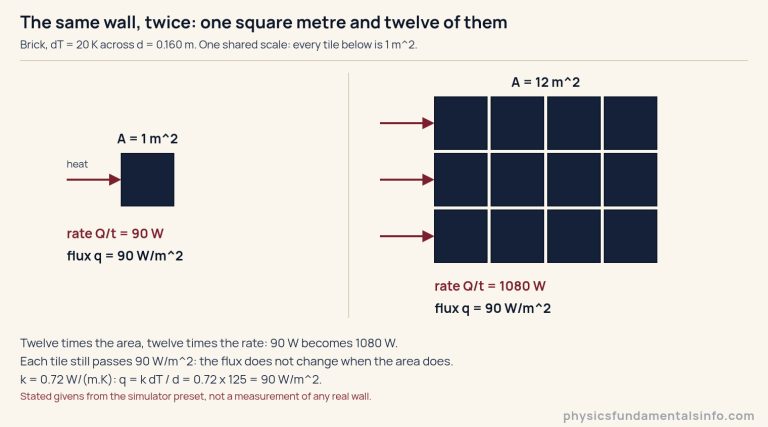
Now the detail that makes the two genuinely confusable rather than merely different. At an area of exactly 1 m2 the rate in watts and the flux in W/m2 come out as the same number — 90 and 90 — while meaning different things. Move off one square metre and they part company immediately, which is why a flux and a rate quoted as the same figure should always make you check the area.
Why the Area Cancels
The area cancels because the flux is already a per-square-metre quantity: multiplying it by the area gives the rate, and dividing that rate by the area gives it straight back. Nothing about the material or the temperature difference changed in between.
The simulator above makes this a two-second experiment. Its area slider runs from 0.1 to 20 m2, and at its boot settings — conductivity 0.040, a temperature difference of 20 K, a thickness of 0.160 m — dragging it does this:
| Area A (m2) | Heat flux q (W/m2) | Heat transfer rate Q/t (W) |
|---|---|---|
| 0.1 | 5 | 0.5 |
| 1 | 5 | 5 |
| 2 | 5 | 10 |
| 5 | 5 | 25 |
| 10 | 5 | 50 |
| 20 | 5 | 100 |
Two hundred times the area. The flux does not change, and the rate goes up by the same factor of 200. Two of its other readout cards, Resistance R (m²·K/W) and U-value (W/m²·K), read 4 and 0.25 at those boot settings, each printed to three decimal places, and stay there for the same reason the flux does: both are per-unit-area quantities, and both belong to the heat-loss topic rather than to this one.
Here is the catch that trips people who have just read the formula, though. Look at q = Q / (A t) again: there is an A on the bottom, so how can the flux not depend on it? Because the two experiments hold different things fixed.
- Fix the material, the temperature difference and the thickness — what the simulator’s sliders do — and the flux is pinned at k ΔT / d while the rate rises in proportion to the area. That is the table above.
- Fix the energy and the time instead — what q = Q / (A t) does, and what the calculator’s presets do — and the rate is pinned while the flux falls as 1/A. At Q = 1.8 MJ in one hour, the rate is 500 W whatever the area, and the flux reads 500 W/m2 at 1 m2, 250 W/m2 at 2 m2 and 25 W/m2 at 20 m2.
Both statements are correct and they are not in conflict, because they are answers to different questions. Spreading a fixed amount of energy over more surface really does thin the flux out; giving a wall more area at the same driving conditions really does not. Say which quantities you are holding still and the apparent paradox evaporates.
Converting Heat Flux Units
Every heat flux unit in common use converts to W/m2 by a single multiplication, and all eight factors come from defined-exact values rather than from measurements. The table below is the whole ladder, with the 250 W/m2 anchor from the worked problems carried across it.
| Unit | One of these in W/m2 | Where the factor comes from | 250 W/m2 reads as |
|---|---|---|---|
| W/m2 | 1 | the SI unit, by definition | 250 |
| kW/m2 | 1000 | the SI prefix kilo | 0.25 |
| MW/m2 | 1000000 | the SI prefix mega | 0.00025 |
| W/cm2 | 10000 | 1 cm = 0.01 m, so 1 cm2 = 0.0001 m2 | 0.025 |
| mW/cm2 | 10 | the same cm2, with milli on the watt | 25 |
| cal/(s·cm2) | 41840 | 1 thermochemical calorie = 4.184 J exactly | 0.00597514 |
| kcal/(h·m2) | 1.162222 | 4184 J over 3600 s, an exact ratio | 215.105 |
| BTU/(h·ft2) | 3.154591 | 1055.05585262 J over 334.450944 s·m2, an exact ratio | 79.2496 |
Going the other way, the two reciprocals worth memorising are 1 W/m2 = 0.316998 BTU/(h·ft2) and 1 W/m2 = 0.860421 kcal/(h·m2). Note that neither of those, nor the BTU factor itself, is anywhere near a power of ten. Shifting a decimal point will convert W/m2 to kW/m2 and stop working the moment a foot or a calorie appears — the general method is in our guide to physics unit conversions.
Common Misconceptions About Heat Flux
Four beliefs cause most of the wrong answers, and the first is the one the unit itself invites.
“W/m2 is just a fussy way of writing watts”
It is not: the two are different quantities and cannot be substituted for each other. The belief survives because they agree numerically at exactly 1 m2 — our brick wall gave 90 W and 90 W/m2 there — and because a lot of worked examples quietly use a one-square-metre sample. Enter any other area and the two figures separate.
“A bigger wall has a bigger heat flux”
A bigger wall loses more heat per second, which is a bigger rate, and that is almost certainly what the sentence was reaching for. At the same material, temperature difference and thickness the flux is identical: that is the whole content of the table two sections up, where the area moved by a factor of 200 and the flux did not change at all.
“One flux figure describes the whole surface”
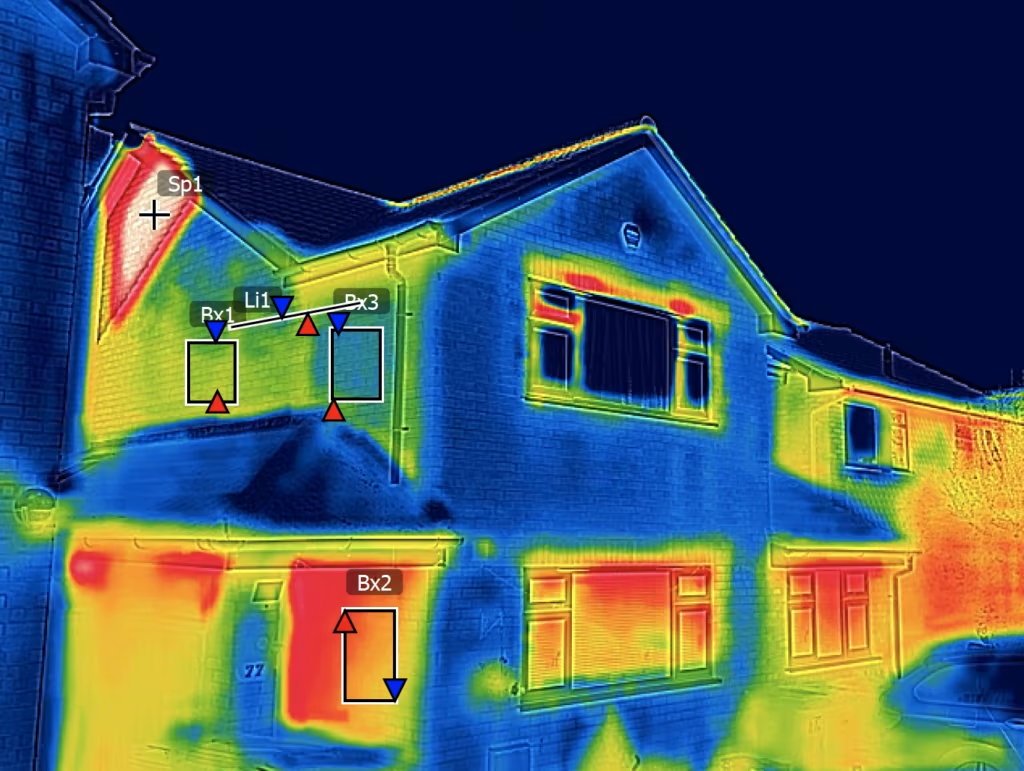
It describes the average, and a real surface is rarely uniform. Dividing by A buries every cold bridge, every stud and every poorly-fitted panel inside a single number, and a thermal camera shows the difference instantly. The average is still the right quantity for an energy sum; it is simply not the peak.
“Flux units convert by moving the decimal point”
Only within the SI prefixes. The factor for BTU/(h·ft2) is 3.154591, the factor for kcal/(h·m2) is 1.162222, and both are exact ratios that happen to look like untidy decimals. Round the BTU factor to “about 3” and every answer comes out roughly five per cent low; round the kcal one to “about 1” and it is low by about fourteen per cent, before any physics has been attempted.
Where Heat Flux Fits Among the Thermal Quantities
Heat flux is the per-area measure of heat moving, which places it next to three families of quantity rather than inside any of them.
First, the transport mode. A flux can be carried by conduction, by convection or by radiation, and our guide to conduction, convection and radiation is the place to settle “a flux of what, exactly?”; the heat transfer simulator shows all three shifting energy side by side.
Second, the material route. When the driving conditions are what you know rather than a measured energy, the thermal conduction calculator is the tool — but it asks for an area alongside the conductivity, the temperature difference and the thickness, and what it hands back is the whole-surface rate in watts rather than a flux, so divide those watts by the area you typed to get back to W/m2. The Fourier’s law simulator is the landing page of the sim embedded above, if you want it on its own.
Third, the question a flux cannot answer: how quickly a temperature change travels rather than how much energy crosses. That is thermal diffusivity, in m2/s, and the thermal diffusivity calculator handles it. A high flux and a slow response are perfectly compatible, which catches people out more often than it should.
Worked Problems
Show Solution
Show Solution
Show Solution
Show Solution
Show Solution
Show Solution
Show Solution
Heat flux q (W/m²) shows 5 to three decimal places, and the rate above it shows 50 W to one. Then drag the area slider across its whole range, 0.1 to 20 m2: the flux does not change, while the rate runs from 0.5 W to 100 W.