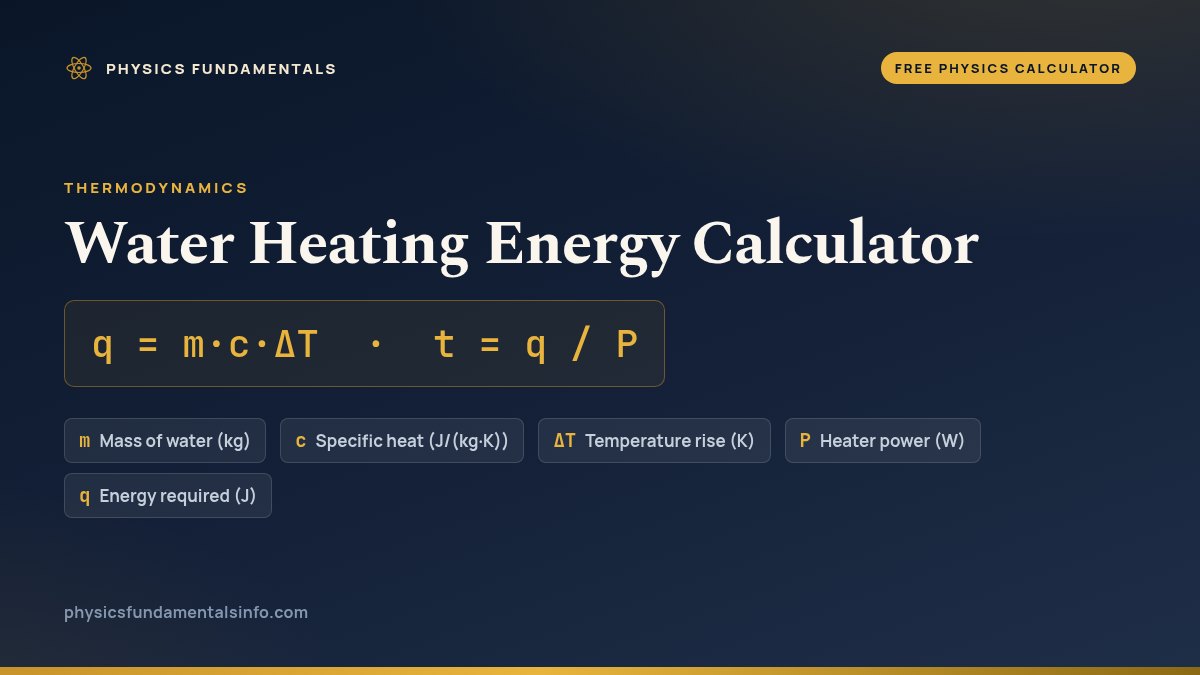
Water heating energy: the energy needed to heat water is q = m·c·ΔT, and at a given heater power the time is t = q/P. This free calculator solves for the energy, the mass, or the temperature rise — and reports the heating time from your heater power — with every step.
What Is the Water Heating Energy Calculator?
The water heating energy calculator is a free online tool built on the formula q = m·c·ΔT · t = q / P. Enter the values you already know, in whichever units suit you, and it solves for energy, heating time, mass or temperature rise and shows every step of the substitution. Energy and time to heat water, from q = mcΔT.
| Symbol | Quantity | Default unit | Also accepts | Example value |
|---|---|---|---|---|
| m | Mass of water | kg | L, g, mL | 1 |
| c | Specific heat | J/(kg·K) | kJ/(kg·K) | 4186 |
| ΔT | Temperature rise | K | °C | 80 |
| P | Heater power | W | kW | 2000 |
| q | Energy required | J | kJ, Wh, kWh | — |
How to calculate water heating energy
To find how much energy it takes to heat water, multiply the mass of water by its specific heat (4186 J/kg/K) and the temperature rise — q = m·c·ΔT. The answer is an energy in joules, which you can also read in kJ or kWh. One litre of water weighs about 1 kg, so you can enter the amount in litres and treat it as kilograms.
There are a few steps. First, decide what you want to find and select it in the Solve for menu: the energy, the mass, or the temperature rise. Second, enter the values you know — the mass, the temperature rise (in °C or kelvin, which are the same size step), and the heater power. Third, read the answer with the worked steps, which show the formula, your numbers substituted in, the result with units, and — when you enter a power — the heating time t = q/P.
To find out how long a heater takes, divide the energy by the power — t = q/P. A more powerful heater delivers the same energy in less time. The specific heat of water is unusually large, which is exactly why kettles and immersion heaters draw so much power. To warm other materials, use the specific heat calculator; to price the electricity a heater uses, see the electricity cost calculator; and for the underlying terms, see the physics glossary.
Worked example
Heating 1 litre (1 kg) of water by 80 °C — from 20 °C up to boiling — needs q = 1 × 4186 × 80 = 334 880 J = 334.9 kJ, about 0.093 kWh. Running that through a 2 kW kettle takes t = 334880 / 2000 = 167 s, roughly 2.8 minutes, ignoring heat losses. A more powerful 3 kW kettle would do the same job in under two minutes.
Why it matters
This is the everyday physics of kettles, boilers, immersion heaters, showers and hot-water tanks. It lets you compare appliance running costs, size a heater for a required flow, and see why heating water is so energy-hungry — water's specific heat is unusually high. Real systems need extra energy for losses, so treat the result as an efficient-case minimum. To explore how quickly a heater delivers that energy, see the power calculator.
Frequently asked questions
How much energy does it take to heat water?
The energy is q = m × c × ΔT, where c = 4186 J/kg/K is the specific heat of water. For example, it takes about 4.19 kJ to raise 1 kg of water by 1 °C. Larger masses and bigger temperature rises need proportionally more energy.
How long does it take to boil water?
Divide the energy needed by the heater power: t = q/P. A 2 kW kettle heating 1 L of water by 80 °C needs about 335 kJ, which takes roughly 2.8 minutes in the ideal case. Real kettles take a little longer because of heat losses.
Does 1 litre of water equal 1 kilogram?
Yes, very nearly. Water has a density of about 1000 kg/m^3, so 1 litre is about 1 kilogram near room temperature. This is why you can enter the mass in litres and treat it as kilograms in the calculator.
Why does the real time exceed the calculated time?
Heat losses to the surrounding air and the container, together with less-than-perfect appliance efficiency, mean real heaters use more energy and time than the ideal q = mcdeltaT predicts. Treat the calculated value as an efficient-case minimum.
What is the specific heat of water?
The specific heat of water is about 4186 J/kg/K (4.186 kJ/kg/K), one of the highest of any common substance. This high value is why water stores and carries heat so well, and why heating water is comparatively energy-hungry.
References & formula source
- Halliday, Resnick & Walker — Fundamentals of Physics, Chapter 18 (Temperature, Heat and the First Law).
- Young & Freedman — University Physics with Modern Physics, §17.5 (Calorimetry and Phase Changes).
- NIST — specific heat capacity of liquid water (4.186 kJ/kg/K).
- Further reading: Specific heat capacity — Wikipedia