A heat flux is a power spread over an area: the heat energy Q that crosses a surface, divided by the area A it crossed and the time t it took, or q = Q / (A t) in watts per square metre. The one thing to keep straight is which of the two quantities you want — Q/t in watts is the heat through the whole surface, and q in W/m2 is the heat through one square metre of it. This free calculator solves the relation for the flux, the energy, the area or the time, prints the same flux in all eight of its units beside the answer, and shows every step.
Load a real case
Each button writes the energy, the area and the time into the three boxes, so the answer changes the moment you press it. The line underneath quotes back whatever the widget then works out, so nothing in it is stored text. All five sets of figures are stated givens chosen to make the arithmetic exact, not measurements of any real surface.
Pick a case above, or type your own figures.
What Is the Heat Flux Calculator?
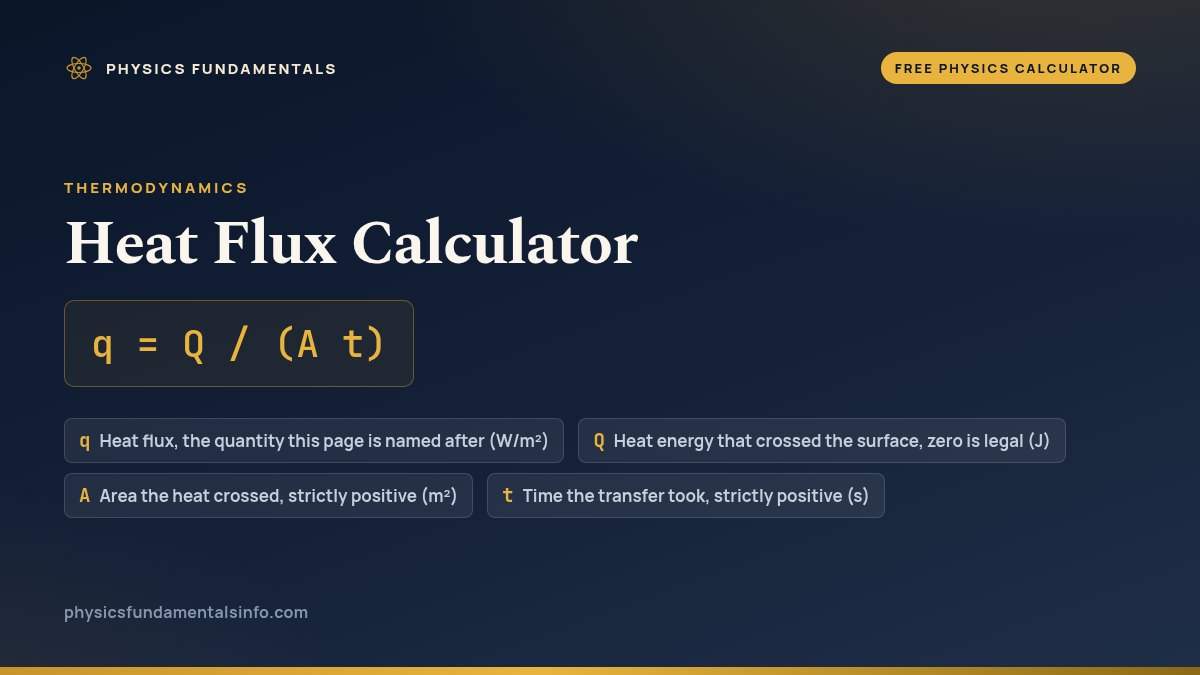
The heat flux calculator is a free online tool for the power crossing one square metre of a surface: q = Q / (A t), the heat energy Q divided by the area A it crossed and the time t it took, in watts per square metre. Give it an energy, an area and a time and it returns the flux; point the Solve for menu at any one of those three instead and it runs the same relation in that direction. The SI unit is W/m2, which is the same thing as J/(s·m2) and reduces in base units to kg/s3.
The distinction to get right is flux against rate, and that single distinction is what this page exists to explain. A heat transfer rate Q/t is a power through the whole surface, in watts; a heat flux q is a power through one square metre of it, in W/m2. The rate chip sits beside every answer for that reason, so the two quantities are always on screen together rather than being confused for one figure.
At an area of exactly one square metre the two print the same number, and that coincidence is where the confusion starts. Enter 1.8 MJ through 1 m2 in one hour and the headline reads 500 W/m2 while the rate chip reads 500 W — one number, two quantities, two units. Move the area off 1 m2 and they separate immediately: at 20 m2 the same energy gives 25 W/m2 at the same 500 W.
Whether a bigger area means a bigger or a smaller flux depends entirely on what is being held fixed. Hold the energy and the time, as this calculator does, and a larger area spreads the same power more thinly, so the flux falls while the rate stays put. Hold the material, the temperature difference and the thickness instead, as a wall does, and the flux is the quantity that does not move while the rate rises with the area — which is the case the Fourier's law simulator lets you drag an area slider through.
Because the keyword is a unit, the answer is given in all eight of them at once. The seven chips under the headline are not extra results: they are the one flux in kW/m2, MW/m2, W/cm2, mW/cm2, cal/(s·cm2), kcal/(h·m2) and BTU/(h·ft2). Every factor is derived in the page from a defined-exact value — 1 ft = 0.3048 m, 1 BTU = 1055.05585262 J, 1 cal = 4.184 J — so the chips and the box menus cannot drift apart.
A heat energy of zero is a legal entry here, not an error. Nothing crossed the surface, so the flux is an exact zero, and the page says so rather than refusing. What it does refuse is an area or a time of zero, which would be a division by nothing rather than an infinite flux, a negative energy or flux, and a flux of zero in the area and time modes, where passing a real amount of energy would need an infinite area or an infinite time.
The formula assumes the flux is uniform over the area and steady over the time, so what it returns is an average over both. A surface with a cold bridge in it, or a period that was interrupted, has exactly that average and a peak that is nowhere near it. No figure on this page is a measurement: the defaults and the presets are stated givens chosen so that all four solve directions come out exact, and no real-world flux value is quoted anywhere on it.
| Symbol | Quantity | Default unit | Also accepts | Example value |
|---|---|---|---|---|
| q | Heat flux, the quantity this page is named after | W/m² | kW/m², W/cm², BTU/(h·ft²) | 250 |
| Q | Heat energy that crossed the surface, zero is legal | J | kJ, MJ, Wh, kWh | 1800000 |
| A | Area the heat crossed, strictly positive | m² | cm², ft² | 2 |
| t | Time the transfer took, strictly positive | s | min, h | 3600 |
How to use the heat flux calculator
- Decide which quantity you are missing. The page opens on the flux. The Solve for menu also rearranges the same relation for the energy, the area and the time; whichever you choose becomes the headline and the other three become your input boxes. Switching the menu clears every box, so set it first and type afterwards.
- Enter the heat energy. The box opens on
1800000J and the menu offers kJ, MJ, Wh and kWh. Pick the unit your figure is already in rather than converting by hand. Zero is accepted and means something: nothing crossed the surface, so the flux is an exact zero. - Enter the area. The box opens on
2m2, with cm2 and ft2 in the menu. It is the area measured across the flow of heat, not along it, and it must be strictly positive. - Enter the time. The box opens on
3600s, which is one hour, with min and h in the menu. It is the period over which that amount of energy crossed, and it must be strictly positive too. - Read the headline. It is the quantity you asked for to six significant figures with trailing zeros dropped, so the defaults read
250rather than 250.000. Solving for the flux, the unit beside it is alwaysW/m²; when the flux is an input instead, its box carries a four-unit menu. - Read the seven conversion chips. They are not extra results. They are the one answer in the other seven units of the flux ladder, from
kW/m²down toBTU/(h·ft²), because which of the eight you are handed depends on the trade whose document you are reading. - Read the rate chip, which is a different quantity. Heat transfer rate is the flux multiplied by the area, in watts:
500 Wat the defaults. It grows when the surface grows; the flux does not. Above 1000 W it is shown in kilowatts as well. - Open Show working. The steps restate the unit trap, give the rearranged relation, list your figures, form the product underneath the line on a line of its own and substitute every number. In the flux mode they then work the same answer out again through the rate, so you can compare the two routes.
- Expect a refusal where no answer exists. An area or a time of zero is refused rather than divided into an infinity, and a negative energy or flux is refused outright. A flux of zero is refused in the area and time modes alone, since it would need an infinite area or an infinite time to pass a real amount of energy.
One warning about the letters before you start, because this site is not consistent about them and nor is physics. On this page lowercase q is the flux and uppercase Q is the energy, a convention the specific heat calculator keeps when it works that energy out; the water heating calculator and the reaction enthalpy one, by contrast, each use a lowercase q for the heat energy itself, in joules. A figure copied from one page to the other has to be checked for which quantity it is, not just for its unit.
If you want the definition argued out in prose, with the unit broken down and a full set of worked problems, the heat flux guide is the half of this topic that this tool is the arithmetic of. It also covers the question this calculator cannot answer for you: whether the flux you have is uniform over the area you are dividing by.
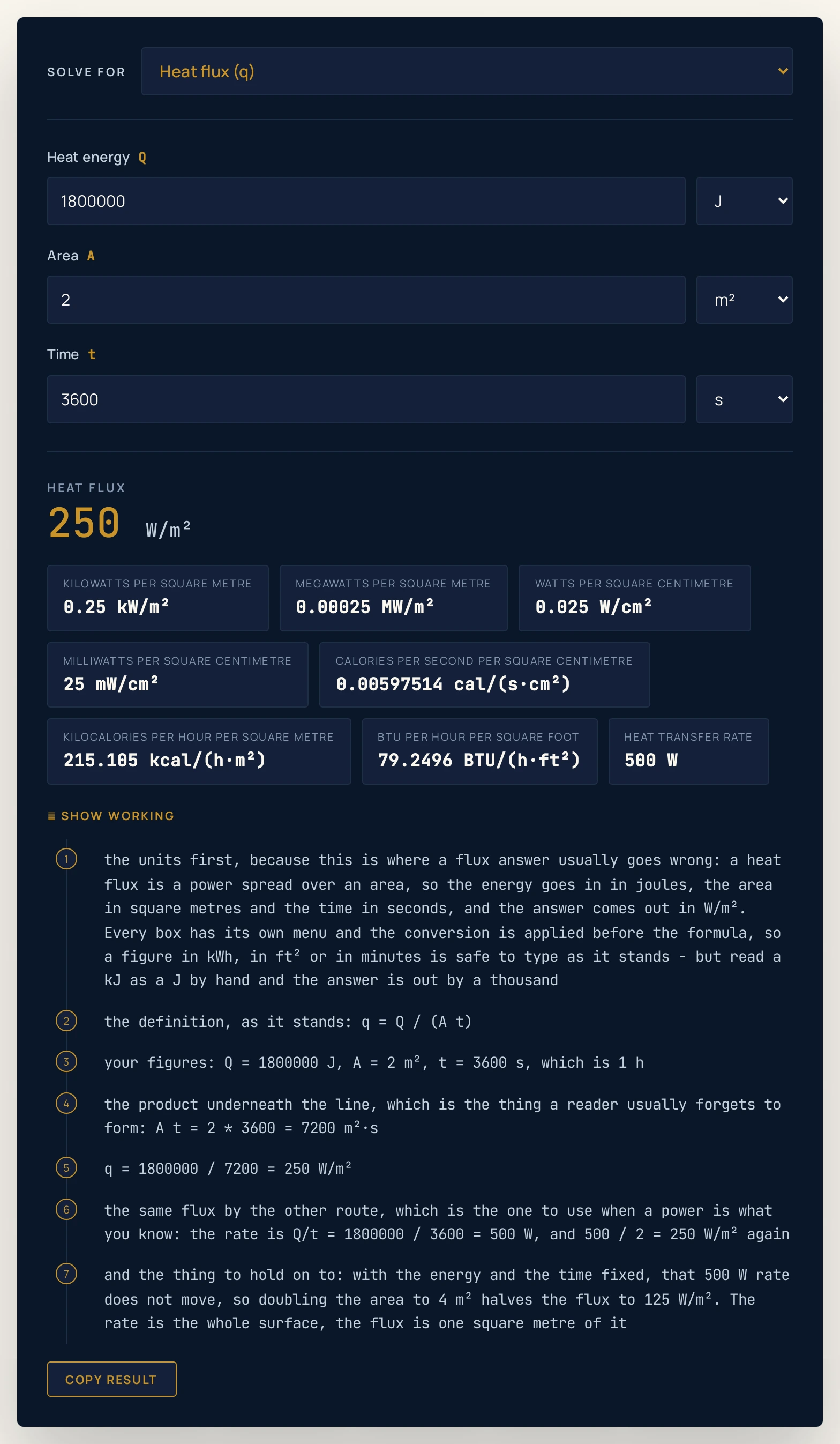
Q = 1.8 MJ, A = 2 m2 and t = 1 h. Those three were chosen because every direction is exact: the flux is exactly 250 W/m2, the rate is exactly 500 W, and solving back for the energy, the area or the time returns 1800000 J, 2 m2 and 3600 s exactly.Worked example: change one thing at a time
The table holds the energy at 1.8 MJ and the time at one hour and changes nothing but the area. Every Headline and chip cell was read out of the running widget rather than worked out by hand. Where a cell and the tool ever part company, believe the tool.
| Area (square metres) | Headline flux (W/m²) | Kilowatt chip | BTU chip | Heat transfer rate chip |
|---|---|---|---|---|
| 1 | 500 | 0.5 kW/m² | 158.499 BTU/(h·ft²) | 500 W |
| 2 | 250 | 0.25 kW/m² | 79.2496 BTU/(h·ft²) | 500 W |
| 4 | 125 | 0.125 kW/m² | 39.6248 BTU/(h·ft²) | 500 W |
| 8 | 62.5 | 0.0625 kW/m² | 19.8124 BTU/(h·ft²) | 500 W |
| 10 | 50 | 0.05 kW/m² | 15.8499 BTU/(h·ft²) | 500 W |
| 20 | 25 | 0.025 kW/m² | 7.92496 BTU/(h·ft²) | 500 W |
One column moves and one refuses to. Twenty times the area gives a twentieth of the flux, exactly — 500 to 25 W/m2 — while the rate chip reads 500 W on every single row. The energy and the time are what is being held fixed here, and that is the whole reason the flux moves at all.
The first row is the one worth staring at. At an area of exactly one square metre the headline reads 500 W/m2 and the rate chip reads 500 W: the same number for two different quantities, in two different units. That coincidence is where most of the confusion between a flux and a rate starts, and it disappears the moment you move off 1 m2.
Switching the Solve for menu runs the same rows backwards. From a flux of 250 W/m2 with Q = 1800000 J and t = 3600 s the area mode returns 2 m2; from the same flux and area the time mode returns 3600 s; and from the flux, the area and the time the energy mode returns 1800000 J.
Formula and symbol reference
| Symbol | What it is | Unit | On this page |
|---|---|---|---|
| q | The heat flux: the power crossing one square metre of the surface, and the quantity this page is named after. Lowercase, always | W/m2 | Box menu reads W/m², kW/m², W/cm² or BTU/(h·ft²). Headline 250 at the defaults, 500 at one square metre, 125 at the second anchor. Default 250 when it is an input. |
| Q | The heat energy that crossed the surface. Uppercase, and a different quantity from the flux — this is the total, not the per-square-metre figure | J | Box menu reads J, kJ, MJ, Wh or kWh. 1800000 J, which is 1.8 MJ, is the default; 0 is legal and gives an exact zero flux. |
| A | The area the heat crossed, measured across the flow rather than along it. Strictly positive, because the flux is a quantity per unit area | m2 | Box menu reads m², cm² or ft². 2 m2 is the default; the worked table sweeps it from 1 to 20 m2. |
| t | The time over which that energy crossed. Strictly positive, and it is the period of the transfer rather than any other elapsed time | s | Box menu reads s, min or h. 3600 s, which is one hour, is the default. |
| Q/t | The heat transfer rate through the whole surface: the flux multiplied by the area. A different quantity from the flux, in a different unit | W | A chip beside the answer, never an input: 500 W at the defaults and at every row of the worked table, because that table holds the energy and the time fixed. |
| q (converted) | The same flux, in the ladder's other seven units. Every factor is derived in the page from an exact definition rather than typed | kW/m2, MW/m2, W/cm2, mW/cm2, cal/(s·cm2), kcal/(h·m2), BTU/(h·ft2) | Seven chips beside the answer. At the defaults they read 0.25 kW/m², 0.00025 MW/m², 0.025 W/cm², 25 mW/cm², 0.00597514 cal/(s·cm²), 215.105 kcal/(h·m²) and 79.2496 BTU/(h·ft²). |
The physics: why a flux and a rate are different quantities
A heat transfer rate answers “how much power is crossing this surface?” and a heat flux answers “how hard is it crossing, per square metre?”. Dividing by the area is what turns the first question into the second, and it is also what makes the flux comparable between a surface the size of a stamp and one the size of a wall. That is the whole content of q = (Q/t) / A.
Which of the two moves when you change the area depends on what else you hold still, and this is where readers most often go wrong. This page holds the energy and the time fixed, so the rate is pinned and the flux falls as the area grows. A wall instead fixes the driving conditions — the material, the temperature difference across it and its thickness — and then the flux is the quantity that sits still while the rate climbs with the area.
That second case is worth seeing rather than reading: the Fourier's law simulator puts Heat flux q (W/m²) on its first readout card and gives you an area slider to drag, and the flux does not budge while the watts move with it. Two of its other readout cards, the resistance R and the transmittance U, are per-unit-area quantities for the same reason the flux is.
For a wall, the flux can be written straight from the material instead of from an energy: q = kΔT / d, with k the thermal conductivity, ΔT the temperature difference and d the thickness. Note that no area appears in it at all, which is exactly why the flux is the quantity that holds still there. That relation is not this calculator's job: the Fourier's law guide derives it and carries the conductivity table, while the thermal conduction calculator solves its whole-surface form Q/t = k·A·ΔT / d — which is why that tool asks for an area and answers in watts, so divide the watts it gives you by that area to return to W/m2.
The unit follows from the definition and needs no new idea. A watt is a joule per second, so a watt per square metre is J/(s·m2), and in SI base units that reduces to kg/s3. The quantity also has a direction, since heat crosses a surface one way rather than the other, which makes it formally a vector; q = Q / (A t) returns the magnitude through one surface, which is what is useful here.
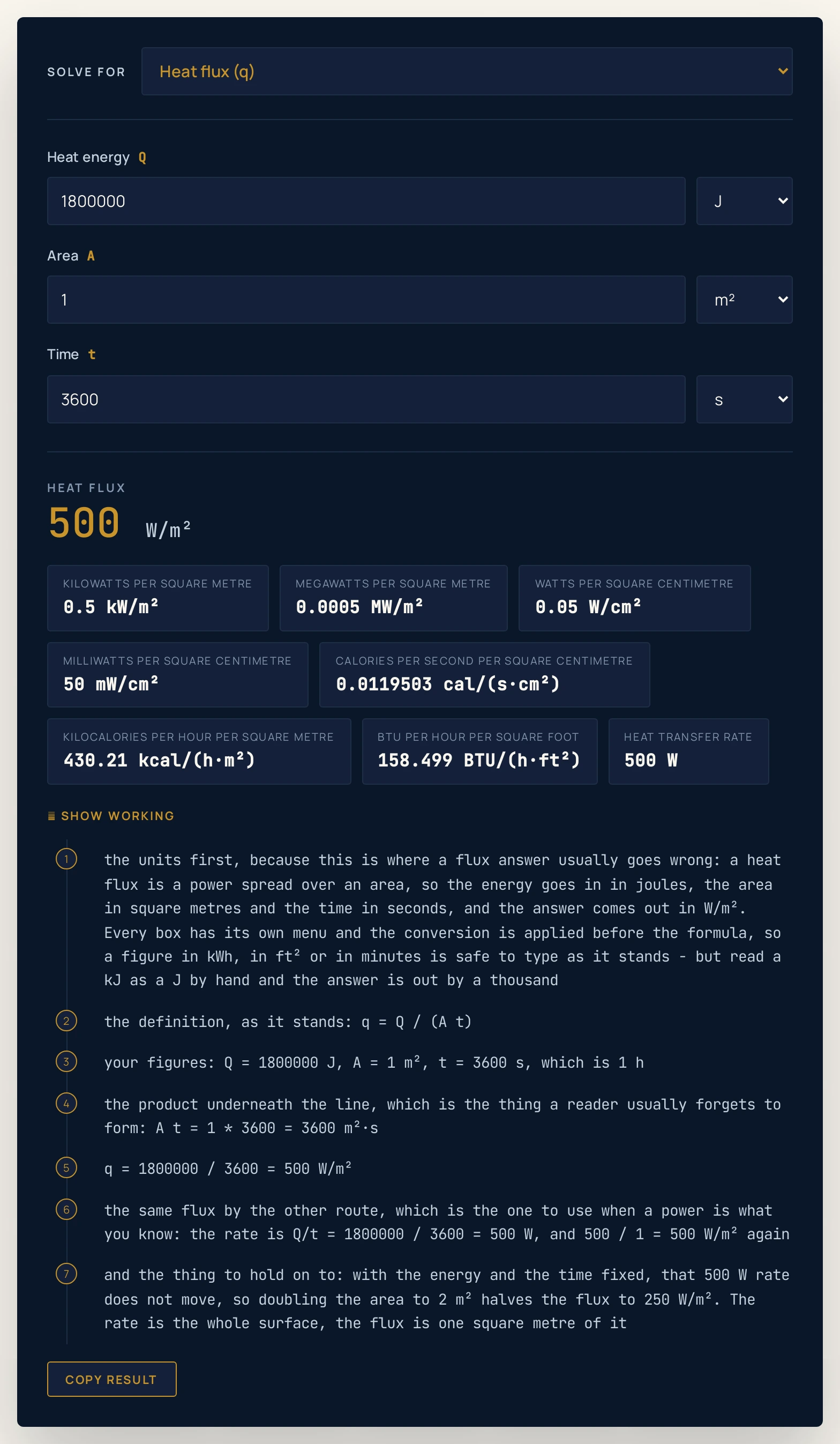
500 W/m2 and the rate chip reads 500 W — one number, two quantities. Change the area to anything other than 1 m2 and the two part company immediately.Where the heat flux calculator breaks down
- It gives you an average, not a peak
- Dividing by the area assumes the flux is the same everywhere over that area, and dividing by the time assumes it was steady throughout. Both are assumptions about your surface, not facts the calculator can check. A wall with a cold bridge in it, or a panel that was shaded for half the period, has exactly the average this page reports and a peak that is nowhere near it.
- It does not know what drove the heat
- There is no conductivity, no temperature difference and no thickness in
q = Q / (A t), so the page can say how much heat crossed but never why. For the material route use the thermal conduction calculator; for how fast a temperature change spreads rather than how much energy moves, the thermal diffusivity guide is the neighbouring quantity. - The area has to be the one the heat crossed
- The commonest wrong answer on this page comes from entering the wrong area rather than the wrong energy. It is the area measured across the flow — the face of the wall, not its volume, and not the floor area of the room behind it. If the heat leaves through several surfaces at once, each has its own flux and they do not add.
- A flux is a vector and this is only its magnitude
- Heat crosses a surface in a direction, so the full quantity carries a sign and a direction as well as a size. This page returns the magnitude through one surface and says nothing about which way it went; the sign convention, and what happens when the surface is not flat or not perpendicular to the flow, are out of its scope entirely.
- Three quantities that are easy to confuse
- A heat flux in W/m2, a heat transfer rate in W and a heat energy in J are three different quantities, and the lowercase and uppercase letters for them are not used consistently across physics. Both chips beside the answer exist to keep the first two apart on screen; the guide to heat against temperature sorts out the third, which is the distinction the
Qin this formula depends on.
Where heat flux is actually used
- Comparing two surfaces of different sizes
- A rate in watts tells you nothing about a surface until you know how big it is, which is why a flux is the figure that gets compared. At the page defaults 1.8 MJ in an hour is a 500 W rate whether it crossed 1 m2 or 20 m2, while the flux falls from
500to25W/m2 across that range. Only the second of those two numbers says how hard the surface is working. - Reading a figure given in somebody else's unit
- The same flux is quoted in W/m2, kW/m2, W/cm2, cal/(s·cm2) and BTU/(h·ft2) depending on whose document you are holding, and the factors between them are not round. The seven chips are there so that no conversion has to be looked up: 250 W/m2 is
79.2496 BTU/(h·ft²), and a figure arriving in BTU/(h·ft2) is multiplied by 3.154591 to come back. The unit conversions guide covers the general method. - Turning a metered amount of energy into a flux
- Energy is usually what gets measured, in kWh or MJ, and a flux is what gets compared, so this page is mostly used in the direction it opens in. One kilowatt hour through 4 m2 over two hours is
125W/m2 at a500 Wrate — the same rate as the defaults, from a different energy over a different time. - Working backwards to an area or a time
- The other two modes answer the questions a fixed flux poses: how much surface is needed to pass a given amount of energy, and how long a given surface will take over it. Both are a single division once the rate is in hand, which is why the working prints the rate as its own line before it divides.
- Checking an answer before checking its arithmetic
- A flux and a rate quoted as the same number should make you check the area, because they agree only at 1 m2. A flux that moved when you enlarged a wall at the same temperature difference should make you check which quantity you have. The heat transfer simulator is the place to watch conduction, convection and radiation moving energy side by side.
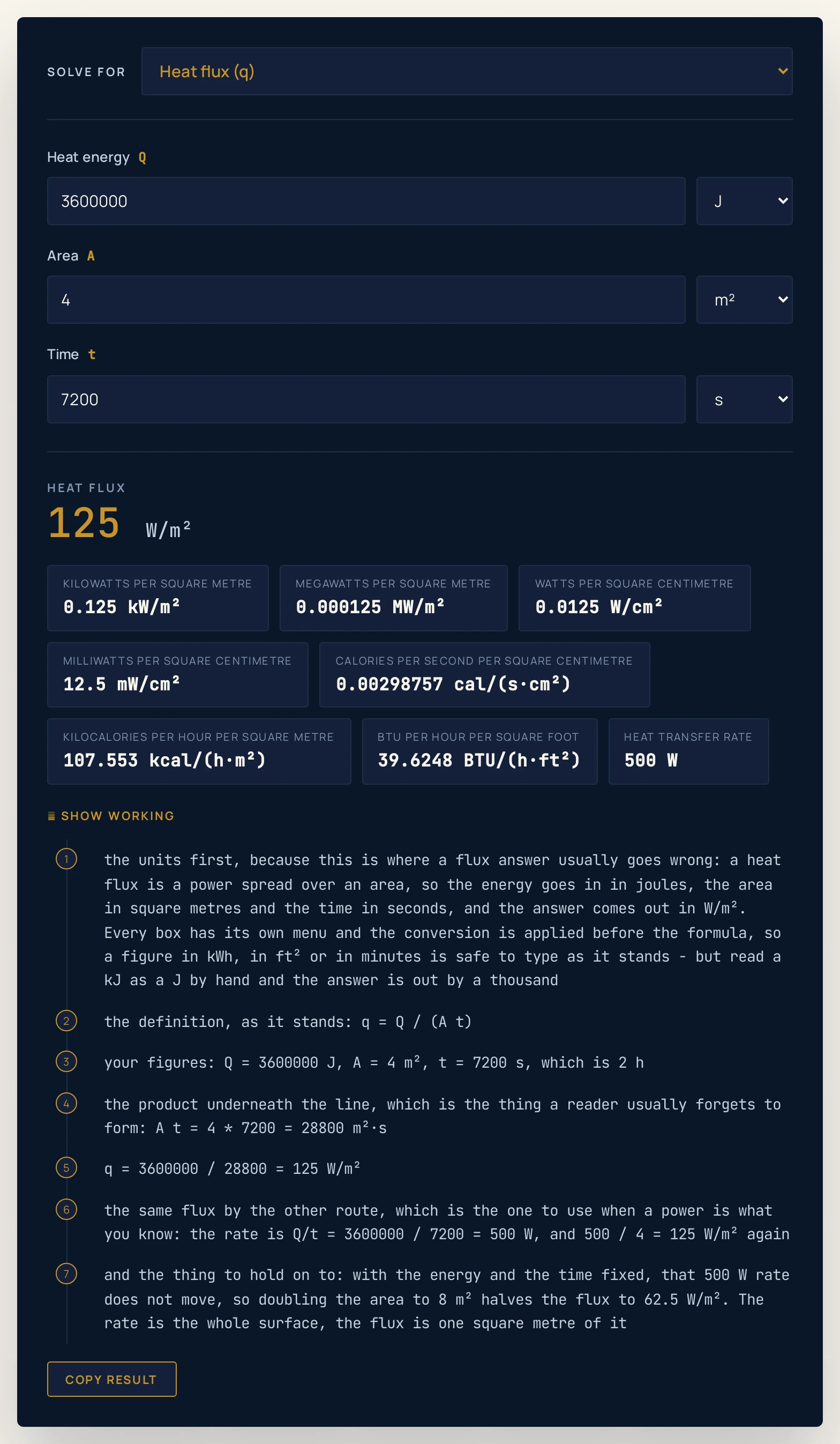
125 W/m2 — half the defaults, because the area is doubled — while the rate chip still reads 500 W. A different energy and a different time can give the same rate.Where to go next
For the definition in prose, the unit taken apart and a full set of worked problems, read the heat flux guide, which this tool is the arithmetic half of. The Fourier's law guide is where the flux through a wall comes from a material rather than from a measured energy, the guide to conduction, convection and radiation answers “a flux of what, exactly?”, and the SI units guide is where kg/s3 and the rest of the derived units are set out.
Four tools sit beside this one. The thermal conduction calculator takes the material route but reports the whole-surface rate in watts, so divide its answer by the area A to get a flux; the specific heat calculator works out the Q you would then divide; the thermal diffusivity calculator handles how fast rather than how much; and the Fourier's law simulator lets you drag the area and watch the flux hold still. The full physics lab library and the calculator index are open too.
Frequently asked questions
What is the unit of heat flux?
The SI unit is the watt per square metre, written W/m². It is a power per unit area, so it is equivalently J/(s·m²), and in SI base units it reduces to kg/s³. The calculator shows the same answer in seven other units alongside, because the figure you are given may be in kW/m², W/cm², cal/(s·cm²), kcal/(h·m²) or BTU/(h·ft²).
What is the formula for heat flux?
q = Q / (A t), where Q is the heat energy in joules, A is the area the heat crossed in square metres and t is the time in seconds. The same relation can be read as q = (Q/t) / A, which is the heat transfer rate in watts divided by the area. Both routes are shown in the working, and they give the same figure.
Is heat flux the same as the heat transfer rate?
No. The rate is a power through the whole surface and is measured in watts; the flux is a power per unit area and is measured in W/m². The two are easy to confuse because at an area of exactly one square metre they come out as the same number: enter 1.8 MJ through 1 m² in one hour and the headline reads 500 W/m² while the rate chip reads 500 W.
Does a bigger area mean a bigger heat flux?
That depends entirely on what you are holding fixed, and it is the question this page exists to answer. Hold the energy and the time fixed, as the presets here do, and a larger area spreads the same power more thinly, so the flux falls while the rate stays put. Hold the material, the temperature difference and the thickness fixed instead and the flux is unchanged while the rate rises in proportion to the area.
How do you convert W/m² to BTU/(h·ft²)?
Divide by 3.154591, or multiply by 0.316998 for the same thing. That factor is not a measurement: it follows from 1 BTU (International Table) being exactly 1055.05585262 J and 1 ft being exactly 0.3048 m, so 1 ft² is exactly 0.09290304 m². At the page defaults 250 W/m² comes out as 79.2496 BTU/(h·ft²).
What is the difference between heat flux and heat flux density?
They are two names for the same quantity. Wikipedia records heat flux density, heat-flow density and heat-flow rate intensity as alternative names for the flow of energy per unit area per unit time, and watts per square metre as its SI unit. This page uses "heat flux" throughout and the symbol q, lowercase.
Is heat flux a vector?
Yes. It has a direction as well as a magnitude, since the energy crosses the surface one way rather than the other. What q = Q / (A t) gives you is the magnitude through one surface, which is what a calculator can usefully return; the sign convention and the surface integral are a separate matter and are not treated here.
What is a typical heat flux?
This page quotes no typical value, and that is deliberate: nothing on it is a measurement. A flux depends on the material, the temperature difference and the geometry, and the same surface can carry fluxes orders of magnitude apart under different conditions. If you need a figure for work that matters, take it from a source you can cite and verify it before use.
Why does the calculator refuse some combinations?
Because some of them have no answer, and printing a number for them would be worse than saying so. An area or a time of zero has no flux behind it rather than an infinite one, and a negative energy or a negative flux is not an input. A flux of zero is refused in the area and the time modes alone, because passing a real amount of energy at no flux at all would need an infinite area or an infinite time.
Does the formula assume anything about the surface?
It assumes the flux is the same everywhere over the area and steady over the whole time. That is why it is written with a plain division rather than as a limit: what it returns is the average flux over A and over t. A surface with a hot patch and a cold patch has the same average and a quite different peak.
References & formula source
- The heat flux through a surface is computed on this page as q = Q / (A t), with Q the heat energy in joules, A the area in square metres and t the time in seconds, giving a flux in W/m². The same figure is equivalently (Q/t) / A, the heat transfer rate in watts divided by the area, and both routes are printed in the working.
- The SI unit, the alternative names and the vector character of the quantity are taken from the Wikipedia article linked below: a flow of energy per unit area per unit time, measured in watts per square metre, also called heat flux density, heat-flow density or heat-flow rate intensity, and a vector quantity. That article writes the symbol with a combining arrow above it; this page writes it as a plain lowercase q, because no font served by this site carries that combining character.
- Every unit conversion shown is derived in the page from a defined-exact value and nothing is a typed factor: 1 cm = 0.01 m, 1 ft = 0.3048 m so 1 ft² = 0.09290304 m², 1 h = 3600 s, 1 thermochemical calorie = 4.184 J, and 1 International Table BTU = 1055.05585262 J. The eight rungs are therefore 1, 1000, 1000000, 10000, 10, 41840, 1.162222 and 3.154591 W/m², and the reciprocals a reader converting into SI needs are 1 W/m² = 0.316998 BTU/(h·ft²) = 0.860421 kcal/(h·m²).
- In SI base units W/m² reduces to kg/s³, since a watt is a joule per second and a joule is a kilogram metre squared per second squared. That form is quoted because it is what the SI defines; it is not a form anyone calculates in.
- Lowercase q is the flux on this page and uppercase Q is the heat energy, which is also how /calculators/specific-heat writes that energy. The letters are not used consistently across physics or across this site, though: /calculators/water-heating and /calculators/reaction-enthalpy both use a lowercase q for the heat energy itself, in joules, so a figure copied between pages has to be checked for which quantity it is.
- q = Q / (A t) assumes the flux is uniform over the area and steady over the time, so what it returns is an average over both. A non-uniform surface has the same average and a different peak, and a flux that changes during the period is not described by it at all.
- The relation between this quantity and conduction through a wall is stated once in the body of this page, attributed and linked, and is not developed here: it belongs to /calculators/thermal-conduction and to the Fourier law guide, which carry the conductivity table and the resistance route. The resistance and the transmittance are named once, as two of the four readout cards on the Fourier simulator, and neither is calculated here.
- No measured real-world flux appears anywhere on this page - not a solar figure, not a surface, not a device - because none was sourced for it. Every input shown in a preset, a placeholder or a table is a stated given chosen so that the arithmetic is exact, and every figure printed beside an answer is a string this page produced from those givens.
- The defaults were chosen so that all four solve directions are exact: 1.8 MJ through 2 m² in 1 h is 250 W/m² and a rate of 500 W, and the round trips back to 1800000 J, 2 m² and 3600 s are exact. The second anchor, 1 kWh through 4 m² in 2 h, is 125 W/m² at the same 500 W rate.
- Halliday, Resnick and Walker, Fundamentals of Physics, chapter on temperature, heat and the first law of thermodynamics (heat transfer).
- Young and Freedman, University Physics with Modern Physics, chapter on temperature and heat (mechanisms of heat transfer).
- Further reading: Heat flux — Wikipedia