Thermal diffusivity is how fast a temperature change travels through a material, as opposed to how much heat finally flows through it. This free thermal diffusivity calculator solves alpha = k / (rho × c) four ways — for the diffusivity itself, or for the conductivity, the density or the specific heat capacity behind it. Beside the answer it prints the thermal effusivity, the volumetric heat capacity, the time the layer needs to reach 99 per cent of its steady state, the time the mid-depth is half way there, the Fourier number after one hour and the steady flux the layer passes per kelvin.
Load a real case
Each button puts the Solve for menu on the unknown that case is asking about, sets every unit menu the case names, and fills the remaining boxes. Whatever the widget then works out is read back into the line underneath, so nothing there is stored text. The six triples are idealised values that land near a published diffusivity rather than measurements of any real brick, bar or board, which is why every name carries a "-like"; the three material figures are typed to six significant figures, and the diffusivity to seven, so that a case run backwards returns exactly the figures it started from.
Pick a case above, or type your own numbers.
What Is the Thermal Diffusivity Calculator?
The thermal diffusivity calculator is a free online tool for how fast a temperature change travels through a material, rather than how much heat finally flows through it. Enter the thermal conductivity, the density and the specific heat capacity and it returns alpha = k / (rho × c) in square millimetres per second; move the Solve for menu and the same relation runs backwards for whichever of those three you are missing. Beside the answer it prints the thermal effusivity e = sqrt(k × rho × c), the volumetric heat capacity, the Fourier number after one hour, the steady flux the layer passes per kelvin, and the times the layer takes to reach half and 99 per cent of its steady state for a slab with one face stepped and the far face held.
| Symbol | Quantity | Default unit | Also accepts | Example value |
|---|---|---|---|---|
| k | Thermal conductivity | W/(m K) | mW/(m K) | 1 |
| rho | Density | kg/m3 | g/cm3 | 1995.26 |
| c | Specific heat capacity | J/(kg K) | kJ/(kg K) | 900 |
| alpha | Thermal diffusivity | mm2/s | cm2/s, m2/s | 0.5568754 |
| L | Layer thickness | mm | m | 100 |
How to use the thermal diffusivity calculator
- Choose the unknown. The Solve for menu opens on Thermal diffusivity. The other three choices are Thermal conductivity, Density and Specific heat capacity, and whichever you pick vanishes from the boxes below.
- Type the conductivity. Thermal conductivity is the figure a handbook lists in watts per metre per kelvin, and the box also takes mW/(m K) for insulation and still air. It is the only one of the three material figures that carries heat forward; the other two decide how much of it is spent warming the material on the way.
- Type the density and the specific heat capacity. These two enter only as their product, so the boxes are asking for one number in two parts. Density takes kg/m3 or g/cm3 and Specific heat capacity takes J/(kg K) or kJ/(kg K).
- Set the layer thickness. Layer thickness is never the unknown, because it is not a property of the material at all. It sets the clock: every time printed on the chips scales with the thickness squared.
- Read the answer and the chips. The headline is the quantity you asked for, carrying up to six significant figures with trailing zeros trimmed. The chips give the thermal effusivity, the volumetric heat capacity, the time to 99 per cent of steady state, the time to half at mid-depth, the Fourier number after one hour and the steady flux per kelvin, per square metre.
- Read the two times for what they are. Both belong to one boundary condition: a slab that starts at a single temperature, with one face stepped to a new one and the far face held there. A slab heated from both sides, or backed by insulation, keeps a different schedule and neither figure carries over to it.
- Compare two materials rather than reading one. Load the Still-air-like gap, note the diffusivity, then load the Stainless-like plate. The conductivity climbs by a factor of 575 and the diffusivity falls by 5.71, which is the comparison a steady-state tool has no way of showing.
- Open Show working. The steps restate the relation, list your figures in SI base units whatever the menus say, and end on the two times. Seeing 100 mm come back as 0.1 m in that second line is the quickest way to see what the conversion did.
This page starts where a steady-state tool stops. Once nothing is changing any more, the heat flow through a slab is Fourier's law and the thermal conduction calculator is the right tool, with its area, its temperature difference and its thickness. What it cannot tell you is how long the wall took to get there, because it has nowhere to put a density or a specific heat.
For the underlying law, the conductivity table and the way resistances add in series, the guide to Fourier's law of thermal conduction covers all of it, and this page assumes it. The one quantity it names and then hands on is this one. If the specific heat capacity in the denominator is the part you are unsure of, the guide to specific heat capacity defines it properly and the specific heat calculator works it out from an energy and a temperature rise.
Two mistakes account for most wrong answers here, and both are about what was typed. The first is a specific heat capacity entered per gram rather than per kilogram, which makes the material a thousand times slower than it is; the kJ/(kg K) option is there because that is how many tables print it. The second is a unit menu left on the wrong option after a preset, which the second line of Show working will always catch.
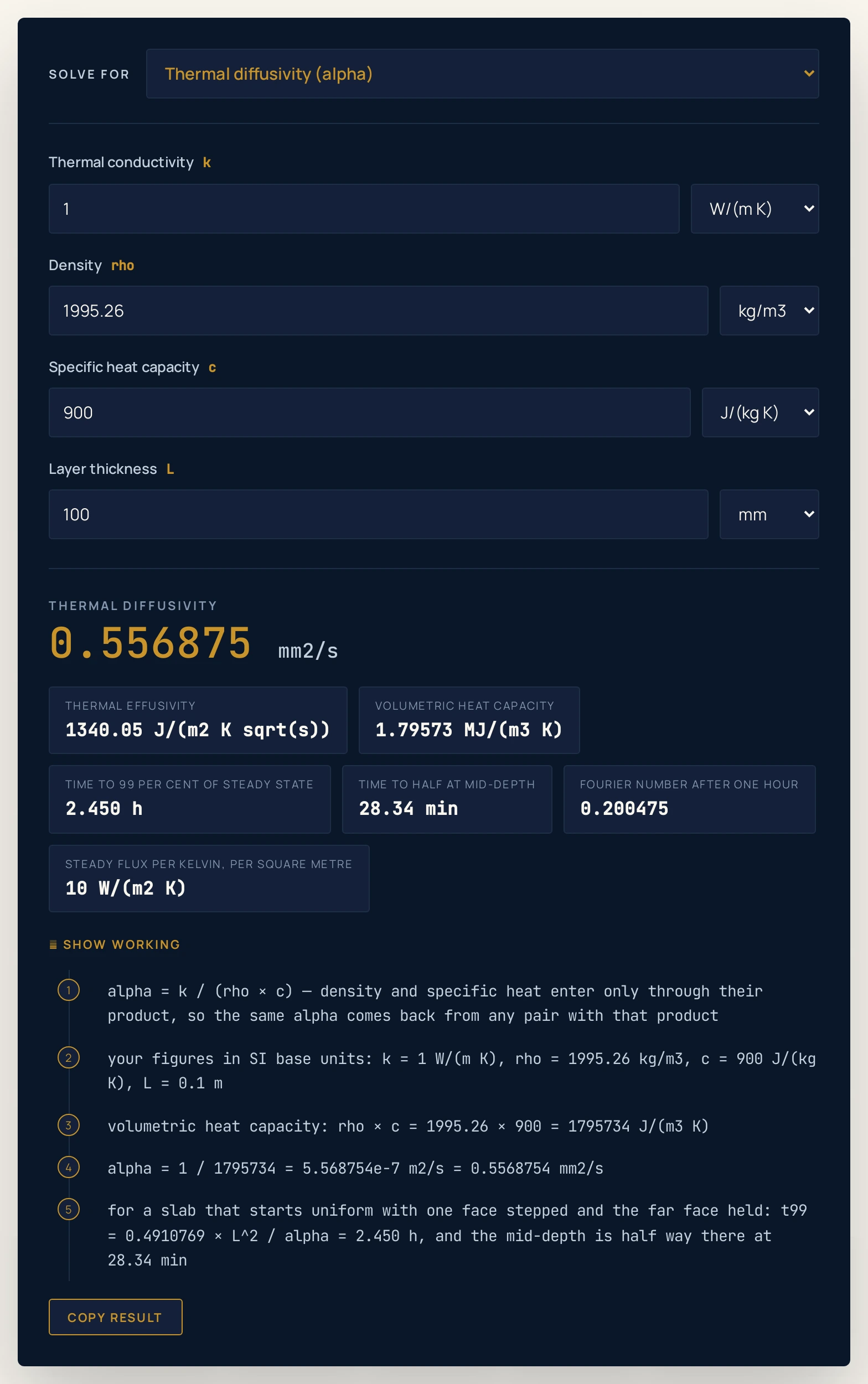
1.79573 MJ/(m3 K) chip and the 0.556875 mm2/s headline are the same arithmetic printed twice — the answer is the conductivity divided by that chip — so their agreeing confirms nothing at all.Worked example: change one thing at a time
The table starts at the defaults and moves one thing at a time: which quantity is the unknown, then the material, then the thickness, then the unit the figures are typed in. Every Result cell was read out of the running widget rather than worked out by hand, so where a cell and the tool ever part company, believe the tool. The input column is simply what you type, in the order the boxes appear.
| Step | Solving for | Case | What you type | Result | Time to 99 per cent |
|---|---|---|---|---|---|
| The page as it opens | Thermal diffusivity | Brick-like wall | 1 W/(m K), 1995.26 kg/m3, 900 J/(kg K), 100 mm | 0.556875 mm2/s | 2.450 h |
| Feed that answer back | Thermal conductivity | Brick-like wall | 0.5568754 mm2/s, 1995.26 kg/m3, 900 J/(kg K), 100 mm | 1 W/(m K) | 2.450 h |
| and again, for the density | Density | Brick-like wall | 1 W/(m K), 900 J/(kg K), 0.5568754 mm2/s, 100 mm | 1995.26 kg/m3 | 2.450 h |
| and the specific heat | Specific heat capacity | Brick-like wall | 1 W/(m K), 1995.26 kg/m3, 0.5568754 mm2/s, 100 mm | 900 J/(kg K) | 2.450 h |
| Same product, other split | Thermal diffusivity | Brick-like wall | 1 W/(m K), 997.63 kg/m3, 1800 J/(kg K), 100 mm | 0.556875 mm2/s | 2.450 h |
| A gap of still air | Thermal diffusivity | Still-air-like gap | 0.0263027 W/(m K), 1.20226 kg/m3, 1005 J/(kg K), 100 mm | 21.7689 mm2/s | 3.76 min |
| Stainless steel instead | Thermal diffusivity | Stainless-like plate | 15.1356 W/(m K), 7943.28 kg/m3, 500 J/(kg K), 100 mm | 3.81092 mm2/s | 21.48 min |
| A bar of copper | Thermal diffusivity | Copper-like bar | 398.107 W/(m K), 9120.11 kg/m3, 385 J/(kg K), 100 mm | 113.381 mm2/s | 43.3 s |
| A layer of water | Thermal diffusivity | Water-like layer | 0.60256 W/(m K), 1000 kg/m3, 4185 J/(kg K), 100 mm | 0.143981 mm2/s | 9.474 h |
| A pine board | Thermal diffusivity | Pine-like board | 0.1 W/(m K), 630.957 kg/m3, 1900 J/(kg K), 100 mm | 0.0834155 mm2/s | 16.353 h |
| The same brick, 25 mm thin | Thermal diffusivity | Brick-like wall | 1 W/(m K), 1995.26 kg/m3, 900 J/(kg K), 25 mm | 0.556875 mm2/s | 9.19 min |
| The same brick, 300 mm thick | Thermal diffusivity | Brick-like wall | 1 W/(m K), 1995.26 kg/m3, 900 J/(kg K), 300 mm | 0.556875 mm2/s | 22.046 h |
| Density typed in g/cm3 | Thermal diffusivity | Brick-like wall | 1 W/(m K), 1.99526 g/cm3, 900 J/(kg K), 100 mm | 0.556875 mm2/s | 2.450 h |
| A density of zero | Thermal diffusivity | nothing at all | 1 W/(m K), 0 kg/m3, 900 J/(kg K), 100 mm | no answer | — |
Rows 1 to 4 are one state read four different ways. Each answer returns the figure the row above it started from, so the diffusivity gives back the conductivity, then the density, then the specific heat capacity. Four unknowns, one relation, and no arrangement more fundamental than another.
That round trip is the genuine check on this page, and it is worth saying why the volumetric heat capacity chip is not. In row 1 the answer is the conductivity divided by that chip, so the two agreeing is the definition restated. Rows 2 to 4 do different arithmetic in the other direction and still land on 1 W/(m K), 1995.26 kg/m3 and 900 J/(kg K), which is a claim that can fail.
Row 5 halves the density and doubles the specific heat capacity, and the diffusivity does not move. That is algebra rather than a discovery: the two appear only as their product, and the tool is restating its own definition rather than testing it. It is still worth seeing, because it is the reason a light foam and a dense solid can share a diffusivity.
Rows 6 and 7 are the demonstration this page exists for. The still-air-like gap conducts 575 times worse than the stainless-like plate and diffuses a temperature change 5.71 times faster, so the two quantities put the same pair of materials in opposite orders. A steady-state conduction tool has no density and no specific heat capacity, so it can never show that.
Rows 8 to 10 run from the quickest of the six presets to the slowest, with the water-like layer sitting between them: a copper-like bar at 113.381 mm2/s against a pine-like board at 0.0834155, a factor of about 1359 across that pair. The times beside them say the same thing more usefully: 43.3 s against 16.353 h for the same 100 mm.
Rows 11 and 12 change only the thickness, and the headline does not move, because thickness is not a material property. The time does: 25 mm takes 9.19 min and 300 mm takes 22.046 h, which are the same 2.450 h multiplied by a sixteenth and by nine. Rows 13 and 14 are the edges — the same brick typed as 1.99526 g/cm3 returns the identical answer, and a density of zero is refused rather than answered with infinity.
Formula and symbol reference
The calculator uses one relation in four arrangements. The diffusivity is alpha = k / (rho × c), so the conductivity is k = alpha × rho × c, the density is rho = k / (alpha × c) and the specific heat capacity is c = k / (alpha × rho). The effusivity chip beside them is e = sqrt(k × rho × c), the same three properties arranged the other way round.
Those two carry everything the three do, for conduction: k = e × sqrt(alpha) and rho × c = e / sqrt(alpha). It is worth knowing because the two say opposite things about the same material — of the six presets only the copper-like bar diffuses faster than the still-air-like gap, and not one of them has an effusivity anywhere near as low as that gap's.
| Symbol | Meaning | SI unit | Values used on this page |
|---|---|---|---|
| alpha | Thermal diffusivity: how fast a temperature change travels, and the quantity this page opens on. Written with a Greek alpha in textbooks and spelled out here, because the labels beside it are uppercased by the stylesheet | square metre per second, m2/s | Boxes take mm2/s, cm2/s or m2/s: 0.556875 mm2/s on the opening brick-like wall, 113.381 for the copper-like bar, 0.0834155 for the pine-like board. |
| k | Thermal conductivity: how much heat crosses a metre of the material per kelvin of temperature difference, once nothing is changing any more. The numerator of the diffusivity | watt per metre per kelvin, W/(m K) | Boxes take W/(m K) or mW/(m K): 1 for the brick-like wall, 0.0263027 for the still-air-like gap, 398.107 for the copper-like bar. |
| rho | Density. It never acts alone here: it enters only multiplied by the specific heat capacity, and a Greek rho is what most textbooks print | kilogram per cubic metre, kg/m3 | Boxes take kg/m3 or g/cm3: 1995.26 for the brick-like wall, 1.20226 for the still-air-like gap, 1000 for the water-like layer. |
| c | Specific heat capacity: the energy it takes to raise a kilogram of the material by one kelvin. Together with the density it makes the volumetric heat capacity in the denominator | joule per kilogram per kelvin, J/(kg K) | Boxes take J/(kg K) or kJ/(kg K): 900 for the brick-like wall, 4185 for the water-like layer, 1900 for the pine-like board. |
| L | Layer thickness. The one box that is never the unknown, because it changes no material property - it sets the clock the diffusivity is measured against | metre, m | Boxes take mm or m: 100 mm throughout the presets, 25 mm and 300 mm in the two rows that show the thickness-squared law. |
| e | Thermal effusivity, the square root of k times rho times c. It decides the contact temperature at the first instant two surfaces touch, and it is printed as a chip rather than typed | J/(m2 K sqrt(s)) | Computed, never typed: 1340.05 on the opening state, 37387.8 for the copper-like bar, 346.24 for the pine-like board. |
The physics: why conductivity alone cannot tell you how long
Heat arriving at one face of a slab does two things at once: some of it moves on through the material, and some of it stays behind to warm the material it has passed. Conductivity governs the first and the volumetric heat capacity governs the second, and the speed of the front is the ratio of the two. That ratio is the diffusivity, and it is why a good conductor with a great deal of heat to absorb can be slow.
The model behind the two times on the chips is the simplest one that ends in Fourier's law. A slab starts at a single temperature; one face is stepped to a new one and the far face is held at the old one for ever. The temperature profile then climbs from flat to the straight line that the steady-state law assumes from the outset, and the whole of the transient is carried by one dimensionless group.
That group is the Fourier number, Fo = alpha × t / L2. Two different materials at the same Fourier number have identical temperature profiles, differing only in how long they took to get there, which is why the chips print one after an hour: it says where a given layer is in its own story. The thickness enters squared, so it is the most powerful thing on the page.
Mid-depth reaches 99 per cent of its final rise at Fo = 0.4911, and that number is exact algebra rather than a fit. The mid-depth series contains only odd terms, so the one-term form is wrong by the third term, a matter of 4e-20. The companion figure for the far face is a solved root rather than a closed form, and it is larger: the far face is still delivering only 98.43 per cent of its final flux when the mid-depth is 99 per cent of the way there, so temperature settles before flux does.
Both constants belong to that boundary condition and to no other. Heat the slab from both faces, insulate the back of it, or make it a cylinder, and the transient has different numbers in front of the same L2/alpha. What survives every version is the L2 itself, which is why the 25 mm and 300 mm rows of the table differ by exactly a factor of 144.
The effusivity chip answers a different question again: not how fast the front moves, but what happens in the instant two surfaces touch. Two bodies brought into contact settle their interface immediately at a temperature weighted by their effusivities, so equal effusivities meet exactly in the middle and a much more effusive body keeps the interface close to its own temperature. The copper-like bar's chip reads 37387.8 against the pine-like board's 346.24, a factor of 108, which is the honest version of the familiar observation that metal feels colder than wood at the same temperature.
None of this brings in a property the material did not already have. The same three figures make the diffusivity and the effusivity, the temperature difference cancels out of every percentage and every time on this page, and the Fourier's law simulator shows what the same slab is doing once all of it has finished happening.
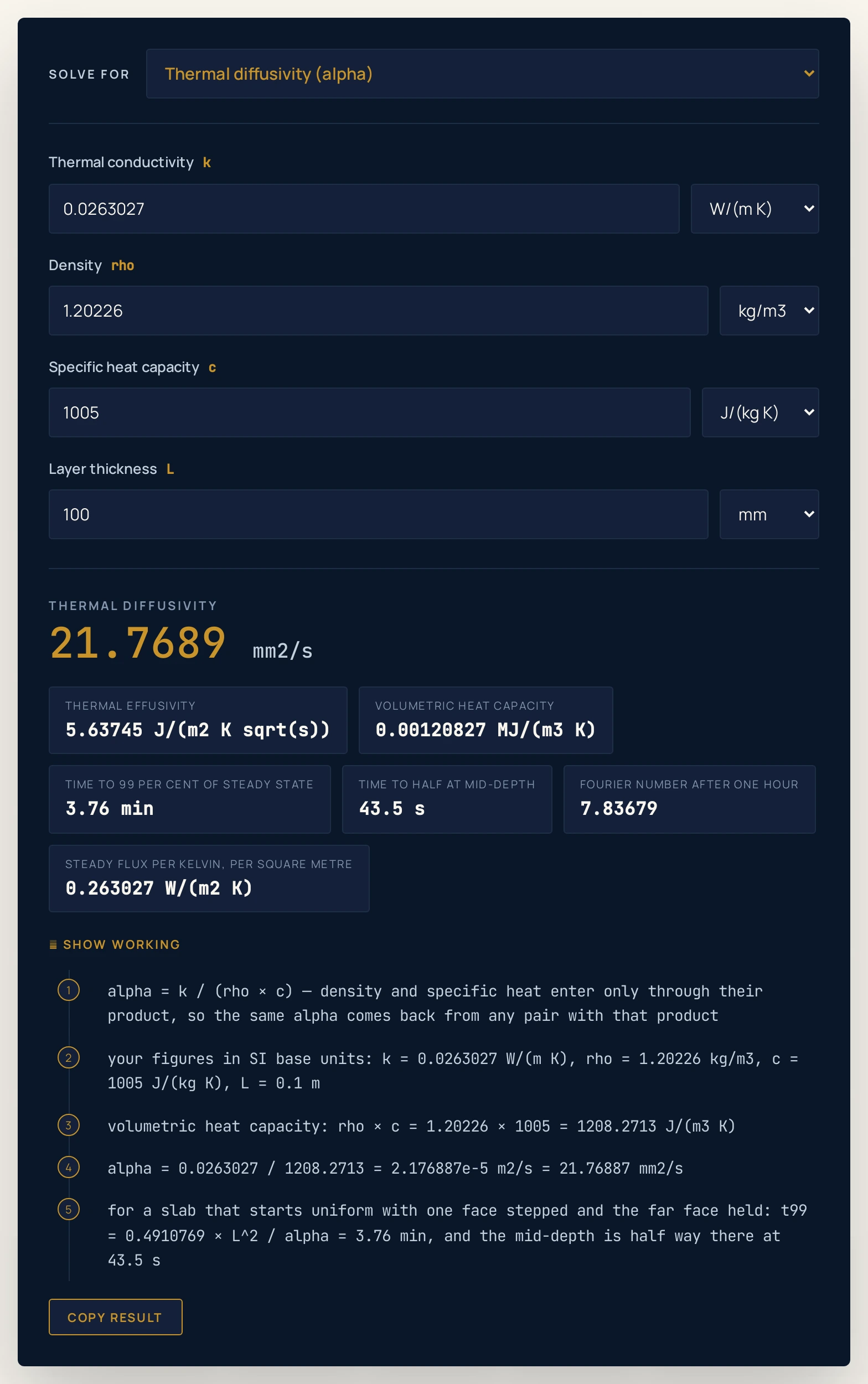
5.63745 against 7753.27, is lower by a factor of 1375.Where the thermal diffusivity calculator breaks down
The arithmetic is short and hard to get wrong. What fails is the relation being pressed onto a situation it does not describe, or a constant being carried somewhere it does not belong.
- The two times belong to one boundary condition
- A slab that starts uniform, with one face stepped and the far face held for ever. Heat it from both sides, insulate the back face, or make it a rod or a cylinder and the same
L2/alphacarries a different number in front of it. The diffusivity itself is unaffected; only the schedule changes. - Symptom: a measured time that is a fixed multiple of the figure here, rather than randomly wrong.
- The properties all move with temperature
- Conductivity, density and specific heat capacity are each functions of temperature, and the diffusivity inherits all three. Over a small range the tool is fine; over the range of a quench or a furnace it is not, and the honest approach is to run it at both ends and treat the two answers as a band.
- A layered wall has no single diffusivity
- Each layer has its own, and the transient depends on which one is on the outside as well as on the thicknesses. Running each layer alone gives the individual timescales and the slowest usually dominates, but the combination is not the average of the parts.
- Moisture changes everything at once
- Water in a porous material raises the conductivity, the density and the specific heat capacity together, and moving water carries heat in a way this relation does not model at all. A figure for dry brick says little about the same brick after a week of rain.
- Anything that melts, boils or sets breaks the specific heat capacity
- A phase change absorbs energy at constant temperature, which is a latent heat rather than a specific heat, and no single value of c describes a material passing through one. The same goes for a curing resin or a hydrating cement, where the material is generating heat of its own.
- Contact resistance and surface films are not modelled
- The model steps the face itself to the new temperature. A real surface is warmed through an air film or a joint, which delays everything by an amount this page knows nothing about, and thin fast layers are affected most.
- Wood, composites and rolled metals are not the same in every direction
- Conductivity along the grain and across it can differ by a factor of two or more, so a single diffusivity describes one direction only. Note which figure a table is quoting before you use it.
- The presets are idealised triples, not materials
- Each is chosen to land near a published diffusivity, and each lands a little off it: the still-air-like gap is 14.6 per cent above the published 19 mm2/s, and the stainless-like plate about 9 per cent below its 4.2. That is stated rather than hidden, and it is why every name carries a "-like".
- Rounded figures in, rounded figures out
- Every number printed is rounded and the arithmetic behind it is not, so multiplying two figures off the screen need not reproduce a third in its last digit. The working lines carry the intermediate products to nine figures for exactly that reason.
Where this calculator is actually used
- Typing a thickness and reading the wait off the chips
- A heavy wall delays heat rather than stopping it, and that delay is the whole reason the Layer thickness box is on the page at all. Load the Brick-like wall and the chips read 2.450 h to 99 per cent of steady state with 28.34 min to half way at mid-depth; retype the thickness as 300 mm and the first of those becomes 22.046 h while the headline does not stir.
- Putting a section thickness against a treatment time
- Whether a quenched or case-hardened section changes right through or only near its face is a question about how quickly the front crosses it, so the figure to read here is one of the times rather than the headline. Load the Stainless-like plate for 3.81092 mm2/s and 21.48 min at 100 mm, then put the section you actually have into the thickness box and read the pair again.
- Putting a food-like layer on the clock
- Most foods sit near the water-like end of the range, and the Water-like layer preset returns 0.143981 mm2/s with 9.474 h to 99 per cent at 100 mm, so the thickness of a joint counts for a great deal more than its weight. Turning the oven up does get the middle to any chosen temperature sooner; what it cannot do is shorten the time to a given fraction of the final rise, because the temperature difference cancels out of that clock — which is why no box on this page asks you for one.
- Turning a flash-method diffusivity back into a conductivity
- The standard laboratory technique pulses one face of a thin disc and watches the other, so what it measures directly is the diffusivity; the conductivity has to be rebuilt from it with a separately measured density and specific heat capacity. That is this page with Solve for moved to Thermal conductivity, which is exactly what the Copper-like bar, back to k preset sets up: 113.3807 mm2/s in, 398.107 W/(m K) out. The diffusivity box takes cm2/s and m2/s as well, because instruments do not all report in the same one.
- Reading the Fourier number to tell a transient from a settled layer
- A heat sink is sized on conductivity, but whether a short burst of power lifts a junction temperature depends on how fast the heat spreads out of it. The Fourier number after one hour chip is the quick test: the still-air-like gap reads 7.83679 and finished long ago, while the water-like layer reads 0.0518331 and has barely begun.
- Reading the effusivity chip when the question is contact
- If what you want to know is how a surface behaves in the instant something touches it, the headline is the wrong number and the Thermal effusivity chip is the right one. The physics section above sets the copper-like bar's chip against the pine-like board's for precisely that reason, and the chip is printed beside the answer in every one of the four solve modes, so you never have to switch to reach it.
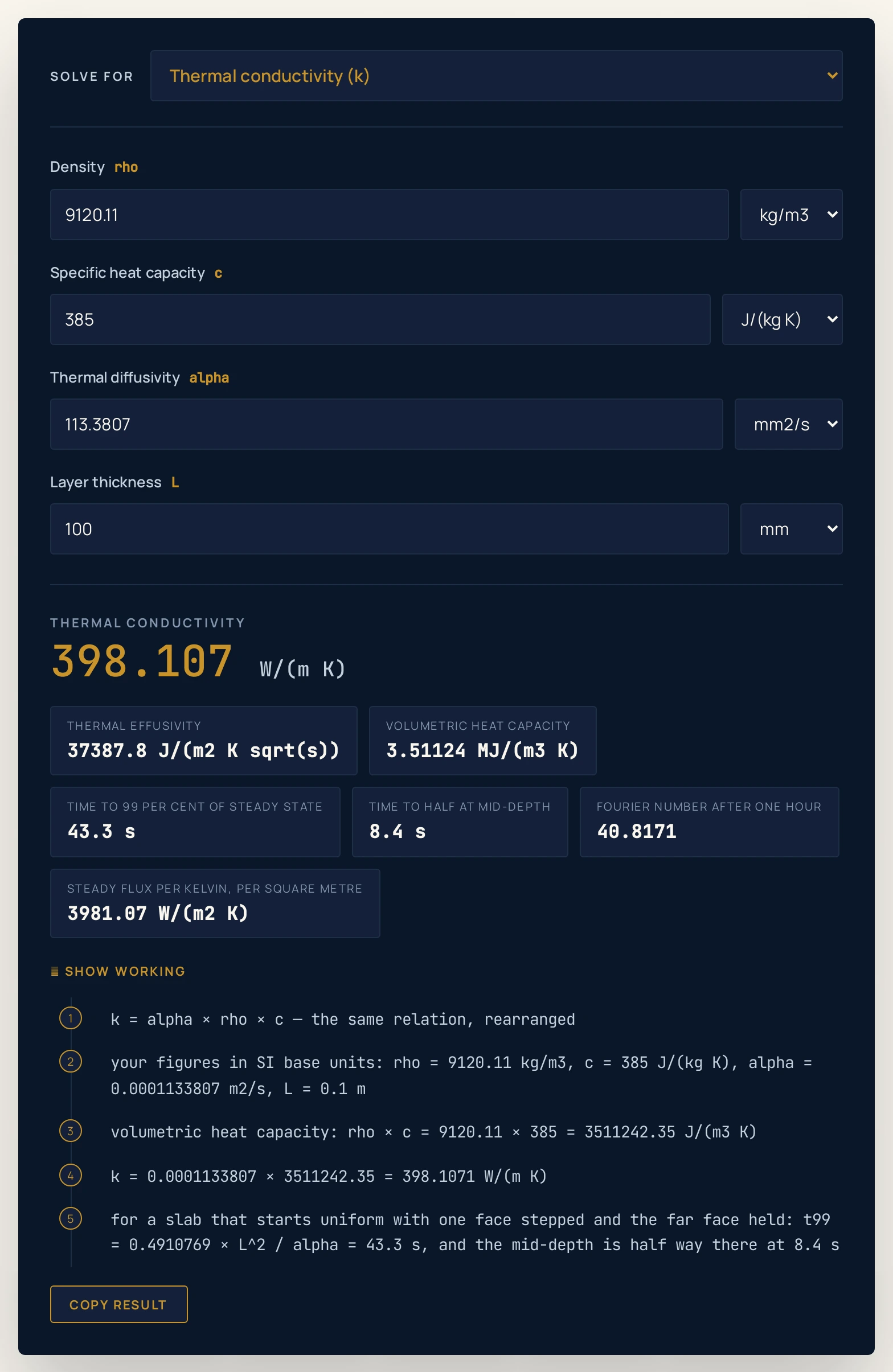
398.107 it came from; rounded to the six the headline carries, 113.381, it returns 398.108 instead.Where to go next
For the method in full, with worked problems and the diagrams that go with them, read Thermal Diffusivity: How Fast Heat Moves. For the steady state this transient ends in — the conductivity table, the R-value and how layers add up — Fourier's Law of Thermal Conduction is the place to go, with the thermal conduction calculator beside it. The specific heat calculator handles the denominator on its own, and the whole physics lab library is open if you would rather watch a temperature front than type one.
Frequently asked questions
What does the thermal diffusivity calculator actually work out?
It works out how fast a temperature change travels through a material rather than how much heat flows once things have settled. Enter the conductivity, the density and the specific heat capacity and it returns alpha = k/(rho c) in square millimetres per second, along with the effusivity, the volumetric heat capacity and the time the layer takes to reach 99 per cent of its steady state. Move the Solve for menu and the same relation runs backwards, recovering whichever one of the three material figures you are missing.
What is the difference between thermal conductivity and thermal diffusivity?
Conductivity answers how much heat flows once the temperatures have stopped changing; diffusivity answers how quickly the change gets there in the first place. They can put two materials in opposite orders, which is not a contradiction: conductivity is the numerator of the diffusivity, and the volumetric heat capacity underneath it can be larger still. Still air is the standard demonstration, since it conducts hundreds of times worse than stainless steel and diffuses a temperature change several times faster.
What units does thermal diffusivity use?
The SI unit is the square metre per second, but published tables almost always use square millimetres per second, because ordinary solids land between roughly 0.08 and 120 in those units. One square millimetre per second is a millionth of a square metre per second. The menu on this page carries all three of mm2/s, cm2/s and m2/s, and the working lines print the SI figure beside the one you asked for.
Why do the density and the specific heat capacity only appear as a product?
Because the relation contains them only that way. Their product is the volumetric heat capacity, the energy it takes to raise a cubic metre of the material by one kelvin, and that is the whole of what they contribute. Halve the density and double the specific heat and the diffusivity does not move at all; this is algebra rather than a property of any particular material, and the tool is restating the definition rather than discovering anything.
How long does heat take to get through a wall?
For a layer that starts at one temperature, with one face stepped to a new one and the far face held, the mid-depth is 99 per cent of the way to its final value at t99 = 0.4911 L squared divided by alpha. That constant belongs to that boundary condition and to no other, so a wall warmed on both faces, or one backed by insulation, is a different problem with a different constant. The thickness squared is the part that always holds: three times the thickness is nine times the wait.
What is thermal effusivity, and how is it different from diffusivity?
Effusivity is the square root of k times rho times c, and it decides how a surface behaves in the first instant of contact rather than how a slab behaves over time. Two bodies pressed together settle their interface immediately at a temperature weighted by their effusivities, so the more effusive one wins the interface. Diffusivity has the same three properties arranged the other way round, which is why the two quantities can disagree completely about which of two materials is the extreme one.
Why does the diffusivity stay the same when I change the thickness?
Because thickness is not a material property and does not appear in alpha = k/(rho c) at all. What it changes is the clock the diffusivity is measured against: the Fourier number is alpha times the time divided by the thickness squared, so the times on the chips move as the square while the headline stays put. That is exactly why thickness is an input here and never an answer.
Are the preset materials real measurements?
No, and each name carries a "-like" for that reason. Each preset is an idealised triple chosen to land near a published diffusivity, and the page states how far it lands from it, which for the air-like gap is 14.6 per cent high. Use them to see the shape of the comparison, then type your own figures from a source you trust before you rely on a number.
Why does the answer not change when I switch the density box to g/cm3?
It does change, unless you also change the number. The menus convert whatever you type into SI base units before any arithmetic happens, so 2.0 g/cm3 and 2000 kg/m3 are the same density and give the same diffusivity, while 2000 g/cm3 is a thousand times denser than most solids and shows it. The second line of Show working always restates your figures in SI, which is the quickest way to catch a menu left on the wrong option.
Can I use this for a wall made of several layers?
Not directly: a layered wall has no single diffusivity, because each layer has its own and the transient depends on the order they are in as well as on their thicknesses. Running one layer at a time gives you the individual timescales, and the slowest of them usually dominates the answer. For the steady heat flow through the finished wall, the resistances in series are the right tool rather than this one.
References & formula source
- Carslaw and Jaeger - Conduction of Heat in Solids, the chapter on the slab with one face held at a new temperature, from which the series and its Fourier numbers come.
- Incropera and DeWitt - Fundamentals of Heat and Mass Transfer, the treatment of the Fourier number and of one-term approximations to transient conduction.
- Wikipedia, "Thermal diffusivity", retrieved 21 September 2026: its table of selected materials is the published column every preset triple here was chosen to land near, and the two figures quoted above - 19 mm2/s for air and 4.2 for stainless steel 304A - are read from it.
- Every figure quoted in the text above is a string this calculator printed for the inputs named beside it. The preset triples are idealised values chosen to land near a published diffusivity and are not measurements of any particular brick, bar or board; check anything you intend to rely on against your own data.
- Further reading: Thermal diffusivity — Wikipedia