Specific heat capacity is the amount of heat energy needed to raise the temperature of one kilogram of a substance by one degree Celsius (or one kelvin). Written as Q = mcΔT, it explains why water heats slowly while metals warm fast, and is measured in joules per kilogram per degree (J/kg·°C).
You have felt this without ever naming it. Walk across dry beach sand at noon and it scorches your soles, yet the sea three steps away is cool enough to wade straight into. Same sun, same afternoon — so why the gulf between them?
The answer is a single property called specific heat capacity. It decides how stubbornly something resists a change in temperature, and once you spot it you start noticing it everywhere — in why a metal spoon burns your fingers before the soup does, and why coastal towns rarely swelter or freeze.
What Is Specific Heat Capacity?
Start with the intuition. Pour the same amount of energy into a kilogram of water and a kilogram of iron, and the iron races up in temperature while the water barely stirs. Specific heat capacity is the number that captures that difference.
More precisely, it is the quantity of heat needed to raise the temperature of one kilogram of a substance by one degree. A high value means the material soaks up a lot of energy for only a small temperature rise; a low value means it warms quickly and cools just as fast.
Crucially, the value depends on what a material is, not how much of it you have. Water sits near the top of the everyday list at 4186 J/kg·°C, while most metals are many times lower.
In short: think of it as thermal inertia — a measure of how hard it is to shift a substance’s temperature.
The Specific Heat Capacity Formula (Q = mcΔT)
One compact equation ties heat, mass and temperature together:
Every symbol carries a precise meaning and an SI unit:
- Q — the heat energy transferred, measured in joules (J).
- m — the mass of the substance, in kilograms (kg).
- c — the specific heat capacity, in joules per kilogram per degree Celsius (J/kg·°C), which is identical to J/(kg·K).
- ΔT — the change in temperature (final minus initial), in degrees Celsius (°C) or kelvin (K).
Read plainly, the formula says the heat needed equals mass times specific heat capacity times the temperature change. Double the mass and you double the heat; double the temperature jump and you double it again.
The diagram below makes the consequence vivid. Add the same 10,000 J to one kilogram of three different materials, and they warm by wildly different amounts.
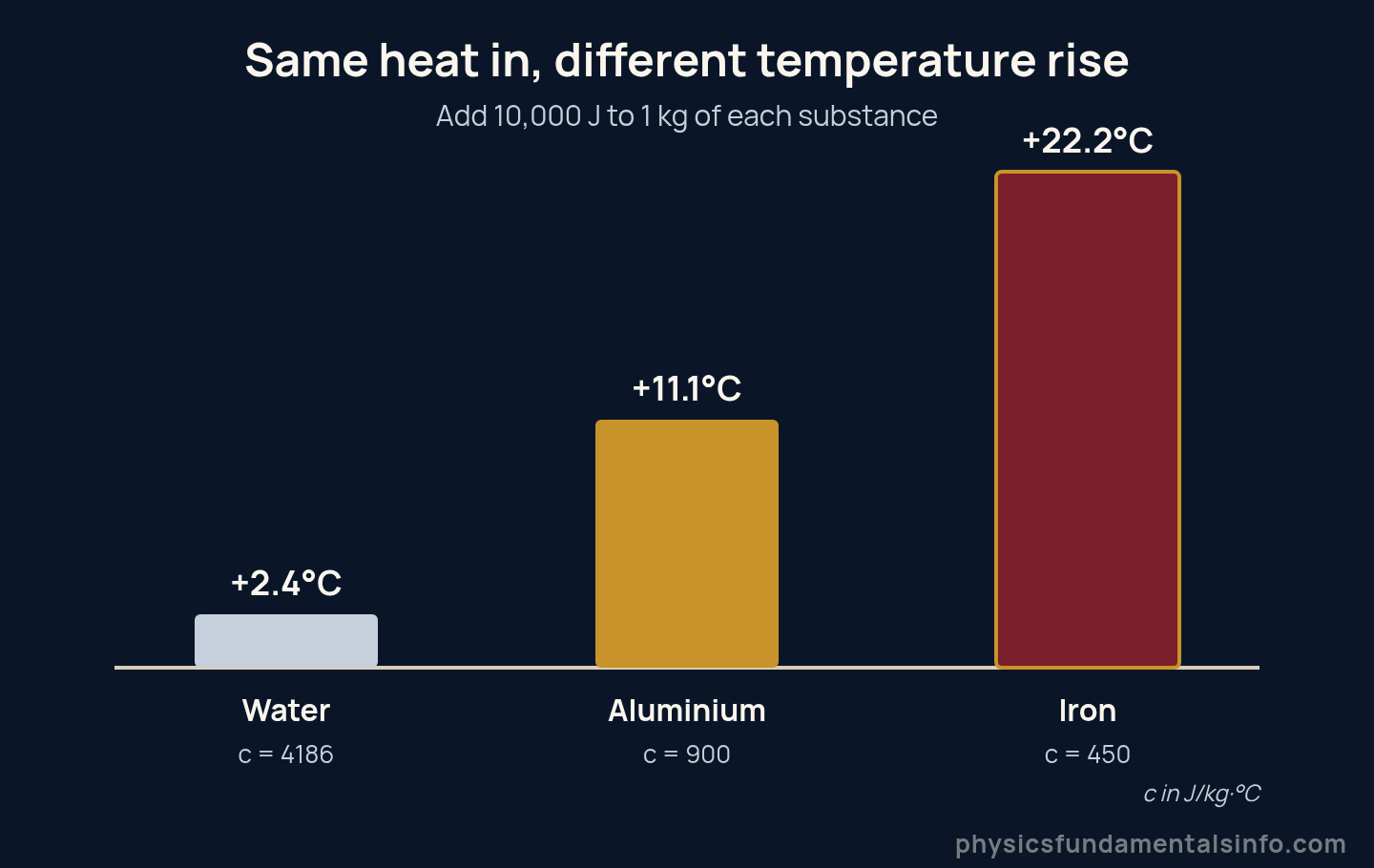
The same energy raises iron’s temperature almost ten times more than water’s — purely because iron’s specific heat is so much lower.
The same equation rearranges to find whatever quantity is missing:
- To find specific heat: c = Q / (mΔT)
- To find the temperature change: ΔT = Q / (mc)
- To find the mass: m = Q / (cΔT)
One caution before you reach for it: this formula only works while the substance stays in one state. The moment ice melts or water boils, a different rule takes over — more on that later.
How Specific Heat Capacity Works
Why should one substance be so much greedier for energy than another? The answer lives at the scale of atoms and bonds.
Heating something means handing energy to its particles, which then jiggle, stretch and move faster. Temperature tracks the average kinetic energy of that motion — the more vigorous the jiggling, the higher the reading on a thermometer.
But not all of the energy you add shows up as faster motion. In materials with many internal ways to store energy — flexible bonds, rotations, vibrations — a share of each joule slips into those hidden modes instead of raising the temperature. More storage routes mean more energy absorbed per degree, and that is exactly what a high specific heat capacity describes.
Metals are the opposite case. Their tightly packed atoms have fewer places to tuck energy away, so almost every joule goes straight into faster vibration, and the temperature shoots up.
A handy sanity check: if something feels like it heats and cools quickly — a frying pan, a car bonnet in the sun — its specific heat is almost certainly low.
Try it yourself. In the lab below, pour the same energy into equal masses of water, aluminium and iron and watch their temperatures pull apart in real time.
Specific Heat Capacity of Common Materials
The quickest way to build intuition is to line materials up side by side. The table lists approximate specific heat capacities near room temperature, alongside the everyday behaviour each value produces.
| Material | Specific heat c (J/kg·°C) | Everyday consequence |
|---|---|---|
| Water (liquid) | 4186 | Stores huge energy; moderates climate and body temperature |
| Ethanol | ~2440 | High for a liquid; slow to warm |
| Ice (≈ 0 °C) | ~2090 | Roughly half of liquid water — different state, different value |
| Air (constant pressure) | ~1005 | Warms and cools rapidly |
| Aluminium | 900 | Heats fast; common cookware base |
| Glass | ~840 (varies by type) | Responds fairly quickly to heat |
| Dry sand | ~800 | Beach surface heats fast by day, cools fast at night |
| Iron / mild steel | ~450 | Tools and pans warm rapidly |
| Copper | 385 | Excellent, fast-responding heat conductor |
| Mercury | ~140 | Very little energy needed per degree |
| Lead | 128 | Warms with almost no energy |
The values are approximate and measured near 20 °C; they shift slightly with temperature and differ between a substance’s solid, liquid and gas states. Because a one-kelvin step and a one-degree-Celsius step are the same size, J/(kg·K) and J/(kg·°C) are numerically identical.
For an authoritative cross-reference, Georgia State University’s HyperPhysics summary of specific heat tabulates many more substances.
Specific Heat Capacity vs Heat Capacity
These two terms sound interchangeable, and confusing them is one of the most common slips in thermal physics.
Specific heat capacity is a property of the material — energy per kilogram per degree. It does not care whether you have a teaspoon or a tanker of the stuff; water is 4186 J/kg·°C either way.
Heat capacity (sometimes “thermal capacity”) is a property of a particular object. It is the energy needed to warm that whole object by one degree, so it depends on both the material and how much of it there is.
The link is simple: heat capacity = mass × specific heat capacity, measured in joules per degree (J/°C). A bathtub of water has a far greater heat capacity than a cup, even though both share the very same specific heat.
Why Does Water Have Such a High Specific Heat?
Water is the quiet overachiever of thermal physics. Its specific heat dwarfs nearly every common liquid and solid — but why?
The secret is hydrogen bonding. Water molecules cling to one another through a web of these weak attractions, and a large share of any heat you add goes into loosening that web rather than speeding the molecules up.
Because energy is siphoned off into bending and breaking bonds, water demands an enormous 4186 joules to lift just one kilogram by a single degree. The same energy would raise a kilogram of iron by more than nine degrees.
That stubbornness is why oceans behave like planet-sized heat reservoirs, why your body — mostly water — holds a steady temperature, and why a hot-water bottle stays warm for hours. For the value in every unit and why sources disagree, see our full guide to the specific heat capacity of water.
Real-World Examples of Specific Heat Capacity
Why beach sand burns but the sea stays cool
Dry sand has a low specific heat (around 800 J/kg·°C), so the midday sun rockets its surface past 50 °C. The sea, with its towering 4186, absorbs the very same sunshine while barely nudging above a comfortable swimming temperature.
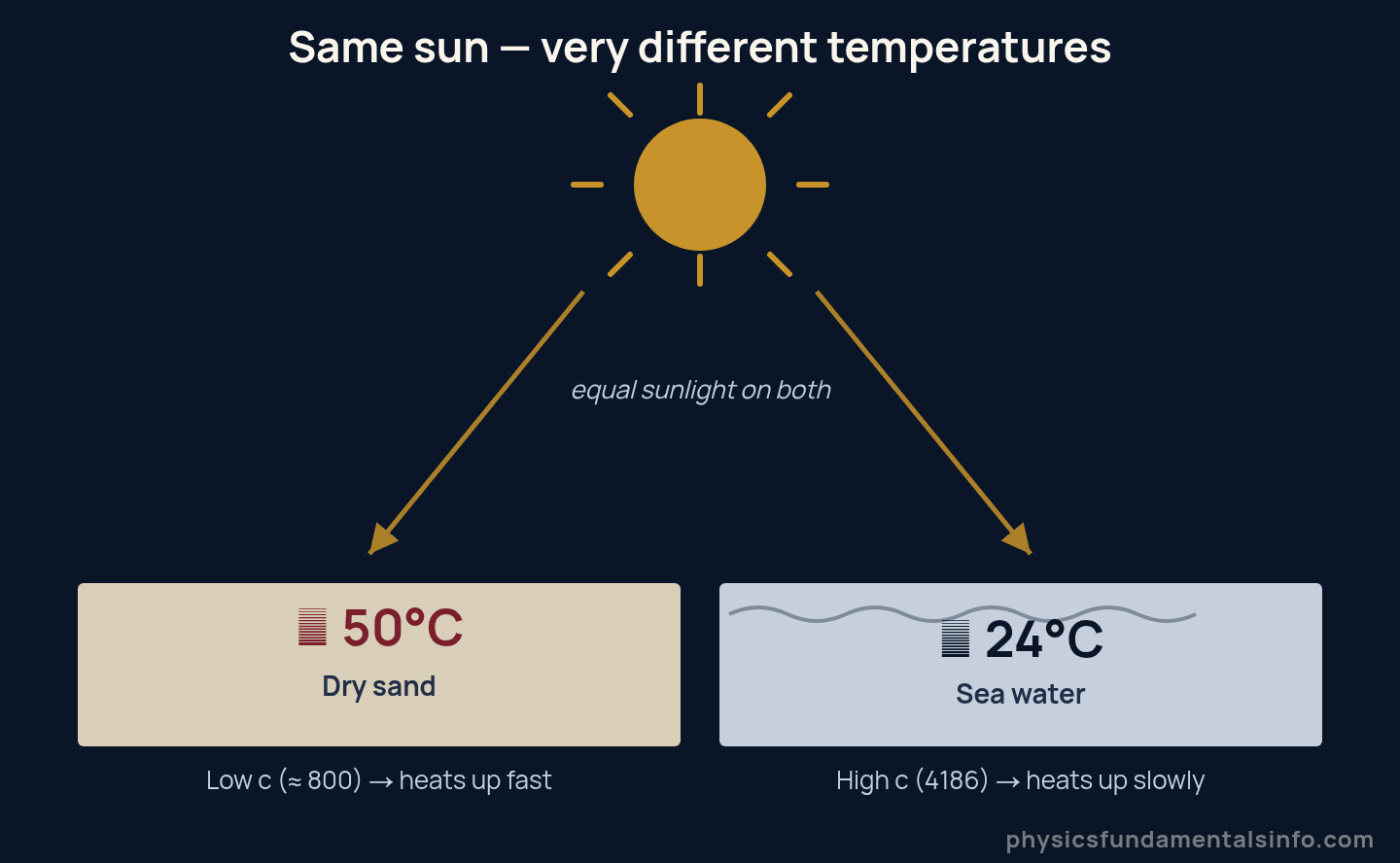
Illustrative temperatures: the same sunshine drives the low-c sand far hotter than the high-c sea.
Coastal climates stay mild
Large bodies of water warm and cool slowly, acting as a thermostat for the land beside them. Coastal towns enjoy milder summers and gentler winters than inland places at the same latitude, simply because the nearby sea resists rapid temperature swings.

Cooking and cookware
Fill a pan with water and it takes minutes to boil, because water hoards energy. The metal pan around it, with a far lower specific heat, heats almost instantly — which is exactly why a forgotten metal handle can scald your hand while the water inside is still merely lukewarm.
Engine coolant and car radiators
Car engines run dangerously hot, so the coolant pumped around them is mostly water for good reason. Its high specific heat lets it carry away a great deal of waste heat for only a modest rise in its own temperature, then shed that heat as it flows through the radiator.
Common Misconceptions About Specific Heat Capacity
“Heat and temperature are the same thing”
They are not. Heat is energy in transit; temperature measures how energetic the particles already are. A lukewarm swimming pool holds vastly more thermal energy than a cup of boiling water, despite its far lower temperature — a distinction worth pinning down by reading up on the difference between heat and temperature.
“A high specific heat means it heats up fast”
It is the reverse. A high value means the material resists temperature change, soaking up lots of energy for each single degree — so it heats slowly and cools slowly. The low-c materials are the speedy ones.
“Bigger objects have a higher specific heat”
Size has nothing to do with it. Specific heat is measured per kilogram, so an iron nail and an iron girder share exactly the same value. What changes with size is the object’s total heat capacity.
“Specific heat never changes”
It shifts with temperature and, more dramatically, with state. Ice, liquid water and steam all have different specific heats, and for gases the value even depends on whether the pressure or the volume is held constant.
How Specific Heat Capacity Relates to Thermal Energy and Latent Heat
Specific heat capacity does not work alone — it sits among a small family of thermal ideas worth learning together.
The Q in the formula is a slice of energy measured in joules, so a firm grasp of energy in physics makes the whole topic click. Heat, after all, is simply energy that flows because of a temperature difference.
There is also a hard limit on the formula. Q = mcΔT holds only while a substance stays in one state. The instant ice melts or water boils, the temperature stops climbing even as energy keeps pouring in — that hidden energy is called latent heat, and it follows a separate rule entirely.
Worked Problems
Show Solution
Solution:
Step 1: Use Q = mcΔT.
Step 2: Substitute the values — Q = 2 kg × 900 J/kg·°C × 50 °C.
Step 3: Multiply — Q = 90,000 J.
Answer: 90,000 J = 90 kJ.
Show Solution
Solution:
Step 1: Find the temperature change — ΔT = 100 − 20 = 80 °C.
Step 2: Apply Q = mcΔT = 0.5 × 4186 × 80.
Step 3: Multiply — Q = 167,440 J.
Answer: 167,440 J ≈ 167 kJ.
Show Solution
Solution:
Step 1: Rearrange for temperature change — ΔT = Q / (mc).
Step 2: Substitute — ΔT = 5000 / (0.2 × 385) = 5000 / 77 = 64.9 °C.
Step 3: Add to the starting temperature — 25 + 64.9 = 89.9 °C.
Answer: about 89.9 °C.
Show Solution
Solution:
Step 1: Rearrange for mass — m = Q / (cΔT).
Step 2: Substitute — m = 27,000 / (450 × 20) = 27,000 / 9000.
Step 3: Divide — m = 3.0 kg.
Answer: 3.0 kg.
Show Solution
Solution:
Step 1: Rearrange for specific heat — c = Q / (mΔT).
Step 2: Substitute — c = 11,250 / (0.5 × 50) = 11,250 / 25.
Step 3: Divide — c = 450 J/kg·°C.
Answer: c = 450 J/kg·°C, which matches iron (or mild steel).
Show Solution
Solution:
Step 1: Heat lost by the iron equals heat gained by the water — m_i c_i (200 − T) = m_w c_w (T − 20).
Step 2: Substitute — 0.3 × 450 × (200 − T) = 1.0 × 4186 × (T − 20), so 135(200 − T) = 4186(T − 20).
Step 3: Expand and solve — 27,000 − 135T = 4186T − 83,720 → 110,720 = 4321T → T = 25.6 °C.
Answer: about 25.6 °C — the water barely warms, thanks to its high specific heat.
Show Solution
Solution:
Step 1: Find the heat needed — Q = mcΔT = 1.5 × 4186 × (100 − 15) = 1.5 × 4186 × 85 = 533,715 J.
Step 2: Use power = energy ÷ time, so time = Q / P.
Step 3: Divide — t = 533,715 / 2000 = 266.9 s.
Answer: about 267 s, or roughly 4.5 minutes — a real kettle takes longer because of heat losses.