Fourier’s law states that the rate of heat conduction through a material is proportional to its thermal conductivity, its cross-sectional area and the temperature difference across it, and inversely proportional to its thickness. In one dimension it is written Q/t = kAΔT/d, giving the heat-flow rate in watts.
Rest your hand on a metal railing on a January morning and it bites. Rest it on the wooden bench beside it and nothing much happens. Same air, same temperature, wildly different sensation — and the entire difference is one number in one equation.
That number is thermal conductivity, and the equation is Fourier’s law. It is the piece of physics that decides how much heat leaks out of your walls tonight, how fast a saucepan browns an onion, and whether a processor survives its own workload. Get comfortable with it and you can put a watt figure on almost anything warm.
What Is Fourier’s Law?
Fourier’s law is the rule that fixes how fast heat flows by conduction through a solid material. It says the flow rate rises with the material’s conductivity, with the area heat can cross, and with the temperature difference driving it — and falls as the material gets thicker.
Think of it as an electrical circuit. Temperature difference is the voltage that pushes; thickness divided by conductivity is the resistance that holds back; the heat-flow rate is the current that results. Physicists lean on that analogy constantly, and once you see it you cannot unsee it.
Joseph Fourier first set the law out in an 1807 memoir to the Institut de France, then published it in mature form in his 1822 Théorie analytique de la chaleur. To crack it he had to invent a new branch of mathematics along the way — Fourier series — which now underpins everything from MP3 compression to MRI scanners.
One thing to be clear about from the start: this law describes conduction only. It is silent on heat carried by moving fluids or beamed across empty space.
The Fourier’s Law Formula
The steady-state, one-dimensional form of Fourier’s law is written like this:
Every symbol, with its SI unit:
| Symbol | Quantity | SI unit | Notes |
|---|---|---|---|
| Q/t | Rate of heat transfer | watt (W) = J/s | Often written as P; it is a power, not an energy |
| k | Thermal conductivity | W/(m·K) | A property of the material, not the object |
| A | Cross-sectional area | m2 | Measured perpendicular to the heat flow |
| ΔT | Temperature difference | K (or °C) | Hot face minus cold face; a difference, so K and °C match |
| d | Thickness | m | Measured along the direction of heat flow |
Three of those four inputs scale the answer directly: double the area, double the loss. Only thickness works the other way, sitting in the denominator where it divides the loss down.
Once the physics is clear, the arithmetic is the boring part — you can hand the numbers to our Thermal Conduction (Fourier’s Law) Calculator, which also rearranges the formula to solve for k, A, ΔT or d without you doing the algebra.
Rearranging the equation
Exam questions rarely hand you the variable you want. The four rearrangements worth memorising:
- k = (Q/t)·d / (A·ΔT)
- A = (Q/t)·d / (k·ΔT)
- ΔT = (Q/t)·d / (k·A)
- d = k·A·ΔT / (Q/t)
Thermal Conductivity (k) Values for Common Materials
Thermal conductivity is the number that tells you how readily a material passes heat along, measured in watts per metre per kelvin. It is the only material-specific term in Fourier’s law, which makes it the number worth knowing by heart.
The range is enormous. Copper carries heat about 27,000 times better than silica aerogel — a spread of more than four orders of magnitude across everyday solids.
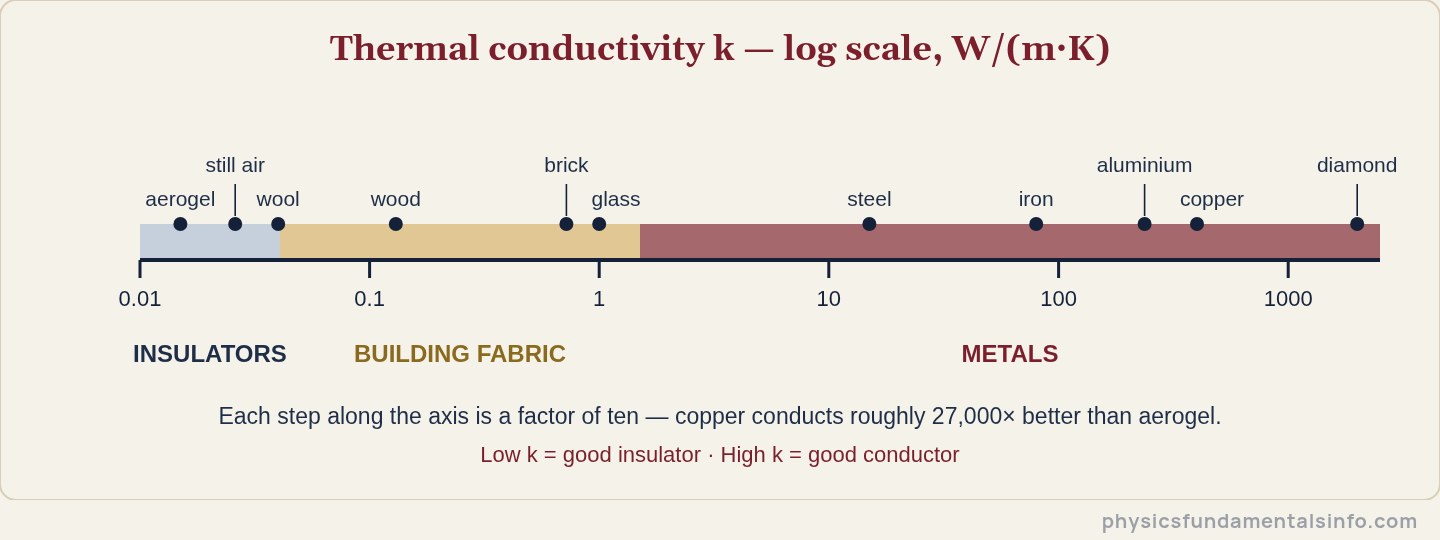
Thermal conductivity of common materials on a logarithmic scale — the single term in Fourier’s law that changes with the material.
| Material | k, W/(m·K) | Class | Why it matters |
|---|---|---|---|
| Diamond (natural) | 1000–2200 | Crystal | Best bulk conductor known; used as a heat spreader |
| Silver | 429 | Metal | Best common metal, but too costly for bulk use |
| Copper | 401 | Metal | The benchmark for heat sinks, pipes and pan bases |
| Gold | 317 | Metal | Used in electronics for corrosion resistance, not k |
| Aluminium | 237 | Metal | Light and cheap — the default heat-sink material |
| Iron | 80 | Metal | Five times worse than copper — cast iron holds heat, it does not spread it |
| Stainless steel (304) | ≈15 | Alloy | Why steel pan handles stay touchable and steel pans burn food |
| Ice (0 °C) | 2.2 | Solid | Almost four times more conductive than liquid water |
| Concrete (dense) | 1.0–1.8 | Building | Great thermal mass, hopeless insulator |
| Glass (soda-lime) | 0.8–1.0 | Building | Thin panes leak badly — see the worked problems |
| Brick (common) | 0.6–0.8 | Building | Structural, never the insulating layer |
| Water (20 °C) | 0.60 | Liquid | Roughly 23× worse than still air — wet insulation is ruined insulation |
| Plasterboard | ≈0.16 | Building | Contributes almost nothing to a wall’s resistance |
| Wood (softwood, across grain) | 0.12–0.15 | Building | Why a wooden spoon in a hot pan stays holdable |
| Mineral wool / glass-fibre batt | 0.035–0.045 | Insulation | The workhorse of loft and cavity insulation |
| EPS (expanded polystyrene) | 0.033–0.038 | Insulation | Cheap rigid board; also the coffee-cup material |
| Still air (25 °C) | 0.026 | Gas | The reason almost every insulator works at all |
| PIR / polyurethane board | 0.022–0.028 | Insulation | Beats still air — see the note below |
| Argon (glazing fill) | 0.018 | Gas | Heavier, slower molecules than air; fills good double glazing |
| Silica aerogel | 0.013–0.020 | Advanced | Nanopores stop air molecules moving freely |
Values are for room temperature, roughly 20–25 °C. Building-material figures are genuinely variable — density, moisture and manufacturer all shift them, which is why NIST maintains a whole measured database of them in its Heat Transmission Properties of Insulating and Building Materials reference collection.
Here is the detail most tables skip. PIR foam beats still air, which sounds impossible for something made of plastic and gas. The trick is that its closed cells are small enough to stop convection currents forming and they are filled with a heavy blowing gas whose fat, sluggish molecules carry less energy than nitrogen and oxygen do.
How Fourier’s Law Works
Heat conduction works because temperature is really just molecular agitation. Where a solid is hot its atoms jiggle hard about their lattice positions; where it is cool they jiggle gently. Neighbouring atoms are coupled, so the vigorous ones knock energy into the sluggish ones and the disturbance ripples along.
In metals a second, much faster channel opens up: free electrons drift through the lattice carrying energy with them. That extra channel is exactly why metals conduct both heat and electricity so well, and why the two abilities track each other so closely across the periodic table.
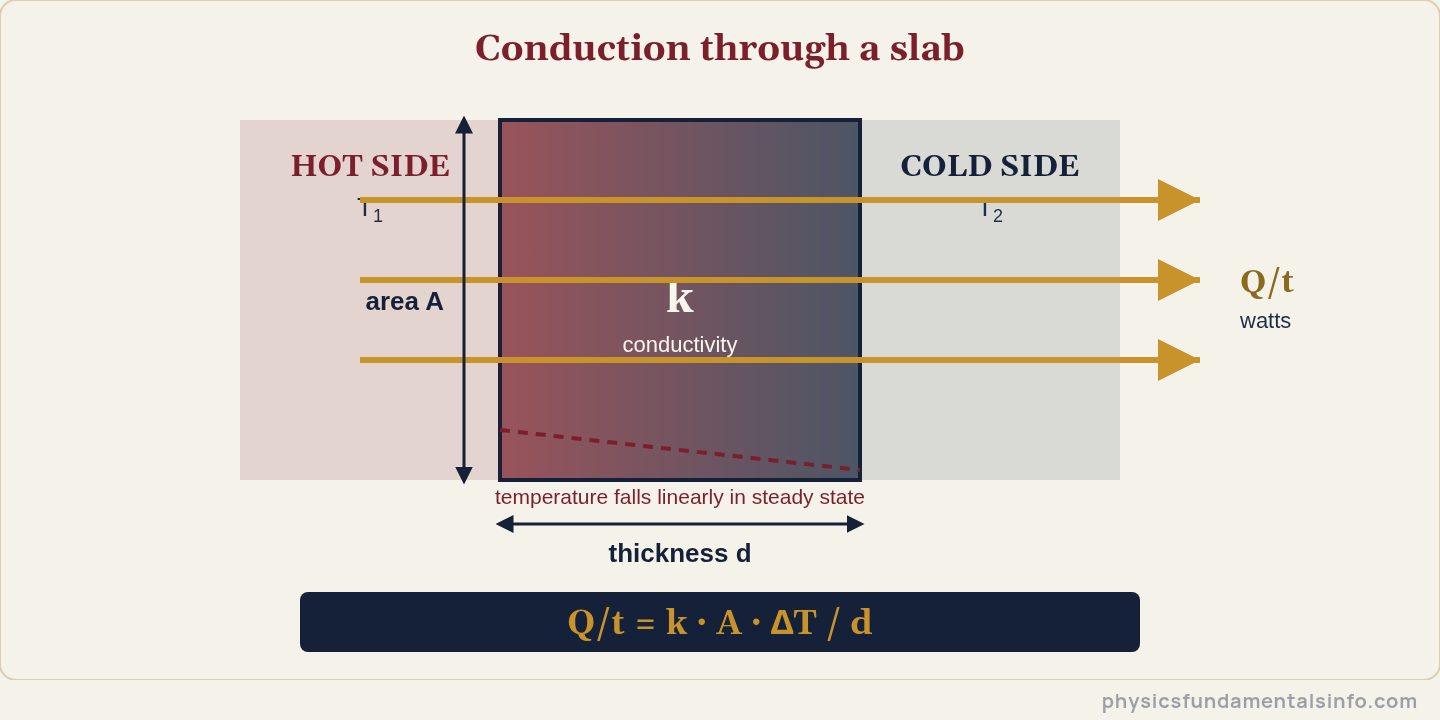
Fourier’s law for a flat slab: heat crosses area A, driven by the temperature difference and slowed by thickness d.
Why thickness divides rather than multiplies
Picture the slab as a queue heat has to shuffle through. Each extra millimetre adds another stretch of jostling to get past, so the flow slows.
What actually drives conduction is the temperature gradient — how sharply temperature changes per metre, ΔT/d. Spread the same 20-degree drop over a thicker wall and the gradient flattens, so the push at every point weakens. In its general differential form the law is written q = −k·(dT/dx), where the minus sign encodes the direction: heat always flows down the temperature gradient, never up it. MIT OpenCourseWare’s heat-transfer notes derive this form from first principles if you want the full argument (PDF).
What “steady state” actually assumes
The Q/t = kAΔT/d form applies once the temperature profile has stopped changing — the dashed line in the diagram above has settled into a straight slope. Before that, the wall is still soaking up heat and storing it.
In practice a thin metal sheet reaches steady state in seconds; a thick masonry wall can take many hours. That lag is why heavy stone buildings stay cool through a hot afternoon, and it is governed by a different quantity — thermal diffusivity — not by Fourier’s law alone.
How to Calculate Heat Loss Through a Wall
Calculating heat loss through a wall means applying Fourier’s law to each layer, adding the layers’ thermal resistances, and multiplying by area and temperature difference. Four steps get you there.
- Convert every unit to SI. Thickness in metres, not millimetres — this single slip causes more wrong answers than anything else.
- Find the thermal resistance of each layer: R = d/k, in m2·K/W.
- Add the resistances in series, plus the inside and outside surface films.
- Compute the loss: Q/t = A·ΔT / Rtotal.
R-value, U-value and how they connect to k
Insulation is rarely sold by conductivity. It is sold by R-value — thermal resistance — because resistances of stacked layers simply add up, which conductivities do not. The US Department of Energy’s Energy Saver guidance uses exactly this quantity to set recommended insulation levels by climate zone.
- R — thermal resistance of a layer, m2·K/W. Higher is better.
- U — thermal transmittance of the whole build-up, W/(m2·K). Lower is better.
- Metric R and US R-values differ: an SI R of 2.5 m2·K/W equals about R-14 in US units, a factor of roughly 5.68.
Two extra resistances belong in any honest wall calculation: thin, near-stagnant films of air clinging to each surface. The ISO 6946 standard values for horizontal heat flow are Rsi = 0.13 m2·K/W inside and Rse = 0.04 m2·K/W outside.
Those films sound trivial. For a single-glazed window they are not — they contribute far more resistance than the 4 mm of glass itself, which is precisely why Problem 2 below produces such an absurd-looking answer.
Real-World Examples of Fourier’s Law
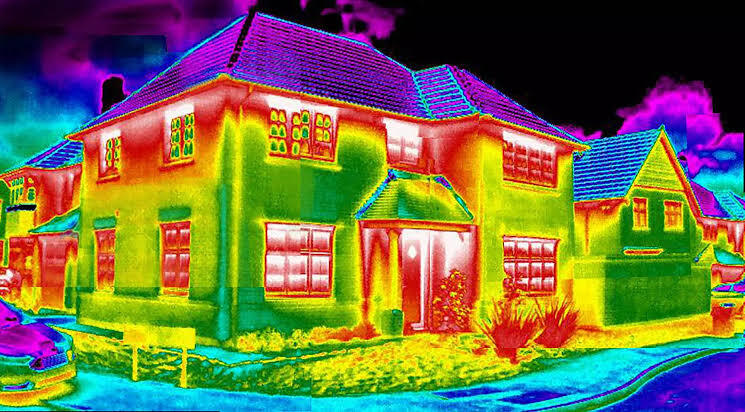
Fourier’s law shows up wherever someone wants heat to move fast — or wants it to stop. Five cases where the four variables are being deliberately tuned:
1. Cookware
A pan base is a deliberate high-k, low-d design: copper or aluminium, a few millimetres thick, so heat crosses almost instantly and no hot spots survive. The handle inverts every choice — stainless steel or wood, long and thin, so barely any heat reaches your fingers.
2. Double and triple glazing
The glass is not the insulator. A sealed 16 mm gap of argon is, at k ≈ 0.018 against glass’s ≈1.0 — a fiftyfold improvement per millimetre. The panes exist only to hold the gas still, because a gas that can circulate stops conducting and starts convecting.
3. Computer heat sinks and thermal paste
A processor pushes 100 W or more through a chip the size of a thumbnail, so d must be tiny and k enormous. Thermal paste is the unglamorous hero here: it displaces microscopic air pockets between chip and heat sink, and air at k = 0.026 would otherwise throttle the entire path.
4. Winter clothing and duvets
Down, fleece and wool are not good insulators — the air they trap is. Loft the fibres and you thicken a still-air layer; compress them and you collapse d, which is exactly why a sleeping bag insulates almost nothing underneath you.
5. Building insulation and the heating bill
Every watt Fourier’s law lets escape has to be replaced by your boiler or heat pump. Because Q/t is a power, multiplying it by hours converts it straight into kilowatt-hours and money — Problem 6 walks through that conversion.
Common Misconceptions About Fourier’s Law
“ΔT has to be converted to kelvin”
It does not, and this trips up a surprising number of students. A one-degree change on the Celsius scale is a one-kelvin change, so a difference of 20 °C equals a difference of 20 K exactly.
Contrast that with radiation, where the Stefan-Boltzmann law needs absolute temperatures raised to the fourth power. There, kelvin is compulsory. Here, only the gap matters.
“Doubling the insulation halves the heat loss”
True for a bare slab in isolation. False for a real wall, because the other layers and the surface films do not double with it.
Take the wall in Problem 7: going from 100 mm to 200 mm of mineral wool takes R from 2.89 to 5.39 m2·K/W, cutting the loss by 46% rather than 50%. Push to 400 mm and the extra 200 mm buys only another 32%. Insulation obeys steep diminishing returns.
“k is a fixed constant for each material”
Conductivity drifts with temperature, density and — above all — moisture. Water conducts about 23 times better than still air, so insulation that gets damp loses much of its point.
In practice this is why building codes specify moisture control alongside insulation, and why textbook k values are quoted at a stated temperature rather than as universal constants.
“Fourier’s law tells you how long something takes to heat up”
It does not. The law gives a rate of flow once conditions are steady, not the time to reach that state.
How quickly a temperature front moves through a material is set by thermal diffusivity, α = k/(ρc) — conductivity divided by density and specific heat capacity. A material can conduct well yet warm through slowly if it stores a lot of energy per degree.
How Fourier’s Law Relates to the Rest of Thermodynamics
Fourier’s law is one of three heat-transfer rate laws, and it only governs conduction. Heat also moves by fluid motion and by electromagnetic waves, each with its own equation — our guide to conduction, convection and radiation sets the three side by side.
It also sits downstream of a deeper principle. The second law of thermodynamics insists heat flows from hot to cold and never spontaneously back; Fourier’s law simply puts a number on how fast. That is what the minus sign in q = −k·(dT/dx) is quietly enforcing.
Two more connections are worth holding onto. Fourier’s law concerns energy in transit, which is why the distinction between heat and temperature matters so much here — temperature difference is the driver, heat is what moves. And because Q/t is measured in watts, every answer you get is a power, directly comparable to a light bulb or a kettle.
Worked Problems
Show Solution
Solution:
Step 1: Use Fourier’s law, Q/t = k·A·ΔT / d.
Step 2: Convert thickness to metres: d = 5.0 mm = 0.0050 m. ΔT = 103 − 100 = 3.0 K.
Step 3: Q/t = (237 × 0.030 × 3.0) / 0.0050 = 21.33 / 0.0050.
Answer: 4.3 × 10³ W (about 4.3 kW)
Sanity check: a domestic hob ring delivers 1–3 kW, so a 3-degree gradient is more than enough to carry it. That is why the base can be thin and the water still boils.
Show Solution
Solution:
Step 1: Q/t = k·A·ΔT / d, with d = 4.0 mm = 0.0040 m and ΔT = 15 K.
Step 2: Q/t = (1.0 × 1.5 × 15) / 0.0040 = 22.5 / 0.0040.
Step 3: Q/t = 5625 W.
Answer: 5.6 × 10³ W
Comment: no real window loses 5.6 kW. The calculation assumed the glass surfaces themselves sit at 20 °C and 5 °C, but the still-air films either side hold most of the resistance, so the true glass-surface ΔT is only a fraction of a degree. Glass is such a poor barrier that the air does the insulating.
Show Solution
Solution:
Step 1: Rearrange Fourier’s law for k: k = (Q/t)·d / (A·ΔT).
Step 2: Substitute with units: k = (25 W × 0.0050 m) / (0.020 m2 × 50 K).
Step 3: k = 0.125 / 1.00 = 0.125 W/(m·K).
Answer: k = 0.13 W/(m·K) to 2 s.f.
That sits between wood and plasterboard, which is a plausible value for a rigid plastic.
Show Solution
Solution:
Step 1: Rearrange for thickness: d = k·A·ΔT / (Q/t).
Step 2: Substitute: d = (0.040 × 10 × 20) / 50 = 8.0 / 50.
Step 3: d = 0.16 m.
Answer: d = 0.16 m (160 mm)
In practice loft insulation is laid far thicker than this — typically 270–300 mm — because the target loss is much lower than 50 W and because settling reduces the effective depth.
Show Solution
Solution:
Step 1: Layers in series add their thermal resistances, R = d/k.
Step 2: R(brick) = 0.100 / 0.72 = 0.1389 m2·K/W. R(EPS) = 0.100 / 0.035 = 2.857 m2·K/W. R(total) = 2.996 m2·K/W.
Step 3: Q/t = A·ΔT / R(total) = (15 × 20) / 2.996 = 300 / 2.996 = 100.1 W.
Step 4: Heat flux q = ΔT / R(total) = 20 / 2.996 = 6.68 W/m2. Drop across brick = q × R(brick) = 6.68 × 0.1389 = 0.93 K. Drop across EPS = 6.68 × 2.857 = 19.07 K.
Answer: Q/t = 100 W; about 0.9 K falls across the brick and 19.1 K across the insulation
The 100 mm of insulation does 95% of the work. Identical thicknesses, twentyfold difference in effect.
Show Solution
Solution:
Step 1: Energy = power × time, so E = (Q/t) × t.
Step 2: In SI: E = 100.1 W × 86,400 s = 8.65 × 10⁶ J = 8.65 MJ.
Step 3: In kWh: E = 100.1 W × 24 h = 2403 Wh = 2.40 kWh.
Step 4: Cost = 2.40 kWh × 0.30 = 0.72.
Answer: 8.65 MJ, or 2.40 kWh, costing about 0.72 per day
A kilowatt-hour is simply 1000 W sustained for one hour, which is 3.6 MJ. Note this is one wall only, in steady state, ignoring air leakage.
Show Solution
Solution:
Step 1: Total resistance is the sum of every layer plus both surface films.
Step 2: R(si) = 0.13; R(plasterboard) = 0.0125 / 0.16 = 0.0781; R(wool) = 0.100 / 0.040 = 2.500; R(brick) = 0.102 / 0.72 = 0.1417; R(se) = 0.04.
Step 3: R(total) = 0.13 + 0.0781 + 2.500 + 0.1417 + 0.04 = 2.890 m2·K/W.
Step 4: U = 1 / R(total) = 1 / 2.890 = 0.346 W/(m2·K).
Step 5: Q/t = U·A·ΔT = 0.346 × 20 × 21 = 145 W.
Answer: U = 0.35 W/(m2·K) and Q/t = 145 W
That U-value is typical of a modern insulated cavity wall. Note the mineral wool alone supplies 87% of the total resistance — the brick contributes under 5%.
Frequently Asked Questions
What is Fourier's law in simple terms?
What are the units of thermal conductivity?
Do I need to convert ΔT to kelvin in Fourier's law?
What is the difference between thermal conductivity and R-value?
Does doubling insulation thickness halve the heat loss?
Why does Fourier's law have a minus sign in some textbooks?
How do I convert a heat loss in watts into kilowatt-hours?
Key Takeaways
- Fourier’s law gives the steady-state conduction rate: Q/t = kAΔT/d, in watts.
- k, thermal conductivity, spans four orders of magnitude — from about 0.015 W/(m·K) for aerogel to 401 for copper.
- Area and temperature difference scale the loss directly; thickness divides it, so insulation shows diminishing returns.
- For layered walls, convert to resistances (R = d/k), add them in series, and use Q/t = A·ΔT/Rtotal.
- ΔT can be in °C or K — but the law covers conduction only, and only once conditions are steady.