Latent heat is the energy a substance absorbs or releases during a change of state — melting, freezing, boiling or condensing — without any change in temperature. It is calculated as Q = mL, where the heat energy (Q) equals the mass (m) multiplied by the specific latent heat (L), measured in joules per kilogram, of that particular phase change.
Crank up the hob under a pan of water and the temperature climbs steadily — until it reaches 100 °C. Then something odd happens. The flame is still roaring and energy is still pouring in, yet the thermometer simply refuses to move.
So where is all that energy going? It is being swallowed whole as the water turns to steam, with nothing to show for it on the dial. That hidden energy is latent heat, and it quietly runs everything from a sweaty afternoon to the raw power of a hurricane.
What Is Latent Heat?
Think about ice melting in your hand. It stays stubbornly at 0 °C the whole time it is turning to water, even though your warm palm keeps feeding it energy. The energy is clearly doing something — but it is not raising the temperature.
That “something” is the heart of latent heat. Latent heat is the energy absorbed or released when a substance changes state, with no change in its temperature. The word latent means hidden — the energy is hidden inside the rearrangement of the molecules rather than appearing as a hotter reading.
Every substance has its own latent heat, and it is usually quoted per kilogram. This per-kilogram value is the specific latent heat, given the symbol L. There are two kinds you will meet again and again: the latent heat of fusion (melting and freezing) and the latent heat of vaporisation (boiling and condensing — US spelling: vaporization).
Contrast this with ordinary heating, where adding energy makes a thermometer rise. That everyday warming is governed by specific heat capacity. Latent heat is its quieter cousin: it changes what a substance is, not how hot it feels.
The Latent Heat Formula: Q = mL
The amount of energy a phase change needs depends on just two things — how much stuff you have, and which substance it is. That gives us a refreshingly short equation.
Here is what each symbol means, with its SI unit:
- Q — the heat energy absorbed or released, in joules (J).
- m — the mass of the substance changing state, in kilograms (kg).
- L — the specific latent heat of the substance, in joules per kilogram (J/kg).
The symbol L comes in two flavours. Use Lf, the specific latent heat of fusion, for melting or freezing; use Lv, the specific latent heat of vaporisation, for boiling or condensing. For water these are about 334,000 J/kg (334 kJ/kg) and 2,260,000 J/kg (2,260 kJ/kg).
Rearranging is easy. Need the mass that a given amount of energy will melt or boil? Use m = Q ÷ L. Measuring an unknown substance’s latent heat in the lab? Use L = Q ÷ m — or work any of these out instantly with our Latent Heat Calculator.
One sign convention to keep straight: Q is positive when energy is absorbed (melting, boiling) and negative when energy is released (freezing, condensing). The size of the energy is the same in both directions — freezing 1 kg of water releases exactly the 334 kJ that melting it absorbed.
How Latent Heat Works: The Heating Curve
Why should adding energy ever not raise the temperature? The answer lives at the molecular scale. Temperature is a measure of the average kinetic energy of the molecules — essentially how fast they are jiggling and zipping about.
While a substance is melting or boiling, the incoming energy is not used to speed the molecules up. Instead it is spent prising them apart, working against the attractive forces that hold them together. That energy becomes molecular potential energy, not kinetic energy — so the speed, and therefore the temperature, holds steady.
The cleanest way to see this is the heating curve: a graph of temperature against heat added as you take a block of ice all the way to steam.
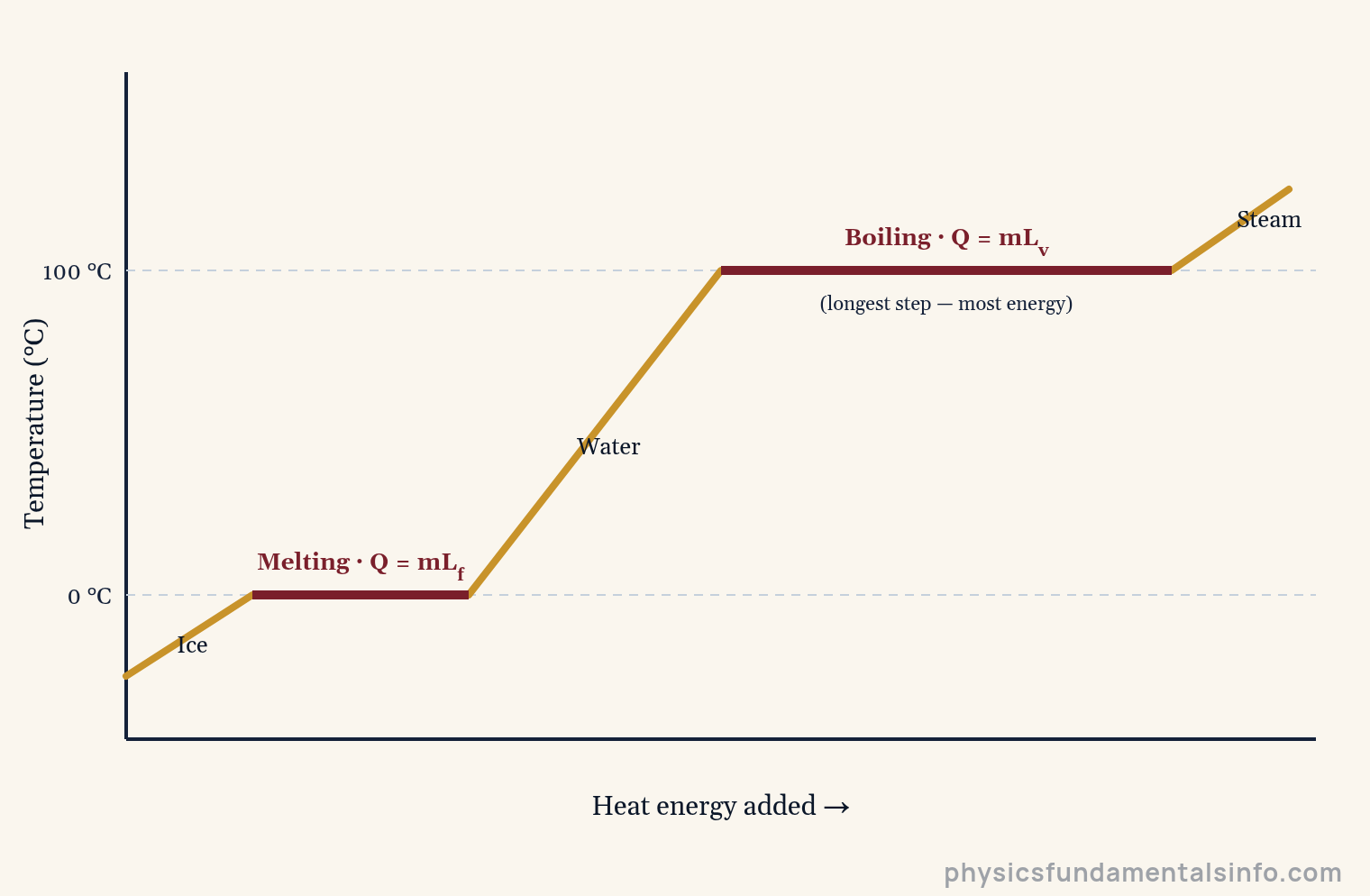
The heating curve of water. Sloped sections (specific heat) raise the temperature; the two flat plateaus (latent heat) change the state while the temperature stays put.
Read the curve left to right and the story is clear. On the sloped sections — warming the ice, then the water, then the steam — the temperature rises, and the energy follows Q = mcΔT. On the flat sections — melting at 0 °C and boiling at 100 °C — the temperature stalls, and the energy follows Q = mL.
Notice how much longer the boiling plateau is than the melting one. That width is energy, and it is your first clue that vaporisation is the far hungrier process.
Latent Heat of Fusion vs Vaporisation
The two specific latent heats describe the two big jumps between states of matter. Melting and freezing are governed by the latent heat of fusion. Boiling and condensing are governed by the latent heat of vaporisation. (A third, rarer jump — solid straight to gas, like dry ice — is the latent heat of sublimation, but fusion and vaporisation are the two you will be tested on.)
For almost every substance, vaporisation demands far more energy than fusion. Water makes the point dramatically.
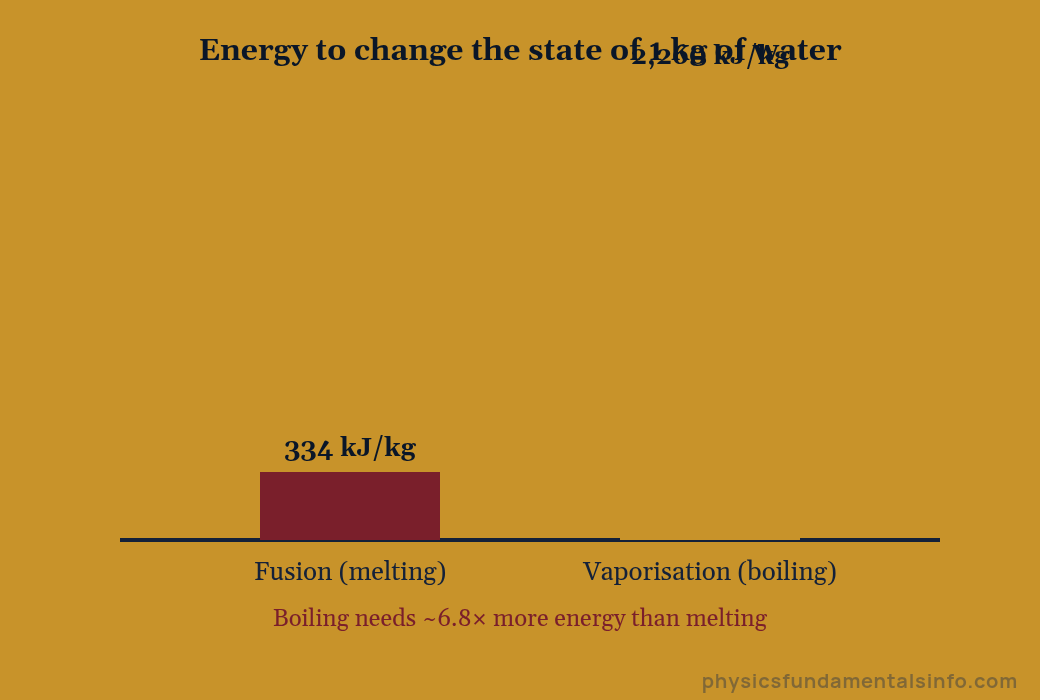
Melting 1 kg of ice takes 334 kJ; boiling 1 kg of water takes 2,260 kJ — almost seven times more.
The reason is structural. Melting only has to loosen a solid: the molecules break free of their rigid lattice but stay packed closely together. Vaporising has to fully separate them, dragging each molecule out of reach of its neighbours and pushing back the surrounding air to make room for the gas. That is a much bigger job — hence the much bigger number.
Here are typical values for some common substances. The pattern — vaporisation well above fusion, every time — is the takeaway.
| Substance | Melting point (°C) | Lf (kJ/kg) | Boiling point (°C) | Lv (kJ/kg) |
|---|---|---|---|---|
| Water | 0 | 334 | 100 | 2,260 |
| Ethanol | −114 | 108 | 78 | 846 |
| Mercury | −39 | 11 | 357 | 294 |
| Lead | 327 | 23 | 1,750 | 859 |
| Oxygen | −219 | 14 | −183 | 213 |
| Nitrogen | −210 | 26 | −196 | 199 |
Approximate values at standard atmospheric pressure; published figures vary slightly between sources.
Real-World Examples of Latent Heat
Latent heat is not a textbook curiosity — it is one of the most useful quantities in physics. Once you spot it, you see it everywhere.
Sweating keeps you cool
When sweat evaporates from your skin, it has to absorb its latent heat of vaporisation from somewhere — and that “somewhere” is you. Each gram that evaporates pulls roughly 2.4 kJ out of your body, which is why a breeze on damp skin feels so cooling.
Steam scalds far worse than boiling water
Both sit at 100 °C, so why is steam so much more dangerous? Because steam carries an extra 2,260 kJ/kg of latent heat. As it condenses on your skin it dumps all of that hidden energy into you before the water has even started to cool.
Ice keeps a drink cold
A glass chilled with ice stays near 0 °C far longer than one chilled with the same mass of cold water. The melting ice keeps soaking up latent heat of fusion from the drink, holding the temperature down until the very last sliver has melted.
Fridges, freezers and air conditioners
Every cooling appliance is a latent-heat machine. A refrigerant evaporates inside the cold compartment (absorbing latent heat from the food) and condenses outside (releasing it to the room). The phase change is doing the heavy lifting of moving heat from cold to warm.
Latent heat drives the weather
On a planetary scale, water vapour is a giant battery of latent heat. When the Sun evaporates ocean water, energy is stored; when that vapour later condenses into clouds, the energy is released — and on a colossal scale it powers thunderstorms and hurricanes. NASA describes how water vapour transports latent heat around the globe, coupling the planet’s energy and water cycles.
Why a watched pot stays at one temperature
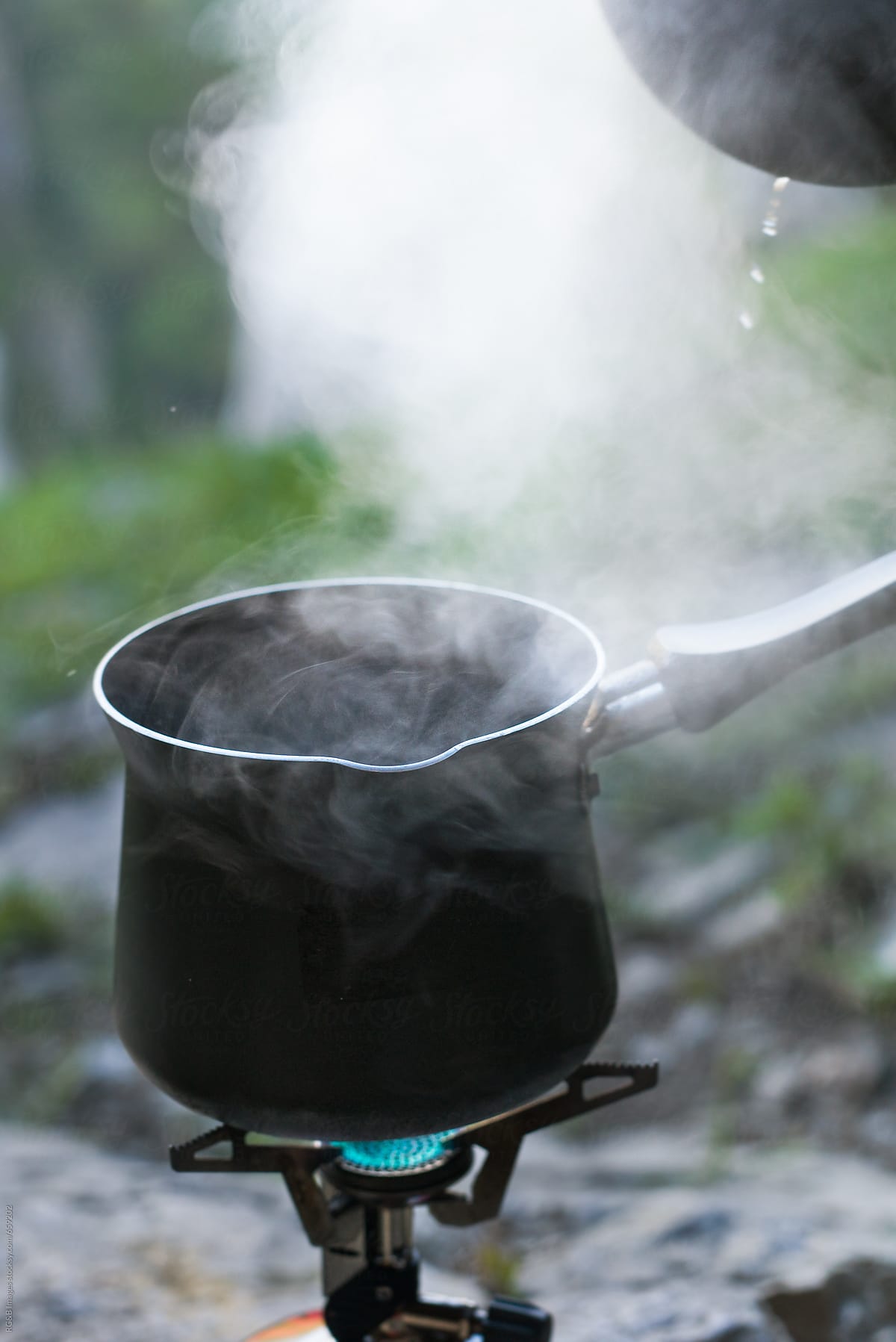
Turn the flame to maximum under boiling water and it will not climb past 100 °C (at sea-level pressure). The extra energy just boils the water away faster. This is why pasta cooks at the same temperature on a gentle simmer or a furious boil — only the speed of evaporation changes.
Common Misconceptions About Latent Heat
“Adding heat always raises the temperature.” Not during a phase change. While ice melts or water boils, the temperature holds perfectly steady even though energy is flowing in the entire time — the surest sign that heat and temperature are different things.
“A fierce flame boils water hotter than a gentle one.” At a fixed pressure, water boils at 100 °C either way. A bigger flame does not make the water hotter; it simply converts it to steam more quickly.
“Latent heat and specific heat are the same.” They are different tools. Specific heat (c) is the energy per kilogram per degree of temperature change (Q = mcΔT). Latent heat (L) is the energy per kilogram of state change, at constant temperature (Q = mL).
“Steam and boiling water at 100 °C carry the same energy.” They do not. Steam holds an extra 2,260 kJ/kg of latent heat, ready to be released the instant it condenses — which is exactly why a steam burn is so much worse than a splash of boiling water.
How Latent Heat Relates to Heat, Temperature and Energy
Latent heat sits at a crossroads of several core ideas, which is part of why it confuses people at first.
Its closest partner is specific heat capacity. The sloped parts of the heating curve obey Q = mcΔT, while the flat parts obey Q = mL — so most real calorimetry problems stitch the two formulas together. If the two ideas feel tangled, the guide to specific heat capacity pulls them apart.
It is also the cleanest demonstration of the gap between heat and temperature. You can pump heat into melting ice for minutes and watch the temperature not move — a vivid case study for the difference between heat and temperature.
Zoom in and it connects to molecular motion. Temperature tracks the molecules’ kinetic energy; during a phase change the absorbed energy becomes potential energy of separated molecules instead, so the kinetic energy — and the temperature — stay flat.
Zoom out and it is pure energy bookkeeping. By the first of the laws of thermodynamics, the latent heat absorbed shows up as increased internal energy (plus a little work done pushing back the atmosphere when a gas forms). At its root, latent heat is simply one of the many guises of energy in physics — stored quietly in the arrangement of matter.
Worked Problems
Work through these in order; they build from a single phase change up to a full heating curve and a calorimetry mixture. Useful values: Lf(water) = 334,000 J/kg, Lv(water) = 2,260,000 J/kg, c(water) = 4,186 J/(kg·K), c(ice) = 2,100 J/(kg·K).
Show Solution
Solution:
Step 1: This is a pure phase change at constant temperature, so use Q = mL with L = Lf.
Step 2: Substitute with units. Q = (2 kg) × (334,000 J/kg).
Step 3: Solve. Q = 668,000 J.
Answer: 668,000 J = 668 kJ
Show Solution
Solution:
Step 1: Constant-temperature phase change, so Q = mL with L = Lv.
Step 2: Substitute. Q = (0.5 kg) × (2,260,000 J/kg).
Step 3: Solve. Q = 1,130,000 J.
Answer: 1,130,000 J = 1.13 MJ
Show Solution
Solution:
Step 1: Rearrange Q = mL for mass: m = Q ÷ L, with L = Lf.
Step 2: Substitute. m = (50,000 J) ÷ (334,000 J/kg).
Step 3: Solve. m = 0.150 kg.
Answer: 0.150 kg = 150 g
Show Solution
Solution:
Step 1: Two stages — melt the ice (Q = mLf), then warm the water (Q = mcΔT).
Step 2: Melt: Q1 = (0.3)(334,000) = 100,200 J. Warm: Q2 = (0.3)(4,186)(100) = 125,580 J.
Step 3: Add them. Q = 100,200 + 125,580 = 225,780 J.
Answer: 225,780 J ≈ 226 kJ
Show Solution
Solution:
Step 1: Three stages — melt, warm 0 → 100 °C, then vaporise.
Step 2: Melt: Q1 = (1)(334,000) = 334,000 J. Warm: Q2 = (1)(4,186)(100) = 418,600 J. Vaporise: Q3 = (1)(2,260,000) = 2,260,000 J.
Step 3: Add them. Q = 334,000 + 418,600 + 2,260,000 = 3,012,600 J.
Answer: 3,012,600 J ≈ 3.01 MJ
Show Solution
Solution:
Step 1: Four stages — warm ice −10 → 0 °C, melt, warm water 0 → 100 °C, vaporise.
Step 2: Warm ice: Q1 = (0.2)(2,100)(10) = 4,200 J. Melt: Q2 = (0.2)(334,000) = 66,800 J. Warm water: Q3 = (0.2)(4,186)(100) = 83,720 J. Vaporise: Q4 = (0.2)(2,260,000) = 452,000 J.
Step 3: Add them. Q = 4,200 + 66,800 + 83,720 + 452,000 = 606,720 J.
Answer: 606,720 J ≈ 607 kJ
Show Solution
Solution:
Step 1: The cooling water releases heat (Q = mcΔT); that heat melts ice (Q = mLf). Set them equal.
Step 2: Heat released by water: Q = (0.2)(4,186)(50) = 41,860 J. Mass of ice melted: m = Q ÷ Lf = 41,860 ÷ 334,000.
Step 3: Solve. m = 0.125 kg.
Answer: 0.125 kg ≈ 125 g of ice melted
Show Solution
Solution:
Step 1: Steam first condenses (Q = mLv), then the resulting water cools (Q = mcΔT).
Step 2: Condense: Q1 = (0.005)(2,260,000) = 11,300 J. Cool 100 → 37 °C: Q2 = (0.005)(4,186)(63) = 1,319 J. Steam total = 11,300 + 1,319 = 12,619 J.
Step 3: Boiling water only cools: Q = (0.005)(4,186)(63) = 1,319 J. The steam delivers about 9.6 times more energy.
Answer: steam ≈ 12,600 J vs boiling water ≈ 1,300 J — nearly 10× more, which is why steam burns are far worse
In practice, the most common slip in these questions is losing track of which segment of the heating curve you are on — using Q = mL when the temperature is actually changing, or Q = mcΔT across a plateau. A quick sanity check: for the same mass of water, boiling should always cost roughly seven times more than melting. If your “melt” figure ever beats your “boil” figure, recheck your formulas.