Electric charge is a fundamental property of matter that determines how strongly it pushes or pulls on other matter through the electromagnetic force. It comes in two kinds, positive and negative, and is measured in coulombs (C). Charge is always conserved, is quantised in units of 1.602 x 10⁻¹⁹ C, and equals current multiplied by time.
Pull a jumper over your head on a dry winter morning and you hear it: that faint crackle, followed by hair standing on end. Reach for a metal door handle a moment later and a spark jumps the gap before your finger touches it.
Nothing was created in that moment. You simply moved something invisible from one place to another – and physics has been measuring that something for over two centuries.
What Is Electric Charge?
Electric charge is a fundamental physical property of matter that causes it to experience a force when placed in an electric field. It is the source of the electromagnetic interaction, one of the four fundamental forces of nature.
Charge is not a substance. You cannot bottle it, and there is no jar of pure charge anywhere in the universe. It is a property that particles carry, in the same way that mass is a property rather than a thing.
Every atom already contains enormous quantities of both kinds. A single copper penny holds roughly 1024 protons and just as many electrons, which is why it sits on your desk doing nothing electrical at all. The positives and negatives cancel exactly.
The two kinds of charge
Charge comes in exactly two varieties, and the labels we use for them are historical accidents. Benjamin Franklin, working in the 1750s, named one kind positive and the other negative long before anyone knew electrons existed.
His coin-flip guess is why the electron – the particle that actually moves in a copper wire – ended up carrying the negative label. The rule that follows from having two signs is the foundation of the whole subject: like charges repel, unlike charges attract.
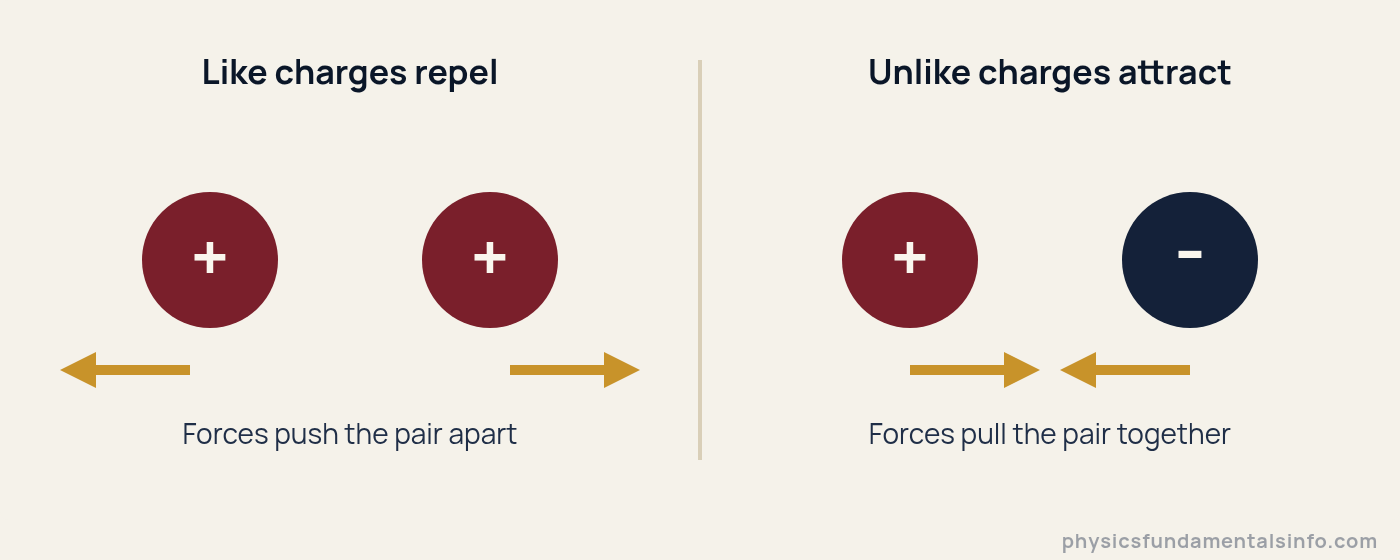
The two-sign rule of electric charge: identical signs push apart, opposite signs pull together.
The Electric Charge Formula
The everyday formula for electric charge is Q = It, where charge equals current multiplied by the time that current flows. It is simply a rearrangement of the definition of current as the rate of charge flow.
| Symbol | Quantity | SI unit |
|---|---|---|
| Q | Electric charge | coulomb (C) |
| I | Electric current | ampere (A) |
| t | Time the current flows | second (s) |
One coulomb is therefore the charge delivered by a steady current of one ampere in one second. If you want the numbers without the algebra, our Electric Current calculator will solve Q = It for whichever of the three quantities you are missing.
Counting the charge instead: Q = ne
There is a second formula, and it is the one that reveals what charge really is. Because charge only exists in whole packets, any charge is a whole number of elementary charges.
- Q – net charge, in coulombs (C)
- n – number of excess (or missing) electrons, a whole number with no unit
- e – the elementary charge, exactly 1.602176634 x 10⁻¹⁹ C
That value of e is no longer measured – it is fixed by definition. Since the 2019 revision of the SI, NIST and the international metrology community define the ampere by assigning the elementary charge an exact value, which makes one coulomb equal to about 6.24 x 10¹⁸ elementary charges.
The force between charges
Charge is only interesting because of what it does, and what it does is exert force. The size of that force follows an inverse-square law that mirrors gravity, set out in Coulomb’s law.
- F – force between the charges, in newtons (N)
- q1, q2 – the two charges, in coulombs (C)
- r – separation between their centres, in metres (m)
- k – Coulomb constant, about 8.99 x 10⁹ N m2 C-2
Drag the charges in the lab below and watch the force reading respond. Flip one charge to negative and the arrows reverse – the same equation handles both attraction and repulsion, because the sign of the product q1q2 carries the direction.
The 4 Properties of Electric Charge
Electric charge obeys four rules that no experiment has ever caught it breaking: it is conserved, quantised, scalar and invariant. Together these four properties do almost all the explanatory work in electrostatics.
1. Charge is conserved
The total charge of an isolated system never changes. Rub a balloon on your hair and you have not manufactured anything – electrons simply move from the hair to the balloon, leaving one negative and the other equally positive.
Add the two together and you get exactly what you started with: zero. This holds at every scale physicists have probed, including nuclear reactions where the particles themselves are destroyed and remade.
In beta-minus decay, a neutron becomes a proton, an electron and an antineutrino. Charge before: 0. Charge after: (+1) + (-1) + 0 = 0. The particles changed identity entirely, yet the books still balance.
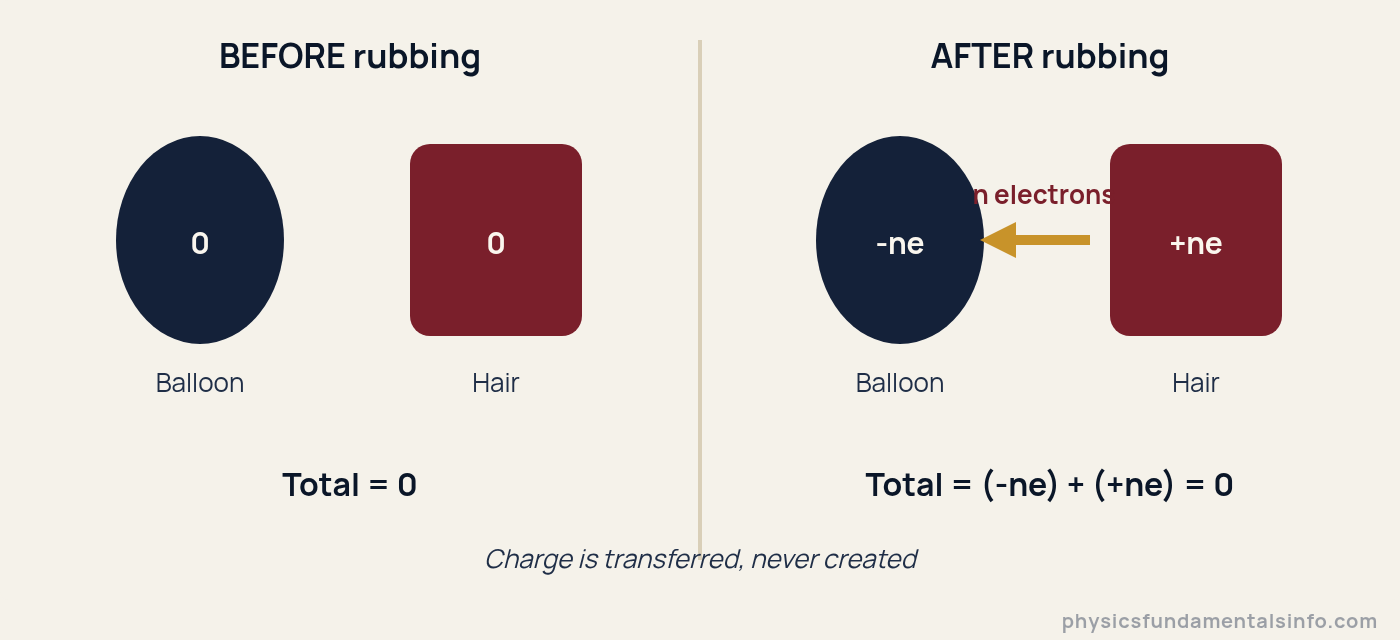
Rubbing separates charge. It never makes any, so the total before and after is identical.
2. Charge is quantised
Charge arrives in indivisible packets. You can hold 1 elementary charge or 2, but never 1.5 – and every measured charge on an isolated object turns out to be a whole-number multiple of e.
Robert Millikan and Harvey Fletcher demonstrated this in 1909 with their oil-drop experiment, balancing tiny charged droplets against gravity and finding the charges always clustered on multiples of a single tiny value.
Quarks are the famous asterisk here, carrying charges of +2/3 e and -1/3 e. They are never found alone, though: they bind into combinations whose totals always land on whole multiples of e, as our guide to quarks and the Standard Model explains.
3. Charge is a signed scalar
Charge has magnitude and sign, but no direction in space – which makes it a scalar, not a vector. That is why you add charges with ordinary arithmetic rather than with triangles and components.
Put +5 nC and -3 nC on the same conductor and the object carries +2 nC. The forces that charges produce are certainly vectors; the charge itself is not.
4. Charge is invariant
An object’s charge does not change when it moves, no matter how fast. Lengths contract and clocks run slow at relativistic speeds, yet every observer measures exactly the same charge.
This is quietly remarkable. If it were not true, a fast-moving hydrogen atom would stop being neutral, and matter would tear itself apart at high speed.
| Particle | Charge (in units of e) | Charge (C) | Found alone? |
|---|---|---|---|
| Electron | -1 | -1.602 x 10⁻¹⁹ | Yes |
| Proton | +1 | +1.602 x 10⁻¹⁹ | Yes |
| Neutron | 0 | 0 | Yes |
| Alpha particle | +2 | +3.204 x 10⁻¹⁹ | Yes |
| Up quark | +2/3 | +1.068 x 10⁻¹⁹ | No – always bound |
| Down quark | -1/3 | -0.534 x 10⁻¹⁹ | No – always bound |
How Objects Become Charged
Objects become charged when electrons are transferred between them, by friction, by conduction, or by induction. Protons stay locked in atomic nuclei, so in everyday situations it is always the electrons that move.
Charging by friction
Rub two different materials together and one of them grips electrons more tightly than the other. The greedier material ends up negative, the other positive – the mechanism behind static electricity and that winter doorknob spark.
Materials can be ranked by this appetite in a triboelectric series. Human hair sits near the electron-donating end and rubber near the electron-grabbing end, which is why a balloon rubbed on hair reliably ends up negative.
Charging by conduction
Touch a charged rod to a neutral metal sphere and charge spreads across both until they share it. Both objects end up with the same sign, because they have simply pooled what was there.
Charging by induction
Here is the subtle one. Bring a charged rod near a neutral conductor without touching, and the conductor’s own electrons shuffle – repelled to the far side, leaving the near side oppositely charged.
Earth the far side briefly while the rod is still held close, and those displaced electrons escape for good. Remove the earth, then the rod, and you are left with a charged sphere carrying the opposite sign to the rod – and the rod itself never lost a single electron.
Real-World Examples of Electric Charge
Electric charge shows up wherever electrons have been separated from the atoms they belong to, from photocopier drums to thunderclouds. Five that you meet regularly:
- Lightning. Colliding ice and graupel inside a storm cloud separate charge until the field breaks down the air. An average bolt moves only about 5 C, yet does it so fast that the current reaches tens of thousands of amperes.
- Laser printers and photocopiers. A drum is charged, then discharged by a laser wherever the page should be white. Toner sticks only to the charged regions – your document is literally printed in electrostatics.
- Spray painting cars. Paint droplets are given a charge and the car body the opposite one, so the paint wraps around edges instead of drifting past. Less waste, more even coverage.
- Fuel tanker earthing straps. Liquid flowing through a hose builds up charge by friction. A grounding strap drains it away before a spark can meet petrol vapour.
- Your phone battery. Charging pushes a fixed quantity of charge into the cell. A 3000 mAh battery holds 10,800 C, which is why capacity is quoted in amp-hours – current multiplied by time, exactly Q = It.
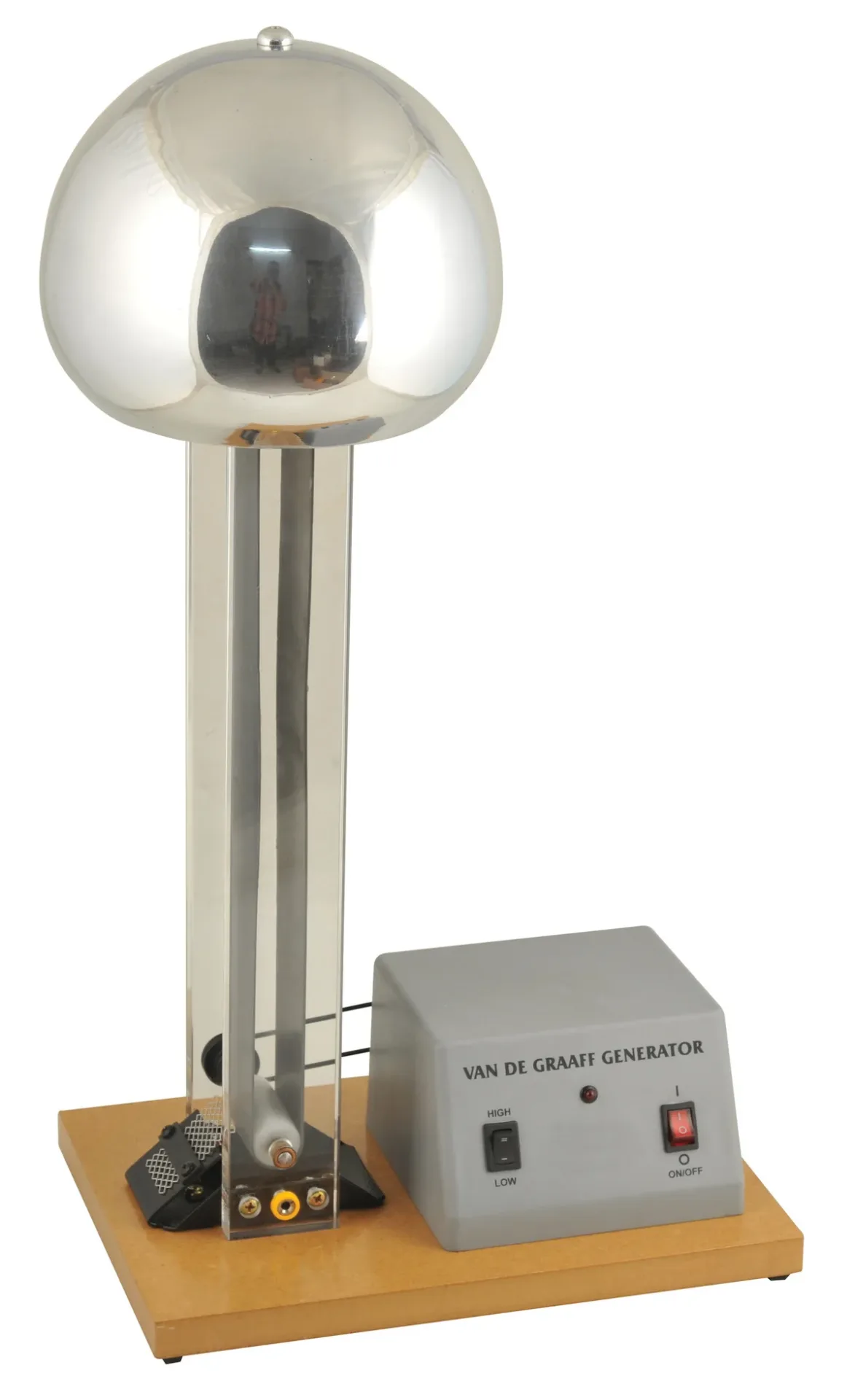
How big is a coulomb, really?
The coulomb is a monster of a unit. Two 1 C point charges placed one metre apart would repel with about 9 x 10⁹ N – roughly the weight of a million tons, as HyperPhysics puts it.
That is why static charges are quoted in nanocoulombs and microcoulombs. The zap from a doorknob might involve under a microcoulomb; you will never hold a loose coulomb in your hand.
| Situation | Typical charge | In elementary charges |
|---|---|---|
| Static shock from a doorknob | Under 1 μC | Roughly 1012 to 1013 |
| Average lightning stroke | About 5 C | About 3 x 10¹⁹ |
| Fully charged 3000 mAh phone battery | 10,800 C | About 6.7 x 10²² |
| One mole of electrons | 96,485 C | 6.022 x 10²³ |
Common Misconceptions About Electric Charge
“Rubbing creates electric charge”
It does not. Rubbing separates charge that was already present in equal and opposite amounts, moving electrons from one surface to the other. The universe’s charge ledger is untouched.
“Charge gets used up in a circuit”
This is the single most common student slip, and it is worth being blunt about: exactly as much charge leaves a lamp as enters it. What gets used up is energy, not charge.
Charge is the delivery van, energy is the parcel. The vans keep circulating; only the parcels are dropped off.
“Current is positive charges moving through the wire”
In a metal, the mobile carriers are electrons, and they drift the opposite way to the conventional current arrow. We keep drawing the arrow from plus to minus purely because Franklin’s convention got there first, and because the physics comes out the same either way.
“Neutral means there is no charge”
Neutral means balanced, not empty. A neutral coin contains something like 1024 protons and an equal number of electrons – vast quantities of charge, cancelling perfectly.
That distinction matters, because it explains why a neutral object can still be attracted to a charged one. Bring a charged balloon near a wall and the wall’s charges shift slightly, and attraction follows.
How Electric Charge Relates to Current, Fields and Voltage
Almost every other electrical quantity is defined in terms of charge, which is why charge is taught first. Once you can count coulombs, the rest of electromagnetism becomes bookkeeping.
- Electric current is charge flow per second, I = Q/t. See electric current for drift speeds and worked circuit examples.
- Electric field is the force per unit charge that a charge creates around itself, E = kQ/r2. Our guide to the electric field covers field lines and strength.
- Potential difference is energy transferred per coulomb, V = W/Q. That is what potential difference actually measures – joules per coulomb.
- Capacitance is charge stored per volt, C = Q/V, the direct measure of how much charge a component can hold.
Notice the pattern: current is charge per time, voltage is energy per charge, capacitance is charge per volt. Charge is the common currency in all three.
Worked Problems
Show Solution
Solution:
Step 1: Use the definition of charge in terms of current, Q = It.
Step 2: Convert the time to seconds: t = 3.0 x 60 = 180 s.
Step 3: Substitute: Q = 2.0 A x 180 s = 360 C.
Answer: Q = 360 C (2 s.f.)
Show Solution
Solution:
Step 1: Charge is quantised, so Q = ne, which rearranges to n = Q/e.
Step 2: Substitute the charge from Problem 1 and e = 1.602 x 10⁻¹⁹ C:
n = 360 C / (1.602 x 10⁻¹⁹ C)
Step 3: Divide: n = 2.25 x 10²¹ electrons.
Answer: n = 2.25 x 10²¹ electrons (3 s.f.)
Show Solution
Solution:
Step 1: Use Q = ne, remembering the electron is negative.
Step 2: Substitute: Q = -(5.0 x 1012) x (1.602 x 10-19 C)
Step 3: Multiply: Q = -8.0 x 10⁻⁷ C.
Answer: Q = -8.0 x 10⁻⁷ C, or -0.80 μC (2 s.f.)
Show Solution
Solution:
Step 1: Convert the rating to coulombs. 1 A h = 1 A x 3600 s = 3600 C.
Step 2: Q = 2.5 x 3600 = 9000 C.
Step 3: Rearrange Q = It to t = Q/I = 9000 C / 0.20 A = 45,000 s.
Step 4: Convert: 45,000 / 3600 = 12.5 h.
Answer: t = 45,000 s, or 12.5 hours
Show Solution
Solution:
Step 1: Apply Coulomb’s law, F = k q1 q2 / r2, with k = 8.99 x 10⁹ N m2 C-2.
Step 2: Convert units: q1 = q2 = 2.0 x 10⁻⁶ C and r = 0.050 m.
Step 3: Substitute: F = (8.99 x 109) x (2.0 x 10-6)2 / (0.050)2
Step 4: Evaluate: F = (8.99 x 109) x (4.0 x 10-12) / (2.5 x 10⁻³) = 14 N.
Answer: F = 14 N, repulsive (2 s.f.)
Show Solution
Solution:
Step 1: Charge is conserved and the spheres are identical, so the total charge shares equally.
Step 2: Total = (+8.0) + (-2.0) = +6.0 μC, so each sphere carries +6.0/2 = +3.0 μC.
Step 3: Apply Coulomb’s law: F = (8.99 x 109) x (3.0 x 10-6)2 / (0.10)2
Step 4: Evaluate: F = (8.99 x 109) x (9.0 x 10-12) / (1.0 x 10⁻²) = 8.1 N.
Answer: Each sphere carries +3.0 μC and they repel with F = 8.1 N (2 s.f.)
Show Solution
Solution:
Step 1: Charge on an isolated object is quantised, so Q must equal n x e for a whole number n.
Step 2: Test the claim: n = (4.5 x 10⁻¹⁹) / (1.602 x 10⁻¹⁹) = 2.81.
Step 3: 2.81 is not a whole number, so no combination of electrons or protons can produce this charge.
Answer: The value is impossible; the nearest allowed charges are 3e = 4.81 x 10⁻¹⁹ C and 2e = 3.20 x 10⁻¹⁹ C
Show Solution
Solution:
Step 1: Rearrange Q = It to give I = Q/t.
Step 2: Convert the time: t = 200 μs = 2.00 x 10⁻⁴ s.
Step 3: Substitute: I = 5.0 C / (2.00 x 10⁻⁴ s)
Step 4: Evaluate: I = 25,000 A = 25 kA.
Answer: I = 2.5 x 10⁴ A, or 25 kA (2 s.f.)
Frequently Asked Questions
What is electric charge in simple words?
What is the SI unit of electric charge?
What are the two types of electric charge?
Is electric charge a scalar or a vector?
Can electric charge be created or destroyed?
What is the smallest possible electric charge?
Why is electric charge quantised?
Key Takeaways
- Electric charge is a fundamental property of matter, measured in coulombs (C), that produces the electromagnetic force.
- Q = It links charge to current and time; Q = ne links it to a whole number of electrons.
- Charge is conserved, quantised, invariant and scalar – four rules with no known exceptions.
- Objects are charged by transferring electrons, never by creating charge.
- The elementary charge is exactly 1.602176634 x 10⁻¹⁹ C, a value now fixed by definition in the SI.