Potential difference is the energy transferred per unit charge between two points in a circuit, given by the formula V = W/Q. It is measured in volts, where one volt equals one joule per coulomb. A potential difference of 6 V means every coulomb of charge passing between those two points transfers 6 joules of energy.
A crow lands on a 25,000-volt power line and carries on preening. No spark, no smoke, nothing at all. Yet a 9 V battery — thousands of times feebler — will make your tongue tingle the moment you touch it across the terminals.
The crow survives for one reason. Voltage is not something a wire contains; it exists between two points, and the bird only ever touches one of them. Get that single idea straight and most of electricity stops being mysterious.
What Is Potential Difference?
Potential difference is the amount of energy transferred per coulomb of charge moving between two points in a circuit. Say that slowly, because every word is doing work. It is energy, it is per coulomb, and it is between two points.
Think of a cell as a pump that lifts charge to the top of a hill. Each coulomb arrives at the top carrying a fixed parcel of energy. As it travels down through a lamp, it hands that parcel over — and the lamp glows.
The size of the parcel per coulomb is the potential difference. A 6 V supply hands every coulomb 6 joules. A 12 V supply hands every coulomb 12 joules, which is why the same lamp burns twice as brightly and twice as briefly.
Notice what the definition never mentions: how much charge you move, or how fast. Potential difference is a property of the two points, not of the traffic between them. Move one coulomb or a million — the energy per coulomb is unchanged.
Potential Difference and Electric Potential
Electric potential is the energy per coulomb at a single point, measured relative to some agreed zero. Potential difference is what you get when you subtract one from another: VAB = VA − VB.
That agreed zero is usually the earth, which is why engineers call it “ground” and set it at 0 V. It is a convention, not a law of nature — much like measuring mountain heights from sea level rather than from the centre of the planet.
The Potential Difference Formula
The potential difference formula is V = W/Q — the energy transferred divided by the charge that transferred it.
Every symbol, with its SI unit:
- V — the potential difference between the two points, measured in volts (V)
- W — the work done, meaning the energy transferred, measured in joules (J)
- Q — the charge moved between the two points, measured in coulombs (C)
This gives the volt its meaning: 1 V = 1 J/C. According to NIST, the SI unit of electric potential difference is the volt, named after Alessandro Volta.
The formula rearranges two ways, and exam questions lean on both:
Use W = QV when you know the voltage and want the energy delivered. Use Q = W/V when you know the energy and want the charge that carried it.
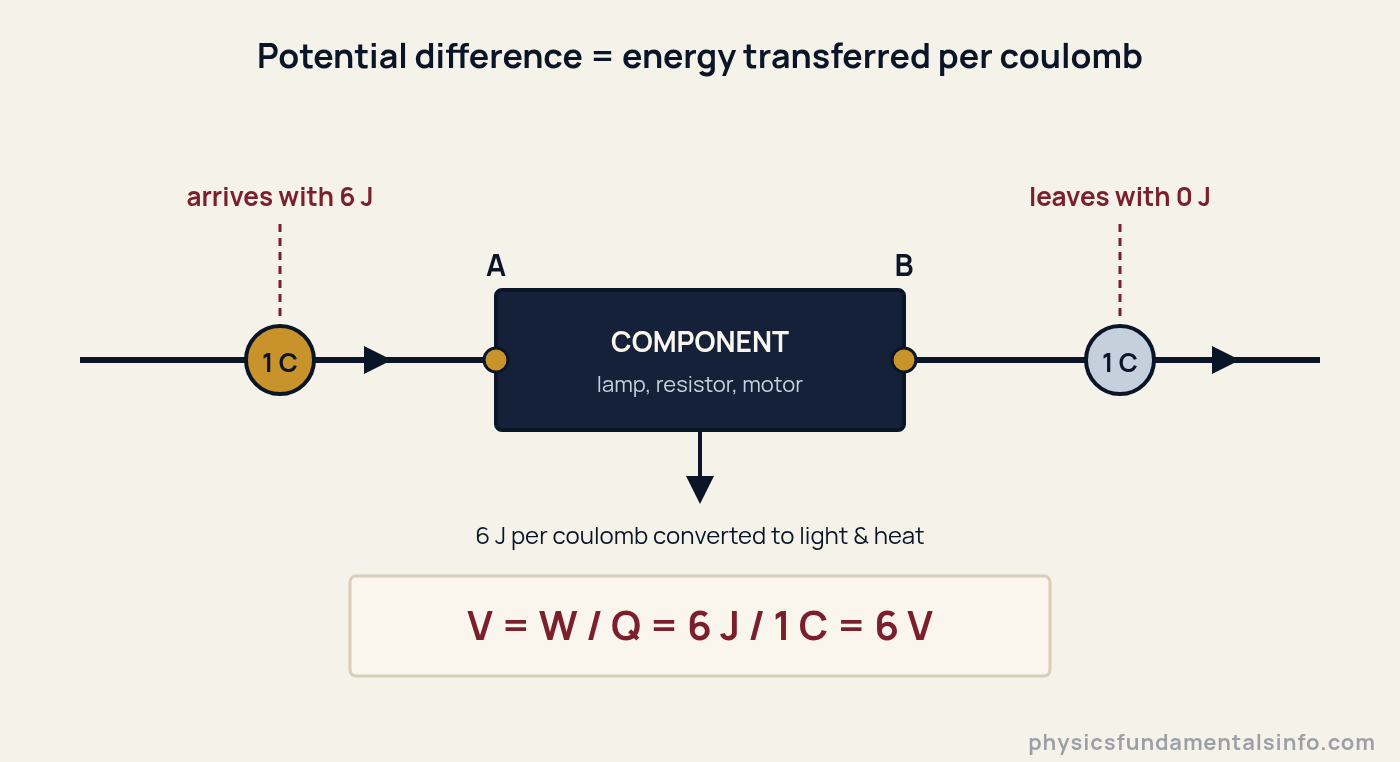
Potential difference is the energy each coulomb gives up between points A and B — here, 6 J per coulomb, so V = 6 V.
How Potential Difference Works in a Circuit
A cell works by chemistry, not magic. Reactions inside it push electrons onto the negative terminal and strip them from the positive one, doing work on each charge and loading it with electrical potential energy.
Once a circuit is complete, that stored energy has somewhere to go. Charge drifts round the loop, and at every component the electric field does work on it — the same field described by Coulomb’s law, just organised into a circuit.
The energy does not vanish; it changes form. In a lamp it becomes light and heat. In a motor it becomes rotation. In a resistor it becomes heat alone, which is why your laptop charger runs warm.
Here is the part students find genuinely surprising. The charge carriers themselves crawl — a drift speed of well under a millimetre per second in typical wiring. The energy still arrives instantly, because the field pushes on every charge in the circuit at once, like a bicycle chain that moves as a whole.
Drop a slider on the lab below and watch the potential fall across each resistor. Then change the charge and notice what refuses to move: the voltage readings.
Why It Is Called a Difference, Not Just a Voltage
It is called a difference because a single point has no voltage of its own — only a voltage relative to somewhere else. Asking “what is the voltage here?” is like asking “how high is this?” without saying above what.
This is where the crow comes back. Both its feet sit on the same conductor, a few centimetres apart, and that stretch of aluminium has almost no resistance. The potential difference across the bird is a few millivolts — so a few millivolts is all it has to work with.
The line may sit 25,000 V above the ground. The crow does not care, because it never touches the ground. No difference, no energy transfer, no problem.
Let one wing brush an earthed pylon, though, and 25,000 V suddenly appears across the bird. Same wire, same bird, catastrophically different outcome — because the difference changed.
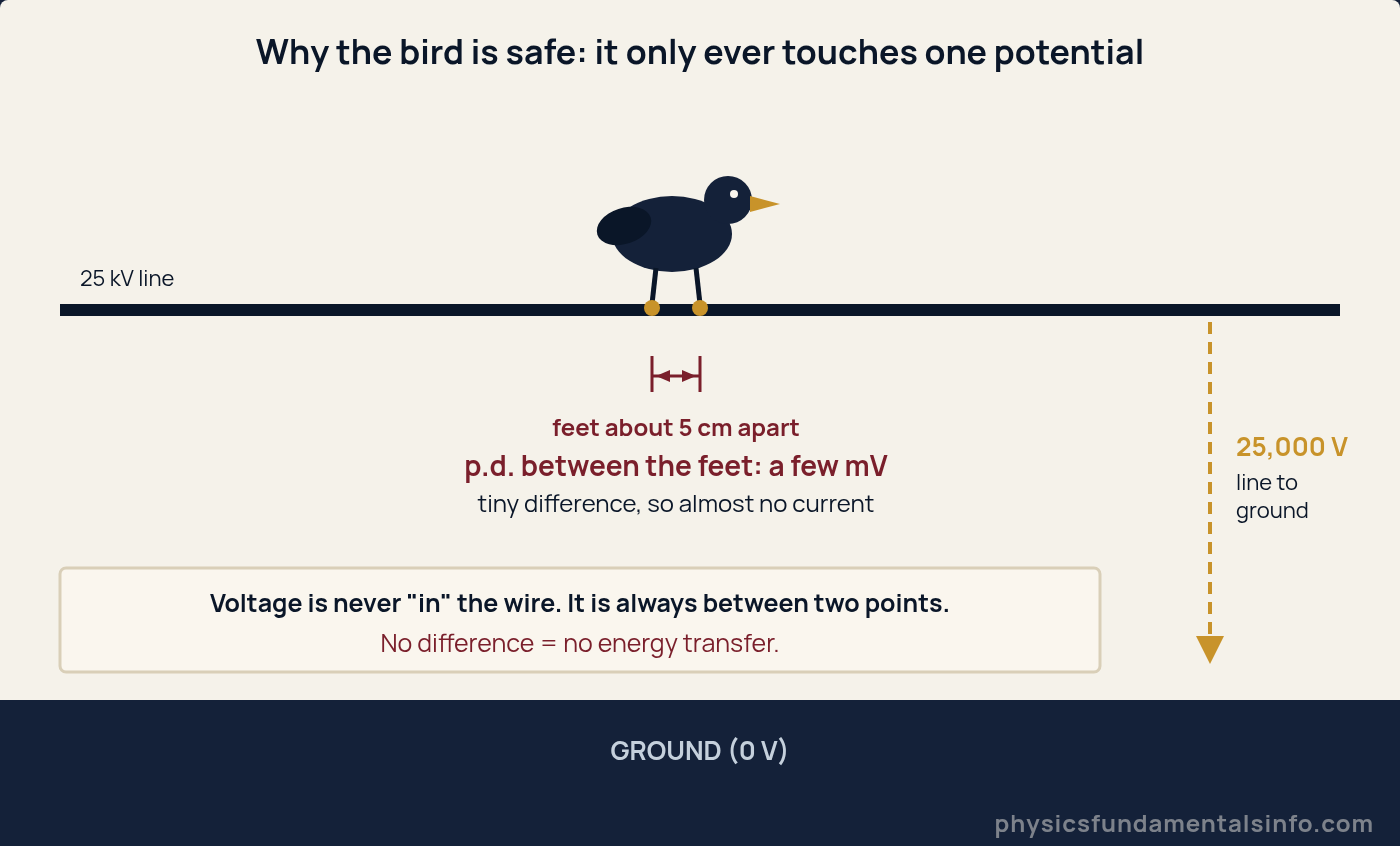
A bird on a power line touches only one potential, so the potential difference across it is a few millivolts — not 25,000 V.
Real-World Examples of Potential Difference
Potential difference spans an absurd range in everyday life — from the tens of millivolts that run your nervous system to the hundreds of millions of volts in a thunderstorm. Same quantity, same formula, ten orders of magnitude apart.
1. The AA cell in your remote (1.5 V). Every coulomb that leaves the terminal carries 1.5 J. That is the entire promise printed on the label.
2. A car battery (12 V). Six 2 V cells in series, stacked so their potential differences add. A fresh one actually reads closer to 12.6 V, which is why “12 V” is a nickname rather than a measurement.
3. Mains electricity (230 V in the UK, 120 V in the US). Each coulomb arrives carrying 230 J — roughly 150 times what a AA cell offers. This is genuinely lethal and is not something to test experimentally.
4. A nerve cell (about 70 mV). Your neurons hold a potential difference across a membrane just a few nanometres thick. Small voltage, but over that tiny distance the electric field is enormous — and every thought you have depends on it.
5. A lightning flash (about 300 million V). NOAA’s National Weather Service puts a typical flash at roughly 300 million volts and 30,000 amps, against 120 V and 15 A for household current.
| Source | Typical potential difference | Energy carried by each coulomb |
|---|---|---|
| Nerve cell membrane (resting) | about 70 mV | 0.07 J |
| AA alkaline cell | 1.5 V | 1.5 J |
| USB port | 5 V | 5 J |
| Car battery | 12 V | 12 J |
| Mains (US) | 120 V | 120 J |
| Mains (UK) | 230 V | 230 J |
| Overhead distribution line | 25 kV | 25,000 J |
| Lightning flash | about 300 million V | about 300 million J |
Potential Difference vs EMF: What Is the Difference?
EMF is the energy per coulomb a source gives to charge; potential difference is the energy per coulomb a component takes from it. Both are measured in volts, and that shared unit is exactly why students blur them together.
A cell converts chemical energy into electrical energy — that is its EMF, symbol ε. A lamp converts electrical energy into light and heat — that is a potential difference. Same currency, opposite direction of trade.
The distinction earns its keep the moment a cell has internal resistance. Some of the energy never escapes the cell; it is dissipated inside it. What you actually measure at the terminals is therefore always a little less than the EMF.
| Feature | Potential difference | Electromotive force (EMF) |
|---|---|---|
| Symbol | V | ε |
| Energy direction | Electrical energy converted out, per coulomb | Other energy converted into electrical, per coulomb |
| Measured across | A component (lamp, resistor, motor) | A source (cell, generator, solar panel) |
| Defining equation | V = W / Q | ε = E / Q |
| Unit | volt (V) | volt (V) |
| In a real cell | Terminal p.d. V = ε − Ir | ε = I(R + r) |
| Is it a force? | No — energy per charge | No, despite the name — energy per charge |
That last row is not pedantry. “Electromotive force” is a historical misnomer that survives out of habit: EMF is measured in volts, not newtons, and it is not a force at all.
3 Common Misconceptions About Potential Difference
Myth 1: “Voltage flows through a component”
Voltage does not flow anywhere — charge flows, and voltage is the difference that drives it. Current goes through a lamp; potential difference sits across it.
This is not just wording. It is why an ammeter goes in series and a voltmeter goes in parallel: one counts charge passing a point, the other compares two points.
Myth 2: “Voltage gets used up by the first component”
Voltage is not a fluid that drains as it travels. In a series circuit the supply p.d. is shared between components in proportion to their resistance, and the shares always add back up to the supply.
Put 4 Ω and 8 Ω across 12 V and you get 4 V and 8 V. Not because the first resistor “used some up”, but because each coulomb hands over energy in proportion to the resistance it meets. Swap the resistors and the shares swap with them.
Myth 3: “High voltage is what kills you”
Voltage alone does not determine danger — the current driven through your body, and the path it takes, do. A Van de Graaff generator can sit at hundreds of thousands of volts and merely lift your hair, because it can supply almost no charge.
The reverse also holds, and it matters more. Mains at 230 V is lethal precisely because it can push amps through you indefinitely. Low number, deadly source — never judge a supply by its voltage alone.
How Potential Difference Relates to Current, Resistance and Power
Potential difference is the driver; current is the response; resistance is the obstruction. Fix any two and the third follows.
For an ohmic conductor at constant temperature, those three lock together in Ohm’s law, V = IR — which is a relationship, not a definition. V = W/Q defines what voltage is; V = IR only tells you what it does in a particular kind of conductor.
That distinction rescues you when a component is non-ohmic. A filament lamp or a diode breaks V = IR completely — yet V = W/Q still holds perfectly, because it is a definition and definitions do not break.
Current links in through I = Q/t. Substitute Q = It into W = QV and you get W = VIt, and dividing by time gives the power equation:
- P — power, in watts (W)
- V — potential difference, in volts (V)
- I — current, in amperes (A)
So a 230 V kettle drawing 10 A converts 2,300 J every second. Multiply volts by amps and you have watts — the whole of domestic electricity in one line.
Worked Problems
Show Solution
Solution:
Step 1: Potential difference is energy per unit charge: V = W / Q
Step 2: Substitute with units: V = 24 J / 2.0 C
Step 3: Solve: V = 12 J/C
Answer: 12 V
Show Solution
Solution:
Step 1: Rearrange V = W / Q to make W the subject: W = QV
Step 2: Substitute with units: W = 5.0 C × 9.0 V
Step 3: Solve: W = 45 C·V = 45 J
Answer: 45 J
Show Solution
Solution:
Step 1: Rearrange V = W / Q to make Q the subject: Q = W / V
Step 2: Substitute with units: Q = 150 J / 6.0 V
Step 3: Solve: Q = 25 J/V = 25 C
Answer: 25 C
Show Solution
Solution:
Step 1: Charge is current × time: Q = It
Step 2: Substitute: Q = 0.50 A × 20 s = 10 C
Step 3: Energy is W = QV = 10 C × 12 V = 120 J
Step 4: Sanity check via power: P = VI = 12 × 0.50 = 6.0 W, and W = Pt = 6.0 × 20 = 120 J — agrees.
Answer: (a) 10 C (b) 120 J
Show Solution
Solution:
Step 1: In series the resistances add: R = 4.0 + 8.0 = 12 Ω. The current is the same everywhere.
Step 2: Find the current: I = V / R = 12 V / 12 Ω = 1.0 A
Step 3: Apply V = IR to each: V1 = 1.0 × 4.0 = 4.0 V, and V2 = 1.0 × 8.0 = 8.0 V
Step 4: Check: 4.0 + 8.0 = 12 V, equal to the supply — as the loop rule demands.
Answer: 4.0 V across the 4.0 Ω, and 8.0 V across the 8.0 Ω
Show Solution
Solution:
Step 1: Some energy is dissipated inside the cell, so terminal p.d. = EMF − lost volts: V = ε − Ir
Step 2: Substitute with units: V = 1.5 V − (0.20 A × 0.50 Ω)
Step 3: Solve: V = 1.5 − 0.10 = 1.4 V
Answer: 1.4 V — slightly below the 1.5 V EMF, which is why a loaded cell always reads low
Show Solution
Solution:
Step 1: Work done on the charge is W = QV, and all of it becomes kinetic energy.
Step 2: Substitute: W = (1.60 × 10⁻¹⁹ C) × (500 V) = 8.0 × 10⁻¹⁷ J
Step 3: Set this equal to kinetic energy: ½mv2 = 8.0 × 10⁻¹⁷ J
Step 4: Rearrange for v: v = sqrt(2W / m) = sqrt(2 × 8.0 × 10-17 / 9.11 × 10⁻³¹)
Step 5: Solve: v = sqrt(1.76 × 10¹⁴) = 1.3 × 10⁷ m/s
Step 6: Sanity check: that is about 4% of the speed of light, so ignoring relativity was fair.
Answer: 8.0 × 10⁻¹⁷ J, and 1.3 × 10⁷ m/s