Coulomb’s law states that the electrostatic force between two point charges is directly proportional to the product of their charges and inversely proportional to the square of the distance between them. As a formula, F = kq1q2/r2, where k ≈ 8.99 × 10⁹ N·m2/C2. The force acts along the line joining the charges: like charges repel, opposite charges attract.
Rub a balloon on your hair, press it against a wall, and let go. It stays put — gravity apparently overruled by a party trick. The invisible hand doing the holding is the electrostatic force, and the rule that sets its exact strength is Coulomb’s law.
The same law is at work far beyond balloons. It crackles in a winter doorknob shock, holds every atom in your body together, and decides where the toner lands inside a laser printer. Master this one equation and a surprising amount of the physical world snaps into focus.
What Is Coulomb’s Law?
Strip away the symbols and the idea is simple: electric charges push and pull on one another, and just two things decide how hard — how much charge each object carries, and how far apart the objects sit.
Stated precisely, Coulomb’s law says the electrostatic force between two stationary point charges is proportional to the product of the charges and inversely proportional to the square of their separation. Double either charge and the force doubles. Double the gap and the force drops to a quarter.
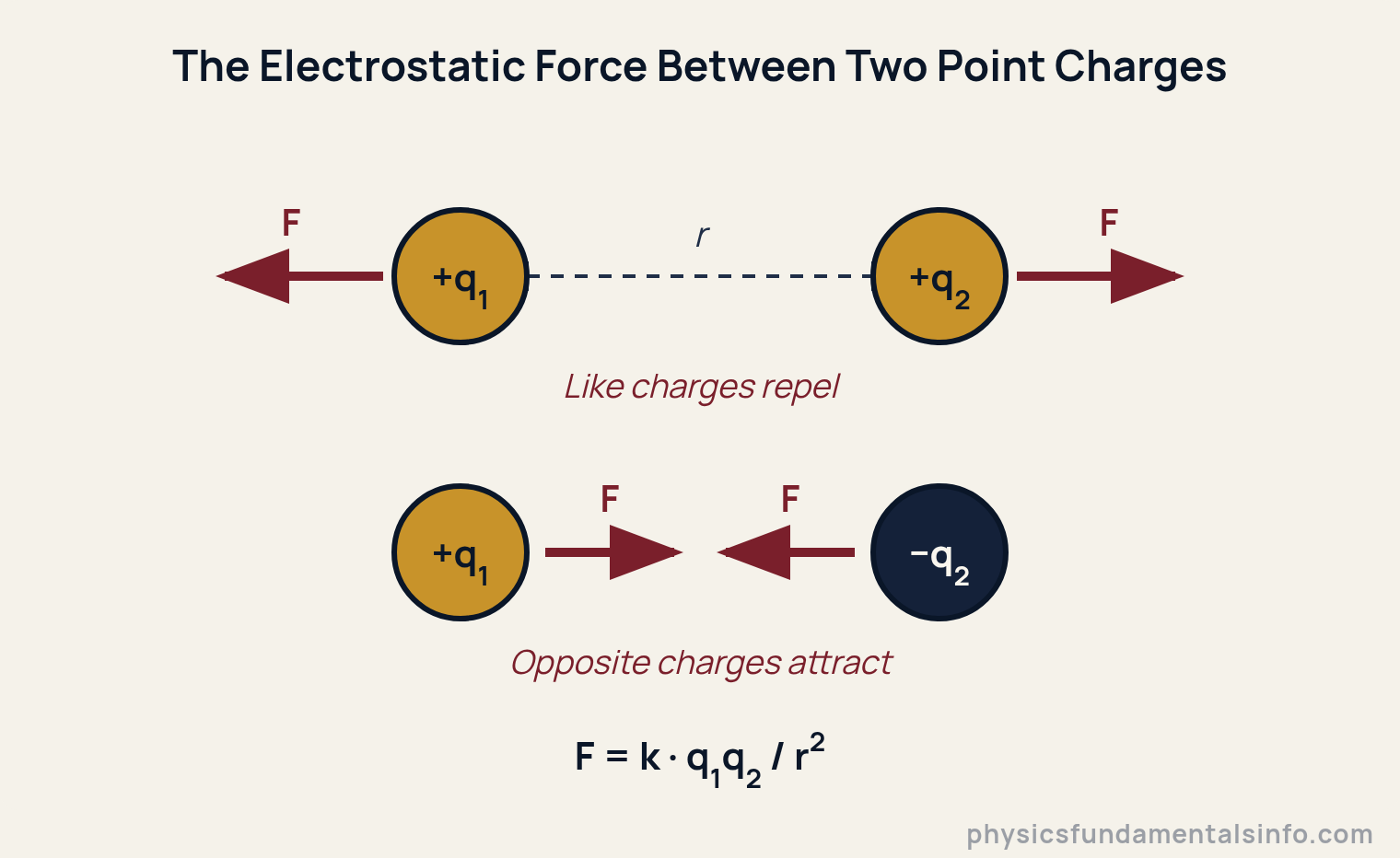
Figure 1 — The force pair always acts along the line joining the charges: outward for like charges, inward for opposite ones.
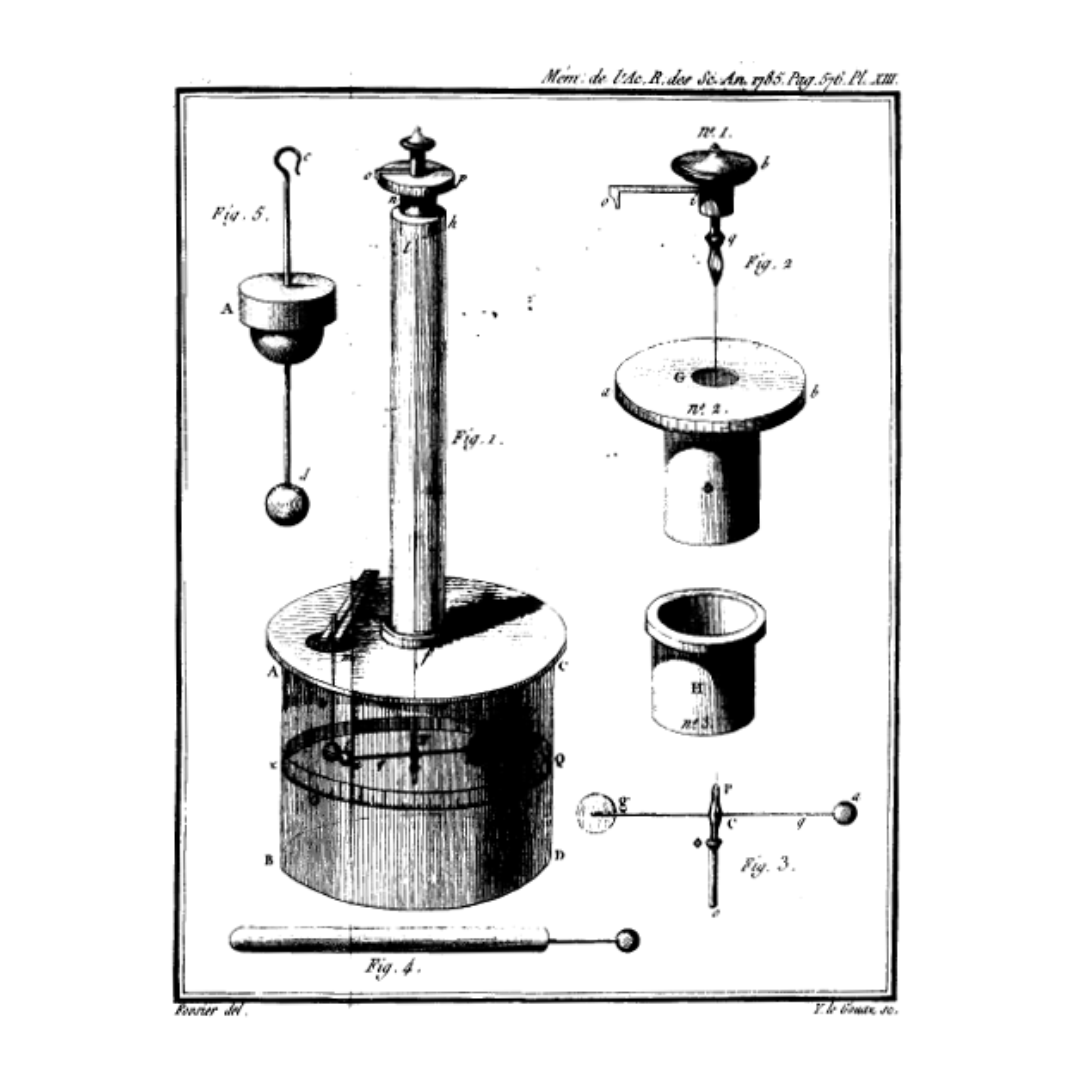
The law carries the name of Charles-Augustin de Coulomb, the French engineer-turned-physicist who measured it in 1785 with a torsion balance — a horizontal needle hung on a fine wire that twisted measurably under tiny electric pushes. Henry Cavendish had quietly found much the same result in the early 1770s, but never published it.
Three conditions sit quietly inside the law. The charges must be at rest (this is electrostatics), they must be point-like or uniformly charged spheres, and the simple constant k assumes they sit in a vacuum — though air is so close to a vacuum electrically that the difference rarely matters.
The Coulomb’s Law Formula
Here is the equation in the form you will use in almost every problem:
Every symbol earns its place. Here is what each one means, with its SI unit:
| Symbol | Meaning | SI unit / value |
|---|---|---|
| F | Electrostatic force between the charges | newton (N) |
| q1, q2 | The two point charges (sign included) | coulomb (C) |
| r | Centre-to-centre separation of the charges | metre (m) |
| k | Coulomb constant, k = 1/(4πε0) | 8.99 × 10⁹ N·m2/C2 |
| ε0 | Permittivity of free space | 8.854 × 10⁻¹² C2/(N·m2) |
Where does k come from? It is shorthand for a deeper constant:
Here ε0 is the permittivity of free space, whose precise value sits among the CODATA recommended constants published by NIST. For coursework, k = 8.99 × 10⁹ N·m2/C2 — or simply 9.0 × 10⁹ — is all you need.
Run a quick sense-check whenever you calculate. Two 1 μC charges held 10 cm apart push with about 0.9 N, roughly the weight of a small apple. If microcoulomb charges ever hand you millions of newtons, a power of ten has slipped somewhere.
You can handle the signs in two ways. Either keep them in the product, in which case a negative answer signals attraction; or — the cleaner exam habit — work with magnitudes using |q1q2| and set the direction from the rule that like charges repel and opposites attract.
How Coulomb’s Law Works
Why multiply the charges? Because every scrap of charge on one object interacts with every scrap on the other, and effects that pair up multiply rather than add. Triple one charge and there are three times as many interactions — so three times the force.
The inverse square has a beautifully geometric reason. A charge’s influence spreads out equally in all directions, like light from a bare bulb, and at distance r that influence is smeared over a sphere of surface area 4πr2. Double the radius and the same influence must cover four times the area, so any single point receives a quarter of the effect.
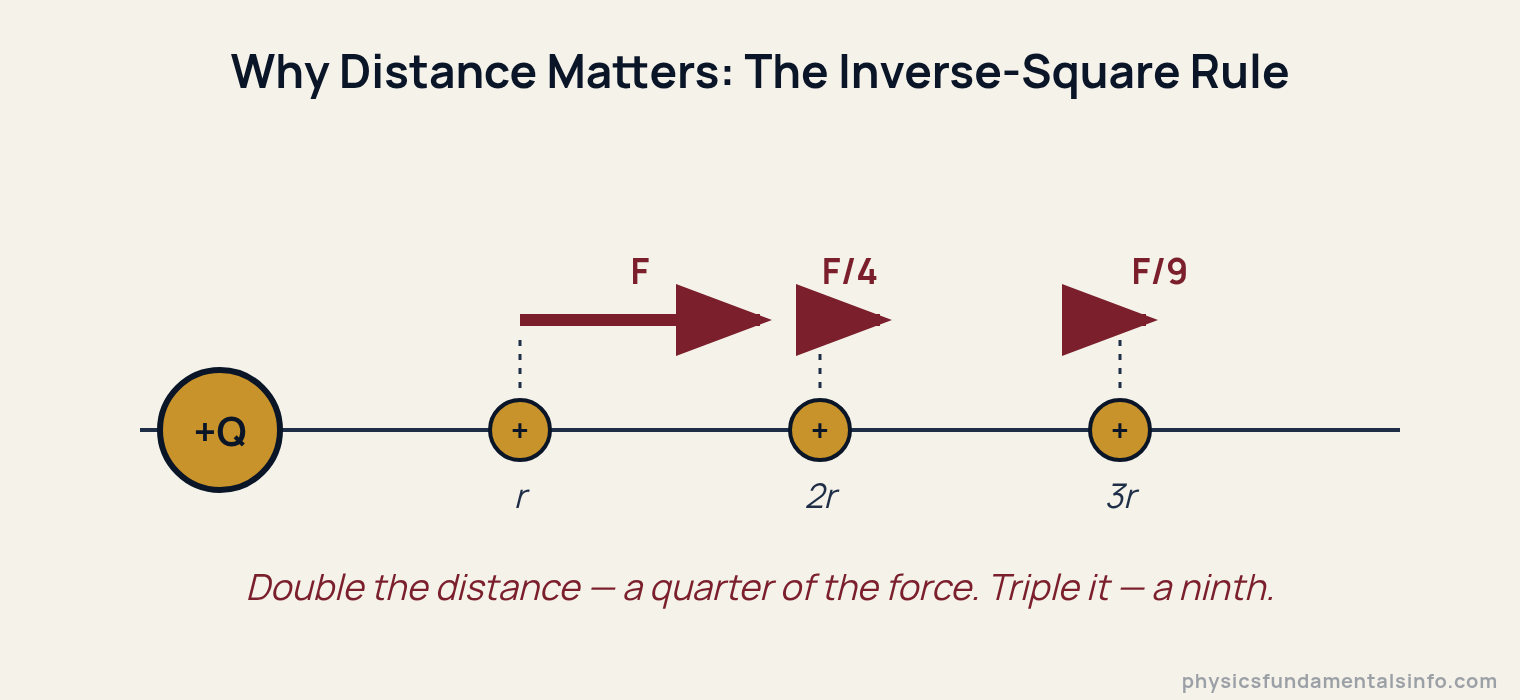
Figure 2 — The same pair of charges at growing separations: the force falls with the square of the distance (F ∝ 1/r2).
Direction comes free with the law: the force always points along the straight line joining the two charges. And it comes in pairs. Whatever force charge A exerts on charge B, B exerts exactly the same magnitude back on A — Newton’s third law, alive and well in electrostatics.
More than two charges? Coulomb’s law still copes. Work out the force from each pair separately, then add the results as vectors — physicists call this the superposition principle, and Problem 7 below puts it to work.
One honest caveat before you calculate. The tidy constant k belongs to charges in a vacuum (air is close enough); inside a material the force shrinks by the material’s relative permittivity, and in water that means a factor of roughly 80. The law also assumes the charges are stationary — set them moving and magnetism enters the story.
Try It Yourself: The Coulomb’s Law Lab
Reading about an inverse-square law is one thing; dragging a slider and watching the force collapse is another. Set both charges positive, then double the separation and check the readout — it should fall to exactly a quarter.
Now flip one charge negative. The magnitude stays identical; only the direction of the arrows changes. That single observation untangles half the sign confusion students bring to this topic.
Coulomb’s Law vs Newton’s Law of Gravitation
If F = kq1q2/r2 gives you déjà vu, trust the feeling. Newton’s law of gravitation, F = Gm1m2/r2, has exactly the same architecture — swap charges for masses and one constant for another.
| Feature | Coulomb’s law (electric) | Newton’s gravitation |
|---|---|---|
| Formula | F = kq1q2/r2 | F = Gm1m2/r2 |
| Acts between | Electric charges | Masses |
| Direction | Attracts or repels | Always attracts |
| Constant | k ≈ 8.99 × 10⁹ N·m2/C2 | G ≈ 6.674 × 10⁻¹¹ N·m2/kg2 |
| Strength (proton–electron) | About 1039 times stronger | Utterly negligible at atomic scale |
| Can it be screened? | Yes — charges cancel and conductors shield | No — mass only adds |
| Distance dependence | Inverse square (1/r2) | Inverse square (1/r2) |
The table hides a genuine shock. Between a proton and an electron, the electric force outguns gravity by a factor of about 2 × 1039 — Problem 6 below proves it. Gravity only dominates the universe because matter is almost perfectly neutral: positive and negative charges cancel, while mass has no negative version and simply keeps adding.
Real-World Examples of Coulomb’s Law
Sticking balloons and static cling
Rubbing a balloon drags electrons from your hair onto the rubber, leaving the balloon negatively charged. Hold it near a wall and it shuffles the wall’s surface charges about, drawing the opposite kind closer — Coulomb attraction does the rest. The crackle of laundry fresh from a tumble dryer is the same physics on a bigger scale.
Laser printers and photocopiers
Inside a laser printer, a rotating drum is given a pattern of static charge — one charged dot for every dot of your document. Toner particles, charged the opposite way, leap onto exactly those dots by Coulomb attraction before being fused onto the paper. Every page you print is an electrostatics experiment that works flawlessly.
Electrostatic precipitators in chimneys
Power stations use Coulomb’s law as a pollution filter. Flue gases pass electrodes that charge the ash particles, which are then pulled onto oppositely charged collection plates and knocked off into hoppers. The technique strips the great majority of particulate matter out of the smoke before it reaches the sky.
Why salt is so hard to melt
A grain of table salt is a three-dimensional lattice of Na+ and Cl− ions, each gripped by Coulomb attraction to its oppositely charged neighbours. That grip is why salt needs roughly 800 °C to melt. Chemistry’s ionic bond is, at heart, Coulomb’s law wearing a lab coat.
Electrostatic paint spraying
Car factories charge paint droplets as they leave the spray gun and earth the car body. The droplets repel one another into a fine, even mist, then follow the Coulomb force onto the metal — even curling round to coat edges the spray never aimed at. Less wasted paint, smoother finish.
Common Misconceptions About Coulomb’s Law
“The bigger charge pushes harder”
It feels intuitive, and it is wrong. The product q1q2 reads the same in either order, so each charge feels exactly the same magnitude of force — a perfect action–reaction pair, a point HyperPhysics makes explicitly. A 5 μC charge pulls a 1 μC charge precisely as hard as it gets pulled back.
“Doubling the distance halves the force”
Distance enters the formula squared, so doubling r divides the force by four, not two. Tripling it divides by nine. Examiners adore this distinction, and Figure 2 above is worth memorising as a picture.
“The formula works for any charged object, anywhere”
Strictly, it works for point charges — objects tiny compared with their separation. Uniformly charged spheres are the lucky exception: viewed from outside, each behaves as if all its charge sat at its centre. For oddly shaped conductors at close range, you need the machinery of electric fields instead.
“The force is the same in every medium”
Place the same two charges in water and the force drops by a factor of about 80, because water’s polar molecules partially screen the charges. That screening is precisely why water dissolves salt so well — it loosens the Coulomb grip between the ions. The familiar k strictly belongs to a vacuum and, very nearly, to air.
How Coulomb’s Law Connects to Other Physics
Coulomb’s law is rarely the destination; it is the gateway. Divide the force by the test charge and you get the electric field, E = F/q — the idea that grows into all of field theory, from capacitors to radio waves.
It also plugs straight into mechanics. The two forces in any charge pair are a textbook action–reaction example from Newton’s laws of motion, and once you know F, Newton’s second law turns it into acceleration through a = F/m.
Energy joins in too. Push two like charges together and you store electric potential energy, U = kq1q2/r; let go and it converts to motion — exactly the bookkeeping described in our guide to energy in physics.
Worked Problems
Cover the solutions, attempt each one, then check your working. The set climbs from a straight substitution to a three-charge net-force calculation — the full range a first exam will throw at you.
Show Solution
Solution:
Step 1: Both objects are small and at rest, so Coulomb’s law applies: F = k|q1q2| / r2.
Step 2: Substitute in SI units: F = (8.99 × 10⁹ N·m2/C2)(3.0 × 10−6 C)(5.0 × 10⁻⁶ C) / (0.20 m)2.
Step 3: Numerator: 8.99 × 109 × 15.0 × 10−12 = 0.1349 N·m2. Denominator: 0.040 m2. So F = 0.1349 / 0.040 = 3.37 N.
Answer: F ≈ 3.4 N (2 s.f.), repulsive — both charges are positive.
Show Solution
Solution:
Step 1: F = k|q1q2| / r2 gives the magnitude; the opposite signs tell you the force is attractive.
Step 2: F = (8.99 × 10⁹ N·m2/C2)(2.0 × 10−6 C)(4.0 × 10⁻⁶ C) / (0.30 m)2 = (8.99 × 109 × 8.0 × 10−12 N·m2) / 0.090 m2.
Step 3: F = 0.0719 N·m2 / 0.090 m2 = 0.799 N.
Answer: Each charge feels 0.80 N (2 s.f.) pulling it towards the other — by Newton’s third law the two forces are equal in magnitude.
Show Solution
Solution:
Step 1: Rearrange Coulomb’s law for distance: r = √(kq1q2 / F).
Step 2: r2 = (8.99 × 10⁹ N·m2/C2)(1.0 × 10−6 C)(1.0 × 10⁻⁶ C) / (1.0 N) = 8.99 × 10⁻³ m2.
Step 3: r = √(8.99 × 10⁻³ m2) = 0.0948 m.
Answer: r ≈ 0.095 m, or about 9.5 cm.
Show Solution
Solution:
Step 1: Force scales with the product of the charges, so tripling one charge multiplies F by 3.
Step 2: Force scales as 1/r2, so doubling r divides F by 22 = 4.
Step 3: Combine the two factors: F’ = (3/4)F.
Answer: F’ = 0.75F — three-quarters of the original force.
Show Solution
Solution:
Step 1: Both particles carry the elementary charge, so F = ke2 / r2.
Step 2: e2 = (1.602 × 10⁻¹⁹ C)2 = 2.566 × 10−38 C2, so ke2 = 8.99 × 109 × 2.566 × 10−38 = 2.307 × 10⁻²⁸ N·m2.
Step 3: r2 = (5.29 × 10⁻¹¹ m)2 = 2.798 × 10⁻²¹ m2, so F = 2.307 × 10⁻²⁸ / 2.798 × 10−21 = 8.24 × 10⁻⁸ N.
Answer: F ≈ 8.2 × 10⁻⁸ N, attractive — tiny in everyday terms, colossal at the atom’s scale.
Show Solution
Solution:
Step 1: Take the ratio Fe/F_g = ke2 / (Gmemp). The r2 cancels, so the answer holds at any separation.
Step 2: Numerator: ke2 = 2.307 × 10⁻²⁸ N·m2 (from Problem 5). Denominator: Gmemp = 6.674 × 10−11 × 9.11 × 10−31 × 1.67 × 10−27 = 1.016 × 10−67 N·m2.
Step 3: Ratio = 2.307 × 10⁻²⁸ / 1.016 × 10−67 = 2.27 × 1039.
Answer: The electric force is about 2.3 × 1039 times stronger — gravity is utterly negligible inside atoms.
Show Solution
Solution:
Step 1: Treat each pair separately, then add the forces as vectors (superposition). Both separations are 0.20 m, so r2 = 0.040 m2.
Step 2: Force from q1 (repulsive, pushes q3 towards +x): F1 = (8.99 × 10⁹ N·m2/C2)(2.0 × 10−6 C)(1.0 × 10⁻⁶ C) / 0.040 m2 = 0.450 N.
Step 3: Force from q2 (attractive, pulls q3 towards +x): F2 = (8.99 × 10⁹ N·m2/C2)(3.0 × 10−6 C)(1.0 × 10⁻⁶ C) / 0.040 m2 = 0.674 N.
Step 4: Both forces point the same way, so F_net = 0.450 + 0.674 = 1.124 N.
Answer: F_net ≈ 1.1 N in the +x direction — towards the −3.0 μC charge.