Quarks are the fundamental particles that make up protons and neutrons, and they carry fractional electric charges of +2/3 or -1/3 of the elementary charge. Six flavours exist: up, down, strange, charm, bottom and top. The strong force binds them so tightly that a single quark can never be pulled out and observed alone.
Hold your hand still for a moment. Every atom in it is mostly empty space wrapped around a dense nucleus, and inside every proton and neutron of that nucleus sit particles that no experiment has ever isolated, not once in nearly sixty years of trying.
That is the strange bargain at the bottom of matter. We know exactly what quarks weigh, what charge they carry and how many kinds there are – and we know we will never hold one. Stranger still, they account for barely one per cent of your body’s mass. The rest is pure energy.
What Are Quarks?
Quarks are elementary particles with no known internal structure, and they are the building blocks of protons, neutrons and every other hadron. “Elementary” here means what it says: probe a quark as hard as our accelerators allow and nothing smaller falls out.
Compare that with a proton. Fire an electron at one hard enough and you find it is lumpy inside – three main lumps, plus a churning mess of other things. That lumpiness is why we know quarks are real.
Each quark carries four properties that matter for almost every question you will be asked about them:
- Electric charge – a fraction of the elementary charge e, either +2/3 or -1/3.
- Mass – quoted in MeV/c2, and spanning a factor of about 80,000 from lightest to heaviest.
- Colour charge – the strong-force equivalent of electric charge, labelled red, green or blue.
- Flavour – which of the six kinds it is, a property the weak force can change.
Quarks are also fermions with spin 1/2, which is why they obey the Pauli exclusion principle and stack into structured hadrons rather than piling up in one state.
The Six Quark Flavours and Their Charges
There are six quark flavours, arranged in three generations of two, and every one of them has been directly observed in experiments. The first generation – up and down – makes up all the ordinary stable matter around you. The other four are heavier, decay within fractions of a second, and show up only in accelerators and cosmic-ray showers.
The masses below are the 2025 Particle Data Group values. Read them as approximate: quark masses depend on the energy scale at which you define them, which is why the light quarks are quoted at a reference scale rather than as fixed constants.
| Flavour | Symbol | Charge | Mass (MeV/c2) | Generation | Found in |
|---|---|---|---|---|---|
| Up | u | +2/3 | 2.16 | 1st | Protons, neutrons |
| Down | d | -1/3 | 4.70 | 1st | Protons, neutrons |
| Strange | s | -1/3 | 93.5 | 2nd | Kaons, lambda baryons |
| Charm | c | +2/3 | 1,273 | 2nd | J/psi, D mesons |
| Bottom | b | -1/3 | 4,183 | 3rd | Upsilon, B mesons |
| Top | t | +2/3 | 172,560 | 3rd | Nothing – it decays first |
That last row is not a typo. The top quark is so heavy that it falls apart in about 5 x 10-25 seconds – faster than the strong force can bind it into anything. It is the one quark that never gets to join a hadron.
Every quark also has an antiquark partner with the opposite electric charge and opposite colour. An anti-up carries -2/3; an anti-down carries +1/3.
The Quark Charge Rule
The electric charge of any hadron is simply the sum of the charges of its constituent quarks. That one rule explains why protons carry exactly +1, why neutrons are neutral, and why you never see a particle with a charge of, say, +0.4.
- Q – total electric charge of the hadron, in units of the elementary charge e = 1.602176634 x 10⁻¹⁹ C
- qi – charge of the i-th quark: +2/3 for u, c, t; -1/3 for d, s, b (signs flip for antiquarks)
A second rule pins down whether you are dealing with a baryon or a meson:
- B = 1 – a baryon (three quarks), such as the proton or neutron
- B = 0 – a meson (one quark and one antiquark), such as a pion or kaon
- B = -1 – an antibaryon (three antiquarks)
Baryon number is conserved in every interaction we have ever measured, which is a large part of why the proton appears to be stable – there is simply nothing lighter for it to decay into that keeps the books balanced.
Here is the rule doing real work across a range of particles:
| Particle | Quark content | Charge sum | Total | Type |
|---|---|---|---|---|
| Proton | u u d | 2/3 + 2/3 – 1/3 | +1 | Baryon |
| Neutron | u d d | 2/3 – 1/3 – 1/3 | 0 | Baryon |
| Pion (positive) | u + anti-down | 2/3 + 1/3 | +1 | Meson |
| Kaon (negative) | s + anti-up | -1/3 – 2/3 | -1 | Meson |
| Lambda | u d s | 2/3 – 1/3 – 1/3 | 0 | Baryon |
| Delta (double plus) | u u u | 2/3 + 2/3 + 2/3 | +2 | Baryon |
| Omega (negative) | s s s | -1/3 – 1/3 – 1/3 | -1 | Baryon |
| J/psi | c + anti-charm | 2/3 – 2/3 | 0 | Meson |
A quick sanity check students find useful: work in thirds. Count everything in units of e/3 and the answer must always land on a whole multiple of 3, because nature only ever hands you integer-charged particles.
Quark masses are quoted in MeV/c2 precisely because mass and energy are the same currency – if you want to see what 2.16 MeV/c2 looks like in kilograms, our E = mc2 calculator does the conversion both ways and shows the working.
Why a Quark Can Never Be Found Alone
No experiment has ever detected an isolated quark, and the reason is a property of the strong force called colour confinement. The Particle Data Group’s summary is blunt: every free-quark search since 1977 has come back negative.
Here is why. Pull two electrons apart and the force between them weakens as 1/r2. Pull two quarks apart and the force between them does not fade at all – it settles at a roughly constant value of order 105 newtons, comparable to the weight of a loaded lorry, and stays there.
So the energy you pour in keeps climbing. Eventually it becomes cheaper for the vacuum to conjure a fresh quark-antiquark pair out of that energy than to stretch the bond any further. The bond snaps – and you are left holding two hadrons instead of one, never a bare quark.
It is less like breaking a stick and more like cutting a bar magnet: you do not get a lone north pole, you get two smaller magnets.

Colour confinement: separating quarks creates new quarks rather than freeing the original one.
Asymptotic Freedom: the Twist
Push two quarks very close together and the strong force does the opposite – it becomes weak. This is asymptotic freedom, and it earned Gross, Politzer and Wilczek the 2004 Nobel Prize in Physics.
It is the reason deep-inelastic scattering worked at all. At very short range the quarks inside a proton behave almost like free particles, so a high-energy electron scatters off one cleanly, as if the other two were not there.
Where Almost All of Your Mass Actually Comes From
Add up the masses of the three quarks in a proton and you get about 1% of the proton’s mass; the other 99% is the energy of the strong-force field binding them. This is the single most surprising fact about quarks, and most people get it backwards.
Run the arithmetic. A proton is two up quarks and one down quark:
- 2 x 2.16 + 4.70 = 9.02 MeV/c2 from the quarks themselves
- The proton’s actual mass is 938.272 MeV/c2
- So the quarks supply 9.02 / 938.272 = 0.96%
The missing 99% is gluon field energy and quark kinetic energy, converted into mass by E = mc2. The proton is, to a first approximation, a knot of energy with three small lumps of matter caught in it.
This is why the popular line that “the Higgs boson gives everything its mass” is misleading. The Higgs mechanism does set the intrinsic masses of the quarks – that 9.02 MeV – but the strong force supplies the other 929 MeV. Take a bathroom scale reading: roughly 99% of what it shows you is binding energy, not stuff.
How Quarks Fit Into the Standard Model
The Standard Model is the theory that catalogues every known fundamental particle and describes three of the four forces, with quarks occupying half of the matter half of the table. CERN’s overview of the Standard Model sets out how these pieces fit together.
Matter comes in two families of six. Quarks feel the strong force; leptons – the electron, muon, tau and their three neutrinos – do not. That single difference is why quarks are trapped inside hadrons and electrons roam free through metals.

The six quarks sit alongside six leptons and five kinds of boson in the Standard Model.
Colour Charge and the Gluon
Quarks carry a second kind of charge with three values, whimsically named red, green and blue. It has nothing to do with visible colour – the names are just labels, chosen because the three combine to something neutral the way primary colours combine to white.
Every observable hadron must be colour-neutral. Baryons manage this with one quark of each colour; mesons pair a colour with its anticolour. The rule is not decoration – it was invented to rescue the Pauli exclusion principle, which the three identical up quarks in a delta baryon would otherwise have violated outright.
Gluons carry the strong force between quarks, and there are eight of them. Unlike photons, gluons carry the charge they mediate, so gluons pull on each other – and that self-interaction is the root of confinement.
How Quarks Were Discovered
Murray Gell-Mann and George Zweig independently proposed quarks in 1964, as a bookkeeping trick for the confusing zoo of particles that accelerators kept producing. Gell-Mann took the name from a line in James Joyce’s Finnegans Wake; Zweig called them “aces”. Almost nobody believed the things were real.
Then came the experiment that settled it. Between 1968 and 1969 a team at the Stanford Linear Accelerator Center fired high-energy electrons at protons and watched far more of them ricochet at wide angles than a soft, structureless proton could explain.
The echo of Rutherford’s gold-foil experiment is exact: hard scattering means hard lumps inside. Friedman, Kendall and Taylor shared the 1990 Nobel Prize in Physics for it.
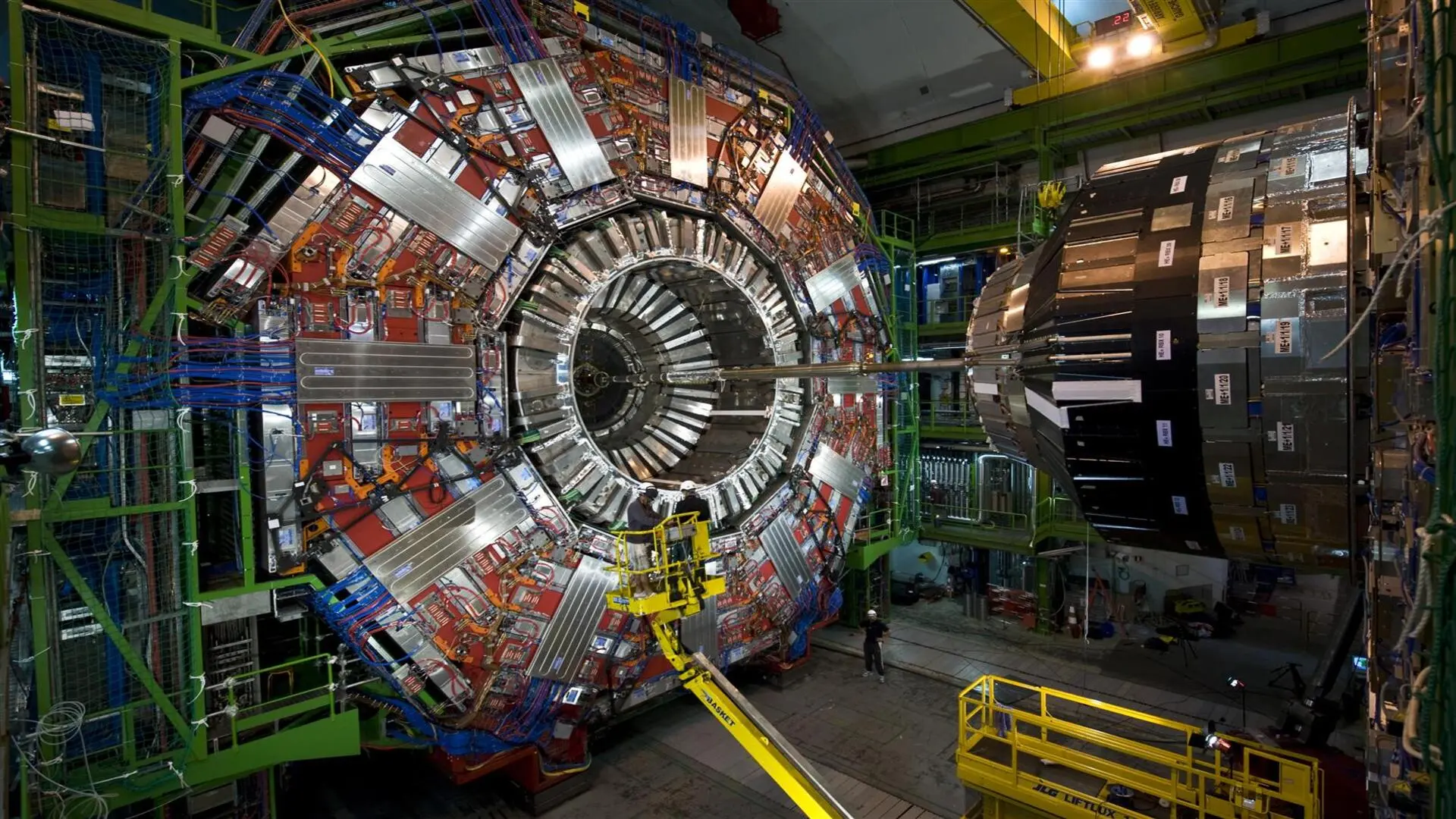
The remaining three flavours arrived one at a time: charm in 1974, bottom in 1977, and top – the last and heaviest – at Fermilab in 1995, twenty-one years after it was first predicted.
Common Misconceptions About Quarks
“Quarks are the smallest pieces of matter, so we could isolate one with enough energy”
More energy makes the problem worse, not better. Every joule you invest in stretching the bond eventually converts into a new quark-antiquark pair, and the bond snaps into two hadrons. This is why decades of free-quark searches have all come back empty.
“The Higgs boson gives you your mass”
It gives the quarks their intrinsic mass, which is about 1% of the proton’s. The other 99% is strong-force field energy. Your body weight is overwhelmingly binding energy that the Higgs never touched.
“A proton contains exactly three quarks”
It contains three net quarks. In reality a proton is a seething cloud of gluons and short-lived quark-antiquark pairs – the “sea” – and the three valence quarks are just the surplus left after the pairs cancel out.
“You could measure a charge of one-third on something”
No isolated particle has ever been found with fractional charge, because confinement guarantees that whatever you can catch in a detector is a colour-neutral hadron. The fractions always sum to a whole number before anything reaches you.
How Quarks Connect to Radioactivity and Nuclear Energy
Beta decay is a quark changing flavour, and it is the clearest everyday evidence that quarks are real. When a neutron in an unstable nucleus decays, one of its down quarks turns into an up quark by emitting a W boson, which promptly becomes an electron and an antineutrino.
Watch the composition change: u d d becomes u u d. The neutron has become a proton. Check the charge and it balances exactly – -1/3 on the left, and +2/3 plus the -1 carried away by the electron on the right.
That single quark transition is what drives the beta component of nuclear radiation, and it sets the decay rates behind every half-life measurement used in radiometric dating and medical imaging.
The mass story matters here too. The energy released in fission and fusion comes from rearranging nuclear binding energy, the same currency that supplies most of a proton’s mass – a link the mass-energy relation makes precise.
Two more connections are worth following. Fractional quark charges still obey ordinary electrostatics, so Coulomb’s law governs their electrical repulsion even while the strong force overwhelms it. And seeing inside a proton at all depends on de Broglie wavelength: higher-energy electrons have shorter wavelengths, which is exactly what makes them fine enough probes to resolve quarks.
Worked Problems
Show Solution
Solution:
Step 1: Charge of a hadron is the sum of its quark charges. Q = q(u) + q(u) + q(d)
Step 2: Substitute the flavour charges. Q = (+2/3) + (+2/3) + (-1/3)
Step 3: Add the thirds. Q = (2 + 2 – 1)/3 = 3/3 = +1
Step 4: A baryon of charge +1 with content u u d is the proton.
Answer: Q = +1e; the particle is a proton.
Show Solution
Solution:
Step 1: An antiquark carries the opposite charge to its quark, so q(anti-up) = -2/3.
Step 2: Q = q(s) + q(anti-up) = (-1/3) + (-2/3)
Step 3: Q = (-1 – 2)/3 = -3/3 = -1
Step 4: Baryon number B = (quarks – antiquarks)/3 = (1 – 1)/3 = 0, confirming it is a meson.
Answer: Q = -1e, B = 0. This is the negative kaon.
Show Solution
Solution:
Step 1: A proton is u u d, so the quark mass sum is 2m(u) + m(d).
Step 2: Substitute. Sum = 2(2.16) + 4.70 = 4.32 + 4.70 = 9.02 MeV/c2
Step 3: Express as a fraction. 9.02 / 938.272 = 0.009613
Step 4: Convert to a percentage. 0.009613 x 100 = 0.96%
Answer: The quarks supply 9.02 MeV/c2, about 0.96% of the proton mass. The remaining 99% is strong-force field energy.
Show Solution
Solution:
Step 1: Identify the compositions. Neutron = u d d; proton = u u d.
Step 2: One down quark becomes an up quark: d becomes u + electron + antineutrino.
Step 3: Charge before, on the down quark: -1/3
Step 4: Charge after: (+2/3) + (-1) + 0 = 2/3 – 3/3 = -1/3
Answer: Charge before and after are both -1/3e, so charge is conserved. The neutron becomes a proton by a single quark flavour change.
Show Solution
Solution:
Step 1: Convert the energy from MeV to joules. E = 172,560 x 106 x 1.602176634 x 10-19 J
Step 2: Evaluate. E = 2.7647 x 10⁻⁸ J
Step 3: Apply E = mc2, so m = E / c2 = 2.7647 x 10⁻⁸ / (2.99792458 x 10⁸)2
Step 4: Divide by c2 = 8.98755 x 10¹⁶ m2/s2. m = 3.076 x 10⁻²⁵ kg
Answer: m = 3.08 x 10⁻²⁵ kg, about 184 times the mass of a whole proton.
Show Solution
Solution:
Step 1: A baryon has three quarks. Let it hold n up quarks and (3 – n) down quarks.
Step 2: Write the charge equation. Q = n(2/3) + (3 – n)(-1/3) = +2
Step 3: Multiply through by 3. 2n – (3 – n) = 6, so 3n – 3 = 6
Step 4: Solve. 3n = 9, giving n = 3.
Answer: The composition is u u u – three up quarks. This is the delta double-plus baryon.
Show Solution
Solution:
Step 1: Take the two masses. m(t) = 172,560 MeV/c2, m(u) = 2.16 MeV/c2
Step 2: Form the ratio. 172,560 / 2.16
Step 3: Evaluate. Ratio = 79,889, or roughly 8 x 10⁴
Step 4: Interpret. The Standard Model does not predict this spread – the quark masses are free parameters fixed by measurement, which is one reason physicists suspect a deeper theory exists.
Answer: About 80,000 times heavier. The unexplained size of this ratio is a known gap in the Standard Model.
Show Solution
Solution:
Step 1: Convert the width to MeV. Width = 1.42 GeV = 1,420 MeV
Step 2: Apply the uncertainty relation. tau = hbar / width = (6.582 x 10⁻²² MeV s) / (1,420 MeV)
Step 3: The MeV units cancel. tau = 4.635 x 10⁻²⁵ s
Step 4: Compare with the strong-interaction timescale of roughly 10-24 s needed to form a hadron. The top decays about ten times faster than that.
Answer: tau is about 4.6 x 10⁻²⁵ s. The top quark decays before it can bind into any hadron, which is why no top-flavoured particles exist.