An electric field is the invisible region of force surrounding any electric charge, where every point is given the force per unit positive charge that a tiny test charge would feel there. Its strength is found from E = F/q, and for a single point charge from E = kQ/r2, measured in newtons per coulomb (N/C).
Pull a wool jumper over your head on a dry winter morning and your hair drifts up to follow it. Reach for a metal door handle and a tiny spark bites your finger. You never touched the charge that did this — yet something crossed the empty gap and pushed.
That invisible reach is the electric field. Every charged object is wrapped in one, and it is the field — not the charge itself — that does the pushing and pulling on everything nearby. Learn to read it and a huge slice of physics, from lightning to the screen you are reading this on, suddenly clicks into place.
What Is an Electric Field?
Think of the space around a charge as quietly “loaded”. Bring nothing into it and nothing happens. Bring in another charge and it is shoved, instantly, without anything visibly touching it. The electric field is our way of describing that loaded space: a map that tells you, at every point, how hard and in which direction a charge would be pushed.
More precisely, the electric field at a point is the force per unit positive charge that a small test charge would experience there. Double the field and you double the force on any charge you place in it. The field exists whether or not you ever put a charge there to feel it.
The idea was Michael Faraday’s. Rather than imagining charges reaching across a void by magic, he pictured invisible lines of force filling the space — a “field” — and that picture became one of the most powerful ideas in all of physics.

Field, force and direction
An electric field is a vector: it has a size and a direction at every point. By convention, the direction is the way a positive test charge would be pushed. So the field points away from a positive source charge and towards a negative one.
That sign convention matters. A positive charge dropped into a field accelerates along the field direction; a negative charge (an electron, say) feels a force in exactly the opposite direction.
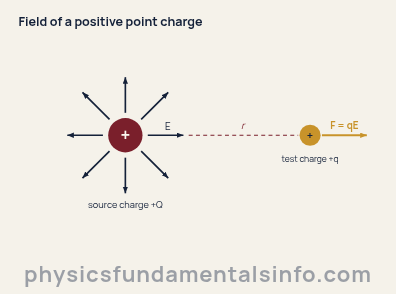
Field lines stream outward from a positive charge. A test charge +q at distance r feels an outward force F = qE.
The Electric Field Formula
There are two key formulas, and knowing which is which removes most of the confusion. The first is the definition; the second is the field of a single point charge.
The defining formula links field to force:
- E — electric field strength, in newtons per coulomb (N/C), which is identical to volts per metre (V/m).
- F — the electrostatic force on the test charge, in newtons (N).
- q — the test charge placed in the field, in coulombs (C).
Rearranged, this gives the formula you will use most often — the force on any charge sitting in a known field:
The second formula gives the field produced by a point charge, a distance r away:
- E — electric field strength, in newtons per coulomb (N/C).
- k — Coulomb’s constant, ≈ 8.99 × 10⁹ N·m2/C2 (often rounded to 9.0 × 10⁹).
- Q — the source charge creating the field, in coulombs (C).
- r — the distance from the source charge to the point, in metres (m).
Coulomb’s constant is not arbitrary. It is set by the vacuum permittivity ε0 through k = 1/(4πε0), and ε0 ≈ 8.854 × 10⁻¹² F/m is one of the measured constants of nature published by NIST.
Notice what the second formula does not contain: the test charge q. The field around a source charge is the same whether you probe it with a huge charge, a tiny one, or none at all.
Once you know the source charge and the distance, you can check the field strength in seconds with our Electric Field Calculator — it rearranges E = kQ/r2 to solve for the field, the charge or the distance.
| Use this formula | When you know… | It gives you… |
|---|---|---|
| E = F/q | the force F on a known test charge q | the field at that point (the definition) |
| E = kQ/r2 | the source charge Q and distance r | the field around a single point charge |
| F = qE | the field E and a charge q in it | the force that charge feels |
| E = V/d | the voltage V across plates and gap d | the uniform field between parallel plates |
Why N/C and V/m are the same unit
Newtons per coulomb and volts per metre look unrelated, but they are equal. A volt is a joule per coulomb, and a joule is a newton-metre, so V/m = (N·m/C)/m = N/C. Use N/C when you are thinking about force, and V/m when you are thinking about voltage across a gap — they describe the same quantity.
How the Electric Field Formula Works
Where does E = kQ/r2 actually come from? It falls straight out of Coulomb’s law. Coulomb’s law gives the force between two point charges, Q and q, as F = kQq/r2. The field is just that force shared out per unit test charge:
E = F/q = (kQq/r2) ÷ q = kQ/r2.
The q cancels. That single cancellation is the whole reason the field is a property of the source alone — it is what lets us draw one field map and use it for every charge we later place in it.
The same result drops out of Gauss’s law in one step: enclose the charge in an imaginary sphere of radius r, and the field — equal everywhere on that sphere by symmetry — works out to kQ/r2. A clean version of this derivation using a spherical Gaussian surface is set out in HyperPhysics.
The inverse-square fall-off
The r2 in the denominator is the part students underestimate. Because the field depends on 1/r2, distance punishes it hard. Move twice as far from a charge and the field does not halve — it drops to a quarter. Move three times as far and it falls to a ninth.
This is why a charged comb lifts paper from a centimetre away but does nothing from across the room. A small change in distance is a large change in field.
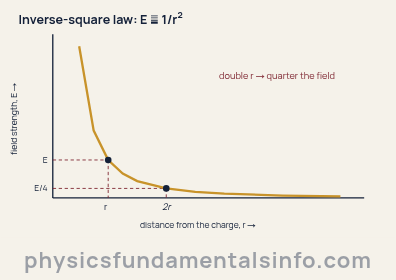
The field of a point charge weakens as 1/r2: doubling the distance cuts it to one quarter.
Try it for yourself — change the charge and the distance in the lab below and watch the field strength respond:
Electric Field Lines and Uniform Fields
Field lines are the picture behind the maths. They are arrows that trace the direction a positive charge would move, and a handful of simple rules makes them reliable:
- Lines start on positive charges and end on negative charges (or run off to infinity).
- The field is stronger where the lines are closer together, weaker where they spread out.
- Lines never cross — the field can only point one way at any single point.
- Lines always meet a conductor’s surface at right angles.
Around a lone point charge the lines fan out like spokes, getting sparser with distance — exactly the inverse-square fall-off, drawn. Around a pair of opposite charges they curve gracefully from positive to negative, forming the familiar dipole pattern.
The special case: a uniform field
Put two flat metal plates parallel to each other and connect them to a battery, and something neat happens. Between the plates the field becomes uniform — the same strength and direction everywhere, shown by evenly spaced parallel lines.
For that uniform field, the formula is refreshingly simple:
- V — the potential difference (voltage) between the plates, in volts (V).
- d — the separation between the plates, in metres (m).
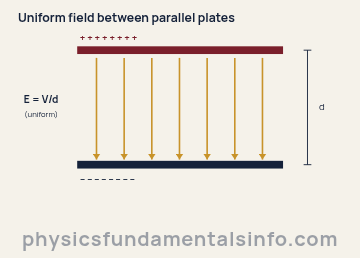
Between parallel plates the field is uniform — equal everywhere — with strength E = V/d.
Real-World Examples of Electric Fields
Electric fields are not a chalkboard abstraction. They are working components in everyday technology and in the natural world. Here are five you meet without noticing.
1. Laser printers and photocopiers
Inside every laser printer is a drum given a careful pattern of electric charge. The field around the charged regions grabs powdered toner exactly where the page needs ink, then presses it onto the paper. No field, no print.
2. Capacitors in your phone and camera flash
A capacitor is two plates with a uniform field between them, storing energy in that field. When a camera flash fires, a capacitor dumps its stored field energy in a millisecond. The same components smooth the power inside virtually every gadget you own.
3. Lightning
Storm clouds separate charge until the field between cloud and ground grows enormous. Once it passes roughly 3 million volts per metre, the air itself breaks down and conducts — and a lightning bolt is the field discharging in a fraction of a second.

4. Touchscreens
A capacitive touchscreen holds a faint electric field across its surface. Your fingertip, being slightly conductive, distorts that field, and the phone reads exactly where the distortion happened. Every tap and swipe is a field measurement.
5. Van de Graaff generators (and hair-raising static)
Touch a Van de Graaff generator and your hair stands on end. Charge spreads over you and your strands, and because like charges repel along the field, each hair pushes away from its neighbours — a vivid, harmless demonstration of a field at work.
| Situation | Approximate field strength |
|---|---|
| Earth’s fair-weather field near the ground | ~100 N/C |
| Sunlight / radio waves reaching the Earth | ~102–103 N/C |
| Just before a spark jumps in dry air (breakdown) | ~3 × 10⁶ V/m |
| Across a cell membrane in your body | ~107 V/m |
| At the electron’s orbit in a hydrogen atom | ~5 × 10¹¹ N/C |
Common Misconceptions About Electric Fields
“The field only exists when there’s a test charge in it”
No. The source charge creates the field throughout the surrounding space all by itself. The test charge is just our probe for measuring what is already there — remove it and the field carries on existing.
“E = F/q means the field depends on q”
It looks that way, but it isn’t. If you halve the test charge, the force on it also halves, so the ratio F/q stays exactly the same. The field at a point is fixed by the source, not by whatever you use to measure it.
“Electric field and electric potential are the same thing”
They are partners, not twins. Field (E) is a vector measured in N/C; potential (V) is a scalar measured in volts. The field is the rate at which potential changes with distance — steep potential means strong field. They are linked, but they are not interchangeable.
“A charge always travels along a field line”
Only sometimes. A charge released from rest does start moving along the field line through that point. But if it is already moving sideways, it follows a curved path that cuts across the lines — the field sets its acceleration, not its whole trajectory.
How Electric Fields Relate to Other Concepts
The electric field is a hub that connects much of electromagnetism. Seeing the links makes each topic easier.
Coulomb’s law and electric force
The field is Coulomb’s force, repackaged per unit charge. Multiply the field by a charge and you are straight back to a force: F = qE. If you want the force between two specific charges instead, Coulomb’s law is the tool.
Voltage, current and circuits
Inside a wire, it is an electric field that nudges the free electrons along, setting up a current. That field-driven flow is the starting point for Ohm’s law and the whole of circuit theory.
Energy and work
Pushing a charge through a field takes work, and that work is stored as electric potential energy. Letting the charge go converts it back into kinetic energy — the principle behind everything from a spark to a particle accelerator.
Magnetism and light
A changing electric field gives birth to a magnetic field, and a changing magnetic field gives birth to an electric one. Together they leapfrog through space as an electromagnetic wave — which is exactly why light travels at the speed of light.
| Quantity | Symbol | Type | SI unit | Depends on… |
|---|---|---|---|---|
| Electric field | E | Vector | N/C (= V/m) | source charge & position (not the test charge) |
| Electric force | F | Vector | newton (N) | the field and the charge placed in it |
| Electric potential | V | Scalar | volt (V) | source charge & position |
| Potential energy | U | Scalar | joule (J) | the charge and the potential (U = qV) |
Worked Problems
Show Solution
Solution:
Step 1: Use the point-charge formula, E = kQ/r2, with k = 8.99 × 10⁹ N·m2/C2.
Step 2: Convert units: Q = 2.0 × 10⁻⁹ C, r = 5.0 × 10⁻³ m, so r2 = 2.5 × 10⁻⁵ m2.
Step 3: E = (8.99 × 109 × 2.0 × 10−9) ÷ (2.5 × 10⁻⁵) = 17.98 ÷ (2.5 × 10⁻⁵).
Answer: E ≈ 7.2 × 10⁵ N/C, directed radially outward (the charge is positive).
Show Solution
Solution:
Step 1: The force on a charge in a field is F = qE.
Step 2: Substitute q = 5.0 × 10⁻⁶ C and E = 2.0 × 10³ N/C.
Step 3: F = (5.0 × 10⁻⁶)(2.0 × 10³) = 1.0 × 10⁻² N.
Answer: F = 0.010 N, in the direction of the field.
Show Solution
Solution:
Step 1: Start from E = kQ/r2 and rearrange for r: r = √(kQ/E).
Step 2: Substitute: r = √[(8.99 × 109 × 1.0 × 10−9) ÷ 900] = √(8.99 ÷ 900).
Step 3: r = √(9.99 × 10⁻³) = 0.0999 m.
Answer: r ≈ 0.10 m (about 10 cm).
Show Solution
Solution:
Step 1: Find the force with F = qE.
Step 2: F = (1.6 × 10⁻¹⁹)(1.0 × 10⁴) = 1.6 × 10⁻¹⁵ N.
Step 3: Use Newton’s second law, a = F/m = (1.6 × 10⁻¹⁵) ÷ (9.11 × 10⁻³¹).
Answer: a ≈ 1.8 × 10¹⁵ m/s2, directed opposite to the field (the electron is negative).
Show Solution
Solution:
Step 1: For a uniform field, E = V/d, with d = 4.0 × 10⁻³ m.
Step 2: E = 120 ÷ (4.0 × 10⁻³) = 3.0 × 10⁴ V/m (= 3.0 × 10⁴ N/C).
Step 3: Force: F = qE = (2.0 × 10⁻⁹)(3.0 × 10⁴) = 6.0 × 10⁻⁵ N.
Answer: E = 3.0 × 10⁴ N/C; F = 6.0 × 10⁻⁵ N.
Show Solution
Solution:
Step 1: Each charge is 0.20 m from the midpoint. Find each field magnitude with E = kQ/r2.
Step 2: E = (8.99 × 109 × 8.0 × 10−9) ÷ (0.20)2 = 71.92 ÷ 0.04 = 1798 N/C from each charge.
Step 3: At the midpoint, the field from the +8.0 nC charge points toward +x, and the field toward the −8.0 nC charge also points toward +x, so they add: 1798 + 1798.
Answer: E ≈ 3.6 × 10³ N/C, pointing from the positive charge toward the negative charge.
Show Solution
Solution:
Step 1: “Motionless” means the electric force balances gravity: qE = mg.
Step 2: Rearrange: q = mg/E = (4.0 × 10−15 × 9.81) ÷ (8.2 × 10⁴).
Step 3: q = (3.92 × 10⁻¹⁴) ÷ (8.2 × 10⁴) = 4.8 × 10⁻¹⁹ C.
Answer: q ≈ 4.8 × 10⁻¹⁹ C — almost exactly 3 electron charges, echoing Millikan’s famous experiment.
Show Solution
Solution:
Step 1: Between two positive charges the fields point in opposite directions, so they can cancel. Set the magnitudes equal at distance x from the +9.0 nC charge: kQ1/x2 = kQ2/(1 − x)2.
Step 2: The k cancels, leaving Q1/x2 = Q2/(1 − x)2, so (1 − x)/x = √(Q2/Q1) = √(4/9) = 2/3.
Step 3: Then 1 − x = (2/3)x, so 1 = (5/3)x, giving x = 0.60 m.
Answer: The field is zero 0.60 m from the +9.0 nC charge (0.40 m from the +4.0 nC charge).


