Electric potential is the electrical potential energy per coulomb at a point in space, measured in volts and taken as zero infinitely far away. Around a single point charge it equals the Coulomb constant times the charge divided by the distance, V = kQ/r. Potential is a scalar, so the potentials of several charges add as plain signed numbers.
Walk across a dry carpet, reach for a metal handle, and you get a snap you can hear. Nothing about you got heavier or bigger. What changed is a single number attached to every point of the space around you — and how big that number grows is what decides whether a spark jumps.
That number is the electric potential, and it does not behave like the force picture most people carry around. It has no direction at all. This page follows it from one charge to two, through the zero that sits infinitely far away, to the thing almost everybody guesses wrong: where the potential is zero, the electric field usually is not.
What Is Electric Potential?
Electric potential at a point is the energy per unit charge that a positive test charge would hold there, measured in volts, with the zero fixed infinitely far from every charge.
Physics has pulled this trick before. Instead of quoting the gravitational potential energy of every object on a hillside separately, you quote the height of the hill and let each object supply its own mass. Height is a property of the place; energy is a property of the place and the thing standing on it. Our guide to potential energy sets out the version with kilograms in it.
Electric potential is that height, for charge instead of mass. Park a charge q at a point where the potential is V and its electrical potential energy is qV, so the volt is doing the same job the metre does on the hillside.
One volt is one joule per coulomb. That is the whole unit: move a coulomb to a spot sitting at 12 V and you have handed it 12 joules, and a spot at 12 V is 12 J/C more expensive than the zero you chose.
Two features make this quantity worth its own name. It is a scalar, with a sign but no direction. And it belongs to the point, not to whatever you might put there — the potential three centimetres from a charged sphere is a fact about that spot even when nothing is sitting in it.
The sign comes straight from the sign of the source. Positive electric charge lifts the potential everywhere around it; negative charge lowers it everywhere around it. Nothing about that changes with distance; only the size does.
The Electric Potential Formula: V = kQ/r
The potential a single point charge produces is the Coulomb constant multiplied by the charge, divided by the distance from it.
- V — the electric potential at the point, in volts (V), where 1 V = 1 J/C. Carries the sign of Q.
- k — the Coulomb constant, 8.9875 × 10⁹ N·m2/C2 throughout this page. The same constant appears in Coulomb’s law.
- Q — the charge producing the potential, in coulombs (C). Signed, and often quoted in nanocoulombs: 1 nC = 10−9 C.
- r — the distance from the charge to the point, in metres (m). Strictly greater than zero; it is the only denominator here.
Only one division is ever involved, which is why the formula is easier to work with than it looks. Multiply k by the charge in coulombs, divide by the distance in metres, and read the answer in volts. If you would rather not run the arithmetic, our electric potential calculator takes any two of the potential, the charge and the distance and returns the third.
Two habits save most of the marks lost on this formula. Convert to coulombs and metres before anything else, because nanocoulombs and centimetres sitting in the same expression are worth three or six orders of magnitude of wrong answer. And carry the minus sign of a negative charge all the way through, rather than computing a size and bolting a sign on afterwards.
Here is the same charge read at six distances. Every figure is what the calculator prints, to six significant figures, with the field strength beside it for comparison.
| Distance r (m) | Potential V (V) | Field strength E (N/C) | V divided by E (m) |
|---|---|---|---|
| 0.1 | +89.8750 | 898.750 | 0.100000 |
| 0.25 | +35.9500 | 143.800 | 0.250000 |
| 0.5 | +17.9750 | 35.9500 | 0.500000 |
| 1 | +8.98750 | 8.98750 | 1.00000 |
| 2 | +4.49375 | 2.24688 | 2.00000 |
| 4 | +2.24688 | 0.561719 | 4.00000 |
A charge of +1 nC read at six distances. The 1 m row prints the same six digits in both middle columns — 8.98750 V and 8.98750 N/C — and that is a coincidence of the number 1, not a physical identity: the units differ, and by the 2 m row the two columns no longer match.
Take the 0.25 m and 0.5 m rows together and the difference between the two columns is already visible. The potential drops from 35.9500 V to 17.9750 V, exactly half, while the field strength drops from 143.800 N/C to 35.9500 N/C, exactly a quarter.
The last column is the neatest self-check on this page. For a point charge the potential divided by the field strength is the distance itself, in metres, which means a potential and a field that do not divide back to the distance you started from cannot both be right.
The lab below puts two charges on a line and a probe between them. Slide the probe, change either charge, pull the charges apart, and watch what the potential does — then look for the point where it crosses zero and check whether the field does anything at all there.
How Fast the Potential Falls Off, and Why the Field Falls Faster
The potential of a point charge falls as one over the distance, while the field strength around the same charge falls as one over the distance squared, so every step away from the charge weakens the field faster than it weakens the potential.
That single power of r is the whole difference, and it is worth staring at. Walk from 1 m out to 2 m and the potential halves; the field quarters. Walk out to 4 m and the potential is a quarter of what it was; the field is a sixteenth.
The field strength expression sitting beside V = kQ/r is E = kQ/r2, and it belongs to our guide to the electric field, which derives it, draws it and works with it properly. It is quoted here for one purpose only: to be compared.

Both curves are drawn from the same charge, so the gap between them is not a matter of one being bigger. On a logarithmic scale, squaring a fraction doubles how far it falls, which is exactly why the wine curve sits twice as far below the top of the axis as the gold one at every distance across the plot.
Now the trap the r = 1.00 m column sets. There the potential reads 8.9875 V and the field strength reads 8.9875 N/C, and a student who has just met both quantities can be forgiven for thinking they are the same thing wearing two hats. They are not. The digits agree because dividing by 1 and dividing by 1 squared are the same operation, and one row down, at 2 m, the numbers part company for good.
Why Electric Potential Is a Scalar, and What That Buys You
Electric potential is a scalar: it has a size and a sign but no direction, so the potential several charges produce at a point is the ordinary sum of what each produces on its own.
Compare the work involved. To combine two electric fields at a point you resolve each into components, add the components separately and recombine — geometry, every time. To combine two potentials you add two signed numbers.
Written out, superposition for the potential is simply this: V at the point equals kQ1/r1 plus kQ2/r2 plus however many more charges there are, with each r measured from its own charge to the same point. No angles enter anywhere.
There is a reason physicists reach for the potential first and recover the field afterwards. Doing the easy scalar sum and then differentiating is almost always less work than doing the vector sum directly, and the differentiating step is the relation E = −dV/dr. The field is the steepness of the potential, with a minus sign because it points downhill.
That relation also hands you a picture. Where the potential curve is steep, the field is strong; where the potential curve is flat, the field is zero. Flat does not mean low, which is the seed of everything in the next section.
Where Is the Potential Zero but the Field Is Not?
Exactly halfway between two equal and opposite charges the potential is zero while the field is not, because the two potentials cancel as signed numbers whereas the two field contributions point the same way and add.
Put +5 nC at one end of a 1.00 m line and −5 nC at the other. At the midpoint each charge is 0.500 m away, so one contributes +89.875 V and the other −89.875 V, and the total is zero to the last decimal place.
The field there does the opposite. Both charges push a positive test charge the same way — away from the positive one, towards the negative one — so the two contributions add up rather than cancelling, and the total is 359.5 N/C.
That midpoint is in fact the weakest the field gets anywhere between the two charges, because moving either way brings you closer to one of them faster than it takes you away from the other. Weakest, and still 359.5 N/C. The potential, meanwhile, is exactly nothing.
Flip one charge and the two zeros swap places. Three arrangements, all with the charges 1.00 m apart and all measured along the line through them:
| The pair | V = 0 on that line at | E = 0 on that line at | V at the midpoint | E at the midpoint |
|---|---|---|---|---|
| +5 nC and −5 nC | the midpoint | nowhere on that line | 0 V exactly | 359.5 N/C |
| +5 nC and +5 nC | nowhere on that line | the midpoint | +179.75 V | 0 N/C exactly |
| +9 nC and −1 nC | 0.400 m and 0.625 m from the midpoint, towards the small charge | 1.000 m from the midpoint, beyond the small charge | +143.8 V | 359.5 N/C |
Three pairs 1.00 m apart, everything measured along the line through both charges. Positions are given as distances from the midpoint towards the second charge named. These are the zeros on that one line; the full V = 0 set is a surface, not a point.
The first two rows are the same two charges with one sign flipped, and each time exactly one of V and E vanishes at the midpoint — and it is the other one each time. That is as clean a demonstration as this topic has that the two quantities are answering different questions.
There is a rule hiding in the midpoint columns. At the midpoint the potential follows the sum of the two charges and the field follows their difference: +5 and −5 sum to zero, +5 and +5 differ by zero, and +9 and −1 differ by the same 10 nC as +5 and −5, which is why rows one and three share a field of 359.5 N/C.
The third row separates all three special places, and it is the one worth working through by hand. The potential vanishes twice, at 0.400 m and at 0.625 m; the field vanishes once, a metre from the midpoint on the far side of the small charge; and at that field-free point the potential is +35.95 V, nowhere near zero.
Careful with the word “the” here. Those are the zeros on that line. Step off the axis and the set of points where V = 0 turns out to be a whole surface, of which this line catches two.
Equipotential Surfaces, and Why Zero Sits at Infinity
An equipotential surface is the set of all points at the same potential, and around a single point charge it is a sphere, because V depends only on r.
Draw those spheres as circles in a flat slice and something useful appears: the field lines cross every one of them at a right angle. They have to. The field points along the steepest change in potential, and the steepest way off a contour is straight across it.
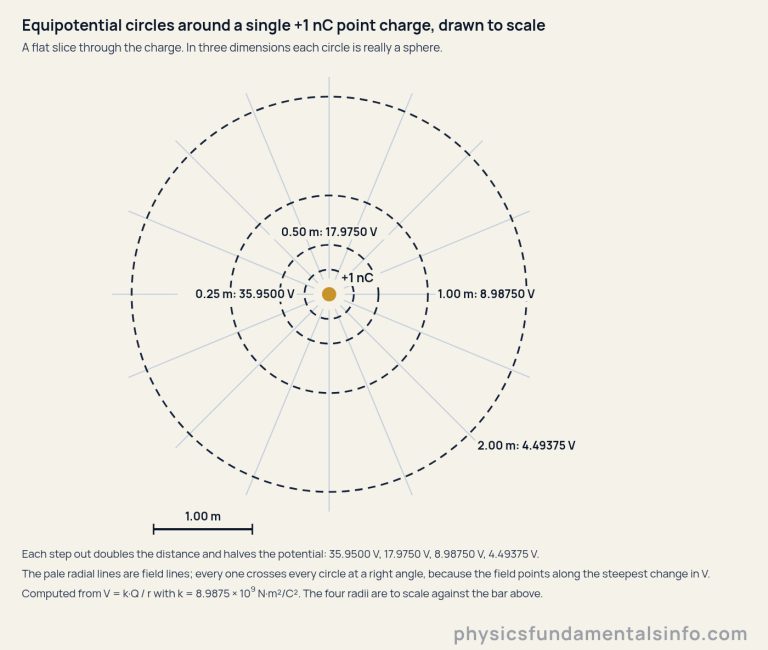
Move a charge along one of those circles and no work is done at all. The force on it is perpendicular to every step it takes, and a force at right angles to the motion does no work — which is the same argument that keeps a satellite in a circular orbit from gaining energy.
Move it across the circles and work is done, and the amount depends only on which circle it started on and which one it ended on. The route in between is irrelevant. That path-independence is what allows a potential to be defined at all.
Now the zero. Nothing in the physics fixes where potential should be called zero; only differences ever show up in an energy, a force or a meter reading. The convention that makes V = kQ/r come out with no extra constant tacked on the end is to set V = 0 infinitely far from every charge.
That choice is what makes a negative potential ordinary rather than alarming. Around a −5 nC charge every potential is below zero, because bringing a positive test charge in from far away releases energy instead of costing it. Negative here means below the level you picked, in exactly the sense that a basement is below ground floor.
Other zeros are chosen all the time for convenience — the chassis in a car, the earth pin in a house — and every number quoted afterwards is relative to that choice. Shift the zero and every potential on this page shifts with it, while every difference between two of them stays exactly the same.
Where Electric Potential Turns Up in Real Life
Four places where the number does real work, and the arithmetic stays the same in all of them.
Charging something to a chosen voltage
A conducting sphere carries its charge on the outside, and from anywhere outside it the sphere behaves exactly like a point charge sitting at its centre. So a metal dome of radius 0.20 m holding 1.0 µC of charge sits at 8.9875 × 109 × 1.0 × 10−6 / 0.20 = 44,937.5 V, about 45 kV.
Turn that round and it becomes a design rule. The charge a conductor needs in order to reach a chosen voltage is what capacitance measures, and for an isolated sphere it depends on nothing but the radius.

Turning a potential into an energy
Multiply a potential by a charge and you have an energy, which is where the electronvolt comes from: an electron dropped through one volt picks up one electronvolt. Atomic and nuclear physics run on that conversion, and it only works because the potential is defined point by point.
Adding up what a group of charges does
Ask what four charges do at one point and the field version means four vectors and a diagram. The potential version means four divisions and a sum, with the signs doing all the bookkeeping.
Auditing somebody else’s answer
Two quick tests catch most slips. A potential and a field quoted for the same point must divide to the distance, and a potential quoted for a negative charge must itself be negative.
Common Misconceptions About Electric Potential
Four traps account for most of the wrong answers here, and each one comes from reading a potential as though it were something else: a difference, a quantity with a floor, a field, or a vector.
“Electric potential and potential difference are the same thing”
They are two of a kind, not one thing. A potential is the value at one point, given a chosen zero; a potential difference is two of those values subtracted, which is why it is the quantity a voltmeter can actually read and why it is defined as V = W/Q, the work per unit charge moved between two places. Our guide to potential difference takes that route.
“A negative potential means there is less than nothing there”
It means below the level you chose, and nothing more. With the zero at infinity, every point around a negative charge is at a negative potential simply because a positive test charge gains energy on its way in. Move the zero and the sign can change without a single physical thing changing.
“Where the potential is zero, the field must be zero too”
This is the big one, and the dipole midpoint kills it in one step: V = 0 there while the field reads 359.5 N/C. The two conditions are unrelated because the field tracks the slope of the potential, not its value, and a curve can cross zero steeply.
“Potentials have to be combined like vectors”
They never do. A potential carries a sign, not a direction, so two contributions of +89.875 V and −89.875 V add to zero without any geometry at all. If an angle has appeared in a potential calculation, it got there through a distance — and only through a distance.
Where the Simple Picture Breaks Down
Everything above is correct inside its model, and the model has edges. Five are worth knowing before leaning on this page too hard.
A point charge has no size, and nothing real is one. Outside a uniformly charged sphere the formula is exact with r measured from the centre, which is why the dome calculation above is legitimate. Inside a uniformly charged shell, or anywhere inside a conductor like the dome, it is simply wrong: the potential stops climbing and levels off.
r = 0 is undefined, not enormous. The expression divides by zero there. An idealised point charge simply has no potential at its own location, which is why a calculator should decline that entry rather than print a huge number.
The zeros here are the zeros on a line. Every position quoted on this page is measured along the straight line through both charges. Away from that line the places where V = 0 form a surface, and locating them is a different job.
The constant is rounded, and not everywhere the same way. This page and the electric field calculator both use 8.9875 × 10⁹, deliberately, so that the two agree digit for digit. The Coulomb’s law calculator on this site rounds to 8.988 × 10⁹ instead.
Taking the 2022 CODATA figure for the vacuum electric permittivity, 8.8541878188 × 10⁻¹² F/m, the Coulomb constant comes out at 8.98755 × 10⁹ N·m2/C2. At 1 nC and 1 m those three roundings give 8.9875 V, 8.9880 V and 8.98755 V — agreeing to four significant figures and parting company after that. Do not carry a last digit between pages.
Nothing here is moving, and nothing else is nearby. The formula describes static charges in a vacuum with no conductors and no dielectric in the way. Put the charge in water and the potential drops by a large factor; put an earthed plate beside it and the potential is pinned to zero at that surface.