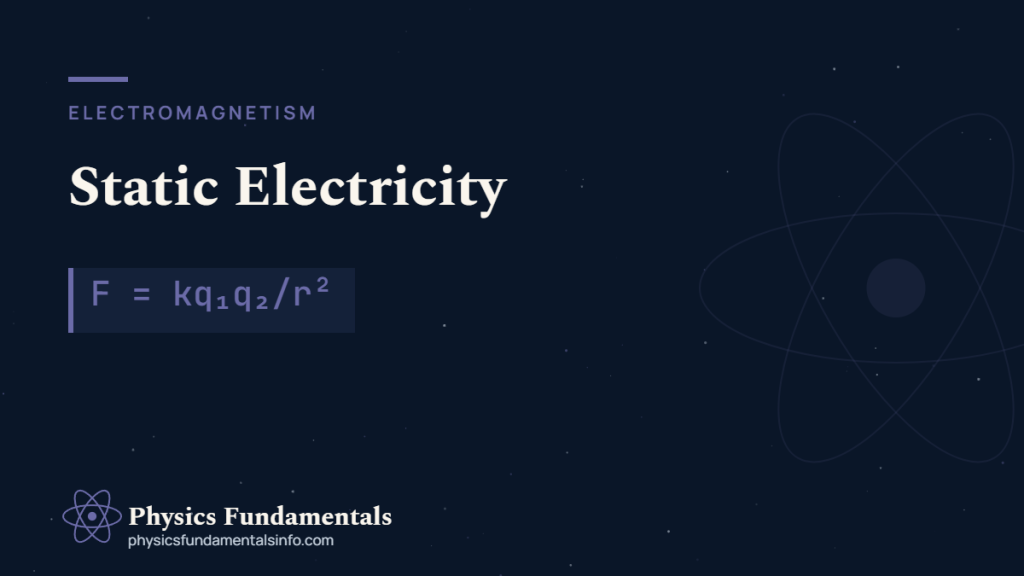
Static electricity is the build-up of stationary electric charge on the surface of a material, caused by an imbalance of electrons after two surfaces touch and then separate. A surface that gains electrons becomes negatively charged; one that loses them becomes positively charged. The force between such charges follows Coulomb’s law, F = kq1q2/r2.
Reach for a metal door handle on a dry winter morning and — snap — a tiny blue spark leaps to your fingertip. Tug a jumper over your head in a dark room and you may hear it crackle, even glimpse faint sparks against your hair. That sting and crackle is static electricity announcing itself.
It is the same effect that glues a balloon to the wall, pulls dust onto a TV screen, and — blown up to monstrous size inside a thundercloud — hurls a bolt of lightning at the ground. To understand all of it, we have to start with something almost unimaginably small: the electron.
What Is Static Electricity?
Everything around you is built from atoms, and every atom carries two kinds of electric charge: positive protons locked in its core, and negative electrons whizzing around the outside. In a normal object the two balance exactly, so the object is neutral and you notice nothing.
Static electricity appears when that balance is broken. Move some electrons from one object to another and the tally no longer matches: the object that lost electrons is left positive, and the object that gained them turns negative. That stranded, unmoving charge is what the word “static” means — electricity at rest.
This is the key contrast. In the wires of a torch or a phone charger, charge flows steadily as an electric current. In static electricity the charge simply sits on a surface, sometimes for hours, waiting. It stays put until it finds a route to even itself out — and that release is the spark you feel.
One rule never bends: charge is never created or destroyed, only moved. The electrons that make your hair stand up did not appear from nowhere; they were borrowed from the balloon. Physicists call this the conservation of charge, and it underpins everything that follows.
The Static Electricity Formula: Coulomb’s Law
Static charges do not just sit there politely — they push and pull on one another. The strength of that push or pull is set by Coulomb’s law, the central equation of electrostatics.
Each symbol has a precise meaning and unit:
- F — the electrostatic force between the two charges, measured in newtons (N).
- k — Coulomb’s constant, ≈ 8.99 × 10⁹ N·m2/C2 (it sets the sheer strength of the electric force).
- q1, q2 — the sizes of the two charges, measured in coulombs (C).
- r — the distance between the centres of the two charges, measured in metres (m).
Notice the r2 on the bottom. Because the force depends on one over the distance squared, separation matters enormously: double the gap and the force drops to a quarter; halve it and the force quadruples. A common student slip is to drop centimetres straight into the formula — always convert r to metres first, or the answer lands orders of magnitude out.
There is a second, simpler relationship hiding behind the scenes. Since charge comes in whole electrons, the total charge on an object is just the number of spare electrons multiplied by the charge each one carries:
- Q — the net charge on the object, in coulombs (C).
- n — the number of excess (or missing) electrons — a plain count.
- e — the elementary charge, 1.602 × 10⁻¹⁹ C, the charge of a single electron or proton.
In practice the charges in everyday static are tiny — a few nanocoulombs to a few microcoulombs — which is why the forces, though plenty to lift your hair, stay gentle.
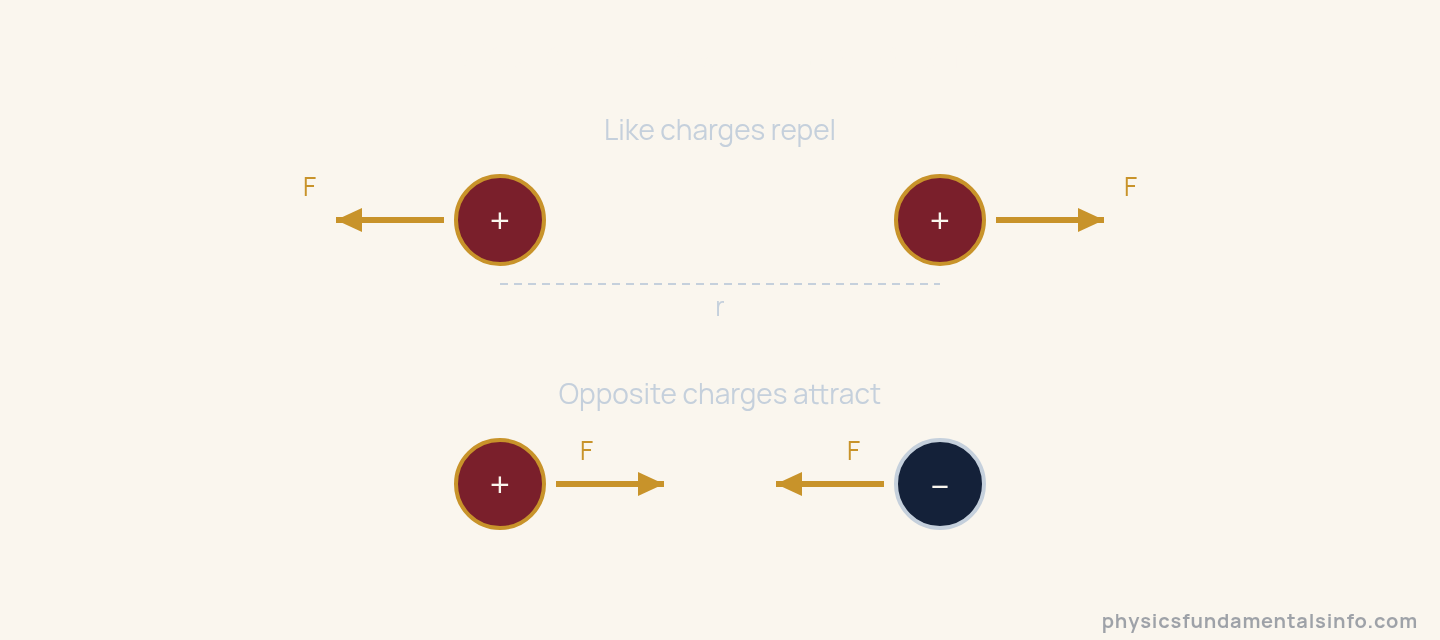
Coulomb’s law gives the size of the force; the signs of the charges decide its direction — like charges repel, opposite charges attract.
The lab below lets you feel this for yourself. Drag the charges and the separation, and watch the force rise and fall as the numbers change.
Want a number fast? Drop your values into our Coulomb’s Law Calculator, which converts units for you and shows the working step by step. For the full derivation and the story of how Charles-Augustin de Coulomb measured it, see our guide to Coulomb’s law.
How Static Electricity Works
Why do electrons move at all? The answer is that they are held far more loosely than protons. Protons are buried deep in the atomic nucleus and stay put. The outer electrons, by contrast, can be coaxed away when two surfaces meet — and that single fact explains almost every static effect you have ever seen.
Contact and separation — the triboelectric effect
Press two different materials together and, where they touch, electrons drift from one into the other. Pull the surfaces apart quickly and some of those electrons are stranded on the new material. The donor is left positive; the receiver is left negative. Scientists call this the triboelectric effect.
Here is the part textbooks often blur: the magic is contact and separation, not friction itself. Rubbing simply presses far more of the two surfaces together, so more electrons change hands — but a firm touch and a clean pull can charge an object too.
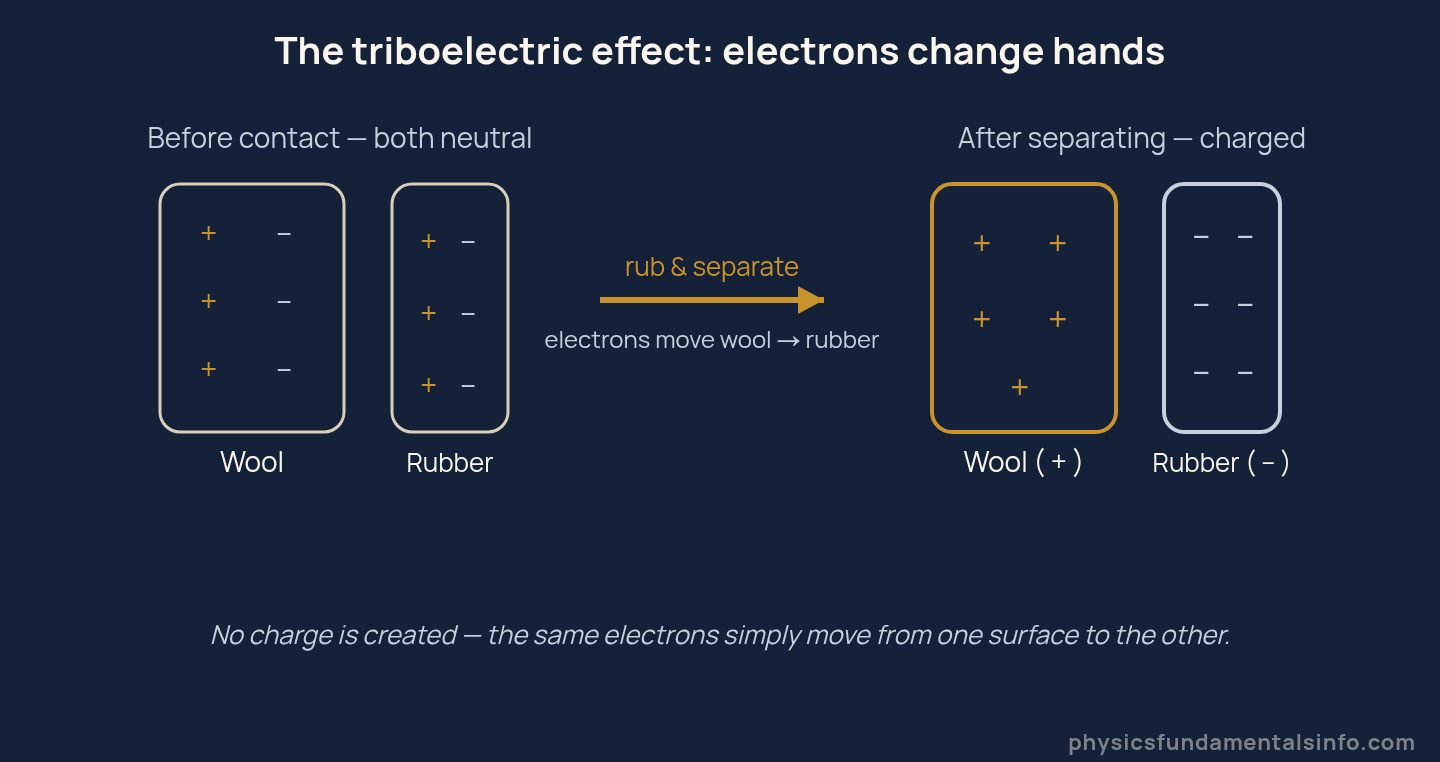
Rubbing wool against rubber transfers electrons, leaving one surface positive and the other negative.
Which material ends up positive?
Whether a material grabs electrons or gives them up depends on what it is paired with. The triboelectric series ranks materials from those that readily lose electrons (becoming positive) to those that greedily collect them (becoming negative). Rub two of them together and the higher one charges positive, the lower one negative.
| Material (top = most positive) | Charging tendency when rubbed |
|---|---|
| Human skin & hair | Strongly loses electrons → becomes positive ( + ) |
| Glass | Loses electrons → positive ( + ) |
| Nylon | Loses electrons → positive ( + ) |
| Wool | Tends positive ( + ) |
| Silk | Slightly positive ( + ) |
| Cotton | Roughly neutral |
| Steel | Roughly neutral (a reference point) |
| Rubber (balloon, hard rubber) | Gains electrons → negative ( – ) |
| Polyester | Gains electrons → negative ( – ) |
| PVC (vinyl) | Strongly gains electrons → negative ( – ) |
| Teflon (PTFE) | Most strongly negative ( – ) |
Treat this as a guide, not gospel. The exact ordering shifts with surface roughness, cleanliness and humidity, so different references disagree on the fine detail — a point made plainly in Harvard’s lecture-demonstration notes. The big picture, though, is reliable: hair and wool charge positive, plastics like PVC and Teflon charge negative.
Why some objects hold charge and others don’t
Materials split into two camps. In insulators — rubber, plastic, glass, dry hair — electrons are stuck where they land, so charge piles up and lingers. In conductors, especially metals, electrons roam freely, so any extra charge spreads out and drains away the instant it can.
That is why static loves a plastic comb but not a metal spoon you are holding: the spoon’s charge escapes through your hand. It also explains the weather. On a humid day a thin film of water on every surface quietly conducts charge away, so static barely builds. On a bone-dry winter day there is nowhere for it to go — it accumulates until it discharges in a snap.
Real-World Examples of Static Electricity
1. The doorknob zap. Shuffle across a nylon carpet and your shoes strip electrons from it, charging your whole body. Touch a metal handle and that charge finds its escape route, jumping the last millimetre as a spark. On a dry day your body can reach tens of thousands of volts before it lets go.
2. A balloon stuck to the wall. Rub a balloon on your hair and it steals electrons, turning negative; your hair, now positive, lifts and follows it. Press the balloon to a wall and its negative charge nudges the wall’s electrons aside, leaving the near surface slightly positive — so the balloon clings, held by attraction to charge it created itself.

3. Clothes that cling and crackle. A tumble dryer is a triboelectric factory: garments tumble, touch and separate thousands of times, so synthetics end up charged and stick to each other and to your skin. The faint crackle as you peel them apart is a chorus of miniature sparks.
4. Lightning — static on a colossal scale. Inside a storm cloud, ice crystals and soft hail (graupel) collide in violent updraughts and swap charge, leaving the cloud’s top positive and its base negative. When the imbalance grows too large for the air to insulate, it breaks down in a giant discharge. A typical bolt carries around 300 million volts and 30,000 amps, according to NOAA’s National Weather Service — and the channel flashes to roughly 30,000 °C, about five times hotter than the surface of the Sun.

5. Static put to work. Not all static is a nuisance. Photocopiers and laser printers charge a drum so that toner sticks only where it should; factories use it for even paint coatings and to filter smoke from chimneys. The same effect that ruins your hair quietly runs a great deal of modern technology.
Common Misconceptions About Static Electricity
Myth: “Friction creates static electricity.” Friction helps, but it is not the cause. What actually charges an object is contact followed by separation; rubbing merely multiplies the points of contact. You can charge surfaces by pressing and peeling them apart with no real rubbing at all. If you would like the mechanics of rubbing itself, see our explainer on what friction is.
Myth: “Static isn’t real electricity.” It is exactly the same electricity. The electrons and the charge are identical to those in a circuit — the only difference is that static charge sits still while current electricity flows. Both obey Coulomb’s law and the conservation of charge.
Myth: “Thousands of volts means it must be deadly.” A static shock can hit 20,000–35,000 volts, yet it rarely harms you. Voltage is only the electrical “pressure”; what does damage is energy and current, and a static spark carries almost none. Danger depends on how much charge flows and for how long — not on voltage alone.
Myth: “Rubbing makes new charge appear.” Nothing is created. Every electron that lands on one object was taken from the other, so the two charges are always equal and opposite. Charge is only ever shifted around, never conjured from nothing.
How Static Electricity Relates to Current, Energy and Coulomb’s Law
Static electricity is one corner of a single, connected subject. The force between the charges is pure Coulomb’s law — the inverse-square equation above. The moment that stored charge finds a conductor and flows, it becomes an electric current, and the rules of Ohm’s law take over to describe how voltage, current and resistance relate.
There is energy here too. A charged object stores electrical potential energy, and a discharge releases it. For a doorknob spark the amount is minuscule; for a lightning bolt it is staggering — enough to split the air into glowing plasma. If you want the bigger picture of where that comes from, start with our overview of energy in physics.
| Feature | Static electricity | Current electricity |
|---|---|---|
| Charge motion | At rest on a surface | Flows continuously |
| Usual setting | Built up on insulators | Moves through conductors and circuits |
| Driven by | A charge imbalance | A sustained voltage source |
| How long it lasts | Until it discharges (often an instant) | As long as the circuit stays closed |
| Everyday example | Doorknob shock, lightning | Mains power, batteries, a torch |
| Governing idea | Coulomb’s law | Ohm’s law |
So the next time a spark bites your fingertip, you are watching the whole of basic electricity in miniature: charge that sat still, a force described by Coulomb, and a fleeting current as it finally lets go.
Worked Problems
Show Solution
Step 1 — Use Coulomb’s law: F = k·q1·q2 / r2.
Step 2 — Substitute in SI units: F = (8.99 × 10⁹ N·m2/C2)(2 × 10−6 C)(3 × 10⁻⁶ C) / (0.5 m)2.
Step 3 — Top line: 8.99 × 109 × 6 × 10−12 = 5.39 × 10⁻² N·m2; divide by 0.25 m2: 5.39 × 10⁻² / 0.25 = 0.216 N.
Answer: F ≈ 0.22 N, repulsive (both charges are positive).Show Solution
Step 1 — Use Q = n·e, so n = Q / e.
Step 2 — Substitute: n = (1 × 10⁻⁶ C) / (1.602 × 10⁻¹⁹ C).
Step 3 — n = 6.24 × 10¹² electrons.
Answer: about 6.2 × 10¹² extra electrons give the rod its −1 μC charge.Show Solution
Step 1 — Use the magnitudes in Coulomb’s law: F = k·q1·q2 / r2.
Step 2 — Substitute: F = (8.99 × 10⁹)(5 × 10⁻⁹)(5 × 10⁻⁹) / (0.02 m)2.
Step 3 — Top line: 8.99 × 109 × 25 × 10−18 = 2.25 × 10⁻⁷; divide by 4 × 10⁻⁴ m2: 5.6 × 10⁻⁴ N.
Answer: F ≈ 5.6 × 10⁻⁴ N, attractive (the charges have opposite signs).Show Solution
Step 1 — Coulomb’s law is an inverse-square law, so F2 / F1 = (r1 / r2)2.
Step 2 — The distance triples: (10 / 30)2 = (1/3)2 = 1/9.
Step 3 — F2 = 0.36 N × 1/9 = 0.040 N.
Answer: F ≈ 0.040 N — tripling the separation cuts the force to one-ninth.Show Solution
Step 1 — Rearrange Coulomb’s law for r: r = √(k·q1·q2 / F).
Step 2 — Substitute: r = √[(8.99 × 10⁹)(4 × 10⁻⁶)(1 × 10⁻⁶) / 9.0].
Step 3 — Inside the root: 8.99 × 109 × 4 × 10−12 = 3.60 × 10⁻²; ÷ 9.0 = 4.00 × 10⁻³; √ = 0.063 m.
Answer: r ≈ 0.063 m ≈ 6.3 cm.Show Solution
Step 1 — Charge: Q = n·e = (5.0 × 10¹⁰)(1.602 × 10⁻¹⁹ C) = 8.0 × 10⁻⁹ C, i.e. −8.0 nC.
Step 2 — Force with a +8.0 nC charge: F = k·q1·q2 / r2 = (8.99 × 10⁹)(8.0 × 10⁻⁹)(8.0 × 10⁻⁹) / (0.02 m)2.
Step 3 — Top line: 8.99 × 109 × 6.4 × 10−17 = 5.77 × 10⁻⁷; ÷ 4 × 10⁻⁴ m2 = 1.4 × 10⁻³ N.
Answer: (a) Q ≈ −8.0 nC; (b) F ≈ 1.4 × 10⁻³ N (about 1.4 mN), attractive.