Classical Mechanics
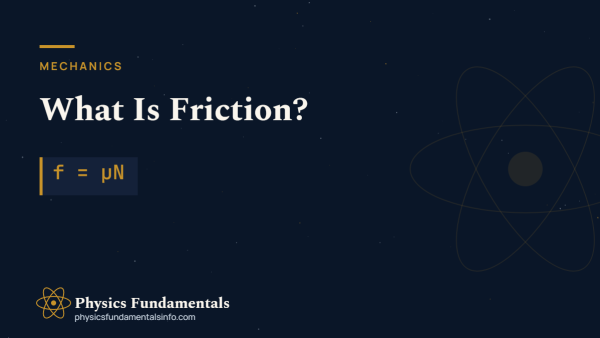
What Is Friction?
Friction is the force that resists sliding between two surfaces. This guide explains what friction is, the f = μN formula, static vs kinetic types, real-world examples, and eight worked problems.
13 min read
Classical mechanics: forces, energy, momentum and motion — Newton’s laws, work and energy, collisions, rotation and the everyday mechanics the rest of physics is built on.
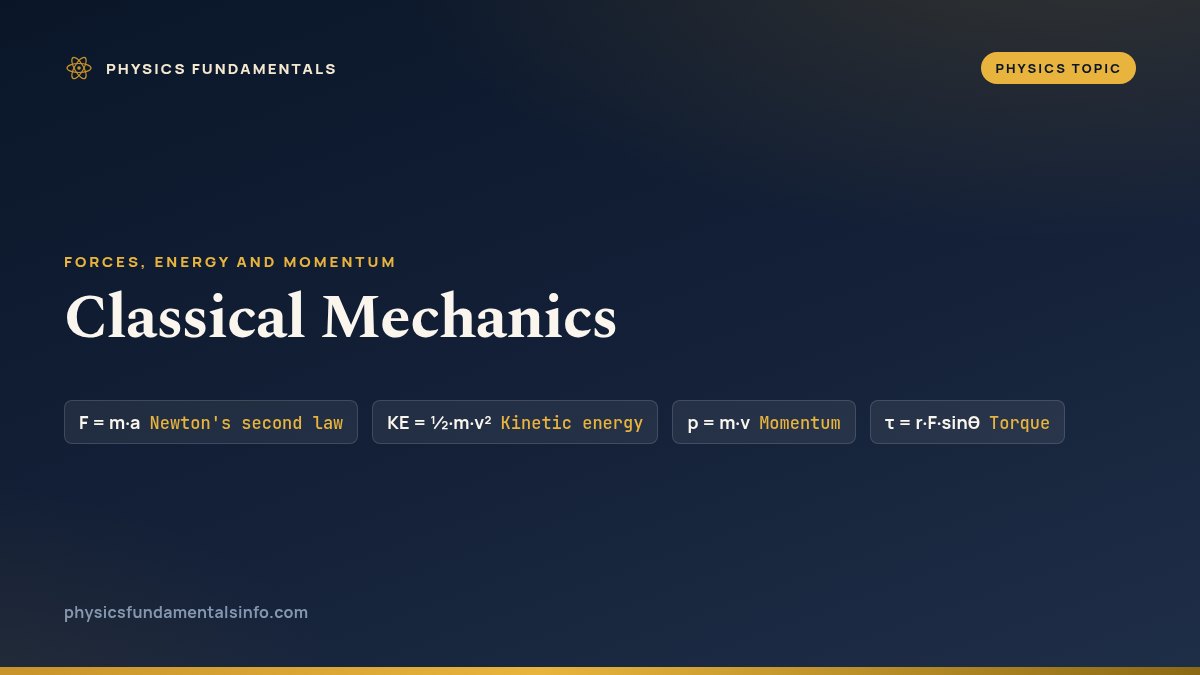
Classical Mechanics is the physics of why motion changes: the forces, energy and momentum that govern everything from a rolling ball to an orbiting satellite. Everything else in physics leans on it.
| Relationship | Equation | What it tells you |
|---|---|---|
| Newton's second law | F = m·a | Net force, mass and acceleration |
| Work done | W = F·d·cosθ | Energy transferred by a force |
| Kinetic energy | KE = ½·m·v² | Energy of a moving mass |
| Gravitational PE | PE = m·g·h | Energy stored by height |
| Momentum | p = m·v | Conserved in every collision |
| Torque | τ = r·F·sinθ | Turning effect of a force |