Conservation of momentum is the physical law stating that the total momentum of an isolated system stays constant: the vector sum of every object’s momentum (mass × velocity) before an interaction equals the total momentum afterward. With no external force, collisions, explosions and recoil only redistribute momentum — they never create or destroy it.
Step off a small boat onto a jetty and the boat darts backwards beneath your foot. Fire a rifle and your shoulder takes the kick. Break a rack of pool balls and a single cue strike scatters fifteen of them across the felt.
Every one of these is the same rule quietly balancing its books. Momentum — the “quantity of motion” a moving object carries — is never simply lost. It only shifts from one object to another, and the totals always match. That single idea is one of the most powerful problem-solving tools in all of physics.
What Is Conservation of Momentum?
Picture two ice skaters drifting toward each other. They grab hands, spin, and push apart. Track every push and shove, and you find the books always balance — what one skater gains, the other loses.
Conservation of momentum is the law that the total momentum of an isolated system never changes. Momentum is the product of an object’s mass and its velocity, written p = mv. Add up the momentum of every object before an event, and you get the exact same total afterward.
The key word is isolated. As long as no outside force pushes on the system, momentum has nowhere to go. Objects can swap it between themselves through collisions, but the grand total is locked.
Momentum is also a vector — it has direction. A 2 kg cart rolling left does not cancel an identical cart rolling right by accident; their momenta point in opposite directions and sum to zero. Keeping track of sign and direction is half the skill of momentum problems, which is why it pays to be clear about velocity versus speed before you start.
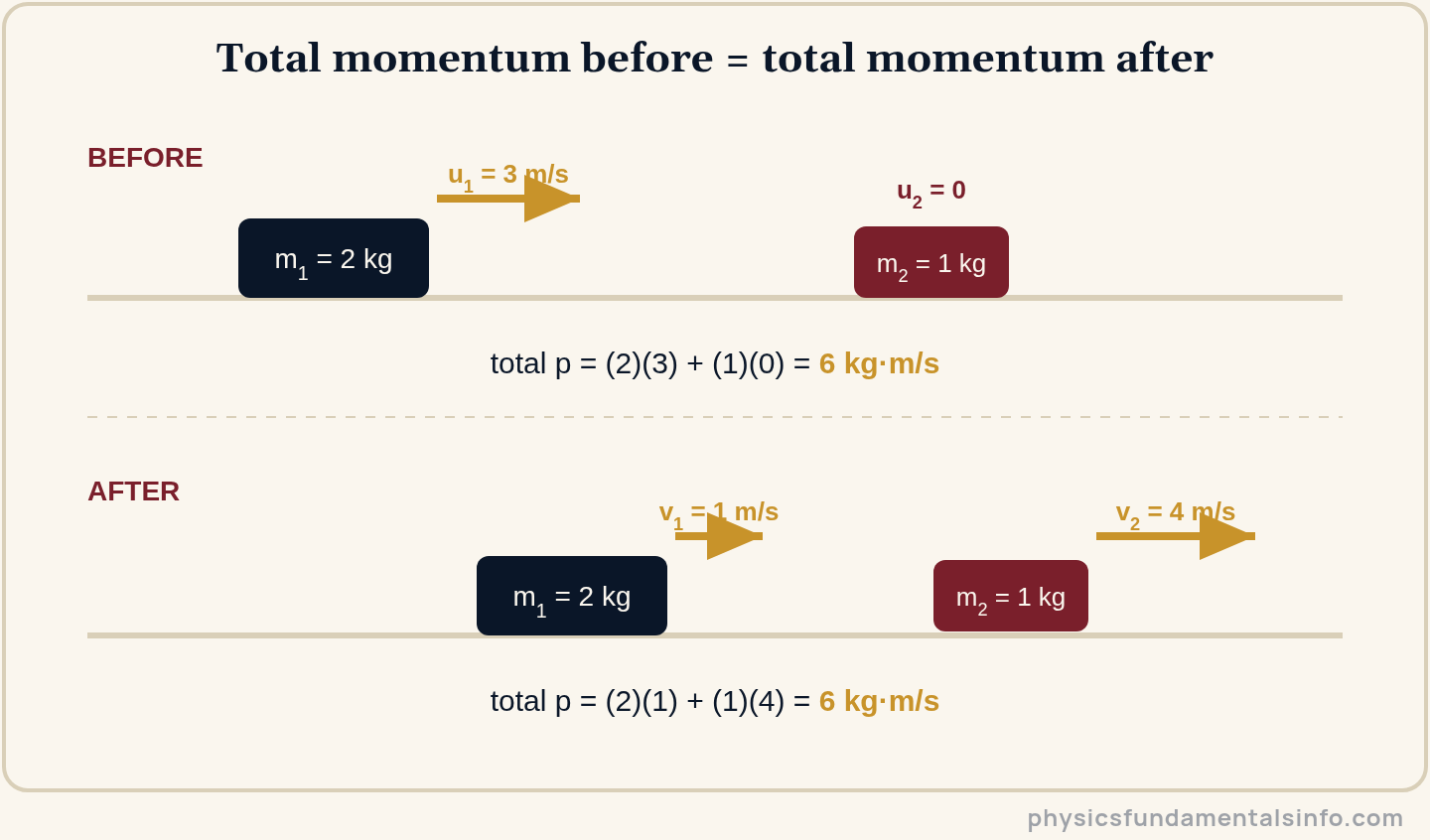
The carts trade velocity in the collision, yet the total momentum (6 kg·m/s) is identical before and after.
The Conservation of Momentum Formula
For two objects colliding in a straight line, the law is written as a single, balanced equation. Initial velocities use u; final velocities use v.
Every term is built from one simpler quantity — the momentum of a single object:
Here is what each symbol means, with its SI unit:
- p — momentum of an object, in kilogram-metres per second (kg·m/s)
- m1, m2 — the masses of object 1 and object 2, in kilograms (kg)
- u1, u2 — the velocities before the interaction, in metres per second (m/s)
- v1, v2 — the velocities after the interaction, in metres per second (m/s)
Because velocity is a vector, sign matters. Choose one direction as positive, then anything moving the other way is negative. Get the signs right and the equation does the rest.
The same idea scales to any number of objects: the total momentum of the system, Σp, is simply the sum of every individual mv, and that sum stays fixed.
How Conservation of Momentum Works
Why should the books balance so perfectly? The answer falls straight out of Newton’s laws of motion — specifically the third law.
When two objects collide, they push on each other. Newton’s third law says those pushes are equal in size and opposite in direction.
- During contact, object A pushes B with force F. By the third law, B pushes A with force −F.
- They touch for exactly the same time, Δt. So the impulse (force × time) on B is F·Δt, and the impulse on A is −F·Δt.
- Impulse equals change in momentum. So B gains exactly the momentum A loses: ΔpB = −ΔpA.
- Add them: ΔpA + ΔpB = 0. The total momentum does not change.
That is the whole proof. The internal forces of a collision always come in equal-and-opposite pairs, so they cancel perfectly when you total the system. According to NASA’s Glenn Research Center, momentum is “neither created nor destroyed, but only changed through the action of forces.”
Use the interactive lab below to see it for yourself. Set the masses and starting speeds, choose how bouncy the collision is, and watch the total momentum readout hold steady while kinetic energy does not.
When Is Momentum Actually Conserved?
Here is the catch students often miss: momentum is only conserved for an isolated system — one with no net external force acting on it.
Internal forces (the objects pushing each other) always cancel. External forces do not. Gravity, friction, a wall, or your hand reaching in can all add or remove momentum from the system.
So why does the law still work for a real pool break or car crash? Because collisions are fast. The forces between the objects are enormous compared with friction, and they act over such a tiny time that the external impulse is negligible. Momentum is conserved to an excellent approximation in that split second.
In practice, friction and air resistance are external forces, so an isolated system is an idealisation. That is exactly why a rolling ball eventually stops — the ground and air are quietly draining its momentum. Read more about that drag in our guide to what friction is.
Elastic vs Inelastic Collisions
Momentum is conserved in every collision. Kinetic energy is not — and that distinction is what separates the two main collision types.
Elastic collisions
In a perfectly elastic collision, both momentum and kinetic energy are conserved. Objects bounce cleanly apart with no energy lost to heat or sound. Two billiard balls or gas molecules come very close to this ideal.
Inelastic collisions
In an inelastic collision, momentum is conserved but some kinetic energy is converted into heat, sound, or permanent deformation. When the objects stick together and move as one, it is perfectly inelastic — the maximum possible energy loss.
| Property | Elastic | Inelastic | Perfectly inelastic |
|---|---|---|---|
| Momentum conserved? | Yes | Yes | Yes |
| Kinetic energy conserved? | Yes | No (some lost) | No (maximum lost) |
| After the collision | Bounce apart | Move separately, slower | Stick and move together |
| Coefficient of restitution e | e = 1 | 0 < e < 1 | e = 0 |
| Everyday example | Billiard balls, Newton’s cradle | Most real-world crashes | Clay ball hitting a wall; coupling train cars |
Real-World Examples of Conservation of Momentum
This is not just a textbook rule — it shapes everything from spaceflight to sport. Here are five places it shows up.
1. Rocket propulsion
A rocket throws hot exhaust gas downward at high speed. To keep total momentum constant, the rocket gains equal momentum upward. There is nothing to “push against” — the gas is the push. This is why rockets work in the vacuum of space.

2. Recoil of a gun
Before firing, the rifle-and-bullet system is at rest, so its total momentum is zero. The bullet leaves with forward momentum, so the rifle must recoil backward with an equal and opposite amount. The bullet is light and fast; the rifle is heavy and slow.
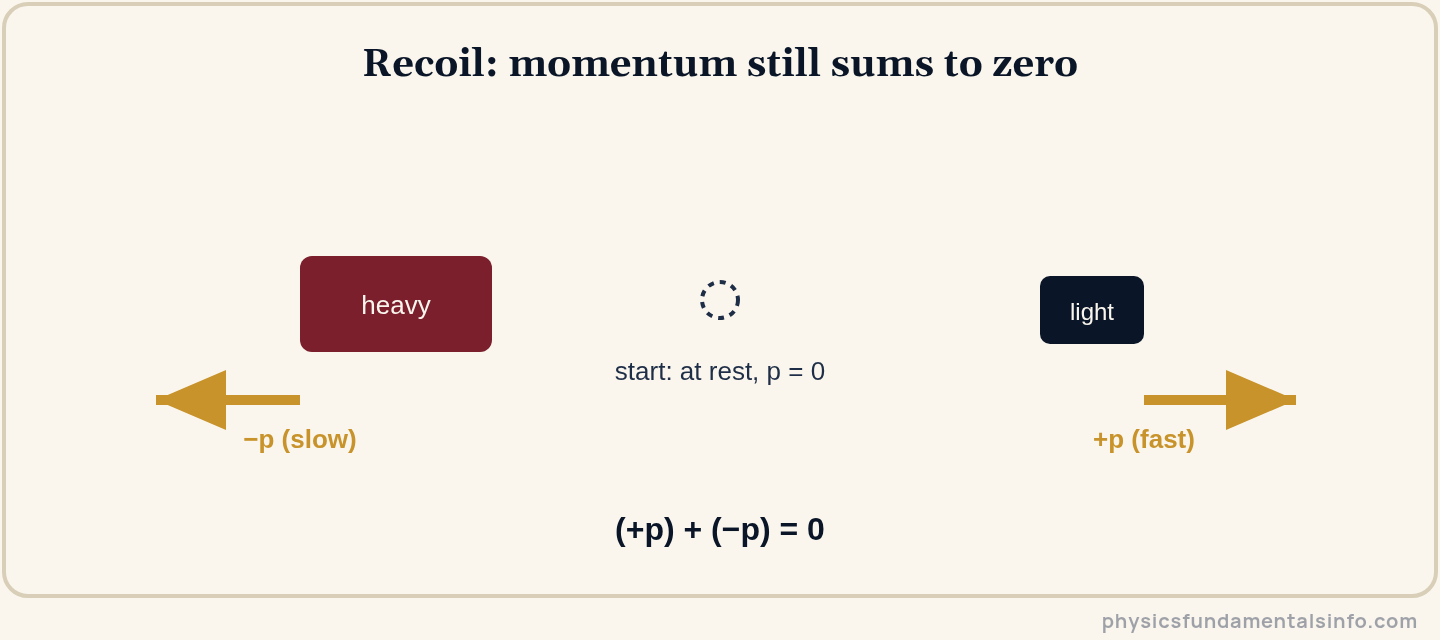
In recoil and explosions, the pieces fly apart with momenta that still add up to the original total.
3. Newton’s cradle
Lift one ball and release it, and a single ball swings out the far end at the same speed. Lift two, and two swing out. The desk toy is a near-elastic chain that passes momentum (and energy) straight through the line of stationary balls.
4. Billiards and the break
When the cue ball strikes the pack, its momentum spreads among every ball it touches. Add up all the scattered momenta as vectors and you recover the cue ball’s original momentum almost exactly — a vivid demonstration on a felt table.
5. Ice skaters pushing apart
Two stationary skaters push off each other and glide backward in opposite directions. They started with zero total momentum, so they must end with zero — the lighter skater simply moves away faster than the heavier one.
Common Misconceptions About Conservation of Momentum
“Momentum and kinetic energy are the same thing.”
They are not. Momentum (mv) is a vector and is conserved in every collision. Kinetic energy (½mv2) is a scalar and is only conserved in elastic collisions. A common exam slip is to assume energy is always conserved — it usually is not.
“Momentum is always conserved, no matter what.”
Only for an isolated system. If an external force — friction, gravity, a wall — acts on the system, its total momentum changes. The law applies to the system as a whole, not to a single object being pushed.
“The heavier object always ‘wins’ a collision.”
Mass alone does not decide the outcome — momentum does, and that depends on mass and velocity. A light, fast object can carry more momentum than a heavy, slow one.
“In an explosion, momentum is created from nothing.”
No. If the object started at rest, the fragments fly off with momenta that cancel to zero. The chemical energy creates kinetic energy, but the total momentum is unchanged.
How Conservation of Momentum Connects to Newton’s Laws, Impulse and Energy
Momentum sits at the centre of a web of ideas you have likely already met. Seeing the links makes each one easier.
Newton’s second law, restated
Newton originally wrote his second law in terms of momentum: force equals the rate of change of momentum. Our guide to Newton’s second law shows how F = ma is just the constant-mass version of F = Δp/Δt.
Impulse — the momentum “kick”
Impulse is force applied over time, and it equals the change in momentum. This is why airbags and crumple zones save lives: they stretch out Δt, which lowers the force needed to change your momentum.
- J — impulse, in newton-seconds (N·s), equal to kg·m/s
- F — average force, in newtons (N)
- Δt — contact time, in seconds (s)
- Δp — change in momentum, in kg·m/s
Energy — the other great conservation law
Momentum and energy are independent bookkeepers. A collision can conserve momentum while losing kinetic energy to heat and sound. To see how energy moves and transforms, visit our explainer on what energy is in physics.
At the deepest level, conservation of momentum reflects a symmetry of nature: the laws of physics are the same everywhere in space. That link between symmetry and conservation, formalised by Noether’s theorem, is touched on in this overview of momentum.
Worked Problems
Show Solution
Solution:
Step 1: Conservation of momentum (perfectly inelastic): m1u1 + m2u2 = (m1 + m2)v
Step 2: Substitute: (2.0)(3.0) + (1.0)(0) = (2.0 + 1.0)v
Step 3: Solve: 6.0 = 3.0v → v = 2.0 m/s
Answer: 2.0 m/s in the original direction
Show Solution
Solution:
Step 1: Total momentum before firing is zero: 0 = m_bullet·v_bullet + m_rifle·v_rifle
Step 2: Substitute: 0 = (0.020)(400) + (4.0)(v_rifle) → 0 = 8.0 + 4.0·v_rifle
Step 3: Solve: v_rifle = −8.0 / 4.0 = −2.0 m/s
Answer: 2.0 m/s backward (the minus sign shows the opposite direction)
Show Solution
Solution:
Step 1: m1u1 + m2u2 = m1v1 + m2v2
Step 2: Substitute: (3.0)(4.0) + (2.0)(0) = (3.0)(0.80) + (2.0)v2
Step 3: Solve: 12 = 2.4 + 2.0v2 → 2.0v2 = 9.6 → v2 = 4.8 m/s
Answer: 4.8 m/s in the original direction
Show Solution
Solution:
Step 1: Take right as positive. Total momentum = m1u1 + m2u2
Step 2: Substitute: (1.0)(+5.0) + (2.0)(−2.0) = 5.0 − 4.0 = 1.0 kg·m/s
Step 3: Divide by total mass: v = 1.0 / (1.0 + 2.0) = 0.33 m/s
Answer: 0.33 m/s to the right
Show Solution
Solution:
Step 1: For an elastic head-on collision between equal masses, the velocities simply exchange.
Step 2: So v1 = 0 and v2 = 6.0 m/s.
Step 3: Check momentum: before = (0.50)(6.0) = 3.0; after = (0.50)(0) + (0.50)(6.0) = 3.0 ✓
Step 4: Check KE: before = ½(0.50)(6.0)2 = 9.0 J; after = ½(0.50)(6.0)2 = 9.0 J ✓
Answer: the first ball stops; the second moves off at 6.0 m/s
Show Solution
Solution:
Step 1: Impulse-momentum theorem: F·Δt = Δp = m(v − u). Take the incoming direction as positive, so rebound is negative.
Step 2: Δp = (0.15)(−15 − 20) = (0.15)(−35) = −5.25 kg·m/s
Step 3: F = Δp / Δt = −5.25 / 0.020 = −262.5 N
Answer: about 263 N, directed away from the wall (the minus sign shows direction)
Show Solution
Solution:
Step 1: Total momentum before the explosion is zero: 0 = m1v1 + m2v2
Step 2: Substitute (east positive): 0 = (1.0)(+8.0) + (2.0)v2
Step 3: Solve: v2 = −8.0 / 2.0 = −4.0 m/s
Answer: 4.0 m/s west
Show Solution
Solution:
Step 1: For an elastic head-on collision with target at rest: v1 = [(m1−m2)/(m1+m2)]u1 and v2 = [2m1/(m1+m2)]u1
Step 2: v1 = [(2.0−1.0)/(3.0)](3.0) = (1/3)(3.0) = 1.0 m/s
Step 3: v2 = [2(2.0)/(3.0)](3.0) = (4/3)(3.0) = 4.0 m/s
Step 4: Check: momentum before = 6.0, after = (2.0)(1.0)+(1.0)(4.0) = 6.0 ✓; KE before = 9.0 J, after = 1.0 + 8.0 = 9.0 J ✓
Answer: v1 = 1.0 m/s and v2 = 4.0 m/s, both forward