What is friction? Friction is the contact force that opposes the relative motion, or attempted motion, between two surfaces touching each other. It acts parallel to the surface, always opposing motion, and turns useful kinetic energy into heat. Its size is set by f = μN — the coefficient of friction multiplied by the normal force pressing the surfaces together.
Strike a match and the head bursts into flame from nothing but a quick scrape. Rub your hands together on a cold morning and they warm up. Slam the brakes and your car drags to a halt. Every one of those moments is friction at work — quietly turning movement into heat.
It is the force that lets you walk without sliding, hold a pencil without it slipping, and stop at a red light. Ignore it in a physics problem and your answer falls apart. Understand it, and a huge slice of everyday mechanics suddenly makes sense.
What Is Friction?
Push a heavy book across a table and you feel something pushing back. That resistance is friction — a force that appears whenever two surfaces are pressed together and one tries to slide over the other.
More precisely, friction is a contact force acting along the surface, always pointing opposite the direction of motion or attempted motion. It never speeds an object up; it only ever resists.
Two things control its strength: how hard the surfaces are pressed together (the normal force) and how “grippy” the pairing is (the coefficient of friction). Change either, and the friction changes with it.
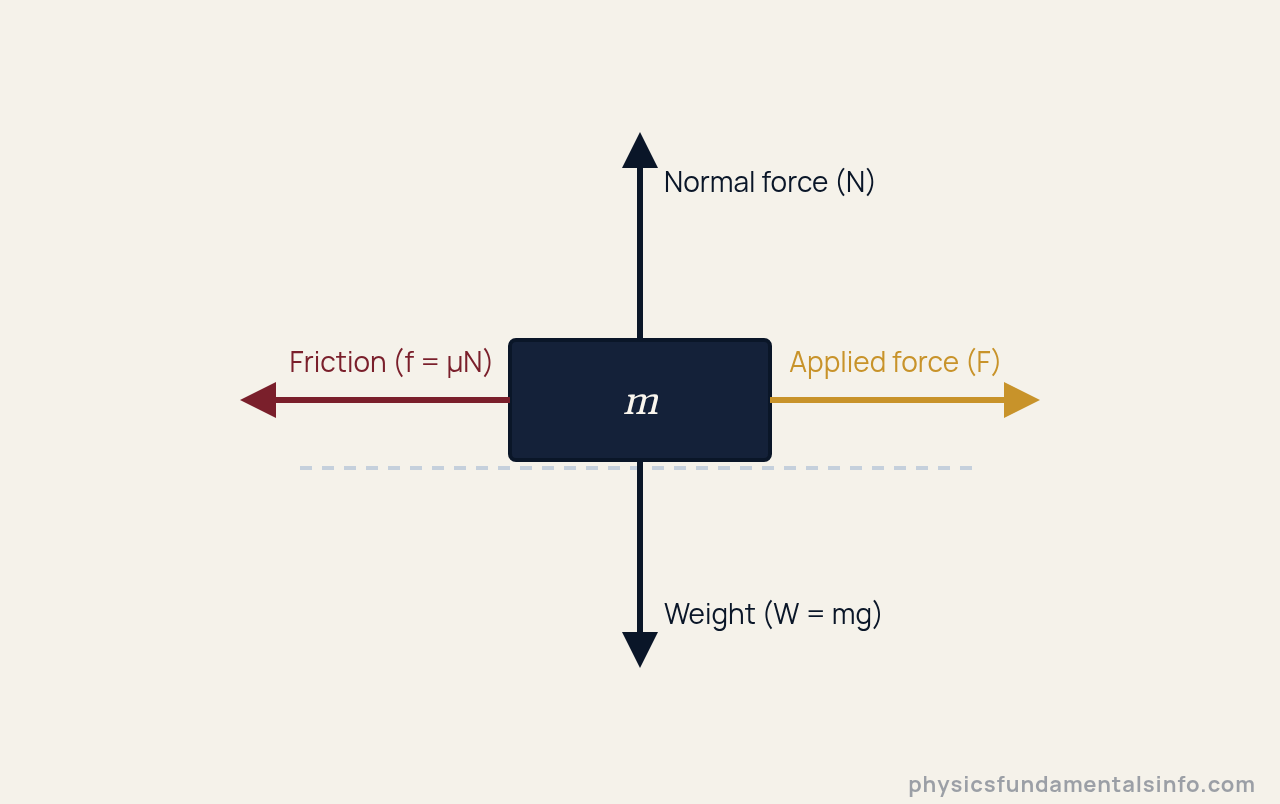
Friction (wine) always points opposite the applied force (gold). On flat ground the normal force balances the weight.
The Friction Formula: f = μN
The everyday model of friction is beautifully simple. The friction force equals a number describing the surfaces, multiplied by how hard they are squeezed together.
Here is what each symbol means, with its SI unit:
- f — the friction force, measured in newtons (N).
- μ (the Greek letter “mu”) — the coefficient of friction, a pure number with no units.
- N — the normal force pressing the surfaces together, also in newtons.
Watch one classic trap. The symbol N for the normal force and the unit N for newtons look identical, and a common student slip is to confuse them — keep the context in mind and you will be fine.
On flat ground with nothing pressing down from above, the normal force is just the object’s weight, N = mg. Tilt the surface, and only part of the weight presses into it.
Static vs kinetic: two coefficients
Most surface pairs actually have two coefficients. One governs the grip before sliding starts; the other governs it once the object is already moving.
Static friction (μs) is a range, not a fixed value: it grows to match whatever tries to push the object, up to a ceiling of μsN. Kinetic friction (μk) takes over once sliding begins and stays roughly constant.
For almost every pair of surfaces μs is larger than μk, which is exactly why things lurch into motion. This simple picture is sometimes called the standard model of friction.

Static friction (gold) climbs to match whatever pushes the object, up to a maximum fs. Once it breaks free, kinetic friction (wine) takes over at a lower, nearly constant value fk.
How Friction Works
Why should two solid objects resist sliding at all? Zoom in far enough and the answer appears.
No surface is truly smooth. Under a microscope, even polished steel looks like a mountain range of tiny peaks and valleys called asperities. When two surfaces meet they touch only at these high points, so the real area in contact is a tiny fraction of what your eye sees.

Up close, even “smooth” surfaces are jagged. They meet only at a few high points — the asperities circled in gold — so the true contact area is far smaller than it looks.
At those contact points two things happen. The peaks physically interlock and must be shoved past one another, and the surfaces bond weakly where they touch — a microscopic stickiness called adhesion. Sliding means continuously breaking and remaking these tiny welds.
All that breaking and scraping costs energy, and the energy escapes as heat. That is why your palms warm when you rub them and why a fast-spinning drill bit gets hot. Friction is, in effect, a one-way street that turns orderly motion into disordered heat.
Here is the counter-intuitive part: rougher is not always grippier. Polish two metals until they are extremely flat and clean, and friction can shoot up as the surfaces begin to cold-weld together. Past a certain point it is molecular bonding, not bumpiness, that rules.
The clearest way to feel the gap between static and kinetic friction is to tilt a slope until a block lets go. Drag the sliders below: raise the angle and watch the block grip, then break free and accelerate.
The Types of Friction
Friction is usually sorted into four kinds. The first two are the headline acts; the others matter just as much in the real world.
1. Static friction
This is the grip that holds a stationary object in place. Lean on a parked car and static friction quietly cancels your push — right up until you shove hard enough to break it free.
2. Kinetic (sliding) friction
Once an object is sliding, kinetic friction takes over and opposes the motion. A book skidding across the floor or a sledge slithering downhill both feel it, and it is usually weaker than the static grip that came before.
3. Rolling friction
A wheel does not slide — it rolls — and rolling friction is far smaller than sliding friction. That single fact is why the wheel ranks among the most important inventions in history.
4. Fluid friction (drag)
Move through air or water and the fluid resists you. This drag is why cyclists crouch low and why fish are shaped like teardrops; it grows rapidly as you speed up.
| Feature | Static friction | Kinetic friction |
|---|---|---|
| When it acts | Object is at rest or about to move | Object is already sliding |
| Formula | fs ≤ μsN (max = μsN) | fk = μkN |
| Size | Variable — grows to match the applied force, up to a limit | Roughly constant once moving |
| Relative strength | Usually larger (μs > μk) | Usually smaller |
| Everyday example | A parked car gripping a hill | A puck sliding on ice; skidding tyres |
The coefficient itself depends entirely on the pair of materials. Here are some typical dry values to give you a feel for the range:
| Surface pair (dry) | μs (static) | μk (kinetic) |
|---|---|---|
| Rubber on dry concrete | ≈ 1.0 | ≈ 0.7 |
| Steel on steel | ≈ 0.74 | ≈ 0.57 |
| Wood on wood | ≈ 0.3–0.5 | ≈ 0.2 |
| Glass on glass | ≈ 0.9 | ≈ 0.4 |
| Ice on ice | ≈ 0.1 | ≈ 0.03 |
| Teflon (PTFE) on steel | ≈ 0.04 | ≈ 0.04 |
Typical textbook values; real coefficients vary with cleanliness, temperature and speed.
Real-World Examples of Friction
Once you start looking, friction is everywhere.
- Walking — your shoe grips the ground and pushes back; on ice, with almost no friction, you slip.
- Car brakes — pads clamp the discs, and kinetic friction turns the car’s motion into heat.
- Writing — a pencil leaves marks because friction shears off tiny flakes of graphite.
- Striking a match — one quick scrape generates enough frictional heat to ignite the head.
- Tyres on the road — grip from friction is what lets a car accelerate, corner and stop.
Engineers spend enormous effort tuning friction — adding it where grip matters, as in brake pads and climbing shoes, and removing it where it wastes energy, as in engine oil and ball bearings.
Common Misconceptions About Friction
“Friction depends on the contact area”
It usually does not. For ordinary dry surfaces, friction depends on the normal force and the coefficient — not on the apparent contact area; widen the contact and the same load simply spreads thinner, so the grip barely changes. Soft race-car slicks are an exception, because heat and sticky rubber break the simple model.
“Friction is always bad”
Far from it. Without friction you could not walk, drive, write or even hold a cup. The goal is rarely to abolish friction — it is to control it.
“Heavier always means more friction”
It is the normal force that matters, not the weight as such. Press down on a light box and you raise its friction; tilt the surface and the friction drops, even though the weight is unchanged.
“Smoother always means less friction”
Only up to a point. Make two surfaces extremely smooth and clean and they can grip harder, even cold-welding together, because molecular adhesion takes over.
How Friction Relates to Forces, Motion and Energy
Friction never acts alone. It is one of the forces in Newton’s second law, so to find an object’s acceleration you add friction — pointing backwards — to all the other forces, then divide by the mass.
It also drains mechanical energy. Work done against friction equals the friction force times the distance slid, and that energy leaves the system as heat — which is why friction is central to any discussion of energy in physics and its conservation.
So friction ties three big ideas together: it pushes back (force), it resists sliding (motion), and it turns movement into heat (energy). Get comfortable with it and the rest of mechanics falls into place.
Worked Problems
Show Solution
Step 1 — On a flat surface the normal force equals the weight: N = mg.
Step 2 — N = 5 × 9.81 = 49.05 N.
Step 3 — Apply f = μkN = 0.4 × 49.05 = 19.62 N.
Answer: f ≈ 19.6 N, opposing the motion.
Show Solution
Step 1 — On a slope the normal force is N = mg cos θ = 10 × 9.81 × cos 20° = 92.2 N.
Step 2 — The weight component pulling it down the slope is mg sin θ = 10 × 9.81 × sin 20° = 33.6 N.
Step 3 — The maximum static friction is μsN = 0.5 × 92.2 = 46.1 N.
Step 4 — Since 33.6 N < 46.1 N, the box stays put, so static friction simply balances the pull at 33.6 N.
Answer: N ≈ 92.2 N; friction ≈ 33.6 N; the box does not slide.
Show Solution
Step 1 — Normal force on flat ground: N = mg = 20 × 9.81 = 196.2 N.
Step 2 — Maximum static friction: μsN = 0.6 × 196.2 = 117.7 N.
Step 3 — Your 100 N push is less than 117.7 N, so the crate stays still.
Step 4 — Static friction adjusts to match the push exactly, so it equals 100 N.
Answer: It does not move; the friction force is 100 N.
Show Solution
Step 1 — At the slipping angle the down-slope pull equals the maximum static friction: mg sin θ = μs mg cos θ.
Step 2 — Cancel mg from both sides: sin θ = μs cos θ.
Step 3 — Rearrange: μs = sin θ ÷ cos θ = tan θ = tan 30°.
Answer: μs = tan 30° ≈ 0.58. (This tilt is called the angle of repose.)
Show Solution
Step 1 — Friction is the only horizontal force, so the mass cancels and the deceleration is a = μkg = 0.25 × 9.81 = 2.45 m/s2.
Step 2 — Use v2 = u2 − 2as with final speed v = 0 and u = 8 m/s: 0 = 82 − 2(2.45)s.
Step 3 — Solve: s = 64 ÷ 4.905 = 13.0 m.
Answer: The puck slides ≈ 13.0 m before stopping.
Show Solution
Step 1 — Down the slope the driving force is mg sin θ, while friction acts up the slope as μkmg cos θ.
Step 2 — Newton’s second law along the slope: ma = mg sin θ − μkmg cos θ, so a = g(sin θ − μk cos θ).
Step 3 — a = 9.81 × (sin 35° − 0.3 × cos 35°) = 9.81 × (0.574 − 0.246) = 9.81 × 0.328 = 3.22 m/s2.
Answer: a ≈ 3.22 m/s2 down the slope.
Show Solution
Step 1 — Normal force: N = mg = 15 × 9.81 = 147.15 N.
Step 2 — (a) To break free you must beat the maximum static friction: Fstart = μsN = 0.5 × 147.15 = 73.6 N.
Step 3 — (b) At constant speed the push balances kinetic friction: Fmove = μkN = 0.35 × 147.15 = 51.5 N.
Answer: ≈ 73.6 N to start it; ≈ 51.5 N to keep it moving. That drop is why objects jerk into motion.
Show Solution
Step 1 — The rope lifts part of the weight, reducing the normal force: N = mg − F sin θ = (10 × 9.81) − (60 × sin 30°) = 98.1 − 30 = 68.1 N.
Step 2 — Kinetic friction: f = μkN = 0.2 × 68.1 = 13.62 N.
Step 3 — Net horizontal force: F cos θ − f = (60 × cos 30°) − 13.62 = 51.96 − 13.62 = 38.34 N.
Step 4 — Acceleration: a = net force ÷ m = 38.34 ÷ 10 = 3.83 m/s2.
Answer: a ≈ 3.83 m/s2. Pulling at an angle eases the load and cuts the friction.