The kinetic energy formula, KE = ½mv2, gives the energy an object has because of its motion: half its mass multiplied by the square of its speed. Kinetic energy is a scalar measured in joules (J), is always positive, and grows with the square of speed — so doubling the speed multiplies the energy by four.
A car braking from 60 mph needs roughly four times the distance to stop as the same car at 30 mph — not twice, four times. That gap is kinetic energy at work, and it is why a small bump in speed makes a crash so much worse.
Every moving thing carries this energy of motion: a sprinter, a falling raindrop, an orbiting planet. Learn to read the kinetic energy formula and you can predict how hard something hits, how far it travels, and how much work it took to get it moving.
What Is Kinetic Energy?
Set a bowling ball rolling and it can flatten the pins; let it sit still and it does nothing at all. The difference is motion — and motion carries energy.
Kinetic energy is the energy an object possesses because it is moving. The faster it travels, or the more mass it has, the more kinetic energy it carries, and the more work it can do when it slows down or stops.
It is one form of energy, the partner of stored (potential) energy. Kinetic energy is a scalar: it has size but no direction, and it is measured in joules (J), the same unit used for every kind of energy and work.
One subtlety worth banking early: kinetic energy is always measured relative to a frame of reference. A coffee cup resting on a moving train has zero kinetic energy relative to you in your seat — but a great deal relative to someone standing on the platform.
The Kinetic Energy Formula
For an object moving in a straight line, the kinetic energy formula is short and exact:
Each symbol has a precise meaning and an SI unit:
- KE — the kinetic energy, measured in joules (J).
- m — the object’s mass, in kilograms (kg).
- v — its speed, the size of its velocity, in metres per second (m/s).
The joule is a built-up unit: one joule equals one kg·m2/s2. So whenever you plug kilograms and metres-per-second into the formula, the answer arrives in joules automatically — no conversion needed.
Notice the single most important detail: the speed is squared. The mass enters once, but the speed enters twice. That is why velocity dominates kinetic energy, as the chart below makes plain.

Kinetic energy rises with the square of speed: a 1000 kg car at 30 m/s carries nine times the energy it has at 10 m/s.
How the Kinetic Energy Formula Is Derived
Where does the ½ come from, and why is the speed squared? It falls straight out of the definition of work. To give an object kinetic energy, you must do work on it.
Push a mass m with a constant net force F over a distance d. The work done is W = F·d. From Newton’s second law, F = ma, and from the equation of motion v2 = u2 + 2ad, the acceleration is a = (v2 − u2) ⁄ 2d.
Substitute and the distance cancels cleanly:
W = m · (v2 − u2) ⁄ 2d · d = ½mv2 − ½mu2
So the net work done equals the change in the quantity ½mv2. That quantity is what we name kinetic energy, and the result is the work–energy theorem:
- W_net — the net work done on the object, in joules (J).
- u — the initial speed; v — the final speed, both in m/s.

Pushing an object with a net force over a distance does work that shows up entirely as extra kinetic energy. You can read the full derivation on HyperPhysics.
See it for yourself. In the lab below, lift the ball and release it: watch potential energy pour into kinetic energy as it drops, then back again as it climbs. The two always add up to the same total.
Types of Kinetic Energy
The familiar ½mv2 describes translational kinetic energy — an object moving from one place to another. But spinning and rolling objects store kinetic energy too, and the formula adapts.
A spinning flywheel has rotational kinetic energy, which mirrors the linear version exactly, swapping mass for moment of inertia and speed for angular velocity:
- I — the moment of inertia (how mass is spread about the axis), in kg·m2.
- ω — the angular velocity, in radians per second (rad/s).
A ball rolling downhill does both at once: it moves and it spins. Its total kinetic energy is simply the two added together, as the table shows.
| Type | Formula | When it applies | Example |
|---|---|---|---|
| Translational | KE = ½mv2 | An object moving through space | A car on a motorway |
| Rotational | KE = ½Iω2 | An object spinning about an axis | A spinning flywheel |
| Total (rolling) | ½mv2 + ½Iω2 | Rolling without slipping | A ball rolling downhill |
Real-World Examples of Kinetic Energy
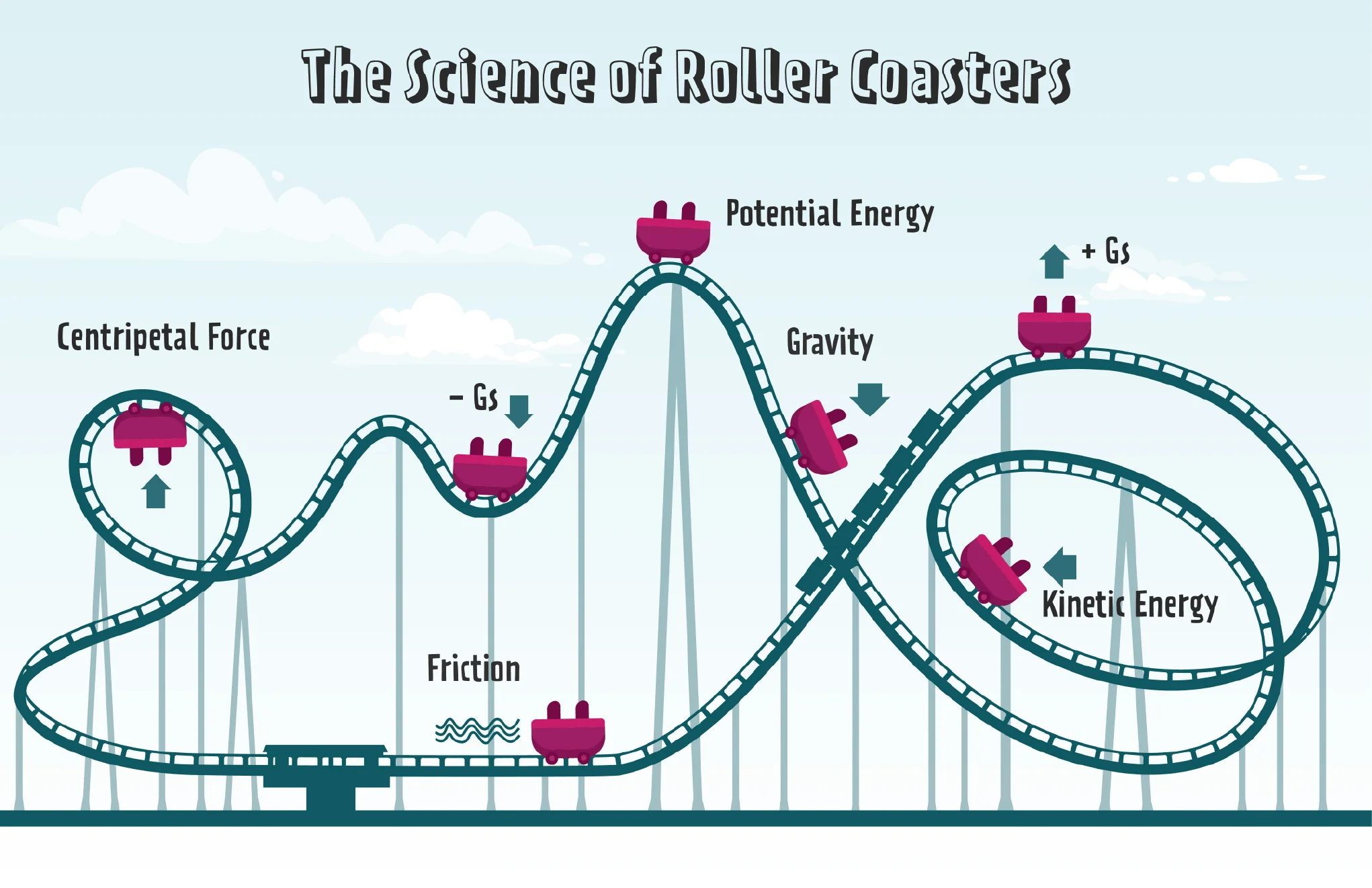
A braking car. When you stop, the brakes turn the car’s kinetic energy into heat through friction. Because that energy scales with v2, a car at 40 m/s carries four times the energy — and needs four times the stopping distance — of one at 20 m/s.
A roller coaster. At the top of a hill the train is barely moving but loaded with potential energy. As it plunges, that store converts almost entirely into kinetic energy, which is exactly why the bottom of the drop is the fastest point.
A wind turbine. Moving air is mass with speed, so it carries kinetic energy. The blades capture a slice of it and hand it to a generator, which is why turbine output rises so steeply when the wind picks up.
A hammer and nail. A swung hammer gathers kinetic energy on the way down. On impact it does work on the nail, driving it into the wood as the hammer’s energy drops to almost nothing.
Flowing water. A river in flood, or water released through a dam, carries enormous kinetic energy. Hydroelectric plants point that moving water at turbines and convert its motion straight into electricity.
Common Misconceptions About Kinetic Energy
“Kinetic energy is proportional to speed.”
It is proportional to speed squared, not speed. Double the speed and the energy quadruples; triple it and the energy is nine times larger. This single fact explains motorway crash severity and braking distances.
“Kinetic energy and momentum are the same thing.”
They are not. Momentum is mv, a vector with direction; kinetic energy is ½mv2, a scalar with none. The two behave differently in collisions, and a comparison table appears further down.
“A heavier object always has more kinetic energy.”
Only at the same speed. Because speed is squared, a light, fast object can easily out-energise a heavy, slow one — a 250 kg motorbike at 40 m/s carries more energy than some far heavier vehicles crawling along.
“Kinetic energy can be negative when something slows down.”
No. Mass is positive and v2 is positive, so kinetic energy is never below zero. When an object slows, its kinetic energy falls toward zero; the change ΔKE can be negative, but the kinetic energy itself cannot.
How Kinetic Energy Relates to Work, Momentum & Potential Energy
Work. The two are inseparable: doing net work on an object changes its kinetic energy, exactly as the work–energy theorem above states. Energy is, in a sense, stored-up work.
Momentum. Both grow with mass and velocity, but in different ways, and they are easy to confuse. If you know an object’s momentum and mass, you can find its kinetic energy directly:
Here p is momentum, in kg·m/s. The clearest way to keep the two straight is side by side:
| Property | Kinetic energy (KE) | Momentum (p) |
|---|---|---|
| Formula | KE = ½mv2 | p = mv |
| Quantity type | Scalar (size only) | Vector (size + direction) |
| SI unit | joule (J) = kg·m2/s2 | kg·m/s |
| Depends on speed as | v2 (quadratic) | v (linear) |
| Can be negative? | No — always ≥ 0 | Yes — sign shows direction |
| Conserved in… | Elastic collisions only | All collisions (closed system) |
Potential energy. In a closed system with no friction, kinetic and potential energy trade back and forth while their sum stays fixed — the conservation of mechanical energy you saw in the lab. The whole picture is laid out in our guide to energy in physics.
Heat. Zoom in on any warm object and its particles are jittering. That microscopic motion is kinetic energy too: temperature is essentially a measure of the average kinetic energy of those particles, the link explored in heat vs temperature.
Worked Problems
Show Solution
Solution:
Step 1: Use the kinetic energy formula, KE = ½mv2.
Step 2: Substitute, carrying units: KE = ½ × 1500 kg × (20 m/s)2 = ½ × 1500 × 400.
Step 3: KE = 750 × 400 = 300,000 J.
Answer: 300,000 J = 300 kJ.
Show Solution
Solution:
Step 1: Rearrange KE = ½mv2 for speed: v = √(2KE ⁄ m).
Step 2: Substitute: v = √(2 × 100 J ⁄ 0.50 kg) = √(200 ⁄ 0.50) = √400.
Step 3: v = 20 m/s.
Answer: 20 m/s.
Show Solution
Solution:
Step 1: Apply KE = ½mv2 at both speeds.
Step 2: KE1 = ½ × 1200 × 152 = 600 × 225 = 135,000 J. KE2 = ½ × 1200 × 302 = 600 × 900 = 540,000 J.
Step 3: Factor = 540,000 ⁄ 135,000 = 4.
Answer: The kinetic energy increases 4-fold — because speed doubled and KE ∝ v2.
Show Solution
Solution:
Step 1: Work–energy theorem: net work equals the gain in kinetic energy, W = Fd = KE (the block starts at rest).
Step 2: W = 12 N × 4.0 m = 48 J, so ½ × 3.0 × v2 = 48 → v = √(2 × 48 ⁄ 3.0) = √32.
Step 3: v = 5.66 m/s.
Answer: ≈ 5.7 m/s.
Show Solution
Solution:
Step 1: Compute KE = ½mv2 for each.
Step 2: Truck: ½ × 9000 × 82 = 4500 × 64 = 288,000 J. Bike: ½ × 250 × 402 = 125 × 1600 = 200,000 J.
Step 3: Compare: 288,000 J > 200,000 J.
Answer: The truck (288 kJ vs 200 kJ) — its mass wins even though the bike is five times faster.
Show Solution
Solution:
Step 1: Use KE = p2 ⁄ (2m), which follows from p = mv and KE = ½mv2.
Step 2: KE = (30)2 ⁄ (2 × 5.0) = 900 ⁄ 10.
Step 3: KE = 90 J. (Check: v = p ⁄ m = 6 m/s, so ½ × 5 × 36 = 90 J.)
Answer: 90 J.
Show Solution
Solution:
Step 1: Friction must do work equal to all the car’s kinetic energy: ½mv2 = f·d, with friction force f = μmg.
Step 2: KE = ½ × 1000 × 202 = 200,000 J. f = 0.70 × 1000 × 9.81 = 6,867 N.
Step 3: d = KE ⁄ f = 200,000 ⁄ 6,867 = 29.1 m. (Equivalently d = v2 ⁄ 2μg.)
Answer: ≈ 29 m — and at 40 m/s it would be four times as far, about 117 m.