Simple harmonic motion (SHM) is a repetitive back-and-forth oscillation in which the restoring force is directly proportional to the displacement from equilibrium and always acts toward it. The result is smooth, sinusoidal motion at a single constant frequency, described by x = A·cos(ωt + φ), with period T = 2π√(m/k) for a mass on a spring.
Pluck a guitar string and it hums at one clear pitch. Tap a wine glass and it rings. Give a child on a swing a push — gentle or hard — and each return takes about the same time. These everyday wobbles all obey one hidden rule.
That rule is simple harmonic motion, and once you spot it you see it everywhere: the bounce of a diving board, the sway of a skyscraper, the quartz crystal ticking inside your watch, even atoms jittering in a solid. Learn this one pattern and you hold the master key to oscillations and waves across all of physics.
What Is Simple Harmonic Motion?
Picture a ball resting at the bottom of a smooth bowl. Nudge it and it rolls back; push it further and it fights back harder. Simple harmonic motion is the idealised version of exactly this — motion around a stable resting point, with a force that always tries to undo the displacement.
More precisely: simple harmonic motion is oscillation in which the restoring force is proportional to displacement and directed back toward equilibrium. Double the displacement and you double the force. That single proportionality is what makes the motion a clean sine wave rather than some messy wobble.
The defining condition can be written in one line of physics:
Acceleration is proportional to displacement and points the opposite way — that is what the minus sign means. If a system’s acceleration obeys this relation, its motion must be simple harmonic. The constant ω (omega) is the angular frequency, and it sets how fast the oscillation runs.
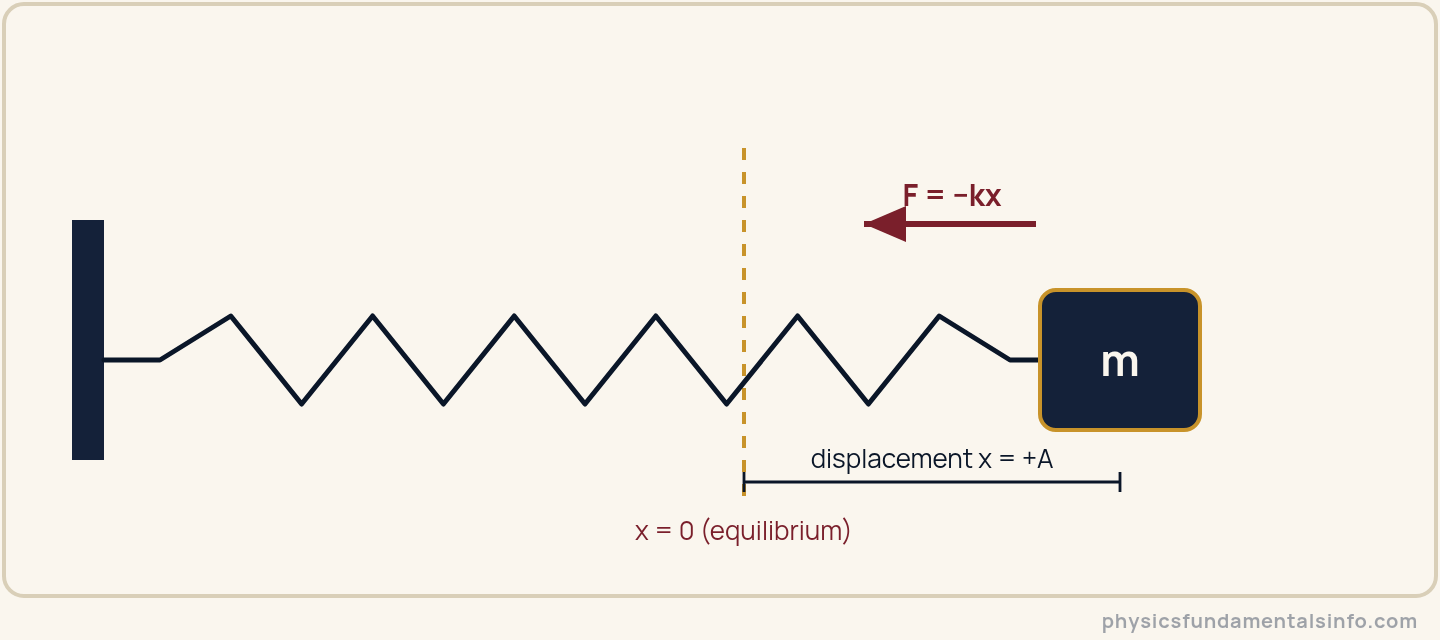
Figure 1: In simple harmonic motion the spring’s restoring force always points back toward equilibrium, and it grows in proportion to how far the mass is displaced (F = −kx).
The Simple Harmonic Motion Formula
There isn’t a single formula for SHM but a small family of them, each describing a different slice of the same motion. It starts with the force that drives a spring — the elastic force, written as Hooke’s law:
Feed that into the motion and two headline quantities pop out: the period (the time for one full cycle) and the angular frequency, for a mass m on a spring of stiffness k.
The position at any instant traces a cosine curve. Differentiate it once to get velocity, and again to get acceleration:
Finally, the energy. In an ideal oscillator the total mechanical energy never changes — it simply shuttles between kinetic and potential form:
Here is every symbol with its SI unit:
- x — displacement from equilibrium, in metres (m).
- A — amplitude, the maximum displacement, in metres (m).
- t — time, in seconds (s).
- T — period, the time for one full cycle, in seconds (s).
- f — frequency, cycles per second, in hertz (Hz).
- ω — angular frequency (ω = 2πf), in radians per second (rad/s).
- φ — phase constant, fixing where the motion starts, in radians (rad).
- k — spring (force) constant, the stiffness, in newtons per metre (N/m).
- m — mass, in kilograms (kg).
- E — total mechanical energy, in joules (J).
A sanity check worth carrying into exams: a stiffer spring (bigger k) or a lighter mass (smaller m) gives a shorter period — the system snaps back faster. Both sit under the square root, so quadrupling the mass only doubles the period.
How Simple Harmonic Motion Works
The restoring force is the engine
Every oscillation needs something pulling the system back toward the middle. For a spring it is the elastic force; for a pendulum it is gravity; for a sound wave it is air pressure. The crucial feature isn’t just that a restoring force exists — it is that the force grows in step with displacement.
Stretch the spring twice as far and it pulls back twice as hard. That proportionality is the whole secret. It is what bends the motion into a perfect sinusoid instead of an irregular jiggle.
From a force to a sine wave
Combine Hooke’s law with Newton’s second law (F = ma) and something neat happens. Setting ma = −kx and rearranging links acceleration directly to position:
The only functions whose second derivative is a negative copy of themselves are sine and cosine. So the maths forces the answer: x(t) has to be a cosine wave, oscillating at ω = √(k/m). No other shape can satisfy the equation.
Energy trades back and forth
At the turning points the mass is momentarily still, and all its energy is stored as potential energy in the stretched spring. As it rushes back through the centre, that store has converted entirely into kinetic energy, and the speed is greatest there.
With no friction, the total energy stays constant — it just sloshes between kinetic and potential twice every cycle. That is why an ideal oscillator, once started, would keep swinging forever.
The three curves below show how displacement, velocity, and acceleration travel together, each a quarter-cycle out of step with the next.
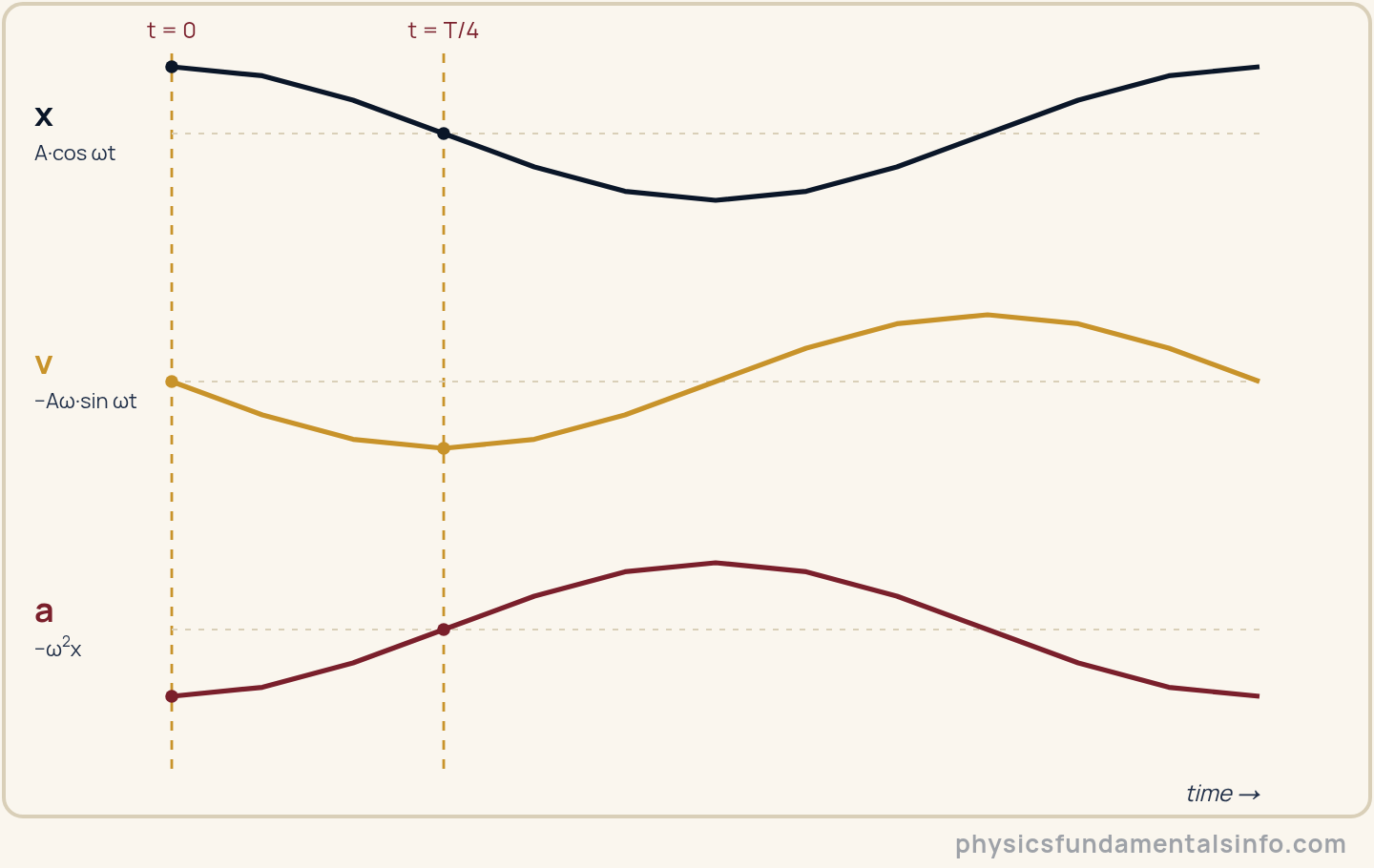
Figure 2: Displacement, velocity, and acceleration are all sinusoidal but out of step. Velocity peaks as the mass races through the centre (where displacement is zero); acceleration is largest at the turning points and always points opposite to the displacement.
Want to feel it rather than read it? Drag the sliders below to change the mass, spring stiffness, and amplitude, and watch the period, the energy, and the motion respond in real time.
Real-World Examples of Simple Harmonic Motion
SHM is an idealisation — real systems always bleed a little energy to friction — but it is an astonishingly good model for a huge range of everyday motions.
- A mass on a spring. The textbook case, and the closest thing to “pure” SHM you will meet. Car suspensions and the recoil spring in a retractable pen are everyday cousins.
- A tuning fork or guitar string. Each point on a vibrating string oscillates back and forth in near-perfect SHM, hundreds of times a second. That steady vibration is exactly what gives a musical note its clean pitch.
- The balance wheel in a mechanical watch. A tiny wheel twists to and fro on a hairspring at a fixed rate, slicing time into even ticks — the mechanical heart of every wind-up watch.
- Atoms in a solid. Atoms in a crystal sit in tiny “energy bowls” and vibrate about fixed positions. Modelling each bond as a spring (SHM) helps explain how solids store heat.
Here is a tidy comparison of the two systems you will meet most in class. It also settles the question that trips up almost everyone — does mass change the period?
| Feature | Mass on a spring | Simple pendulum (small swing) |
|---|---|---|
| What provides the restoring force | The spring’s elastic force (Hooke’s law, F = −kx) | Gravity acting along the arc (≈ −mgθ for small angles) |
| Angular frequency, ω | √(k / m) | √(g / L) |
| Period, T | 2π√(m / k) | 2π√(L / g) |
| Does mass affect the period? | Yes — more mass means a longer period | No — the mass cancels out |
| Does amplitude affect the period? | No, for any amplitude | No, but only while the swing stays small (≲ 15°) |
| Is it true SHM? | Yes — an ideal spring obeys Hooke’s law exactly | Only approximately, for small angles |
| Everyday example | Car suspension, a mass on a slinky | Pendulum clock, a child on a swing |
Is a pendulum simple harmonic motion?
A simple pendulum is SHM — but only approximately, and only for small swings. The restoring force is gravity acting along the arc, which is proportional to sin θ, not to θ itself. For small angles (under about 15°), sin θ ≈ θ, and the motion becomes genuinely simple harmonic.
Its period depends only on length and gravity, never on the mass of the bob or — for small swings — the amplitude:
Here L is the length in metres and g ≈ 9.81 m/s2 is Earth’s gravitational field strength. Push the pendulum out to a wide angle, though, and the approximation breaks down: the swing takes slightly longer than the formula predicts. Try it — change the length, gravity, and starting angle below.
Common Misconceptions About Simple Harmonic Motion
“A bigger swing takes longer”
For true SHM, the period is completely independent of amplitude — a property called isochronism. A larger pull stretches the travel distance, but the bigger restoring force speeds the mass up to match, so each cycle takes the same time. This is exactly why pendulum clocks keep good time even as the swing slowly dies down.
“A heavier pendulum bob swings slower”
Mass cancels out of the pendulum equation entirely, so a lead bob and a cork bob of the same length keep identical time. Mass does matter for a spring, though — there, a heavier mass gives a longer period. Mixing up the two systems is one of the most common exam slips.
“The object moves at constant speed”
Speed is never constant in SHM. It is zero at the turning points and greatest at the centre, changing smoothly in between. It is the period that stays constant, not the speed.
“The restoring force is fixed”
The force changes every instant — that is the whole point. It is zero at equilibrium and largest at the extremes, always proportional to displacement. A constant force would give constant acceleration and produce projectile-style motion, not an oscillation.
How Simple Harmonic Motion Relates to Circular Motion and Waves
SHM does not live in isolation. It is the shadow of uniform circular motion: shine a light on a ball moving steadily around a circle, and the shadow it casts on a wall moves in perfect SHM. Richard Feynman built his entire treatment of oscillators on this trick — you can read it in his lecture on the harmonic oscillator.
It is also the building block of every wave. A wave is just countless particles, each performing SHM slightly out of step with its neighbour. How many cycles each one completes per second is the wave’s frequency, and the way each particle’s speed peaks at the centre follows the same rules we met above.
For a fuller, equation-by-equation reference, Georgia State’s HyperPhysics maps out how all the SHM relationships connect. Master oscillations here and damped motion, resonance, AC circuits, and even quantum oscillators all become variations on a theme you already know.
Worked Problems
Show Solution
Solution:
Step 1: Use the period formula for a mass on a spring: T = 2π√(m / k).
Step 2: Substitute with units: T = 2π√(0.50 kg / 200 N/m) = 2π√(0.0025 s2).
Step 3: √0.0025 = 0.050 s, so T = 2π × 0.050 = 0.314 s.
Answer: T ≈ 0.31 s.
Show Solution
Solution:
Step 1: Angular frequency: ω = √(k / m) = √(200 / 0.50) = √400.
Step 2: So ω = 20 rad/s.
Step 3: Frequency f = ω / 2π = 20 / (2π) = 3.18 Hz (a useful check: f = 1 / T = 1 / 0.314 ≈ 3.2 Hz).
Answer: ω = 20 rad/s and f ≈ 3.2 Hz.
Show Solution
Solution:
Step 1: Maximum speed occurs at the centre: v_max = Aω.
Step 2: v_max = 0.10 m × 20 rad/s = 2.0 m/s.
Step 3: Maximum acceleration occurs at the extremes: a_max = Aω2 = 0.10 × 202 = 0.10 × 400.
Answer: v_max = 2.0 m/s and a_max = 40 m/s2.
Show Solution
Solution:
Step 1: Use the pendulum period: T = 2π√(L / g).
Step 2: T = 2π√(1.0 / 9.81) = 2π√(0.1019) = 2π × 0.3193.
Step 3: T = 2.01 s. Mass does not appear in the formula, so doubling the bob’s mass changes nothing.
Answer: T ≈ 2.0 s; the period is unchanged by the mass.
Show Solution
Solution:
Step 1: Total energy E = ½kA2 is shared as E = KE + PE. If KE = PE, then PE = ½E.
Step 2: So ½kx2 = ½(½kA2) = ¼kA2, which gives x2 = A2 / 2.
Step 3: Take the square root: x = A / √2 ≈ 0.71A.
Answer: x = A / √2 ≈ 0.71A (about 71% of the amplitude).
Show Solution
Solution:
Step 1 (a): Total energy E = ½kA2 = ½ × 100 × (0.080)2 = ½ × 100 × 0.0064 = 0.32 J.
Step 2 (b): Use v = ω√(A2 − x2), with ω = √(k / m) = √(100 / 0.25) = √400 = 20 rad/s.
Step 3: v = 20 × √(0.0802 − 0.0402) = 20 × √(0.0064 − 0.0016) = 20 × √0.0048 = 20 × 0.0693.
Answer: E = 0.32 J and v ≈ 1.4 m/s.
Show Solution
Solution:
Step 1: Compare with x = A cos(ωt): amplitude A = 0.05 m and angular frequency ω = 8π rad/s.
Step 2: Period T = 2π / ω = 2π / (8π) = 0.25 s. Maximum acceleration a_max = Aω2 = 0.05 × (8π)2 = 0.05 × 631.7.
Step 3: Maximum speed occurs at x = 0: cos(8πt) = 0 first when 8πt = π/2, so t = 1/16 = 0.0625 s.
Answer: A = 0.05 m, T = 0.25 s, a_max ≈ 31.6 m/s2, and the first maximum speed is at t ≈ 0.063 s.