Tension force is the pulling force transmitted along a rope, string, cable, or similar connector when it is pulled taut by forces acting from opposite ends. It always acts along the connector and pulls inward on whatever is attached. In an ideal massless rope, tension is uniform throughout and measured in newtons (N).
Pick up a heavy bag by its handle and you can feel it: that firm, straining pull running up the strap into your hand. That pull is tension — and it is doing the entire job of holding the weight up.
Tension shows up the moment anything hangs, tows, or holds. It is the force in a lift cable, a guitar string, a swing’s chain, and a suspension bridge. Understand it once and a huge slice of everyday mechanics suddenly clicks into place.
What Is Tension Force?
Picture a tug-of-war rope, pulled tight between two teams. Every point along that rope is being stretched — tugged toward each end at once. That internal state of being pulled is tension.
More precisely, tension force is the pulling force carried along a rope, string, cable, chain, or any flexible connector when it is pulled tight from both ends. It always acts along the connector, and it always pulls — never pushes — on whatever is attached.
Because a rope can only ever be pulled, tension can only point away from the object and back along the line of the rope. Let the rope go slack and the tension vanishes in an instant.
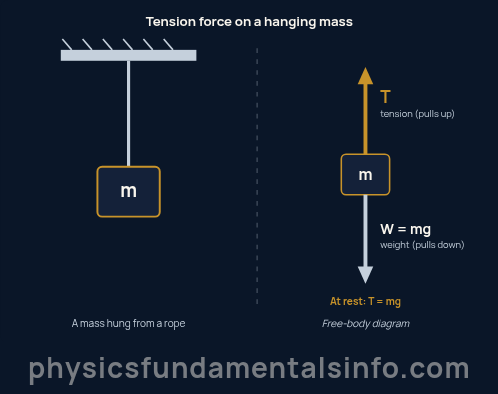
A hanging mass drawn as a free-body diagram. Tension (gold) pulls up along the rope; weight, mg, pulls down. At rest the two balance exactly, so the tension equals the object’s weight.
Tension is a contact force
Tension belongs to the family of contact forces — forces that act only where objects actually touch. The rope must physically grip the object for tension to exist.
That puts it alongside friction and the normal force. The difference is direction: a normal force pushes outward from a surface, while tension always pulls inward along a line.
The Tension Force Formula
Here is the part that trips people up: there is no single “tension equation” the way there is for gravity. Tension is simply whatever value Newton’s second law demands to keep the rope consistent with the motion.
For the most common case — one object hanging from, or being lifted by, a vertical rope — the tension is:
- T = tension force, in newtons (N)
- m = mass of the object, in kilograms (kg)
- g = gravitational field strength ≈ 9.81 m/s2 (the acceleration due to gravity near Earth’s surface)
- a = acceleration of the object, in metres per second squared (m/s2) — positive when it accelerates the same way the tension pulls (upward), negative when it accelerates the other way (downward)
When the object simply hangs at rest, its acceleration is zero and the formula collapses to the case you will use most often:
In plain words: a still, hanging object pulls the rope with exactly its own weight. Start it moving faster or slower, though, and the tension changes.
The table below puts the formula to work for a 10 kg load. Look at the last row — in free fall the rope goes slack and the tension drops to zero.
| Situation | Acceleration (a) | Tension (T) | T for a 10 kg load |
|---|---|---|---|
| At rest or constant velocity | 0 | mg | 98.1 N |
| Accelerating upward (2.0 m/s2) | +2.0 m/s2 | m(g + a) | 118 N |
| Accelerating downward (2.0 m/s2) | −2.0 m/s2 | m(g − a) | 78 N |
| In free fall | −9.81 m/s2 | 0 (rope goes slack) | 0 N |
How Tension Force Works
Zoom in far enough and a rope is just countless molecules held together by electromagnetic bonds. Pull on the ends and those bonds stretch a little, like microscopic springs resisting the separation. The combined pull of all those stretched bonds is what we feel as tension.
Two idealisations make tension problems solvable, and both are worth stating clearly.
An ideal rope has the same tension everywhere
Treat a rope as massless and unstretchable, and the tension is identical at every point along it. Pull one end with 50 N and the far end pulls back with 50 N — the rope just transmits the force, undiluted.
Real ropes have mass, so a hanging rope carries slightly more tension at the top than at the bottom. For most problems that difference is tiny, and we ignore it.
An ideal pulley doesn’t change the tension
Run a rope over a frictionless, massless pulley and the tension is the same on both sides. The pulley only redirects the pull; it neither adds to it nor saps it. That single fact unlocks almost every pulley problem you will meet.
Adjust the load and the lift’s acceleration in the lab below, and read the tension live — then watch the rope slacken as the load nears free fall.
Real-World Examples of Tension Force
Tension is one of the most useful forces in engineering precisely because a cable is light, flexible and strong in a pull. Here are five places it does the heavy lifting.
Lift (elevator) cables
A lift hangs entirely on cable tension. When the car accelerates upward, the tension rises above the car’s weight — which is exactly why you feel briefly heavier as it sets off. (See Worked Problem 2.)
Guitar and violin strings
Tightening a string raises its tension, which speeds up the waves travelling along it and lifts the pitch. Tuning an instrument is really just fine-adjusting tension.
Suspension bridges
The great main cables of a suspension bridge hang in tension, carrying the deck’s weight up to the towers and down into the anchorages buried at each end.
Cranes and tow ropes
A crane cable hoisting a steel beam, or a tow rope dragging a stranded car, is pure tension at work — the connector pulls the load straight along the line of the cable.
Your own tendons
Your Achilles tendon transmits tension from calf muscle to heel every time you push off the ground. Fittingly, “tendon” and “tension” share the same Latin root, tendere, meaning to stretch.

Common Misconceptions About Tension Force
“Tension can push”
It cannot. A rope, string or cable can only pull; push on it and it buckles and goes slack. If your working ever has tension shoving an object, a sign has gone the wrong way.
“Tension always equals the weight”
Only when the object is at rest or moving at constant speed. The moment it accelerates, the tension differs from the weight — larger when accelerating upward, smaller when accelerating downward. This is exactly the trap in Georgia State University’s classic lifting-a-mass problem.
“Tension differs on each side of a pulley”
For an ideal pulley it doesn’t. One rope over a frictionless, massless pulley carries a single tension throughout. Different tensions appear only with real pulleys that have mass or friction.
“Tension only exists when something moves”
A book dangling motionless on a string is under tension right now. Tension depends on the forces in play, not on whether anything is moving.
How Tension Force Relates to Other Forces and Waves
Tension never works alone. It is one player in the wider cast of forces you meet in mechanics — and it is solved with the very same toolkit.
Newton’s laws
Every tension value comes from Newton’s second law, F = ma, applied to the object on the end of the rope. And by Newton’s third law, the rope pulls the object exactly as hard as the object pulls the rope.
Friction and inclines
In pulley-and-incline problems, tension teams up with friction and gravity. Resolving the forces along the slope is the standard move — you will see it in Worked Problem 6.
Acceleration
The acceleration term in T = m(g + a) ties tension directly to acceleration. Change how fast a load speeds up and you change the rope’s tension.
Waves on a string
Tension also governs how fast a wave travels along a string, and therefore its frequency and pitch:
- v = wave speed along the string, in metres per second (m/s)
- T = tension in the string, in newtons (N)
- μ (mu) = linear mass density, the mass per unit length, in kilograms per metre (kg/m)
Raise the tension and the wave speeds up — the physics behind tuning every stringed instrument.
Worked Problems
Show Solution
Solution:
Step 1: At rest the acceleration is zero, so Newton’s second law gives T − mg = 0, which means T = mg.
Step 2: Substitute the values: T = 5.0 kg × 9.81 m/s2.
Step 3: T = 49.05 N.
Answer: T ≈ 49 N (2 s.f.).
Show Solution
Solution:
Step 1: Taking upward as positive, Newton’s second law gives T − mg = ma, so T = m(g + a).
Step 2: Substitute: T = 5.0 × (9.81 + 2.0) = 5.0 × 11.81.
Step 3: T = 59.05 N.
Answer: T ≈ 59 N — larger than the 49 N at rest, because the rope must also accelerate the lamp upward.
Show Solution
Solution:
Step 1: With upward positive, the acceleration is a = −2.0 m/s2, so T = m(g + a) = m(g − 2.0).
Step 2: Substitute: T = 5.0 × (9.81 − 2.0) = 5.0 × 7.81.
Step 3: T = 39.05 N.
Answer: T ≈ 39 N — smaller than at rest, because gravity now does part of the accelerating.
Show Solution
Solution:
Step 1: Vertical equilibrium means the two upward components balance the weight: 2T sin θ = mg.
Step 2: Rearrange and substitute: T = mg / (2 sin θ) = (20 × 9.81) / (2 × sin 30°) = 196.2 / (2 × 0.5).
Step 3: T = 196.2 / 1.0 = 196.2 N.
Answer: T ≈ 196 N per rope — about the sign’s entire weight, even with two ropes. The shallower the angle, the larger the tension grows.
Show Solution
Solution:
Step 1: The heavier mass falls and the lighter rises with the same acceleration a. For each: 5.0 kg → m2g − T = m2a; 3.0 kg → T − m1g = m1a.
Step 2: Add the two equations: (m2 − m1)g = (m1 + m2)a, so a = (5.0 − 3.0)(9.81) / (3.0 + 5.0) = 19.62 / 8.0 = 2.45 m/s2.
Step 3: Find T from the lighter mass: T = m1(g + a) = 3.0 × (9.81 + 2.45) = 3.0 × 12.26 = 36.79 N.
Answer: a ≈ 2.5 m/s2 and T ≈ 37 N. (Check with the heavy mass: T = 5.0 × (9.81 − 2.45) = 36.8 N ✓.)
Show Solution
Solution:
Step 1: The hanging weight (m2g = 29.43 N) competes with the block’s gravity component down the slope (m1g sin θ = 4.0 × 9.81 × 0.5 = 19.62 N). The hanging mass wins, so it descends and pulls the block up the slope. Equations: m2g − T = m2a and T − m1g sin θ = m1a.
Step 2: Add them: m2g − m1g sin θ = (m1 + m2)a, so a = 9.81 × (3.0 − 4.0×0.5) / 7.0 = 9.81 × 1.0 / 7.0.
Step 3: a = 1.40 m/s2. Then T = m2(g − a) = 3.0 × (9.81 − 1.40) = 3.0 × 8.41 = 25.23 N.
Answer: a ≈ 1.4 m/s2 and T ≈ 25 N. (Check via the block: T = 4.0 × (1.40 + 4.905) = 25.2 N ✓.)
Show Solution
Solution:
Step 1: The wave speed on a string is v = √(T / μ). First convert the mass density: 4.0 g/m = 0.0040 kg/m.
Step 2: Substitute: v = √(80 N / 0.0040 kg/m) = √(20 000 m2/s2).
Step 3: v = 141.4 m/s.
Answer: v ≈ 141 m/s. Tighten the string further and this speed — and the pitch — both rise.