Terminal velocity is the constant maximum speed a falling object reaches when the upward drag force from the air exactly balances its downward weight, leaving zero net force and zero acceleration. It depends on the object’s mass, cross-sectional area, shape and the air’s density — not on how far the object has already fallen.
Step out of a plane and, for the first few seconds, you really do accelerate — the ground rushes up faster and faster. Then something odd happens. The rushing stops getting worse: you are still plummeting, yet your speed locks in and refuses to climb any higher.
That ceiling is terminal velocity. It is why a skydiver, a hailstone and a falling leaf each settle into a steady descent instead of speeding up without limit, and it is the reason a parachute can save your life. The whole idea comes down to one tug-of-war: gravity pulling down, air pushing back.
What Is Terminal Velocity?
Picture two forces fighting over a falling object. Gravity pulls it down with a steady force — its weight. The air shoves back with a drag force that points up, against the motion. The catch is that drag is not constant: the faster you move, the harder the air resists.
At the instant of release the object is barely moving, so drag is almost nothing and gravity wins easily. As speed builds, drag grows quickly. Eventually the upward drag matches the downward weight exactly.
When those two forces cancel, the net force is zero. By Newton’s first law, an object with no net force keeps moving at a constant velocity — it stops accelerating. That steady, top speed is the terminal velocity. The object is still falling fast; it simply cannot go any faster in those conditions.
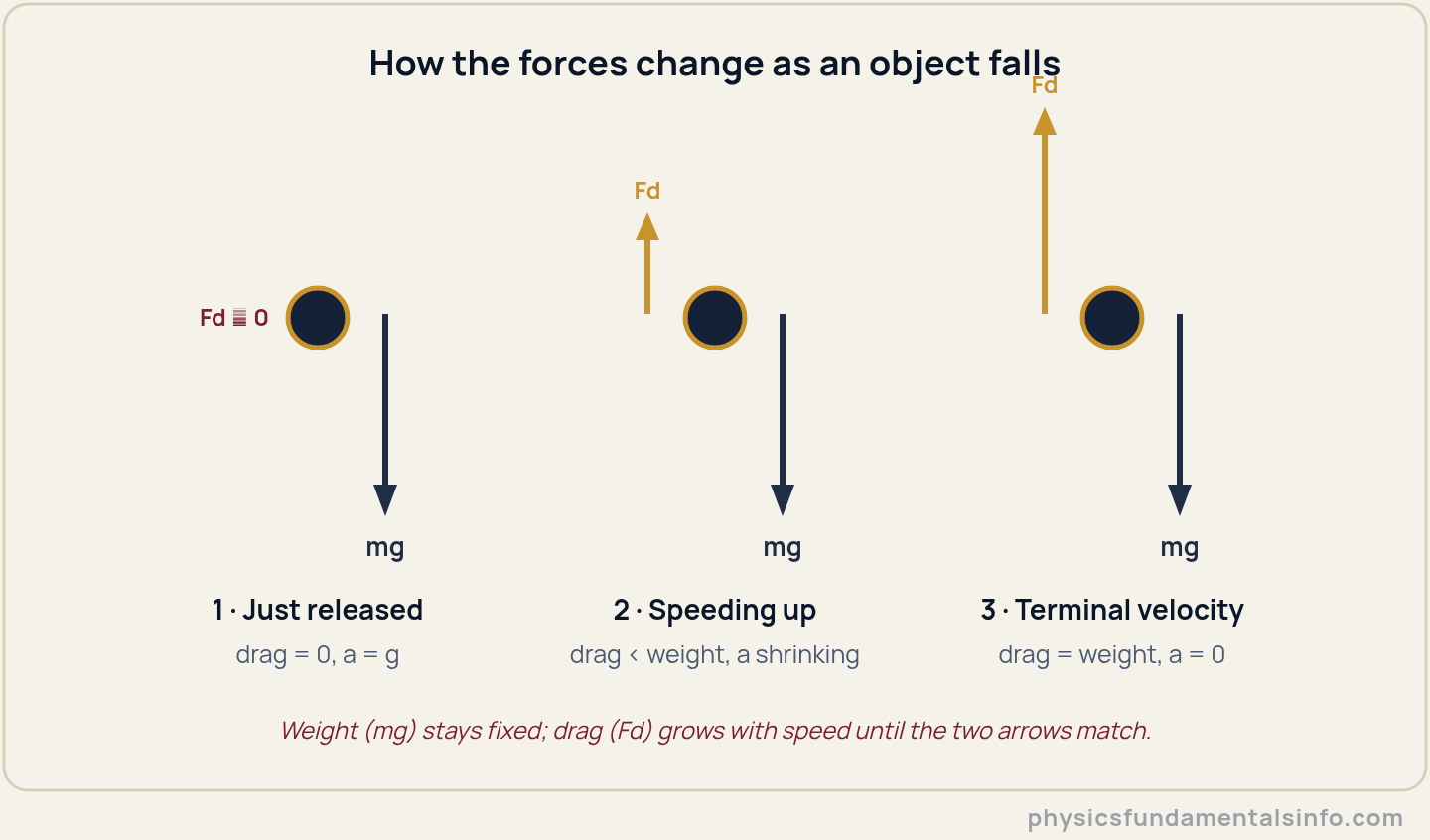
Figure 1: A falling object reaches terminal velocity the moment the growing upward drag equals its constant downward weight.
Notice what terminal velocity is not. It is not the speed of a normal free fall in a vacuum, where nothing pushes back. It needs a fluid — air, water, oil — to exist at all.
The Terminal Velocity Formula
Two things set the answer: how hard gravity pulls (the weight) and how hard the air pushes (the drag). Write down the drag force, set it equal to the weight, and the speed that makes them balance drops straight out.
Here each symbol means:
- vt — terminal velocity, in metres per second (m/s).
- m — mass of the object, in kilograms (kg).
- g — gravitational field strength, ≈ 9.81 m/s2 near Earth’s surface.
- ρ (rho) — density of the fluid; for air at sea level and 15 °C, ρ ≈ 1.225 kg/m3.
- A — cross-sectional (frontal) area facing the flow, in square metres (m2).
- C_d — drag coefficient, a dimensionless number fixed by the object’s shape and surface (≈ 0.47 for a smooth sphere, ≈ 1.0–1.3 for a flat plate).
The formula comes from the standard drag equation, which describes the resisting force of the air at everyday falling speeds:
At terminal velocity the drag force equals the weight, so F_d = mg. Substitute mg for F_d, then rearrange for v, and you arrive at the terminal-velocity formula above. NASA derives exactly the same result on its Terminal Velocity page.
Read the formula and the behaviour makes sense. More mass on top pushes vt up. More area or a higher drag coefficient on the bottom pulls vt down. That is why a feather, all area and almost no mass, drifts, while a steel ball bearing of the same size plummets.
The low-speed case: Stokes’ law
The square-of-speed drag above applies to skydivers, raindrops and most falling objects you can see. For very small, very slow objects — mist, dust, microscopic droplets — the air behaves differently and drag becomes proportional to speed itself. Terminal velocity then follows Stokes’ law:
- r — radius of the (spherical) particle, in metres (m).
- ρ_p — density of the particle, in kg/m3.
- ρ_f — density of the fluid, in kg/m3.
- η (eta) — dynamic viscosity of the fluid; for air, η ≈ 1.8 × 10⁻⁵ Pa·s.
This is why fog hangs in the air for hours. A tiny droplet’s terminal velocity is only a few centimetres per second, so it barely settles at all. Drag and air resistance are close cousins of ordinary friction — a force that opposes motion and depends on how fast you move through the fluid.
How Terminal Velocity Works
Think of the fall in three acts.
Act one — release. Speed is zero, so drag is zero. The only force is weight, and the object accelerates at the full value of g (about 9.81 m/s2 on Earth). This first moment looks exactly like free fall.
Act two — speeding up. As the object gains speed, drag climbs steeply, because it grows with the square of speed. The upward drag eats into the downward weight, the net force shrinks, and so does the acceleration. The object is still getting faster, but less and less eagerly.
Act three — balance. Drag finally equals weight. Net force hits zero, acceleration hits zero, and the speed holds steady. Welcome to terminal velocity.
Strictly, the object approaches this speed without ever quite touching it — the curve flattens but never becomes perfectly horizontal. In practice that distinction does not matter. A belly-down skydiver reaches about 99% of terminal velocity in roughly 10–12 seconds, after falling around 450 m (about 1,500 ft).
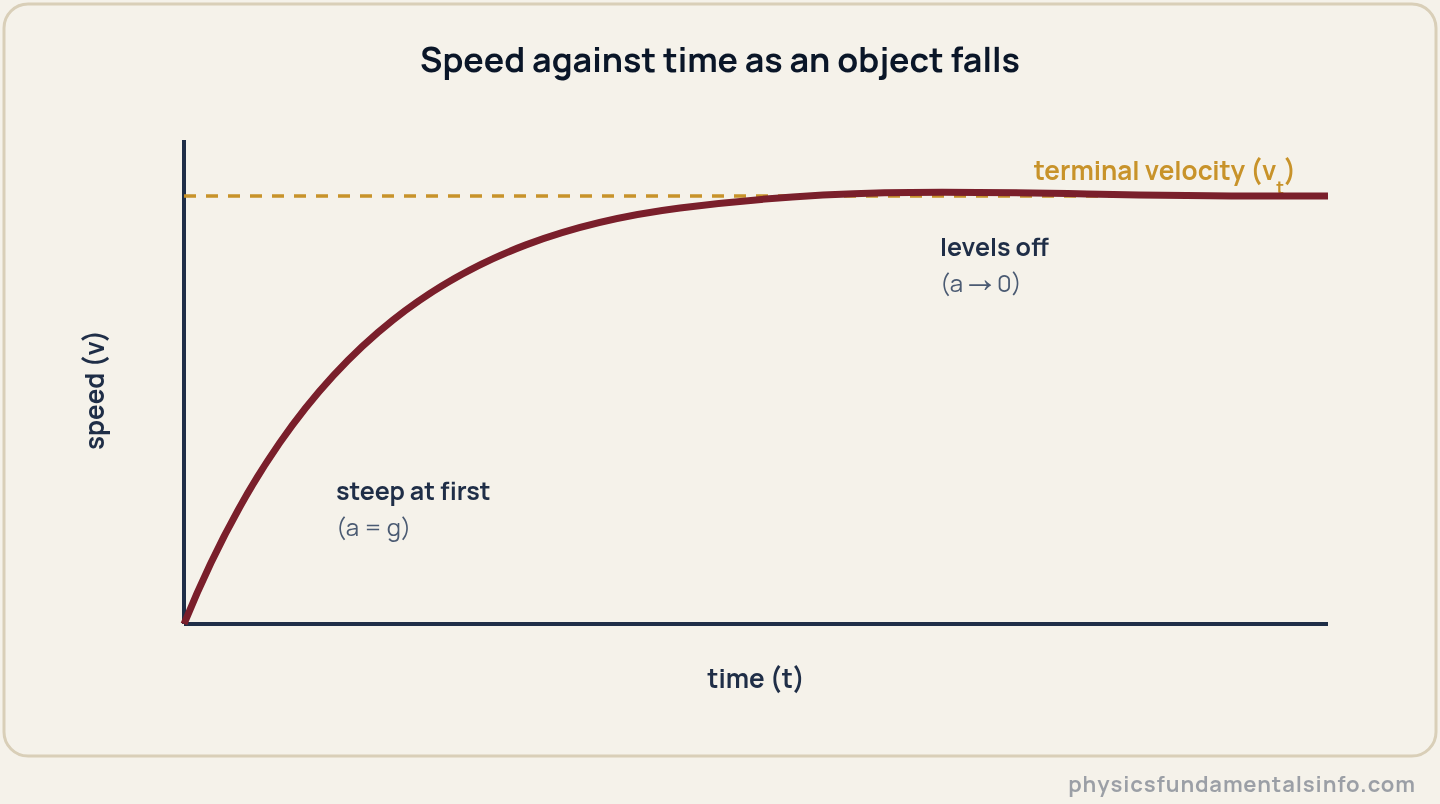
Figure 2: Speed rises quickly at first, then bends over and approaches a flat ceiling — the terminal velocity.
Use the interactive lab below to feel this for yourself. Change the mass, frontal area and drag coefficient, drop the object, and watch the drag arrow grow until it cancels the weight and the speed locks in.
Real-World Examples of Terminal Velocity
You have met terminal velocity more often than you think — every time it rains.
Raindrops. A tiny drizzle drop about 0.5 mm across falls at only a couple of metres per second, while a large raindrop near 5 mm reaches roughly 9 m/s (about 20 mph). That is why a downpour stings and a mist does not: bigger drops have a higher terminal velocity. Meteorologists even use the relationship to estimate drop size from how fast rain falls.
Skydivers. A human in the stable belly-to-earth position tops out around 53 m/s — roughly 120 mph or 190 km/h. Tuck into a head-down dive and you cut your frontal area, so drag drops and terminal velocity climbs to 240–290 km/h (150–180 mph). It is the clearest everyday proof that posture, not just mass, sets your falling speed.

The fastest human freefall. In 2012, Felix Baumgartner jumped from about 39 km up as part of the Red Bull Stratos project. He hit a top speed of 1,357.6 km/h (843.6 mph), Mach 1.25 — the first person to break the sound barrier in freefall. He could only reach it because the air that high is almost a vacuum, so drag was tiny. Lower down, as the air thickened, his terminal velocity fell back to ordinary skydiving speeds.
Parachutes. A parachute is a terminal-velocity machine. By multiplying the frontal area enormously, it slashes the terminal velocity from a lethal 50-plus m/s to a survivable few metres per second — a gentle jog at touchdown rather than a fatal impact.
The Moon. There is no terminal velocity on the Moon. With effectively no atmosphere, there is no drag to balance gravity, so a falling object simply accelerates the whole way down. Apollo 15 astronaut David Scott showed this in 1971 by dropping a hammer and a feather together — both hit the lunar surface at the same instant, exactly as Galileo predicted for a world without air.
| Falling object | Approximate terminal velocity | Set mainly by |
|---|---|---|
| Mist / fog droplet (~20 μm) | ~0.05 m/s | Tiny size, viscous (Stokes) drag |
| Drizzle drop (~0.5 mm) | ~2 m/s | Small mass-to-area ratio |
| Large raindrop (~5 mm) | ~9 m/s (≈20 mph) | Bigger drops fall faster |
| Human skydiver, belly-to-earth | ~53 m/s (≈120 mph / 190 km/h) | Large frontal area, high drag |
| Human skydiver, head-down | ~67–80 m/s (≈150–180 mph) | Streamlined, smaller area |
| Felix Baumgartner (2012, thin stratosphere) | ~377 m/s (1,357.6 km/h, Mach 1.25) | Near-vacuum air, almost no drag |
Values are approximate and shift with posture, clothing, altitude and air density.
Common Misconceptions About Terminal Velocity
A few sturdy myths cling to this topic. Here are the four worth clearing up.
“In air, all objects fall at the same rate.”
Only in a vacuum. Galileo’s famous rule — everything falls together — holds when there is no air resistance. In real air, drag depends on shape and area, so a crumpled ball of paper easily outruns the same sheet held flat. They have identical mass but very different terminal velocities.
“Terminal velocity is a fixed number for an object.”
It changes with conditions. A skydiver doubles or halves their speed just by changing posture, and terminal velocity also drops as you fall into denser air lower down. Baumgartner’s record speed existed only in the thin upper atmosphere; it could never happen at sea level.
“At terminal velocity there is no force on the object.”
Two large forces are still acting — they simply cancel. Weight pulls down, drag pushes up with equal strength, so the net force is zero. Zero net force is not the same as zero force. That is exactly why the speed stays constant rather than dropping.
“A heavier object always has a higher terminal velocity.”
Only when shape and size are identical. For two matching spheres, the heavier one does fall faster (vt grows with the square root of mass). But across different shapes, area and drag coefficient dominate — a heavy parachutist falls far slower than a light pebble.
How Terminal Velocity Relates to Newton’s Laws, Drag and Free Fall
Terminal velocity is really just Newton’s laws in disguise. The balance of forces is pure Newton’s second law: F = ma. When drag equals weight, the net force F is zero, so the acceleration a must be zero too — and zero acceleration means a steady velocity, which is Newton’s first law in action.
The upward force is drag, a resistive force closely related to ordinary friction but produced by pushing through a fluid. It is the same family of “opposing” force, scaled up by speed.
It also sharpens the idea of velocity versus speed. Terminal velocity is a vector — it has a direction (straight down) as well as a magnitude — but in a vertical fall its size is simply the steady falling speed.
Finally, it is the missing piece in projectile motion. Most projectile problems assume no air resistance to keep the maths clean. Terminal velocity is what you get when you stop ignoring the air — the real ceiling that a long fall would actually hit.
Worked Problems
Show Solution
Solution:
Step 1: Use vt = √(2mg / (ρ · C_d · A)).
Step 2: Numerator = 2 × 75 × 9.81 = 1471.5 ; denominator = 1.225 × 0.70 × 0.70 = 0.600.
Step 3: vt = √(1471.5 / 0.600) = √2451.5 = 49.5 m/s.
Answer: vt ≈ 50 m/s (about 180 km/h). Sanity check: real belly-to-earth skydivers reach ~53 m/s (120 mph); the small difference comes from the exact drag coefficient, area and clothing.
Show Solution
Solution:
Step 1: At terminal velocity the net force is zero, so drag exactly equals weight: F_d = mg.
Step 2: F_d = 75 × 9.81 = 735.75 N.
Step 3: Check with the drag equation: ½ × 1.225 × 49.52 × 0.70 × 0.70 ≈ 736 N — it matches.
Answer: F_d ≈ 736 N upward, equal and opposite to the weight.
Show Solution
Solution:
Step 1: From the formula, vt is proportional to 1/√A (area sits under the square root).
Step 2: Multiplying A by 4 multiplies vt by 1/√4 = 1/2.
Step 3: Their terminal velocity halves — from ~50 m/s to ~25 m/s.
Answer: terminal velocity drops to one half (≈25 m/s). This is the principle a parachute uses on a much larger scale.
Show Solution
Solution:
Step 1: With shape and area identical, vt is proportional to √m.
Step 2: Mass ratio is 9, so the velocity ratio is √9 = 3.
Step 3: Sphere B’s terminal velocity is 3 times sphere A’s.
Answer: B falls 3× faster than A. For matching shapes, heavier really does mean faster — but only because area is held fixed.
Show Solution
Solution:
Step 1: Rearrange the formula for C_d: C_d = 2mg / (ρ · A · vt2).
Step 2: A = π × (0.020)2 = 1.257 × 10⁻³ m2 ; numerator = 2 × 0.0027 × 9.81 = 0.05297.
Step 3: C_d = 0.05297 / (1.225 × 1.257 × 10−3 × 9.02) = 0.05297 / 0.1247 = 0.425.
Answer: C_d ≈ 0.42, close to the textbook value of ≈0.47 for a smooth sphere — a good confirmation of the drag model.
Show Solution
Solution:
Step 1: Use vt = 2r2ρ_p g / (9η) for the low-speed (viscous) regime.
Step 2: Numerator = 2 × (2.0 × 10−5)2 × 1000 × 9.81 = 7.85 × 10⁻⁶ ; denominator = 9 × 1.8 × 10−5 = 1.62 × 10⁻⁴.
Step 3: vt = 7.85 × 10⁻⁶ / 1.62 × 10−4 = 0.048 m/s.
Answer: vt ≈ 0.048 m/s (about 4.8 cm/s). The Reynolds number here is ~0.13, well below 1, which confirms Stokes’ law applies — and explains why mist barely settles.
Show Solution
Solution:
Step 1: From the formula, vt is proportional to 1/√ρ.
Step 2: Air density falls to ρ/4, so vt is multiplied by √4 = 2.
Step 3: New vt = 53 × 2 = 106 m/s.
Answer: vt ≈ 106 m/s. This is why high-altitude jumps in thin air reach far higher speeds — the extreme version being Baumgartner’s near-vacuum record.