Projectile motion is the curved path an object follows when it is launched into the air and acted on only by gravity. Its horizontal velocity stays constant while gravity accelerates it downward, bending the path into a parabola. The horizontal range is R = v02 · sin(2θ) / g, where θ is the launch angle.
Watch a basketball arc toward the hoop, or the water from a hose curve down onto the grass. That smooth rise-and-fall is one of the most common shapes in the physical world — and physics pins it down with real precision.
Every object you throw, kick, or fire traces the same kind of path. Learn the rules behind it and you can predict where a ball lands, which angle sends it farthest, and why a dropped coin and a horizontally fired bullet hit the floor at the very same instant.
What Is Projectile Motion?
Throw a stone and it never travels in a straight line for long. It climbs, slows, curves over the top, and falls — and that arc is projectile motion.
Formally, projectile motion is the motion of an object that is given an initial velocity and then moves under the influence of gravity alone. We ignore air resistance, so the only force acting after launch is the object’s own weight.
The object itself is called a projectile, and the line it traces is its trajectory. For an ideal projectile near the Earth’s surface, that trajectory is always a parabola.
The key idea — the one that unlocks every problem — is that the motion splits into two independent parts: steady horizontal motion and accelerating vertical motion. Handle each separately, then recombine.
The Projectile Motion Formulas
For a projectile launched from ground level at speed v0 and angle θ above the horizontal, three formulas do most of the work. First, the range — the horizontal distance it covers before landing:
Next, the maximum height reached at the very top of the arc:
And the total time the projectile spends in the air — its time of flight:
Every symbol has a precise meaning and SI unit:
- R — horizontal range, in metres (m).
- H — maximum height above the launch point, in metres (m).
- T — time of flight, in seconds (s).
- v0 — initial launch speed, in metres per second (m/s).
- θ — launch angle measured from the horizontal, in degrees or radians.
- g — gravitational acceleration, ≈ 9.81 m/s2 near the Earth’s surface.
You will also lean on the velocity components constantly. The horizontal part is fixed; the vertical part shrinks, reverses, then grows:
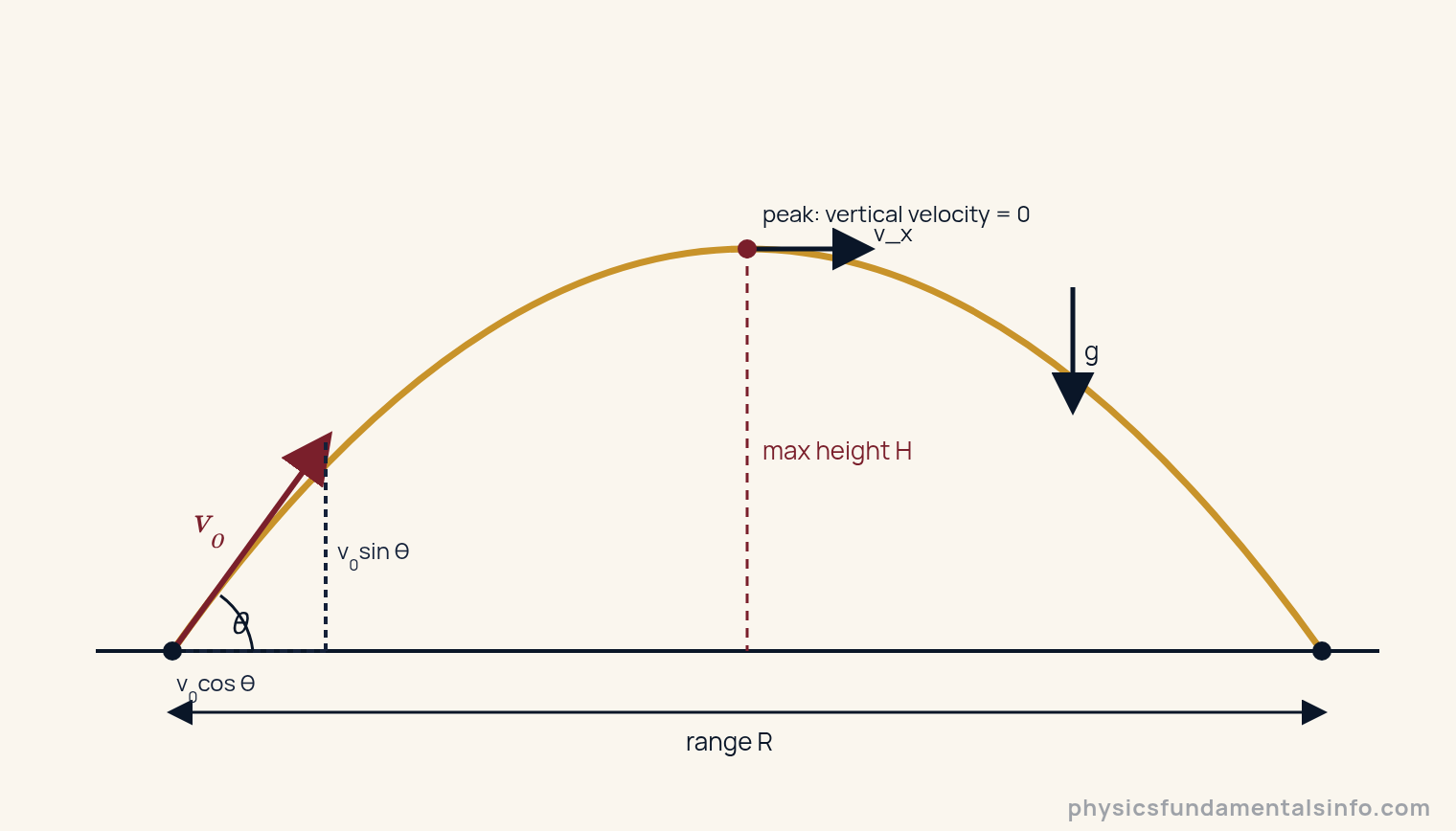
The anatomy of a flight: the launch velocity v0 splits into horizontal and vertical components, the path peaks at height H, and the horizontal distance covered is the range R.
One detail in the range formula matters enormously: R depends on sin(2θ), which is largest when 2θ = 90°. That single fact answers the classic “best angle” question — coming up shortly.
How Projectile Motion Works
The whole subject rests on one move: split the launch velocity into a horizontal piece and a vertical piece, then study each on its own.
Horizontal motion: constant velocity
Once the projectile is in flight, nothing pushes or pulls it sideways — remember, we are ignoring air resistance. With no horizontal force, Newton’s first law takes over and the horizontal velocity simply never changes.
So horizontal position grows steadily with time: x = v0cos(θ) · t. The projectile covers equal horizontal distances in equal time intervals, start to finish.
Vertical motion: free fall
Vertically, gravity is the only player. It produces a constant downward acceleration of about 9.81 m/s2, exactly as if the object were simply falling.
The upward velocity therefore drains away, reaches zero at the top, then rebuilds on the way down: v_y = v0sin(θ) − g · t. Vertical position follows y = v0sin(θ) · t − ½g · t2.
| Property | Horizontal motion | Vertical motion |
|---|---|---|
| Acceleration | 0 | g ≈ 9.81 m/s2, downward |
| Velocity | constant (v0cos θ) | changes: v0sin θ − g·t |
| Force in flight | none (air ignored) | weight (gravity) |
| Position | x = v0cos θ · t | y = v0sin θ · t − ½g·t2 |
| Role | carries it forward | curves it up then down |
Why the path is a parabola
Now combine the two. Solve the horizontal equation for time, substitute into the vertical equation, and the t cancels — leaving height y as a quadratic in horizontal distance x:
A quadratic relationship between y and x is, by definition, a parabola. That is the mathematical reason every ideal projectile carves the same elegant curve.
Where the range formula comes from
On level ground the flight is symmetric: the projectile takes exactly as long coming down as it spent going up. That gives the time of flight, T = 2v0sin(θ)/g.
Multiply that time by the constant horizontal speed and the range appears: R = v0cos(θ) × T = v02 · 2sin(θ)cos(θ)/g, which simplifies neatly to R = v02sin(2θ)/g.
Test these ideas in the lab above: nudge the launch angle and speed, and watch the range and peak height respond in real time.
What Angle Gives the Maximum Range?
Here is the famous result. Because the range scales with sin(2θ), it is greatest when sin(2θ) = 1 — and that happens at 2θ = 90°, so θ = 45°.
There is a lovely symmetry hiding in the formula, too. Any two angles that sit equally above and below 45° produce the same range, just by different routes. The table below makes the pattern obvious for a launch speed of 20 m/s.
| Launch angle θ | Range R (m) | Max height H (m) |
|---|---|---|
| 15° | 20.4 | 1.4 |
| 30° | 35.3 | 5.1 |
| 45° | 40.8 | 10.2 |
| 60° | 35.3 | 15.3 |
| 75° | 20.4 | 19.0 |
Notice the mirror pairs: 30° and 60° both land at 35.3 m; 15° and 75° both reach 20.4 m. Only 45° tops the range column — while the steeper angle of each pair always climbs higher.
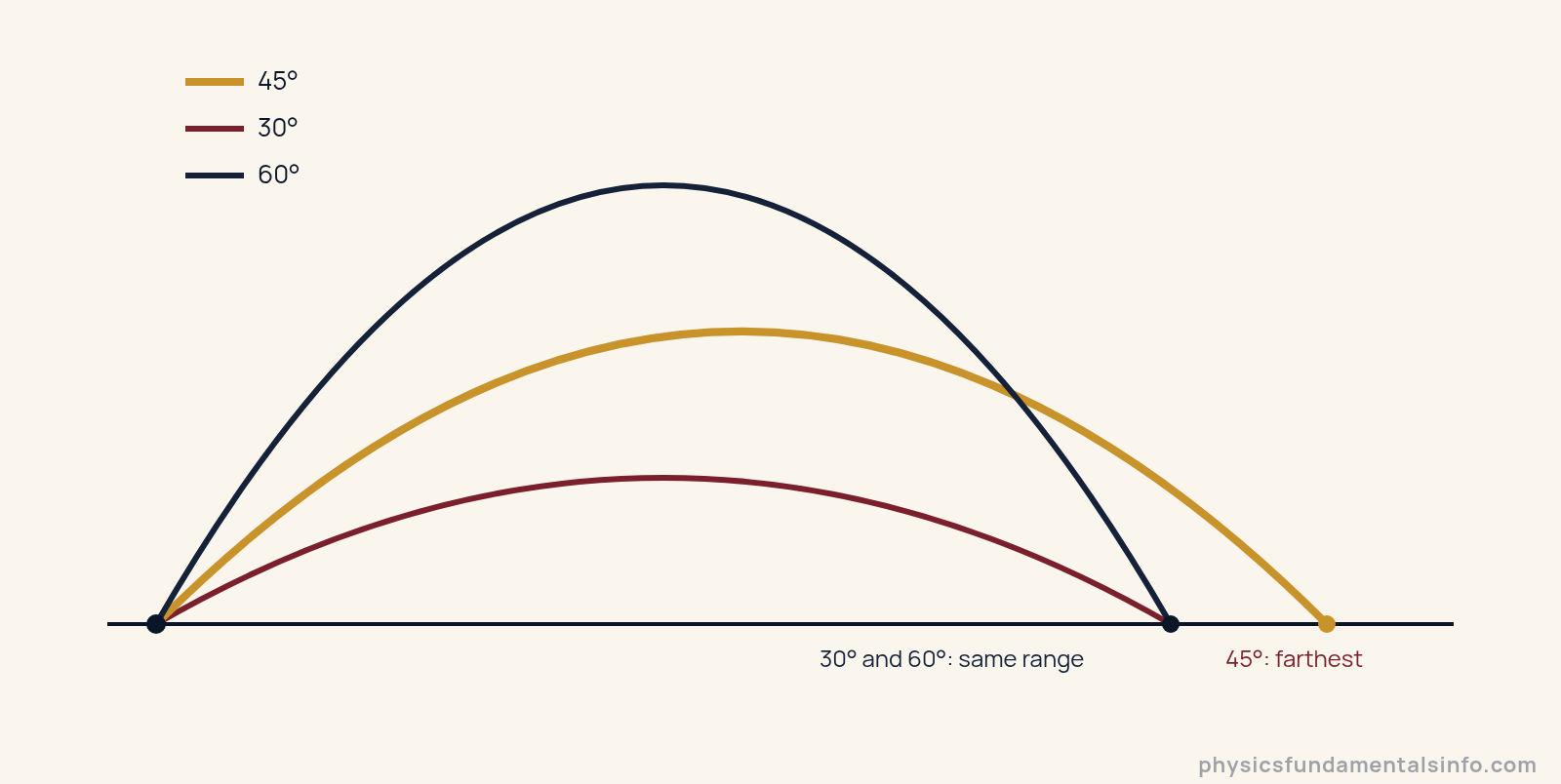
Same launch speed, three angles. The 45° launch (gold) travels farthest, while angles equally above and below 45° — here 30° and 60° — cover the same horizontal distance.
Real-World Examples of Projectile Motion
Sport is full of it. A basketball arcing toward the hoop, a golf ball leaving the tee, a long-jumper’s body in mid-leap — each follows a parabola. Skilled athletes learn, by feel, the launch angle and speed that put the ball (or themselves) exactly where they want.
Water gives the curve away. The jets of a fountain and the stream from a garden hose both trace clean parabolas, because every droplet is its own tiny projectile. This is projectile motion you can literally watch.

Falling from a moving vehicle. Drop a package from a plane flying level and it does not fall straight down — it keeps the plane’s forward speed and curves ahead, landing well in front of the release point. Pilots time air-drops with exactly this in mind.
Artillery and fireworks. The whole science of ballistics began with cannon fire, and Galileo’s discovery that trajectories are parabolic let gunners build range tables. A firework shell, by contrast, is launched steeply — near 75° — so it bursts close to the top of its climb, right overhead.
Common Misconceptions About Projectile Motion
Myth: heavier objects fall — and land — faster
Drop a hammer and a feather in a vacuum and they land together. Projectiles obey the same rule: gravity accelerates every mass equally, so a cannonball and a pebble launched identically trace the same path. As NASA’s ballistic-flight equations note, an ideal trajectory carries no information about the object’s mass at all.
Myth: the horizontal and vertical motions affect each other
They don’t. Fire a bullet horizontally and, at the same instant, drop an identical bullet from the same height — both reach the ground together, because forward speed has no effect on the fall. This independence is the single most useful fact in the topic.
Myth: something keeps pushing the projectile forward
Once an object leaves your hand, no forward force remains — we are ignoring air. It keeps moving sideways purely through inertia, while the only force acting is gravity pulling it down. There is no hidden “force of motion” carrying it along.
Myth: the projectile stops at the top of its arc
At the peak, only the vertical velocity is zero, so for one instant the object is neither rising nor falling. But it is still racing sideways at v0cos(θ), so it never truly stops. That is exactly why the top of the path is rounded, not a sharp point.
How Projectile Motion Relates to Newton’s Laws and Energy
Projectile motion is really Newton’s mechanics in action. The constant horizontal velocity is a direct consequence of Newton’s laws of motion — with no sideways force, the first law keeps the horizontal speed unchanged.
The downward acceleration comes from gravity through Newton’s second law: the weight mg divided by the mass m gives an acceleration of g, which is precisely why mass cancels out of every formula.
Energy runs alongside the geometry. Climbing, the projectile trades kinetic energy for gravitational potential energy and slows; falling, it trades back and speeds up — which is the deeper reason its energy, and its speed, return to the launch values at the original height.
Finally, the clean parabola is an idealisation. In the real world, air resistance acts like a velocity-dependent friction force that shortens the flight and breaks the symmetry. Knowing when you can ignore it — and when you can’t — is part of using these formulas well.
Worked Problems
Show Solution
Solution:
Step 1: Use the range formula R = v02 · sin(2θ) / g.
Step 2: R = (20)2 · sin(60°) / 9.81 = 400 × 0.866 / 9.81.
Step 3: R = 346.4 / 9.81 = 35.3 m.
Step 4: For height, H = v02 · sin2(θ) / (2g) = 400 × (0.5)2 / 19.62 = 100 / 19.62.
Answer: Range ≈ 35.3 m and maximum height ≈ 5.10 m.
Show Solution
Solution:
Step 1: Time of flight T = 2 · v0 · sin(θ) / g.
Step 2: T = 2 × 20 × sin(30°) / 9.81 = 20 / 9.81.
Step 3: T = 2.04 s.
Step 4: Horizontal velocity is constant: v_x = v0 · cos(θ) = 20 × cos(30°) = 17.3 m/s.
Answer: The ball is airborne ≈ 2.04 s, and its horizontal velocity at the top is ≈ 17.3 m/s — the same as at every other instant.
Show Solution
Solution:
Step 1: A horizontal launch means the initial vertical velocity is 0, so the fall obeys h = ½ · g · t2.
Step 2: 25 = ½ × 9.81 × t2 → t2 = 25 / 4.905 = 5.097.
Step 3: t = 2.26 s.
Step 4: Horizontal distance x = v · t = 12 × 2.26 = 27.1 m.
Answer: It lands after ≈ 2.26 s, about 27.1 m from the base of the cliff.
Show Solution
Solution:
Step 1: R = v02 · sin(2θ) / g is largest when sin(2θ) = 1, i.e. 2θ = 90°, so θ = 45°.
Step 2: At θ = 45°, R_max = v02 / g.
Step 3: R_max = (30)2 / 9.81 = 900 / 9.81.
Answer: The maximum range occurs at 45°, giving R ≈ 91.7 m.
Show Solution
Solution:
Step 1: Rearrange R = v02 · sin(2θ) / g for the angle: sin(2θ) = R · g / v02.
Step 2: sin(2θ) = (200 × 9.81) / (50)2 = 1962 / 2500 = 0.785.
Step 3: 2θ = sin−1(0.785) = 51.7°, so θ = 25.9°.
Step 4: The complementary angle also works: θ = 90° − 25.9° = 64.1°.
Answer: Either ≈ 25.9° (a flat, fast shot) or ≈ 64.1° (a high, lobbed shot) lands the projectile at 200 m.
Show Solution
Solution:
Step 1: Maximum height H = v02 · sin2(θ) / (2g).
Step 2: H = (25)2 × sin2(40°) / 19.62 = 625 × 0.413 / 19.62 = 258.2 / 19.62.
Step 3: H = 13.2 m.
Step 4: By symmetry — and by conservation of energy — the speed back at launch height equals the launch speed.
Answer: Maximum height ≈ 13.2 m; the return speed is 25 m/s, equal to the launch speed.
Show Solution
Solution:
Step 1: Resolve the velocity into components: horizontal = 18 · cos(35°) = 14.7 m/s; vertical = 18 · sin(35°) = 10.3 m/s.
Step 2: Take upward as positive with the roof as the origin, so the ground sits at y = −40 m: −40 = 10.3·t − 4.905·t2.
Step 3: Rearrange to 4.905·t2 − 10.3·t − 40 = 0 and apply the quadratic formula: t = [10.3 + √(10.32 + 4 × 4.905 × 40)] / (2 × 4.905).
Step 4: t = [10.3 + √891] / 9.81 = (10.3 + 29.9) / 9.81 = 4.10 s, then x = 14.7 × 4.10 = 60.4 m.
Answer: It lands after ≈ 4.10 s, about 60.4 m from the base of the building.