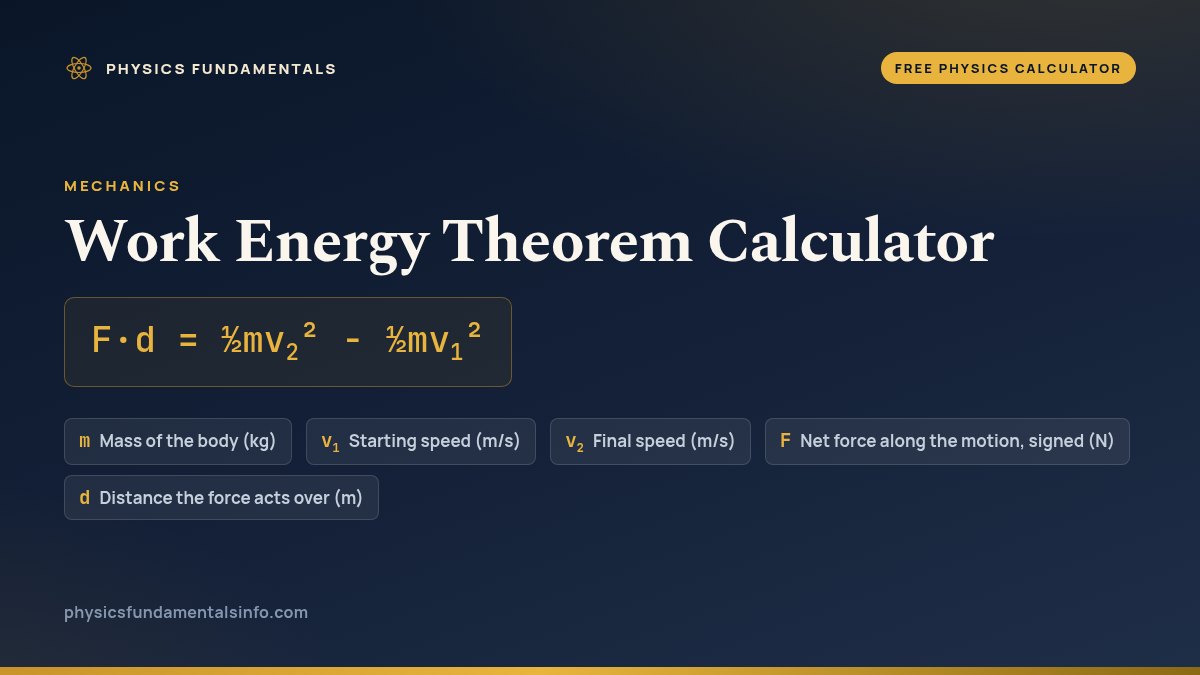
The work-energy theorem says that the net work done on a body equals the change in its kinetic energy. For one constant net force acting along the motion that is F·d = ½mv2² - ½mv1², one equation tying a force and a distance to two speeds. This free work energy theorem calculator solves it five ways — for either speed, the net force, the distance or the mass — and prints the kinetic energy at both ends, the change between them and the net work beside the answer.
Load a real braking, impact or launch case
Each button puts the Solve for menu on the unknown that case is asking about, resets every unit menu to SI and fills the four remaining boxes. Whatever the widget then works out is read back into the line underneath, so nothing there is stored text.
Pick a case above, or type your own numbers.
What Is the Work Energy Theorem Calculator?
The work energy theorem calculator is a free online tool for the one equation that ties a force and a distance to two speeds: F·d = ½mv22 - ½mv12. Enter the mass, the speeds you know, the net force along the motion and the distance it acts over, and it returns whichever of the five quantities you left out — either speed, the force, the distance or the mass. The force is signed, so braking, friction and drag go in negative, and beside the answer the tool prints the kinetic energy at both ends, the change between them, the net work and the acceleration.
| Symbol | Quantity | Default unit | Also accepts | Example value |
|---|---|---|---|---|
| m | Mass of the body | kg | g, t | 1200 |
| v1 | Starting speed | m/s | km/h, mph | 30 |
| v2 | Final speed | m/s | km/h, mph | 0 |
| F | Net force along the motion, signed | N | kN, lbf | -5000 |
| d | Distance the force acts over | m | cm, km, ft | 40 |
How to use the work energy theorem calculator
- Choose the unknown. The Solve for menu opens on Final speed. The other four choices are Starting speed, Net force along the motion, Distance and Mass, and whichever you pick vanishes from the boxes below.
- Add the forces up first. The force box wants the net force along the direction of travel, not whichever force you were thinking about. A 400 N push against 150 N of friction is a net 250 N; a car with nothing but its brakes acting is whatever those brakes supply, and nothing else.
- Give that net force a sign. Positive drives the body along and negative opposes it, so braking, friction and drag all go in negative. The page opens on -5000 N, which is why the answer comes back smaller than the speed you started with.
- Type both speeds as magnitudes. Neither speed is ever negative here, because the direction is carried by the sign of the force instead. A body brought to a complete stop has a final speed of 0.
- Enter the distance the force acts over. That is the distance travelled while the force is doing its work — the length of the skid, the depth the nail goes in, the stretch of track — and not the whole journey. Each box carries a unit menu: kg, g or t for the mass, m/s, km/h or mph for the speeds, N, kN or lbf for the force, and m, cm, km or ft for the distance.
- Read the answer and the extras. The headline is the quantity you asked for, to four significant figures, with its unit printed beside it. The chips underneath give the kinetic energy at each end, the change between them, the net work, the acceleration, and the final energy as a share of the starting energy whenever the body was already moving.
- Check the two middle chips against each other. Change in kinetic energy comes from the two speeds and Net work done on the body comes from the force and the distance, by separate arithmetic. They match because that is exactly what the theorem claims.
- Open Show working. Each step is printed in SI whatever the menus say, with the operands to six significant figures, and the last line carries the headline figure whenever that quantity's own unit menu is on its SI option.
The two halves of this equation each have a page of their own, and they are the right place to start if either is unfamiliar. The work and power calculator handles W = F·d on its own, and the guide to work done in physics covers the angled-push case this tool deliberately leaves out. For the other half, the kinetic energy formula explained takes ½mv2 apart term by term.
The mistake that costs people the most marks is typing a single force into a box that wants the sum. If a crate is being pushed and rubbing along the floor at the same time, work the friction out with the friction calculator, subtract it from the push, and bring the remainder here. On a slope you need the component of the weight along the surface as well, which is what the inclined plane calculator resolves for you.
The second common slip is asking for something that cannot happen. Ask for the final speed of a body that runs out of kinetic energy before it covers the distance and the square root turns negative, so the tool reports that the combination has no valid solution rather than printing a number. That refusal is an answer in itself: the body stopped earlier than the distance you typed.

-200000 J, one worked out from the speeds and one from the force and the distance — which is the whole claim of the equation, printed twice.Worked example: change one thing at a time
The table starts at the defaults and moves one thing at a time: the distance, then the speed, then the braking force, then the mass, then which quantity is the unknown. Every Result, Change and Net work cell was read out of the running widget rather than worked out by hand, so where a cell and the tool ever part company, believe the tool. The input columns are simply what you type.
| Step | Solving for | Mass | Speeds | Net force | Distance | Result | Change in kinetic energy | Net work |
|---|---|---|---|---|---|---|---|---|
| The page as it opens | Final speed | 1200 kg | from 30.0 m/s | -5000 N | 40.0 m | 23.8 m/s | -200000 J | -200000 J |
| Brake over exactly 108 m | Final speed | 1200 kg | from 30.0 m/s | -5000 N | 108 m | 0 m/s | -540000 J | -540000 J |
| Brake that hard from 10.0 m/s | Final speed | 1200 kg | from 10.0 m/s | -5000 N | 40.0 m | no answer | — | — |
| How far to a full stop | Distance | 1200 kg | 30.0 to 0 m/s | -5000 N | asked | 108 m | -540000 J | -540000 J |
| Twice the speed | Distance | 1200 kg | 60.0 to 0 m/s | -5000 N | asked | 432 m | -2160000 J | -2160000 J |
| Three times the speed | Distance | 1200 kg | 90.0 to 0 m/s | -5000 N | asked | 972 m | -4860000 J | -4860000 J |
| Half the braking force | Distance | 1200 kg | 30.0 to 0 m/s | -2500 N | asked | 216 m | -540000 J | -540000 J |
| Twice the mass, same force | Distance | 2400 kg | 30.0 to 0 m/s | -5000 N | asked | 216 m | -1080000 J | -1080000 J |
| Ask for a distance with no force | Distance | 1200 kg | 30.0 to 0 m/s | 0 N | asked | no answer | — | — |
| The force the brakes must find | Net force | 1200 kg | 30.0 to 0 m/s | asked | 45.0 m | -12000 N | -540000 J | -540000 J |
| Hammer on a nail | Net force | 4.50 kg | 12.0 to 0 m/s | asked | 0.0120 m | -27000 N | -324 J | -324 J |
| Train getting up to speed | Final speed | 45000 kg | from 5.00 m/s | 30000 N | 250 m | 18.93 m/s | 7500000 J | 7500000 J |
| How fast before the brakes | Starting speed | 1200 kg | to 20.0 m/s | -5000 N | 40.0 m | 27.08 m/s | -200000 J | -200000 J |
| What mass is being pushed | Mass | asked | 0 to 8.00 m/s | 250 N | 6.40 m | 50 kg | 1600 J | 1600 J |
Rows 4, 5 and 6 are the demonstration this page exists for. The same 1200 kg car under the same -5000 N needs 108 m to stop from 30.0 m/s, 432 m from 60.0 m/s and 972 m from 90.0 m/s. Those are exact factors of four and nine for factors of two and three in speed, not approximations that happen to come out close.
Rows 1 to 3 set that up from the other direction. Forty metres of the same braking leaves the car at 23.8 m/s, exactly 108 m brings it to 0 m/s, and asking for the same 40 m of braking from only 10.0 m/s gets no answer at all — because a car doing 10.0 m/s stops after 12 m, long before 40 m of that force has been applied.
Rows 7 and 8 are the pair that settles an argument. Halving the braking force doubles the distance to 216 m, and so does doubling the mass at the same force. For a fixed force, a heavier body really does take proportionally longer to stop; that is not the same claim as the one about real road braking, which the physics section below separates out.
Row 9 is a guard rather than a failure. With the net force at zero the equation says that a change in kinetic energy equals nothing times a distance, which no distance satisfies, so the tool declines instead of dividing by zero. Rows 10 and 11 then run the question the other way: 45.0 m demands -12000 N of the brakes, and a hammer head stopped in 0.0120 m needs -27000 N, which is what makes a short stopping distance so violent.
Rows 12 to 14 take the remaining three directions out of the braking context altogether. A 45 tonne train under 30 kN for 250 m reaches 18.93 m/s, a car found doing 20.0 m/s after 40 m of braking must have been doing 27.08 m/s before it, and a 250 N push that takes something from rest to 8.00 m/s over 6.40 m was pushing 50 kg. In every row the Change and Net work columns carry the same figure, which is the theorem holding across fourteen different questions.
Formula and symbol reference
The calculator uses one relation in five arrangements. In full it is F·d = ½mv22 - ½mv12, and the five closed forms are v2 = sqrt(v12 + 2Fd/m), v1 = sqrt(v22 - 2Fd/m), F = (½mv22 - ½mv12)/d, d = (½mv22 - ½mv12)/F and m = Fd / [½(v22 - v12)]. No measured constant of nature appears in any of them, and gravity is not an input, because a horizontal problem never needs it and a vertical one wants the weight folded into the net force before you type.
The one symbol worth dwelling on is F. It is the vector sum of every force acting, resolved along the direction of travel, and this page treats it as constant over the whole distance. Anything acting sideways contributes nothing, which is why a horizontal push and a horizontal floor make the arithmetic so clean.
| Symbol | Meaning | SI unit | Values used on this page |
|---|---|---|---|
| m | The mass of the one body the theorem is written for. It never cancels here, because the force is a number you type rather than something proportional to the mass | kilogram, kg | Boxes take kg, g or t: 1200 by default for a small car, 4.50 for a hammer head, 45000 for a train, 50 where the tool works it out. |
| v1 | The speed before the force starts acting. A magnitude, so it is never negative | metre per second, m/s | Boxes take m/s, km/h or mph: 30.0 by default, 60.0 and 90.0 in the rows that quadruple and nonuple the distance, 0 for a body starting from rest. |
| v2 | The speed after it has acted over the whole distance. The default unknown, and also a magnitude | metre per second, m/s | Boxes take m/s, km/h or mph: 0 by default, which is a body brought to a complete stop; 8.00 and 20.0 in the rows solved backwards. |
| F | The NET force along the direction of travel, after every force acting has been added up with its sign. Negative when it opposes the motion | newton, N | Boxes take N, kN or lbf: -5000 by default for a braking car, -2500 for half that, 250 for a steady push, 30000 for a locomotive. |
| d | The distance along the path over which that net force acts. Not the whole journey, and not a straight-line displacement | metre, m | Boxes take m, cm, km or ft: 40.0 by default, 108 and 432 where the car stops dead, 0.0120 for the depth a nail is driven. |
The physics: why stopping distance goes as the square of the speed
Rearranged for the distance, the theorem reads d = (½mv22 - ½mv12)/F. Bring a body to rest and the numerator is just its starting kinetic energy, which carries a v12. Double the speed and you have four times as much energy for the same force to take away, so the distance is four times as long.
Load How far to a full stop and then Twice the speed and the page returns 108 m and 432 m for a 1200 kg car under the same -5000 N. The only thing that changed between them was 30.0 m/s becoming 60.0 m/s. Add a third case at 90.0 m/s and the answer is 972 m, exactly nine times the first.
This is worth stating as strongly as the arithmetic allows: it is not a rule of thumb and it is not roughly four. Both numbers are whole, both come out of the same division, and their ratio is exactly four because the only thing that moved was a squared term. A page that says the distance goes up "quite a lot" with speed is describing the same fact far too weakly.
Two things that ordinary speech blurs are worth keeping apart here. The 108 m this page returns is the distance the brakes need once they are on; a driver's real stopping distance also includes everything covered while they are still reacting, which this theorem says nothing at all about. Nothing on this page should be read as a distance a particular vehicle on a particular road would actually take.
The mass is the other thing worth getting right, because the popular claim cuts both ways. At a fixed force this page is unambiguous: 1200 kg stops in 108 m and 2400 kg in 216 m, exactly double.
Road braking is usually limited by the grip between the tyres and the surface instead, and that friction force grows in proportion to the mass, so there the two effects cancel and the distance stops depending on the mass at all. That makes "heavier vehicles always take longer to stop" true of a fixed force and false of the ordinary road case. The primer on friction is the background for why a friction force scales that way.
The theorem's real advantage over kinematics is scope rather than accuracy. Where a single constant acceleration exists, the SUVAT equations give the same answer and hand you the time as well, which energy alone cannot. Where the force varies there is no single acceleration to feed them, and the theorem still works from the total work done.
That is also the honest limit of this particular page. It multiplies one force by one distance, so a force that changes along the way has to be turned into an energy first, by taking the area under its force-distance graph. A force falling steadily from 300 N to nothing over 0.400 m does 60.0 J, and the work and power calculator is the right place for that step.
One last distinction, because the equations look similar. This theorem and the conservation of energy calculator describe the same trade from different ends: that page asks what height buys what speed, this one asks what force over what distance does. Neither needs the other, and a problem giving you a slope and a distance rather than a height belongs here.

Where the work energy theorem calculator breaks down
The arithmetic is four lines long and hard to get wrong. What fails is the model being pressed onto a situation it does not cover, or an expectation the equation was never making.
- A force that is not constant over the distance
- This page multiplies one force by one distance, so a spring letting go, a magnet closing on steel or a bullet down a barrel all break the assumption. The theorem itself survives — the work is then the area under the force-distance curve — but that area has to be worked out separately and brought here as an energy.
- Symptom: an answer that is too fast, because the peak force was used throughout.
- A single force typed where the net force belongs
- This is the commonest error on the whole topic. Every force acting gets a term with its own sign, and it is their sum that the change in kinetic energy equals; typing the engine's push while ignoring the drag gives a speed no vehicle reaches. Add them up first, and let the sign of the total tell you whether the body is speeding up or slowing down.
- Expecting a time, or a direction
- Energy relates a force and a distance to two speeds and nothing else. It cannot tell you how long the braking took, where the body was halfway through, or which way it was travelling when it arrived. Those belong to kinematics, and a constant-acceleration problem has a tool of its own.
- Anything that rolls, spins or deforms
½mv2counts only the energy of moving along. A rolling ball, a spinning flywheel and a crumpling panel all hold energy this page cannot see, so it will overstate the speed for a body that rolls and understate the force absorbed by one that deforms. The model here is a rigid body that slides.- A distance that is not the distance the force acted over
- The
dinF·dis the path length while that force was applied, not the whole trip and not the straight line between the ends. A trolley pushed for 4 m and then left to coast has two phases, and only the first of them has your push in it. - Asking for a state the body cannot reach
- Ask for the final speed after more braking than the body has energy for, or for a starting speed that could not have produced the arrival you typed, and the square root goes negative. The tool returns no number in that case, which is correct: there is no real speed, not a small one.
- Asking for the mass when the speed does not change
- With the two speeds equal the equation reads a net work of zero, which every mass satisfies if the force and distance also multiply to zero and none satisfies otherwise. There is no determined answer, so the tool declines to print one, and the same goes for a combination whose arithmetic demands a negative mass.
- Rounded figures in, rounded figures out
- The headline is four significant figures while the working and the chips print six, so re-multiplying the printed operands can differ from the printed answer in the last digit. The default state is a good example: the tool prints 23.8 m/s, and typing that back in as the final speed will not return exactly 40 m.
Where the work-energy theorem is actually used
- Braking and skid-mark analysis
- A vehicle's kinetic energy has to go somewhere, and under braking it goes into heat in the discs and the road. Working backwards from the length of a skid to the speed that made it is exactly this equation solved for the starting speed, which is the reason the How fast before the brakes preset exists. The friction coefficient any such estimate uses is chosen for the calculation, never a measured property of a particular tyre and road.
- Hammers, nails and pile drivers
- A 4.50 kg head arriving at 12.0 m/s carries 324 J, and driving a nail 12.0 mm into timber means getting rid of all of it in that distance. The tool returns -27000 N, hundreds of times the weight of the head itself, and that is the whole trick of an impact tool: a modest energy delivered over a tiny distance becomes an enormous force.
- Crumple zones and crash structures
- The same arithmetic run as a design brief. The energy is fixed by the mass and the speed, so the only lever an engineer has is the distance over which it is absorbed — which is why cars are built to fold rather than to resist, and why the force falls as that folding distance grows.
- Arrester beds and run-off ramps
- A gravel bed stops a runaway lorry by supplying a large backwards force over a short distance, and a climbing ramp does it by trading speed for height instead. Both are the same energy being got rid of by different means, and the ramp version is the one the conservation of energy calculator is built for.
- Getting heavy things moving
- A locomotive leaving a station, a conveyor starting under load or a ship warping off a quay are all steady forces over long distances, with the speed as the thing you want. The Train getting up to speed preset is that question: 45 tonnes under 30 kN for 250 m ends up at 18.93 m/s.
- Laboratory trolley and track experiments
- The standard practical pulls a trolley with a measured force over a measured distance and times it through a gate at the end. Comparing the measured speed against the figure this page gives for the same force is a direct test of the theorem, and the shortfall is the friction the track and the axles took. The interactive lab for this topic does the same thing with sliders instead of a bench.
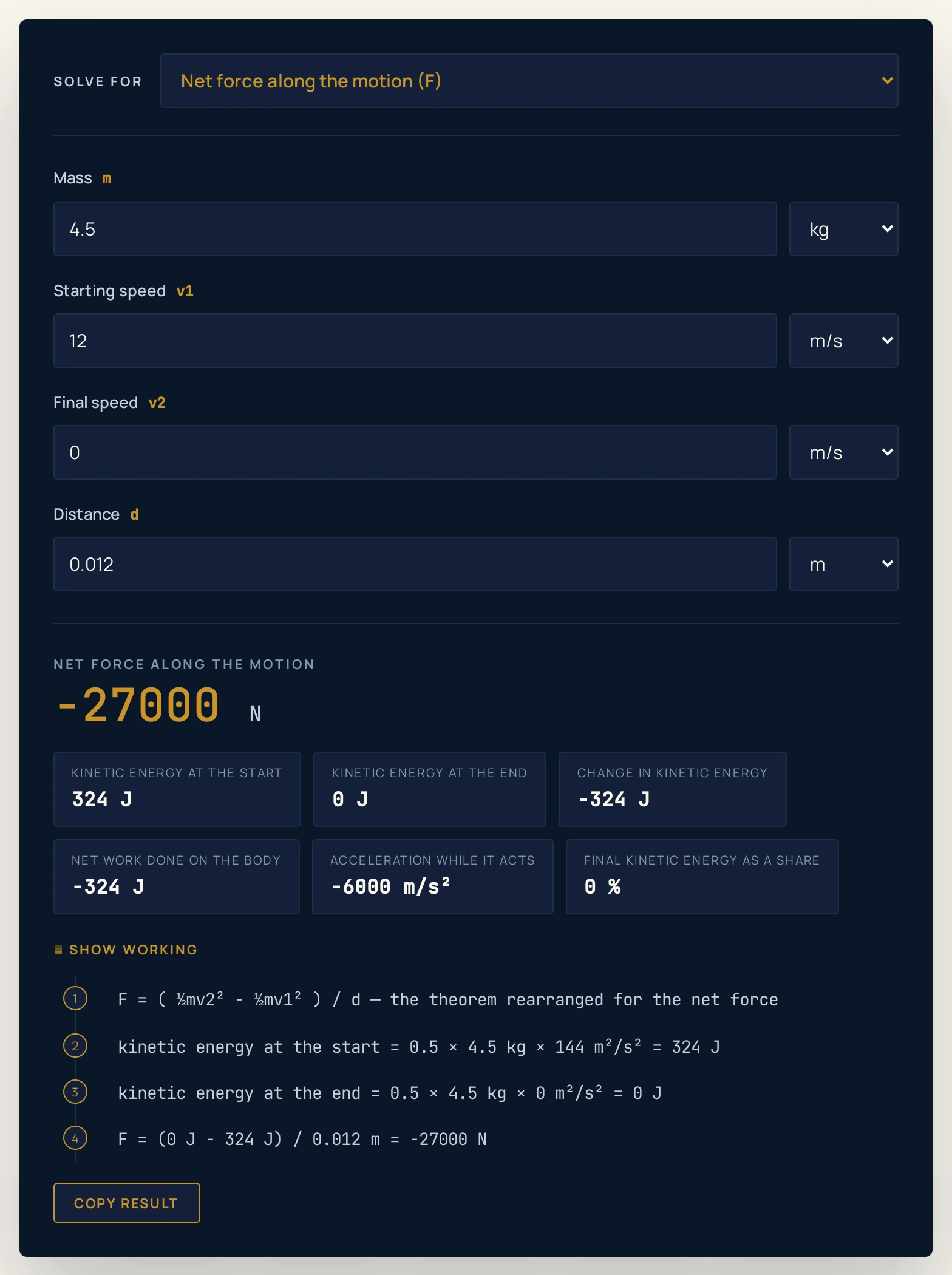
-27000 N — more than twice the force the car's brakes needed. It is the short distance, not the large energy, that makes an impact violent.Where to go next
For the method in full, with eight worked problems of rising difficulty and the diagrams that go with them, read The Work-Energy Theorem. Take one piece at a time to the work and power calculator or the kinetic energy calculator, a slope to the inclined plane calculator, or a collision to the momentum calculator and the impulse calculator when you need what a force does over a time rather than over a distance. The whole physics lab library is open beside them if you would rather watch the energy move than type it.
Frequently asked questions
What is the work-energy theorem?
It says that the net work done on a body equals the change in its kinetic energy: F·d = ½mv2² - ½mv1² for a constant net force acting along the motion. The word net is doing real work in that sentence. Every force acting gets a term, with a sign, and it is their sum that the change in kinetic energy is equal to.
Why is the force allowed to be negative?
Because a net force that opposes the motion does negative work and takes kinetic energy away. That is the ordinary case for braking, friction and drag, and it is the reason this page opens on -5000 N. A positive force speeds the body up, a negative one slows it down, and the sign of the answer tells you which happened.
Why does doubling the speed quadruple the stopping distance?
Because the kinetic energy carries a v², and the distance is that energy divided by the braking force. Load the "How far to a full stop" and "Twice the speed" presets and the tool returns 108 m and 432 m for the same 1200 kg car at the same -5000 N. That is a factor of exactly four, not approximately four, and tripling the speed gives 972 m, which is exactly nine times.
Do heavier vehicles always take longer to stop?
Only when the braking force is fixed. At a constant -5000 N this page returns 108 m for 1200 kg and 216 m for 2400 kg, so there the mass matters exactly in proportion. Real road braking is limited by friction instead, and a friction force grows with the mass, so the two effects cancel and the mass drops out. Both statements are true of different situations, and neither is true of both.
Why did it say the combination has no valid solution?
Something you asked for has no real answer, and the tool declines rather than inventing one. The usual causes are a square root that comes out negative, which means the body runs out of kinetic energy before it covers the distance; a net force of zero when you have asked for a distance, because no distance of no force changes a speed; two equal speeds when you have asked for the mass, because then the mass cancels out of the question; a mass or a distance of zero or less; and an arithmetic result that demands a negative mass or a negative distance. Nothing is printed in any of those cases, because no number would be honest.
Can I use it if the force changes along the way?
Not directly, because this page multiplies one force by one distance. The theorem itself still holds for a varying force, but the work then has to be found as the area under the force-distance graph and brought here as an energy. A force falling steadily from 300 N to nothing over 0.400 m does 60.0 J of work, not the 120 J that 300 N throughout would suggest.
Will it tell me how long the braking took?
No. The theorem relates a force and a distance to two speeds and mentions time nowhere, so it cannot give you a duration and it cannot give you a direction either. That is also its advantage: you can use it when you have no time and no acceleration to work with. For the timing side you need a kinematics tool instead.
Does it work for something rolling or spinning?
Only for the part of the motion that moves the body along. ½mv² counts translation only, so a rolling ball or a spinning flywheel holds kinetic energy this page cannot see and the answer will overstate the speed. The model here is a rigid body that slides rather than rolls.
Can I get the answer in km/h, or the force in kN?
Yes, but set that menu before you solve for that quantity. Each box carries its own unit menu, and the menu disappears while that quantity is the unknown, so the answer is returned in whatever unit the menu was last left on. The unit is always printed beside the number, so it is never ambiguous, and reloading the page puts every menu back to SI.
References & formula source
- Halliday, Resnick & Walker — Fundamentals of Physics, the chapter on kinetic energy and work.
- Young & Freedman — University Physics, the chapter on work and kinetic energy.
- Kleppner & Kolenkow — An Introduction to Mechanics, the chapter on work and energy.
- Serway & Jewett — Physics for Scientists and Engineers, the work-kinetic energy theorem and its worked examples.
- BIPM — The International System of Units (SI brochure): the joule as a newton metre, and the newton as a kilogram metre per second squared.
- Further reading: Work (physics) — Wikipedia