Inclined plane physics splits an object’s weight into two components on a ramp: mg sin θ acting down the slope and mg cos θ pressing into the surface. The surface pushes back with a normal force N = mg cos θ, so only mg sin θ drives motion. A frictionless block accelerates at a = g sin θ, regardless of its mass.
Try lifting a fridge straight up into a van and you will lose. Slide it up a ramp and — awkwardly, slowly — it goes. Nothing about the fridge changed; you simply stopped fighting all of its weight at once.
That trade is the whole point of a ramp, and it explains why inclined planes turn up everywhere from loading bays to mountain roads. It is also why examiners love them. Get one idea right and most ramp questions collapse into two lines of algebra.
What Is an Inclined Plane in Physics?
An inclined plane is a flat surface tilted at an angle θ to the horizontal, and in physics it is the standard setting for splitting an object’s weight into a part that drives motion and a part that presses into the surface. That split is the entire subject.
Gravity has not changed just because the surface tilted. The weight mg still points straight down, exactly as it does on a table or in mid-air. What changes is that the surface can no longer push straight back up against it.
A surface can only push perpendicular to itself. So on a slope it pushes at an angle, cancelling part of the weight and leaving the rest unopposed. That leftover part is what slides the fridge, the skier and the exam block down the hill.
Why we tilt the axes
Here is the move that makes ramp problems easy: stop using horizontal and vertical axes. Rotate them so that x runs along the slope and y runs perpendicular to it.
The payoff is immediate. The block can only accelerate along the slope, never through the surface, so the perpendicular direction becomes a simple balance — and the whole problem drops from two dimensions to one.
The cost is that gravity is now the awkward, tilted vector, which is why we resolve it. If you want the underlying vector rules first, our guide to scalar and vector quantities covers how any vector splits into perpendicular components.
The Inclined Plane Formulas: mg sin θ and mg cos θ
The weight mg resolves into exactly two pieces on a ramp — one along the slope, one into it. Every other inclined plane formula is built from these two.
The surface answers the second one. Because the block does not sink into the ramp or lift off it, the perpendicular forces must balance exactly.
That leaves mg sin θ with nothing to cancel it. On a frictionless slope it is the net force, so Newton’s second law gives the acceleration in one step.
Notice what vanished. The mass cancels, because mg sin θ divided by m is just g sin θ — the same reason a feather and a hammer fall together in a vacuum, tilted through an angle.
Every variable, with units
| Symbol | Quantity | SI unit |
|---|---|---|
| m | Mass of the object | kilogram (kg) |
| g | Acceleration due to gravity (9.81 near Earth’s surface) | metre per second squared (m/s2) |
| mg | Weight — always vertically downwards | newton (N) |
| θ | Angle of the incline above the horizontal | degree (°) or radian (rad) |
| mg sin θ | Weight component along the slope, pointing downhill | newton (N) |
| mg cos θ | Weight component perpendicular to the slope | newton (N) |
| N | Normal force — surface pushing back, perpendicular to itself | newton (N) |
| f | Friction force, always along the surface | newton (N) |
| μs | Coefficient of static friction (not yet sliding) | dimensionless |
| μk | Coefficient of kinetic friction (already sliding) | dimensionless |
| a | Acceleration along the slope | metre per second squared (m/s2) |
One diagram settles the sin-versus-cos question for good. Draw the weight, drop the two components onto the tilted axes, and look at where θ reappears.
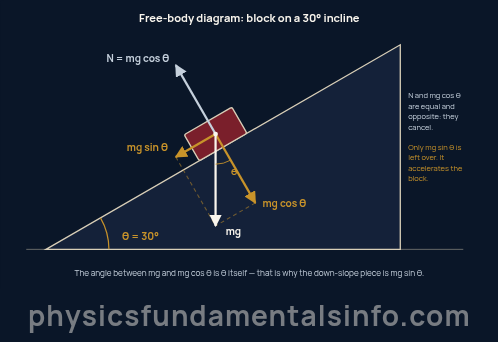
Figure 1: On a 30° incline the weight mg splits into mg sin θ down the slope and mg cos θ into the surface. The normal force N cancels mg cos θ exactly, leaving mg sin θ to accelerate the block.
The tilted angle inside the block is the same θ as the one at the base of the ramp, because rotating the surface rotates the perpendicular by the identical amount. That angle sits between mg and mg cos θ. In any right-angled triangle the side adjacent to the angle takes the cosine and the side opposite takes the sine — so the perpendicular piece is mg cos θ and the down-slope piece is mg sin θ.
Slide the angle in the lab below and watch both components move. The perpendicular one shrinks as the slope steepens; the down-slope one grows. At 0° and 90° they swap places entirely.
How Do You Solve an Inclined Plane Problem? 5 Steps
Solve any inclined plane problem by tilting your axes along the slope, resolving the weight into mg sin θ and mg cos θ, finding N from the perpendicular balance, then applying F = ma along the slope. The five steps below work for every ramp question you will meet.
- Draw the free-body diagram. Put every force on the block itself: weight mg straight down, normal force N perpendicular to the surface, friction f along the surface, plus any applied force or tension.
- Tilt the axes. Let x run along the slope and y run perpendicular to it. Now only the weight needs resolving — everything else already lies on an axis.
- Resolve the weight. Down-slope: mg sin θ. Into the surface: mg cos θ. Write both on the diagram before you touch the algebra.
- Balance the perpendicular direction. The block cannot accelerate through the ramp, so N = mg cos θ (unless something else pushes perpendicular). Use this N in any friction calculation.
- Apply F = ma along the slope. Add the along-slope forces with signs, divide by m, and check the answer against a limiting case.
Step 4 is where marks are won. Friction depends on N, and N depends on the angle, so an error there quietly poisons everything downstream. Our explainer on the types of forces is worth a look if normal and contact forces still feel slippery.
Step 5 rewards a habit most students skip: sanity-check the extremes. Set θ = 0 and the acceleration should vanish. Set θ = 90° and it should become g — a vertical drop.
Every standard ramp situation on one page
Almost every inclined plane question is one of six scenarios. Identify which one you have and the algebra is already written.
| Situation | Forces along the slope | Normal force | Acceleration |
|---|---|---|---|
| Frictionless, released | mg sin θ down only | N = mg cos θ | a = g sin θ, down the slope |
| At rest, tan θ < μs | mg sin θ down, f up | N = mg cos θ | a = 0, and f = mg sin θ |
| On the verge of slipping | mg sin θ down, μs·mg cos θ up | N = mg cos θ | a = 0, and tan θ = μs |
| Sliding down | mg sin θ down, μk·mg cos θ up | N = mg cos θ | a = g (sin θ – μk cos θ), down |
| Coasting up (no push) | mg sin θ down, μk·mg cos θ down | N = mg cos θ | a = g (sin θ + μk cos θ), slowing |
| Pushed up at constant speed | F up; mg sin θ and μk·mg cos θ down | N = mg cos θ | a = 0, so F = mg (sin θ + μk cos θ) |
Read down the third column. The normal force is N = mg cos θ in every single row — the angle sets it, and nothing about the motion changes it. That is the anchor of the whole method.
Inclined Plane Problems With Friction
Friction on a ramp is f = μN, and because N = mg cos θ on an incline, friction is always μ·mg cos θ. The hard part is never the formula — it is knowing which way f points and which μ to use.
Friction opposes relative sliding, not gravity. That single sentence resolves most of the confusion, because it means the friction arrow flips when the motion flips, even though the ramp and the weight have not changed at all.
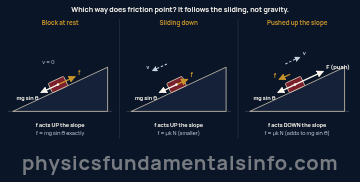
Figure 2: Same ramp, same block, same gravity. Friction reverses direction with the sliding, and when the block is pushed up the slope, friction and mg sin θ both fight the motion.
Static friction adjusts; kinetic friction does not
Static friction is not fixed at μs·N. It is whatever it needs to be to hold the block still, up to a maximum of μs·N — like a hand gripping just hard enough, and no harder.
So for a block sitting on a slope, friction is exactly mg sin θ, not μs·mg cos θ. The formula f = μs·N gives you the ceiling, and you only use it at the instant of slipping. This is the single most common error in ramp questions with friction, and Problem 3 below is built around it.
Kinetic friction behaves differently. Once the block slides, f = μk·N regardless of speed, and μk is usually a little smaller than μs. That step down is why a stubborn box lurches the moment it finally breaks free.
The full picture lives in our guide to what friction is and how it works.
The angle of repose
Tilt a slope slowly and the block holds on until mg sin θ finally beats μs·mg cos θ. Set them equal and something remarkable falls out.
Both m and g cancelled. The tipping angle depends only on the surfaces in contact — which is why a pile of dry sand always settles to the same slope whether the pile is a handful or a quarry heap. It also gives you a genuinely good lab experiment: tilt a plank until the object slips, measure the angle, and read off μs directly.
A reference table of angles
Ramp problems reuse the same handful of angles. Keep this table nearby while you practise, and use the frictionless column as a fast sanity check on any answer.
| θ | sin θ | cos θ | tan θ | a = g sin θ (m/s2) |
|---|---|---|---|---|
| 0° | 0 | 1 | 0 | 0 |
| 10° | 0.1736 | 0.9848 | 0.1763 | 1.70 |
| 15° | 0.2588 | 0.9659 | 0.2679 | 2.54 |
| 20° | 0.3420 | 0.9397 | 0.3640 | 3.36 |
| 30° | 0.5000 | 0.8660 | 0.5774 | 4.91 |
| 37° | 0.6018 | 0.7986 | 0.7536 | 5.90 |
| 45° | 0.7071 | 0.7071 | 1.0000 | 6.94 |
| 53° | 0.7986 | 0.6018 | 1.3270 | 7.83 |
| 60° | 0.8660 | 0.5000 | 1.7321 | 8.50 |
| 90° | 1 | 0 | undefined | 9.81 |
The 37° and 53° rows are worth memorising — they are the 3-4-5 triangle in disguise, which is why exam boards reach for them so often.
Real-World Examples of Inclined Plane Physics
Inclined planes appear wherever something heavy has to change height without being lifted. The physics is identical in every case: trade a big force over a short distance for a small force over a long one.
Wheelchair and loading ramps
Accessibility standards are, at heart, an argument about mg sin θ. The U.S. Access Board’s guide to the ADA ramp standards caps a ramp’s running slope at 1:12 — about 4.8°, or an 8.33% grade.
Run the numbers and the reason is obvious. At 4.8°, sin θ is only 0.083, so pushing a 90 kg wheelchair-plus-occupant up the slope takes roughly 73 N instead of the 883 N needed to lift it. That is the difference between possible and impossible.
Mountain roads and switchbacks

A road straight up a mountainside would be unusable, so engineers stretch it sideways instead. Each hairpin buys distance, and distance buys a gentler θ. The lorry still climbs the same height and does the same work against gravity — it just never has to produce a huge force at once.
Ski slopes, slides and skateboard ramps
Every one of these is a = g sin θ with friction subtracted. A gentle nursery slope at 10° gives about 1.70 m/s2 before friction; a steep 37° black run gives 5.90 m/s2. Same skier, same gravity — the slope alone decides.
Screws, wedges and axes
A screw thread is an inclined plane wrapped around a cylinder, and a wedge is two inclined planes back to back. Turning a screw slides its thread a long way to advance it a short way, which is exactly why it grips so ferociously. We unpack that trade in our guide to mechanical advantage.
Common Misconceptions About Inclined Plane Physics
“The normal force equals the weight”
It does not — on a ramp, N = mg cos θ, always less than mg. The normal force only equals mg on a horizontal surface, which is the special case where cos θ = 1.
This is the number one error in ramp problems, and it is contagious: friction depends on N, so an inflated N inflates every friction force after it. If you catch yourself writing f = μ·mg on an incline, stop.
“Heavier objects slide down faster”
They do not. On a frictionless slope a = g sin θ, with no m anywhere in it — a marble and a boulder released together stay level all the way down.
The reason is the same one Galileo chased. Doubling the mass doubles the driving force mg sin θ, but it also doubles the inertia resisting it, and the two effects cancel exactly. Add friction and mass still cancels, because f = μ·mg cos θ carries an m too.
“Just use sin — or was it cos?”
Guessing is unnecessary; the limiting cases settle it in two seconds. At θ = 0 the ramp is flat, so the down-slope force must be zero and the normal force must be the full mg.
Test your guess against that. Only sin 0° = 0 and cos 0° = 1, so the slope component must take sine and the perpendicular component must take cosine. Even better, HyperPhysics at Georgia State University makes the same check on its mass on a frictionless incline page: the push needed is mg sin θ, which is zero on the flat and mg on a vertical wall.
“Friction always points up the slope”
Friction points against the sliding, so it points down the slope whenever the block is moving up it. Push a crate up a ramp and gravity’s component and friction gang up on you together — which is why shoving something uphill is so much harder than the height alone suggests.
“Static friction is μs·N”
Only at the very instant of slipping. Below that, static friction takes whatever value keeps the block still, so on a stationary slope f = mg sin θ. Reach for μs·N only when the question says “on the verge”, “just about to slip”, or “maximum angle”.
How Inclined Planes Relate to Friction, Newton’s Laws and Energy
An inclined plane is not a separate topic — it is where vectors, Newton’s laws, friction and energy all meet in one diagram. That is precisely why it is examined so heavily.
Newton’s laws
The perpendicular direction is Newton’s first law in action: no acceleration through the surface, so the forces there balance and N = mg cos θ. The along-slope direction is Newton’s second law, F = ma, applied to whatever survives the cancellation. MIT’s OpenCourseWare 8.01 Classical Mechanics unit on Newton’s laws works through contact forces and friction in the same order.
Kinematics
Once you have a, the ramp is finished and the problem becomes ordinary straight-line motion. Feed a into the SUVAT equations to get the speed at the bottom or the time taken. Problems 2 and 7 below do exactly this.
Energy
Energy offers a second, independent route — and a free way to check your work. Drop through a height h and the block converts mgh of potential energy into kinetic energy, minus whatever friction takes as f × L along the way.
On a frictionless slope this gives v = sqrt(2gh), with no θ in it at all. A block dropping 2.0 m arrives at 6.26 m/s whether the slope is 10°, 30° or 60° — the gentle slope simply takes longer to get there. Problem 7 solves the same question by forces and by energy, and the two agree to four figures.
Worked Problems
Eight problems, increasing in difficulty. Every value uses g = 9.81 m/s2 and is quoted to three significant figures.
Show Solution
Solution:
Step 1: Weight is W = mg, and it resolves into mg sin θ along the slope and mg cos θ into the surface.
Step 2: W = 5.0 × 9.81 = 49.05 N, so W = 49.1 N.
Step 3: mg sin 30° = 49.05 × 0.5000 = 24.525 N, so 24.5 N down the slope.
Step 4: mg cos 30° = 49.05 × 0.8660 = 42.4785 N, so 42.5 N into the surface. The surface balances this exactly, so N = 42.5 N.
Step 5: The only unbalanced force is mg sin θ, so a = g sin 30° = 9.81 × 0.5000 = 4.905 m/s2.
Answer: W = 49.1 N; mg sin θ = 24.5 N; mg cos θ = N = 42.5 N; a = 4.91 m/s2 down the slope.
Show Solution
Solution:
Step 1: Frictionless, so a = g sin θ.
Step 2: a = 9.81 × sin 15° = 9.81 × 0.2588 = 2.5390 m/s2, so a = 2.54 m/s2.
Step 3: Use v2 = u2 + 2as with u = 0 and s = 3.0 m: v2 = 2 × 2.5390 × 3.0 = 15.234 m2/s2.
Step 4: v = sqrt(15.234) = 3.9031 m/s.
Step 5: Note the 20 kg never appeared. The mass cancels out of a = g sin θ, so a 2 kg crate would arrive at the same speed.
Answer: v = 3.90 m/s.
Show Solution
Solution:
Step 1: Compare tan θ with μs. The box slides only if tan θ > μs.
Step 2: tan 20° = 0.36397 and μs = 0.45. Since 0.364 < 0.45, the box stays put.
Step 3: Find the down-slope pull. W = 8.0 × 9.81 = 78.48 N, so mg sin 20° = 78.48 × 0.3420 = 26.8417 N.
Step 4: Find the friction ceiling. N = mg cos 20° = 78.48 × 0.9397 = 73.7471 N, so the maximum static friction is 0.45 × 73.7471 = 33.1862 N.
Step 5: The box is not on the verge, so friction is not 33.2 N. It is in equilibrium, so friction must exactly balance the down-slope pull: f = mg sin 20° = 26.8 N.
Answer: The box does not slide. Friction = 26.8 N up the slope, not 33.2 N. The 33.2 N is only the ceiling it never reaches.
Show Solution
Solution:
Step 1: At the point of slipping, the down-slope pull equals the maximum static friction: mg sin θ = μs·mg cos θ.
Step 2: Divide both sides by mg cos θ. Both m and g cancel, leaving tan θ = μs.
Step 3: tan θ = 0.60, so θ = arctan(0.60) = 30.9638°.
Step 4: Because m cancelled in Step 2, the angle is independent of mass.
Answer: θ = 31.0°, and a heavier block slips at exactly the same angle.
Show Solution
Solution:
Step 1: It is sliding down, so kinetic friction acts up the slope. Along the slope: ma = mg sin θ – μk·N, and perpendicular: N = mg cos θ.
Step 2: Substitute N and divide by m: a = g (sin θ – μk cos θ). The mass cancels again.
Step 3: sin 35° = 0.573576 and cos 35° = 0.819152.
Step 4: a = 9.81 × (0.573576 – 0.25 × 0.819152) = 9.81 × (0.573576 – 0.204788) = 9.81 × 0.368788 = 3.6178 m/s2.
Step 5: Sanity check — this is less than the frictionless 5.63 m/s2, as it must be.
Answer: a = 3.62 m/s2 down the slope.
Show Solution
Solution:
Step 1: Constant speed means a = 0, so the push balances everything acting down the slope: F = mg sin θ + μk·N, with N = mg cos θ.
Step 2: W = 25 × 9.81 = 245.25 N, so W = 245 N.
Step 3: mg sin 18° = 245.25 × 0.3090 = 75.7864 N, so 75.8 N down the slope.
Step 4: N = mg cos 18° = 245.25 × 0.9511 = 233.2466 N, so friction is f = 0.30 × 233.2466 = 69.974 N, or 70.0 N down the slope (it opposes the upward motion).
Step 5: F = 75.7864 + 69.974 = 145.7604 N. Lifting the crate vertically would need the full 245 N.
Answer: F = 146 N along the ramp, versus 245 N to lift it — a saving of about 40.6%.
Show Solution
Solution — force method:
Step 1: Sliding down, so a = g (sin θ – μk cos θ).
Step 2: a = 9.81 × (0.4226 – 0.20 × 0.9063) = 9.81 × 0.241329 = 2.3677 m/s2.
Step 3: v2 = 2as = 2 × 2.3677 × 6.0 = 28.412, so v = 5.3303 m/s.
Solution — energy method:
Step 4: Height dropped: h = L sin θ = 6.0 × 0.4226 = 2.5357 m, so 2.54 m.
Step 5: Potential energy released: mgh = 40 × 9.81 × 2.5357 = 995.01 J, so 995 J.
Step 6: Friction force: N = mg cos 25° = 392.4 × 0.9063 = 355.6352 N, so f = 0.20 × 355.6352 = 71.127 N. Work done against friction: f × L = 71.127 × 6.0 = 426.76 J, so 427 J.
Step 7: Kinetic energy at the bottom: 995.01 – 426.76 = 568.25 J. Then v = sqrt(2 × 568.25 / 40) = 5.3303 m/s.
Answer: v = 5.33 m/s by both methods — an exact match, which is the best check you can run on a ramp problem.
Show Solution
Solution:
Step 1: Guess the direction first. The block is pulled down-slope by m1·g sin 30° = 4.0 × 9.81 × 0.5 = 19.62 N, while the hanging mass pulls with m2·g = 3.0 × 9.81 = 29.43 N. The hanging mass wins, so it descends and the block climbs.
Step 2: Write Newton’s second law for each mass, taking that direction as positive.
For the hanging mass: m2·g – T = m2·a
For the block on the slope: T – m1·g sin θ = m1·a
Step 3: Add the two equations. T cancels: m2·g – m1·g sin θ = (m1 + m2)·a.
Step 4: a = (29.43 – 19.62) / (4.0 + 3.0) = 9.81 / 7.0 = 1.40143 m/s2.
Step 5: Find T from the block: T = m1·(a + g sin θ) = 4.0 × (1.40143 + 4.905) = 25.2257 N.
Step 6: Check with the hanging mass: T = m2·(g – a) = 3.0 × (9.81 – 1.40143) = 25.2257 N. The two agree.
Answer: a = 1.40 m/s2, and T = 25.2 N. Note that T is not 29.4 N — the tension only equals the hanging weight when the acceleration is zero.