Mechanical advantage is the factor by which a machine multiplies force: the load force divided by the effort force (MA = Load ÷ Effort). It has no units. A machine with a mechanical advantage of 4 turns a 100 N effort into 400 N — but the effort must move four times as far, because work is never multiplied.
Put a spanner on a seized bolt and lean on it — nothing. Now slide a length of pipe over the handle and try again. Same arm, same muscle, same grunt, and the bolt cracks loose.
You did not get stronger in those ten seconds; the geometry did. That single trick is why one person can lift an engine block, split an oak log, or raise a car off the road with one hand. Machines never hand you extra strength — they rearrange where your strength gets spent.
What Is Mechanical Advantage?
Ask a physicist what a machine does and you will not hear “it makes work easier”. You will hear something fussier: a machine changes the size or the direction of a force. Mechanical advantage is the number that tells you by how much.
Formally, mechanical advantage is the ratio of the output force a machine delivers — the load — to the input force you supply — the effort. Both are forces in newtons, so the ratio is dimensionless. It is a bare number, never “4 newtons” or “4 metres”.
An MA of 6 means the machine returns six newtons of load force for every newton you push with. An MA of 0.2 means it returns one newton for every five you push with. That second machine is not broken — it is buying you speed and range of movement instead of force.
The three words you need
- Effort (Fe) — the force you apply to the machine, in newtons (N).
- Load (FL) — the force the machine applies to the thing you are moving, in newtons (N).
- Fulcrum — the fixed pivot a lever turns about. Pulleys, ramps and screws have equivalents, but the fulcrum is where the idea is easiest to see.
The Mechanical Advantage Formula
There are two mechanical advantage formulas, and mixing them up is the single most common slip in this topic. The first is measured with a force meter; the second is measured with a ruler. OpenStax’s Simple Machines chapter defines both and ties them together through efficiency.
- MA — mechanical advantage; dimensionless (no unit).
- Fload — output force delivered to the load, in newtons (N).
- Feffort — input force applied by the user, in newtons (N).
Because this version uses the forces a real machine actually produces, it is called the actual mechanical advantage (AMA). Friction is baked into it, whether you like it or not.
The second formula ignores friction entirely and looks only at the machine’s geometry — how far the effort moves compared with how far the load moves.
- IMA — ideal mechanical advantage; dimensionless.
- deffort — distance moved by the effort, in metres (m).
- dload — distance moved by the load, in metres (m).
Put the two together and you get efficiency — the fraction of your work that reaches the load rather than warming up the bearings.
If you would rather not grind through the arithmetic, our Mechanical Advantage Calculator solves all three — the force ratio, the distance ratio and the efficiency — and shows every step.
How Mechanical Advantage Works: The Force–Distance Trade-Off
Why can’t a machine just give you free force? Because energy has to come from somewhere, and a lever has no battery. Whatever work you put in, at best the same work comes out.
Rearrange that one line and the ideal mechanical advantage falls straight out of it:
Read it slowly. The force ratio and the distance ratio are the same number, flipped. Multiply the force by ten and you divide the distance by ten. There is no third option.
This is the bargain every simple machine offers, and none of them can renegotiate it. A ramp lets you push a crate with a third of its weight — over three times the distance. A block and tackle quarters the pull — and you haul four metres of rope for every metre the load rises.
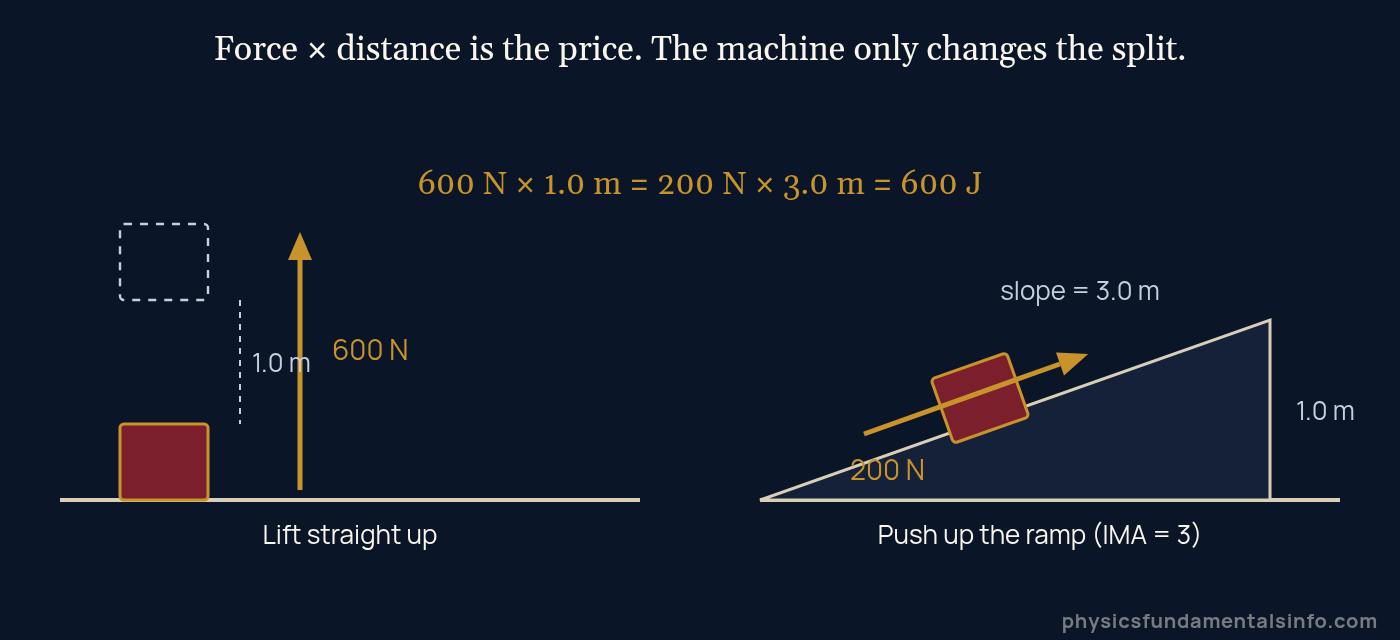
The same 600 J of work, spent two ways. The ramp cuts the force to a third and stretches the distance by three.
A word of caution students often need. The trade-off is a statement about work, not about comfort or time. Pushing 200 N along three metres may take longer and feel easier, and it is still exactly 600 J.
The Six Simple Machines and Where Their Mechanical Advantage Comes From
Every mechanism you have ever used is built from six primitives. NASA teaches the same six to astronauts and schoolchildren alike, because a torque wrench in orbit obeys the rules a crowbar obeys on Earth — see NASA’s STEMonstrations: Simple Machines lesson.
What changes from machine to machine is not the physics. It is which two distances you compare.
1. The lever
A rigid bar and a pivot. The effort arm and the load arm are the perpendicular distances from the fulcrum to each force, and their ratio is the ideal mechanical advantage. Georgia State’s HyperPhysics derives it straight from torque equilibrium.
Levers come in three classes, and the class is decided by one question only: what sits in the middle?
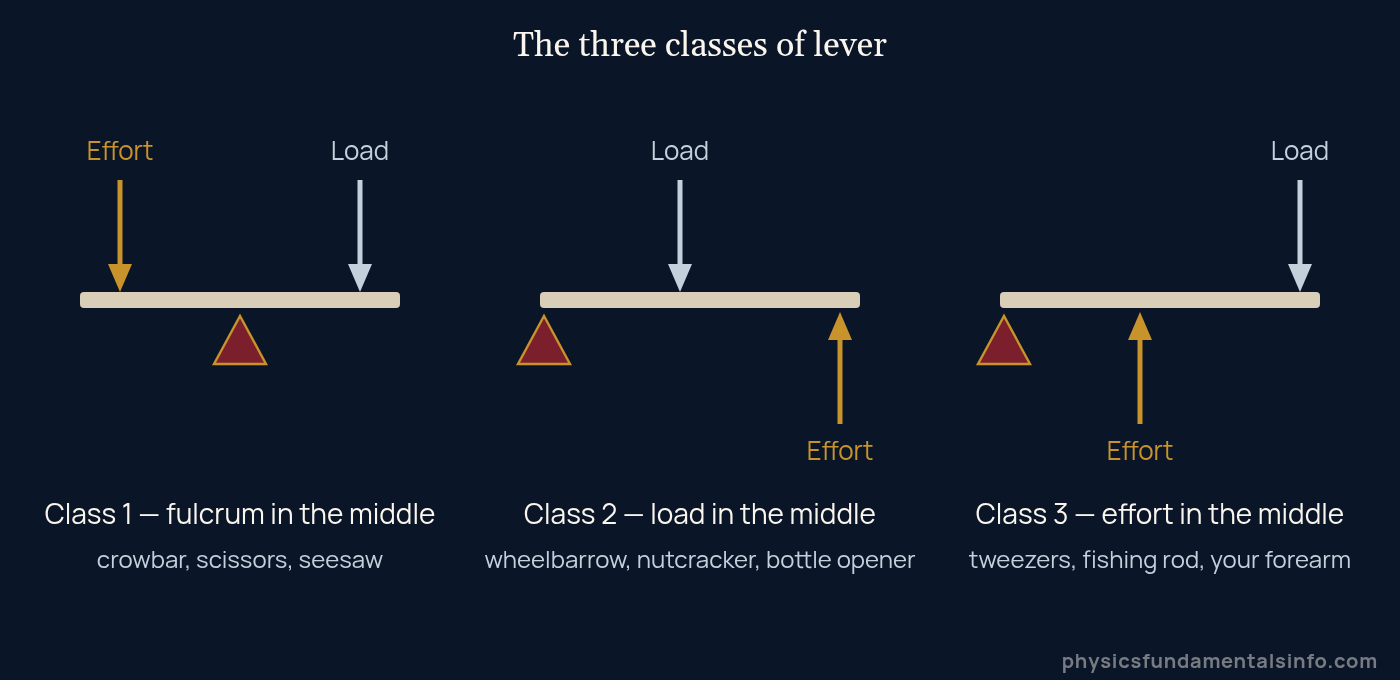
Class 1 and class 2 levers multiply force. Class 3 levers always have MA < 1 — they multiply speed instead.
2. The wheel and axle
A lever that never runs out of arc. Turn the big wheel of radius R and the axle of radius r turns with it, so IMA = R/r. A screwdriver, a doorknob and a steering wheel are all the same machine wearing different clothes.
3. The pulley
Here is the rule that saves marks: count the rope segments that actually support the moving load, not the number of wheels. A single fixed pulley has one supporting segment, so its ideal mechanical advantage is 1 — it changes only the direction of your pull, which is worth plenty when you would rather stand on the ground than hang from a beam.
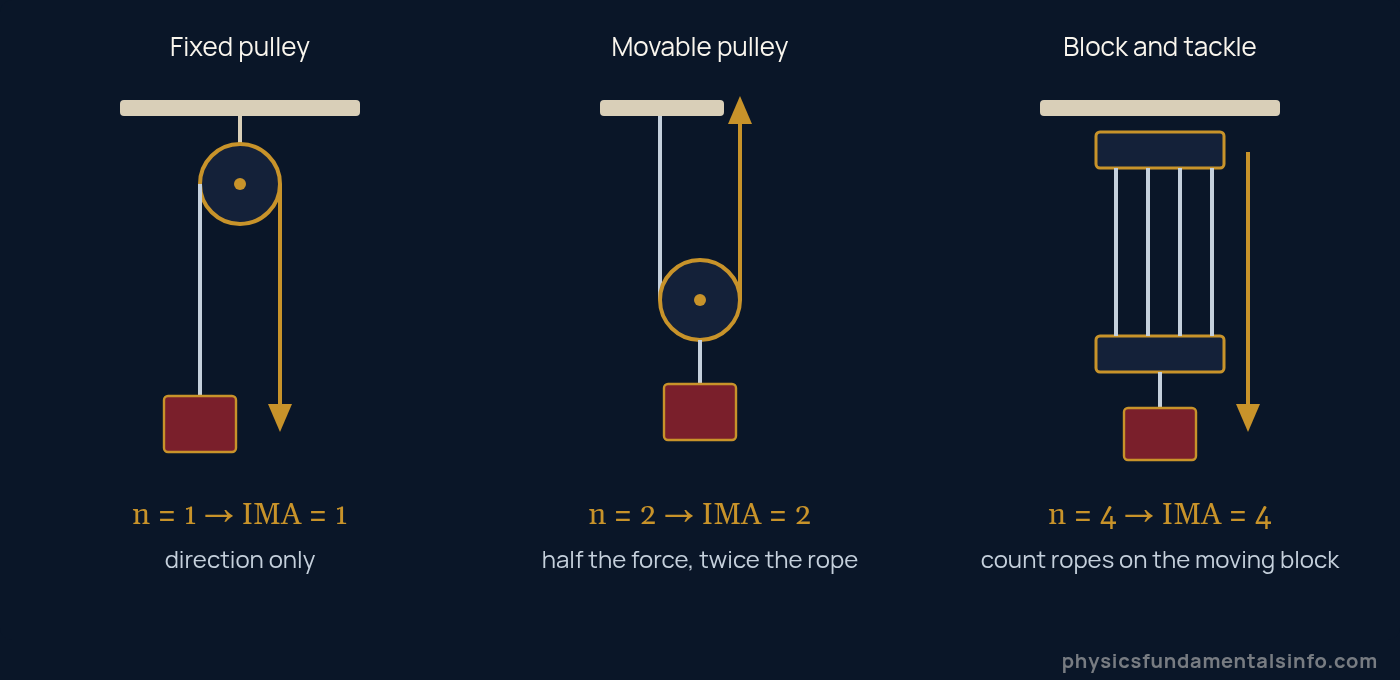
Pulley IMA equals the number of rope segments pulling up on the moving load. The gold segment is the effort — it only counts when it lifts the moving block.
4. The inclined plane
A ramp trades height for length. Slide the load a distance L along the slope to raise it a height h, and IMA = L/h. Wheelchair ramps built to a 1:12 gradient therefore hover around an ideal mechanical advantage of 12.
5. The wedge
An inclined plane that moves. Drive a wedge of length L and thickness t into a log, and the splitting force is roughly L/t times the force on the back of the axe. The wedge does not go under the load — it drives the load apart.
6. The screw
An inclined plane wrapped round a cylinder. One full turn of the handle sweeps a circumference 2πr while the screw advances by one pitch p, so IMA = 2πr/p. Pitches are small and handles are long, which is how a modest screw jack lifts a tonne.
| Simple machine | Ideal mechanical advantage | Symbols | Everyday example |
|---|---|---|---|
| Lever | IMA = de / dL | effort arm ÷ load arm (m) | Crowbar prising a floorboard |
| Wheel and axle | IMA = R / r | wheel radius ÷ axle radius (m) | Screwdriver, doorknob |
| Pulley | IMA = n | n = rope segments supporting the load | Block and tackle on a crane |
| Inclined plane | IMA = L / h | slope length ÷ height (m) | Loading ramp, wheelchair ramp |
| Wedge | IMA = L / t | wedge length ÷ thickness (m) | Axe head, chisel, knife |
| Screw | IMA = 2πr / p | handle radius r (m), pitch p (m) | Car scissor jack, vice, bolt |
| Hydraulic press (bonus — not one of the classic six) | MA = A2 / A1 = (d2/d1)2 | piston areas A (m2), diameters d (m) | Garage jack, car brakes |
Ideal vs Actual Mechanical Advantage
Measure a real pulley system and you will get a smaller number than the geometry promised. Rope stiffness, bearing drag and friction all skim energy off the top, so the actual mechanical advantage always falls short of the ideal.
Efficiency is the honest bookkeeping. It is the ratio of the two, and for any real machine it is under 100%.
Two consequences worth holding on to:
- More stages, more losses. Every extra sheave in a tackle adds another bearing to turn and another bend in the rope, so IMA climbs faster than AMA does.
- Low efficiency is sometimes the point. A screw jack wastes much of your effort on thread friction — which is precisely why the car does not come crashing down the moment you let go of the handle.
In practice, engineers measure AMA on the bench and compare it with the IMA on the drawing. The gap tells them where the energy is going. TeachEngineering’s classroom unit on simple machines has students do exactly this with ramps and pulleys.
Real-World Examples of Mechanical Advantage
Bolt cutters — levers inside levers
Long handles, short jaws, and a second pair of pivots hidden in the head. Each stage multiplies the last, so a compound machine’s total MA is the product of its stages. Sixty newtons at the grips becomes thousands at the cutting edge.
A block and tackle on a crane
Four rope segments under the hook mean the winch pulls a quarter of the load — and reels in four metres of cable per metre of lift. The tension force in every segment is the same, which is exactly why the trick works.

Bicycle gears
Drop into a low gear on a climb and the chain drives a large rear sprocket. Each turn of the pedals now spins the wheel through fewer turns than a high gear would, so force at the tyre goes up and road speed goes down. Shift up on the flat and you run the same machine backwards, buying speed with force.
Gears keep the same books as levers. The mechanical advantage of a gear train is set by the tooth ratio, and whatever torque you gain you hand straight back in rotational speed.
The ramp at the back of a delivery van
Nobody lifts a washing machine 1.2 m straight up if a 4 m ramp is bolted to the tailgate. The work done against gravity is identical either way — about 2.4 kJ for a 200 kg load. Only the force changes.
Your own forearm
Now the uncomfortable one. Your biceps attaches about 4 cm from the elbow joint, while the thing in your hand sits roughly 32 cm away. That is a class 3 lever with an MA near 0.13.
Hold a 5 kg dumbbell — about 49 N — and your biceps must pull with something close to 390 N to balance it. Your body chose speed over force: the hand sweeps eight times faster than the muscle contracts. Handy for throwing a spear, brutal on the tendon.
Common Misconceptions About Mechanical Advantage
“Machines reduce the work you do”
They do not. In the ideal case the work is exactly equal; in every real case you do more work than the load receives, because friction takes a cut. What a machine reduces is the force, never the work.
“Mechanical advantage is always greater than 1”
Tweezers, chopsticks, fishing rods, a cricket bat, your forearm — all have MA below 1 by design. They multiply distance and speed instead of force. An MA of 0.13 is not a badly built lever; it is a lever built for a different job.
“Add more pulley wheels and the mechanical advantage goes up”
Only if the extra wheels add rope segments that support the moving block. Hang three fixed pulleys from a beam in a row and you still have IMA = 1 — you have simply redirected the rope three times. This is the classic exam-day slip: students count sheaves, not ropes.
“Ideal and actual mechanical advantage are basically the same”
They differ by exactly the efficiency, and for something like a screw jack that gap is enormous. Quote an IMA of 377 as though it were the force you will get, and your answer will be wrong by a factor of three or more.
How Mechanical Advantage Relates to Work, Energy and Torque
Mechanical advantage is not a standalone rule. It is what conservation of energy looks like when you write it out for a rigid object with a pivot.
The force ratio comes from balancing torques about the fulcrum, and the force balance itself is nothing more than Newton’s laws of motion applied to a body that is not accelerating.
So three ideas keep showing up, and they are the same idea:
- Torque (τ = r F sinθ) explains why a long effort arm wins.
- Work (W = F d) explains what you pay for the force you gain.
- Efficiency explains where the missing joules went.
Master those three and levers, ramps, gears and hydraulics stop being six separate topics.
Worked Problems
Show Solution
Solution:
Step 1: For a lever, IMA = effort arm ÷ load arm.
Step 2: IMA = 1.20 m ÷ 0.15 m = 8.00 (dimensionless).
Step 3: F_load = IMA × F_effort = 8.00 × 250 N = 2000 N.
Answer: IMA = 8.00 and the nail feels 2.0 × 10³ N (2.0 kN).
Show Solution
Solution:
Step 1: The wheel axle is the fulcrum (class 2 lever). Balance torques: F_effort × d_effort = F_load × d_load.
Step 2: F_effort × 1.20 m = 800 N × 0.40 m = 320 N·m.
Step 3: F_effort = 320 N·m ÷ 1.20 m = 266.7 N.
Step 4: MA = F_load ÷ F_effort = 800 N ÷ 266.7 N = 3.00.
Answer: effort ≈ 267 N; MA = 3.00.
Show Solution
Solution:
Step 1: For a pulley system, IMA = n = 4.
Step 2: Ideal effort = F_load ÷ IMA = 1200 N ÷ 4 = 300 N.
Step 3: AMA = efficiency × IMA = 0.80 × 4 = 3.20.
Step 4: Actual effort = F_load ÷ AMA = 1200 N ÷ 3.20 = 375 N.
Step 5: Rope pulled = IMA × load distance = 4 × 0.50 m = 2.00 m. (Distance is set by geometry, so friction does not change it.)
Answer: ideal effort 300 N; actual effort 375 N; AMA = 3.20; rope pulled 2.00 m.
Show Solution
Solution:
Step 1: Weight of the crate, F_load = mg = 500 kg × 9.81 m/s2 = 4905 N.
Step 2: IMA = slope length ÷ height = 6.00 m ÷ 1.50 m = 4.00.
Step 3: AMA = F_load ÷ F_effort = 4905 N ÷ 1500 N = 3.27.
Step 4: Efficiency = AMA ÷ IMA = 3.27 ÷ 4.00 = 0.8175.
Answer: IMA = 4.00; AMA = 3.27; efficiency ≈ 81.8%.
Show Solution
Solution:
Step 1: For a screw, IMA = 2πr ÷ p, with r and p in the same unit. p = 5.0 mm = 0.0050 m.
Step 2: IMA = 2π(0.30 m) ÷ 0.0050 m = 1.885 m ÷ 0.0050 m = 377.
Step 3: AMA = efficiency × IMA = 0.30 × 377 = 113.
Step 4: F_load = AMA × F_effort = 113 × 40 N = 4524 N ≈ 4.5 kN.
Step 5: m = F_load ÷ g = 4524 N ÷ 9.81 m/s2 = 461 kg.
Answer: about 4.5 kN, i.e. a mass of roughly 4.6 × 10² kg.
Show Solution
Solution:
Step 1: Pressure is transmitted equally, so MA = A2 ÷ A1 = (d2 ÷ d1)2.
Step 2: MA = (12.0 cm ÷ 2.0 cm)2 = 6.02 = 36.
Step 3: F_out = 36 × 150 N = 5400 N (a mass of 5400 ÷ 9.81 = 550 kg).
Step 4: Volume is conserved, so d_out = d_in ÷ MA = 24 cm ÷ 36 = 0.67 cm.
Answer: MA = 36; output force 5400 N; the large piston rises 0.67 cm (6.7 mm).
Show Solution
Solution:
Step 1: This is a class 3 lever. Take torques about the elbow: F_muscle × 0.040 m = 50 N × 0.32 m.
Step 2: F_muscle = (50 N × 0.32 m) ÷ 0.040 m = 16 N·m ÷ 0.040 m = 400 N.
Step 3: MA = F_load ÷ F_effort = 50 N ÷ 400 N = 0.125.
Step 4: Speed ratio = 0.32 m ÷ 0.040 m = 8.0, so the hand moves 8.0 times faster than the tendon.
Answer: muscle force 400 N; MA = 0.125; the hand gains a factor-of-8.0 speed advantage.
Show Solution
Solution:
Step 1: The crank and drum form a wheel and axle: IMA1 = R ÷ r = 0.35 m ÷ 0.050 m = 7.00.
Step 2: The movable pulley adds IMA2 = n = 2.
Step 3: For machines in series, total IMA = IMA1 × IMA2 = 7.00 × 2 = 14.0.
Step 4: AMA = efficiency × IMA = 0.75 × 14.0 = 10.5.
Step 5: F_effort = F_load ÷ AMA = 2800 N ÷ 10.5 = 266.7 N.
Step 6: Distance is geometric: d_effort = IMA × d_load = 14.0 × 1.0 m = 14 m of handle travel.
Answer: effort ≈ 267 N; the handle travels 14 m of arc for a 1.0 m lift.