Physics constants are fixed quantities that appear in physical laws and take the same value everywhere in the universe. Seven of them now define the SI exactly, including the speed of light c = 299,792,458 m/s and the Planck constant h = 6.62607015 × 10⁻³⁴ J s. Others, such as the gravitational constant G, must still be measured.
On 20 May 2019, a polished cylinder of platinum-iridium sitting in a vault outside Paris quietly stopped being the kilogram. It had defined mass for 130 years. Its replacement is a number: the Planck constant, fixed forever at 6.62607015 × 10⁻³⁴ J s.
That swap tells you what these numbers really are. A constant is not trivia to memorise before an exam — it is the anchor that ties an equation to the physical world, and increasingly it is the definition of the unit itself.
What Are Physics Constants?
Physics constants are quantities whose value does not change with time, place, or the experiment being run, and which appear in the equations describing how nature behaves. Some are fixed by definition; others are measured, and carry an uncertainty.
That distinction matters more than most textbooks admit. Lump them together and you end up quoting g to nine decimal places, or treating G as though it were known as precisely as c. Neither is true.
It helps to sort them into four honest categories:
- Defining constants. Exact by international agreement, with zero uncertainty. c, h, e, k and NA are in this group.
- Derived exact constants. Built from defining constants by pure arithmetic, so also exact — though irrational. R and the Stefan-Boltzmann constant σ sit here.
- Measured constants. Known only as well as the best experiment allows. G is the classic case.
- Conventional or conditional values. Agreed for convenience, or true only under stated conditions. Standard gravity g and the speed of sound in air both belong here.
Only the first two are genuinely universal in the strict sense. The last group is the one students trip over, and we will come back to it.
Physics Constants Reference Table
The table below lists the constants you will meet in school and first-year university physics, with the CODATA 2022 values published by NIST, SI units, and whether each one is exact or measured.
| Constant | Symbol | Value | SI unit | Status |
|---|---|---|---|---|
| Standard gravity | g | 9.80665 (use 9.81) | m/s2 | Conventional |
| Speed of light in vacuum | c | 299,792,458 | m/s | Exact |
| Planck constant | h | 6.62607015 × 10⁻³⁴ | J s | Exact |
| Reduced Planck constant (h-bar) | h/2π | 1.054571817… × 10-34 | J s | Exact (derived) |
| Gravitational constant | G | 6.67430(15) × 10-11 | m3 kg-1 s-2 | Measured (22 ppm) |
| Molar gas constant | R | 8.314462618… | J mol-1 K-1 | Exact (derived) |
| Boltzmann constant | k | 1.380649 × 10⁻²³ | J/K | Exact |
| Avogadro constant | NA | 6.02214076 × 10²³ | mol-1 | Exact |
| Elementary charge | e | 1.602176634 × 10⁻¹⁹ | C | Exact |
| Coulomb constant | ke | 8.98755179 × 10⁹ | N m2 C-2 | Derived |
| Vacuum permittivity | ε0 | 8.8541878188(14) × 10-12 | F/m | Measured |
| Vacuum permeability | μ0 | 1.25663706127(20) × 10-6 | N/A2 | Measured |
| Stefan-Boltzmann constant | σ | 5.670374419… × 10-8 | W m-2 K-4 | Exact (derived) |
| Electron mass | me | 9.1093837139(28) × 10-31 | kg | Measured |
| Proton mass | mp | 1.67262192595(52) × 10-27 | kg | Measured |
| Speed of sound in air (20 °C) | v | 343 | m/s | Conditional |
Trailing dots mean the decimal expansion never terminates, but the value is still exact. Digits in brackets are the standard uncertainty in the final two figures, so 6.67430(15) means 6.67430 ± 0.00015.
If you need constants beyond this working set, NIST publishes the full CODATA list as a one-page wall chart.
Why the SI Is Now Built on Seven Defining Constants
Since 20 May 2019, every SI base unit has been defined by fixing the numerical value of a constant of nature rather than by a physical artefact, as set out in the BIPM definition of the SI. The kilogram now follows from the Planck constant; the metre follows from the speed of light.
Think of it as changing the reference from a ruler in a drawer to a property of the universe. Anyone with the right apparatus can rebuild the kilogram in Nairobi or Nagoya and get the same answer, because the definition travels as a number rather than a lump of metal.
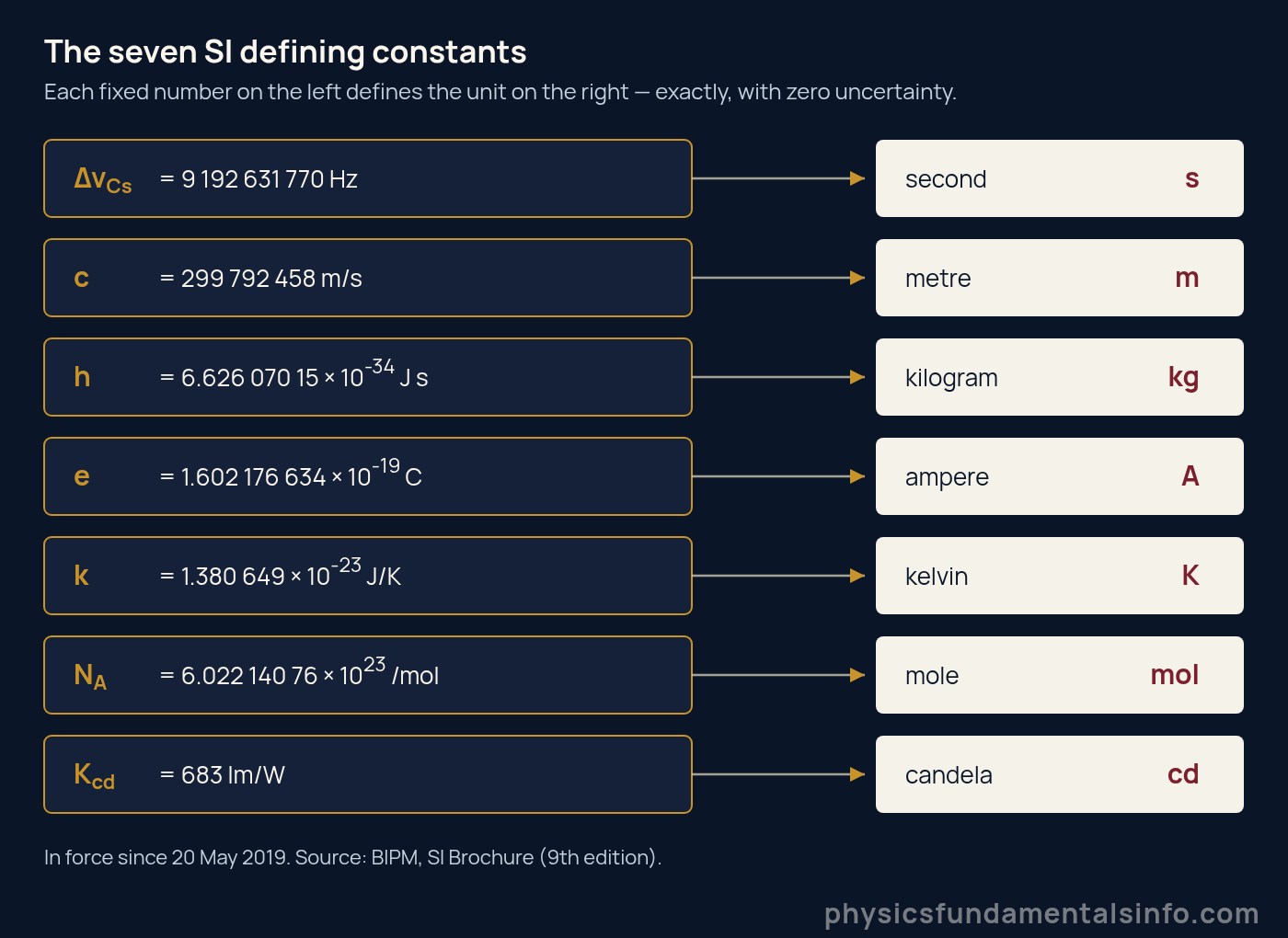
The seven defining constants of the SI and the base unit each one fixes.
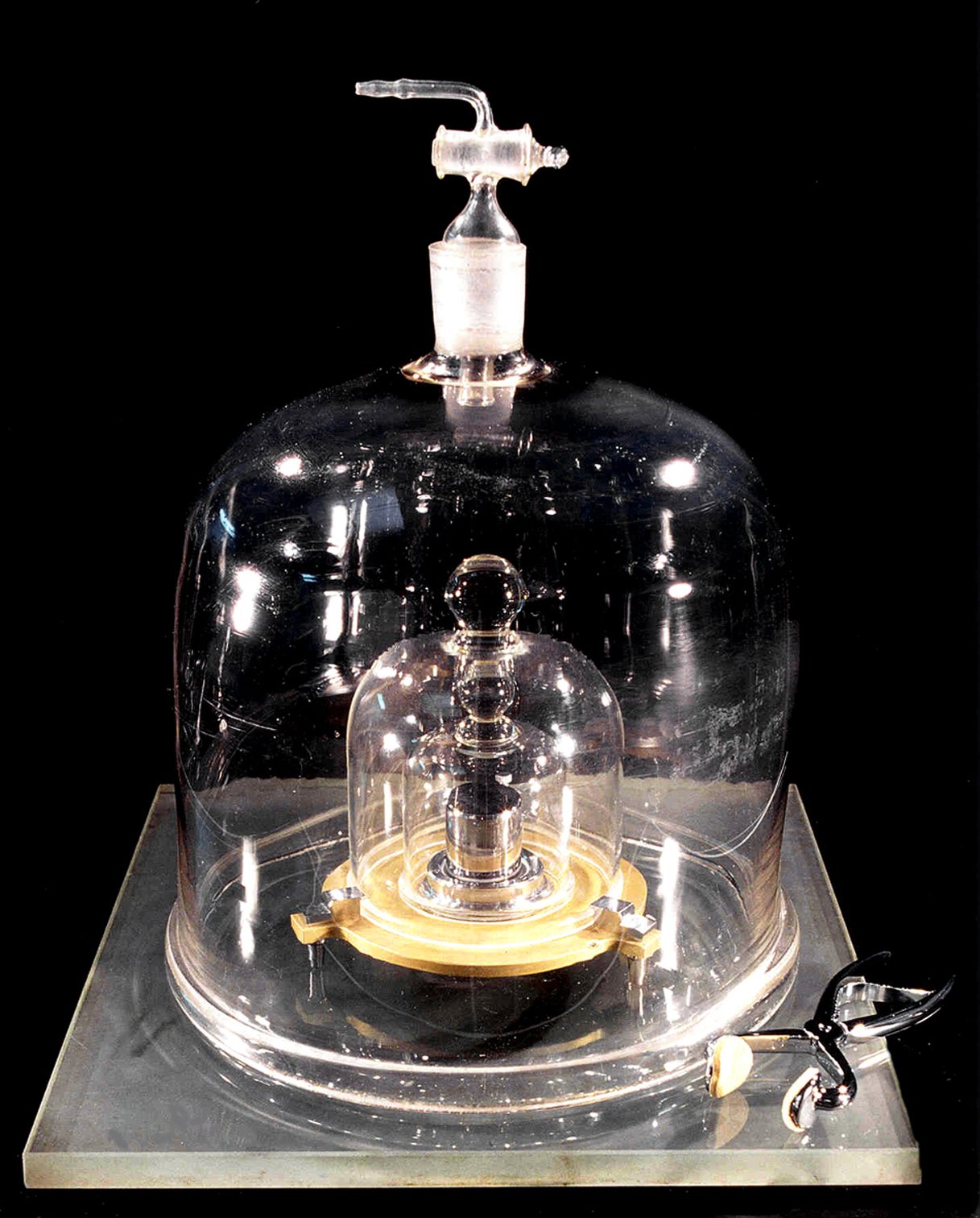
Notice what this does to precision. Once a value is fixed by decree, its uncertainty is zero forever, and the uncertainty moves instead into how well we can realise the unit in a laboratory.
The Seven Constants You Actually Use
Five constants carry most of the load in school and first-year physics — g, c, h, G and R — with the Coulomb constant and the speed of sound close behind. Here is what each one does, and the trap that comes with it.
g — Standard Gravity
Standard gravity is the conventional acceleration of free fall near Earth’s surface, fixed at exactly 9.80665 m/s2 by the 3rd General Conference on Weights and Measures in 1901.
- W — weight, the gravitational force on the object, in newtons (N)
- m — mass, in kilograms (kg)
- g — gravitational field strength, in newtons per kilogram (N/kg), numerically equal to the free-fall acceleration in m/s2
Here is the catch: g is not a constant of nature at all. Real local gravity runs from roughly 9.78 m/s2 at the equator to about 9.83 m/s2 at the poles, because Earth spins and bulges.
In practice, use 9.81 m/s2 unless a question specifies otherwise. The 9.80665 figure is a legal convention for trade and calibration, not a measurement of your particular hillside.
c — The Speed of Light in Vacuum
The speed of light in vacuum is exactly 299,792,458 m/s, and has been since 1983, when the metre was redefined in terms of it.
- E — energy, in joules (J)
- m — mass, in kilograms (kg)
- c — speed of light in vacuum, in metres per second (m/s)
That exactness is not a boast about measurement. It is a definition: we stopped measuring c and started using it to define length, so the metre is now whatever distance light covers in 1/299,792,458 of a second.
h — The Planck Constant
The Planck constant relates a photon’s energy to its frequency, and is exactly 6.62607015 × 10⁻³⁴ J s.
- E — photon energy, in joules (J)
- h — Planck constant, in joule seconds (J s)
- f — frequency, in hertz (Hz)
Because h is tiny, quantum effects stay hidden at everyday scales — a single green photon carries only about 4 × 10-19 J. If you are converting between wavelength, frequency and energy repeatedly, the photon energy calculator handles the unit juggling for you.
G — The Gravitational Constant
The gravitational constant sets the strength of gravity between any two masses, with a CODATA 2022 value of 6.67430(15) × 10-11 m3 kg-1 s-2.
- F — gravitational force, in newtons (N)
- G — gravitational constant, in m3 kg-1 s-2 (equivalently N m2 kg-2)
- m1, m2 — the two masses, in kilograms (kg)
- r — separation between their centres, in metres (m)
G is the embarrassment of precision physics. We know the electron’s magnetic moment to about one part in a trillion, yet G is pinned down only to 22 parts per million, because gravity is far too weak to shield from everything else.
It is also the constant students most often confuse with g. They are not related by a shortcut; you can compute the gravitational force between any two objects with the gravitational force calculator and see how different the scales are.
R — The Molar Gas Constant
The molar gas constant links pressure, volume, amount of substance and temperature for an ideal gas, and equals exactly 8.314462618… J mol-1 K-1.
- p — pressure, in pascals (Pa)
- V — volume, in cubic metres (m3)
- n — amount of substance, in moles (mol)
- R — molar gas constant, in J mol-1 K-1
- T — absolute temperature, in kelvin (K)
R is not fundamental in its own right. It is simply the Boltzmann constant scaled up to one mole, R = NAk, which is why it inherited exactness the moment both of those were fixed.
Keep T in kelvin and p in pascals and the units take care of themselves; the ideal gas law calculator is useful for checking a rearrangement you are unsure about.
ke — The Coulomb Constant
The Coulomb constant sets the strength of the electrostatic force and equals 8.98755179 × 10⁹ N m2 C-2, usually rounded to 8.99 × 10⁹.
- F — electrostatic force, in newtons (N)
- ke — Coulomb constant, equal to 1/(4πε0), in N m2 C-2
- q1, q2 — the two charges, in coulombs (C)
- r — separation, in metres (m)
Compare ke with G and the gulf between the two forces becomes obvious: one is around 109, the other around 10-11. Electrostatics beats gravity by roughly twenty orders of magnitude for everyday particles.
v — The Speed of Sound in Air
The speed of sound in dry air is about 343 m/s at 20 °C, and it changes with temperature rather than with pressure.
- v — speed of sound in dry air, in metres per second (m/s)
- 331.3 — the speed at 0 °C, in m/s
- T — air temperature, in degrees Celsius (°C)
This is the most conditional entry on the page. Quote 343 m/s without stating the temperature and you have quoted a number, not a constant.
Which Physics Constants Are Exact, and Which Are Measured?
Five constants are exact because the SI defines them: c, h, e, k and NA. Everything else is either arithmetic built from those, or a genuine measurement carrying an uncertainty.
| Constant | Relative uncertainty | In plain terms |
|---|---|---|
| c, h, e, k, NA | 0 | Exact by definition |
| R, σ, h/2π | 0 | Exact, built by arithmetic from the above |
| ε0, μ0 | 1.6 × 10⁻¹⁰ | About 1 part in 6 billion |
| me, mp | 3.1 × 10⁻¹⁰ | About 1 part in 3 billion |
| G | 2.2 × 10⁻⁵ | About 1 part in 45,000 |
Read the last two rows together and the oddity jumps out. We know the mass of a proton roughly a hundred thousand times more precisely than we know the strength of the force holding the solar system together.
The values themselves are also wildly spread out, which is worth seeing rather than being told.
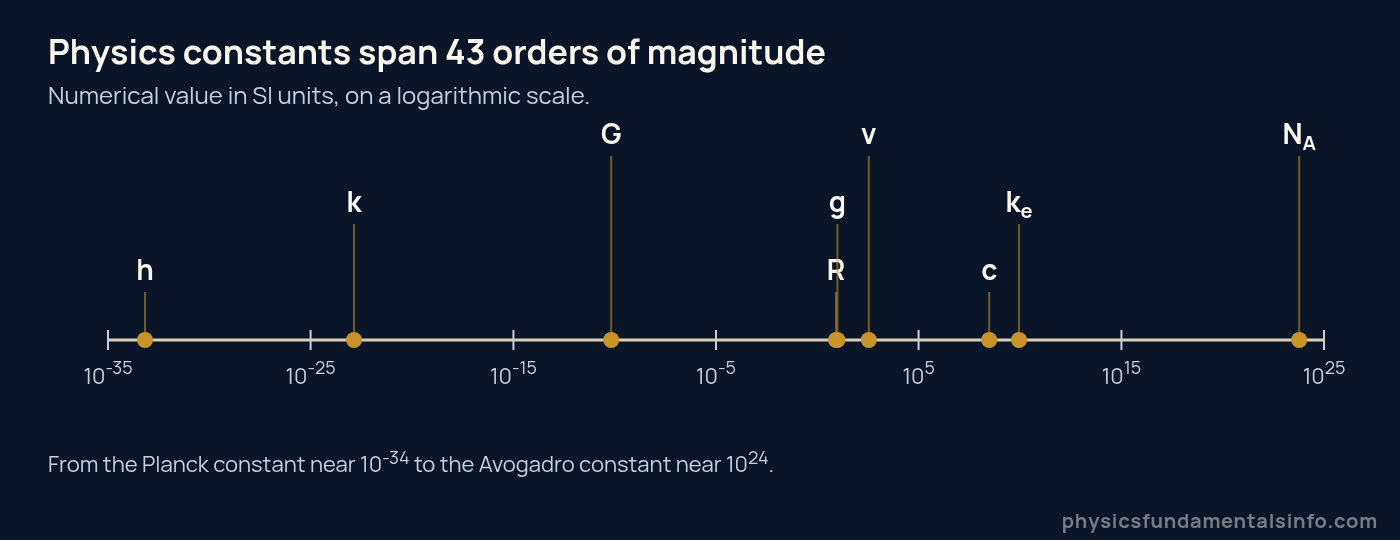
Physics constants plotted on a logarithmic scale, from the Planck constant to the Avogadro constant.
A useful sanity check follows from that picture: if a calculation involving h returns something near 1, you have almost certainly dropped a power of ten somewhere.
Real-World Examples of Physics Constants at Work
Physics constants are not confined to exam papers; they are wired into technology you use daily. Five cases make the point.
- Satellite navigation (c). Your position is worked out from signal travel times. Light covers about 30 cm in a nanosecond, so a clock error of a few nanoseconds becomes a metre of error on the ground.
- LED lighting and screens (h). The colour of an LED is set by the photon energy it emits. A blue LED at 450 nm puts out photons of about 2.76 eV, and h is the conversion factor that gets you there.
- Kitchen and laboratory scales (g). A scale measures force, then divides by g to display a mass. Ship the same scale from the equator to the Arctic without recalibrating and a 70 kg reading drifts by roughly 0.36 kg.
- Tyre pressure and weather balloons (R). Both are the ideal gas law in disguise: warm the gas and either the pressure or the volume has to give.
- Judging a thunderstorm (v). Count the seconds between flash and bang. Three seconds at 343 m/s puts the strike about a kilometre away.
Common Misconceptions About Physics Constants
Four errors account for most of the marks lost on this topic, and the first is by far the most expensive.
Mistake 1: Treating g and G as the Same Thing
They are different quantities with different units and different natures. G is a universal constant in m3 kg-1 s-2; g is a local field strength in N/kg that changes depending on where you stand.
The two connect only through a specific body: g = GM/R2, where M and R are that planet’s mass and radius. Confusing them also feeds the older confusion between weight and mass, since weight is the thing that changes when g does.
Mistake 2: Assuming g Is 9.81 Everywhere
Local gravity varies by about half a percent across Earth’s surface, from roughly 9.78 m/s2 at the equator to 9.83 m/s2 near the poles. Altitude and local rock density shift it further.
Use 9.81 m/s2 as a working value, but do not report an answer to five significant figures on the back of it.
Mistake 3: Thinking c Is Still Being Measured More Precisely
It is not, and it cannot be. Since 1983 the metre has been defined from the speed of light, so measuring c more accurately now just measures your ruler.
Any experiment that appears to time light more precisely is really calibrating a length standard.
Mistake 4: Treating R and k as Unrelated
They are the same physics at two different scales. The Boltzmann constant k applies per particle, the gas constant R applies per mole, and R = NAk connects them exactly.
Use R when you are counting in moles and k when you are counting individual molecules — mixing them up is a factor of 6 × 10²³ error, which is hard to miss.
How Physics Constants Relate to Formulas, Units and Uncertainty
A constant only means something once it is attached to an equation and a set of units. That is why this page pairs naturally with the wider toolkit.
- Formulas. Every constant here is the fixed term in some relationship; the grouped guide to physics formulas shows where each one slots in.
- Thermodynamics. R does its main work in the ideal gas law, where keeping temperature in kelvin is the whole battle.
- Quantum physics. h is the bridge between frequency and energy, worked through step by step in the guide to photon energy.
- Electrostatics. ke exists only inside Coulomb’s law, and its enormous size is why static shocks are so easy to generate.
Uncertainty is the thread running through all of it. Your answer can never be more precise than the least precise number you fed in, and with gravity that number is almost always G.
Worked Problems
Show Solution
Solution:
Step 1: Weight is the gravitational force on a mass, W = mg.
Step 2: Substitute with units. W = 72 kg × 9.81 m/s2 = 72 × 9.81 kg m/s2.
Step 3: Solve. W = 706.32 N, and 1 kg m/s2 is 1 N.
Answer: W = 706 N (3 s.f.)
Show Solution
Solution:
Step 1: Light travels at constant speed in vacuum, so t = d / c.
Step 2: Substitute with units. t = (1.496 × 10¹¹ m) / (2.99792458 × 10⁸ m/s).
Step 3: Solve. t = 499.0 s, and 499.0 / 60 = 8.32 min.
Answer: t = 499 s, or about 8.32 minutes
Show Solution
Solution:
Step 1: Find the speed of sound at that temperature using v = 331.3 sqrt(1 + T/273.15).
Step 2: Substitute. v = 331.3 × sqrt(1 + 35/273.15) = 331.3 × sqrt(1.1281) = 351.9 m/s.
Step 3: Distance is d = vt = 351.9 m/s × 4.2 s = 1478 m.
Answer: d = 1.5 km (2 s.f.)
Show Solution
Solution:
Step 1: Get the frequency from f = c / λ, then use E = hf.
Step 2: f = (2.99792458 × 10⁸ m/s) / (500 × 10-9 m) = 5.996 × 10¹⁴ Hz.
Step 3: E = (6.62607015 × 10⁻³⁴ J s) × (5.996 × 10¹⁴ Hz) = 3.973 × 10⁻¹⁹ J.
Step 4: Convert using 1 eV = 1.602176634 × 10⁻¹⁹ J, giving 3.973 / 1.602 = 2.48 eV.
Answer: E = 3.97 × 10⁻¹⁹ J, or 2.48 eV
Show Solution
Solution:
Step 1: Rearrange the ideal gas law pV = nRT to give V = nRT / p.
Step 2: Substitute with units. V = (1.00 mol × 8.314462618 J mol-1 K-1 × 273.15 K) / 101,325 Pa.
Step 3: The numerator is 2271.0 J, so V = 2271.0 / 101,325 = 0.022414 m3.
Step 4: Convert to litres: 0.022414 m3 × 1000 = 22.41 L.
Answer: V = 0.02241 m3, or 22.41 L
Show Solution
Solution:
Step 1: Surface field strength comes from g = GM / R2.
Step 2: Numerator: (6.67430 × 10-11) × (5.972 × 1024) = 3.986 × 10¹⁴.
Step 3: Denominator: (6.371 × 10⁶)2 = 4.059 × 10¹³.
Step 4: g = 3.986 × 10¹⁴ / 4.059 × 1013 = 9.82 m/s2.
Step 5: This sits just above the conventional 9.81 m/s2 because the calculation ignores Earth’s rotation and its equatorial bulge.
Answer: g = 9.82 m/s2, confirming that g is derived from G, not independent of it
Show Solution
Solution:
Step 1: Electrostatic force, F = ke q1 q2 / r2.
Step 2: FE = (8.98755 × 109) × (1.0 × 10-6)2 / (0.010)2 = (8.98755 × 109 × 10-12) / 10-4 = 89.9 N.
Step 3: Gravitational force, F = G m1 m2 / r2.
Step 4: FG = (6.67430 × 10-11) × (1.0) × (1.0) / (0.010)2 = 6.674 × 10⁻⁷ N.
Step 5: Ratio = 89.9 / (6.674 × 10⁻⁷) = 1.35 × 10⁸.
Answer: The electrostatic force is about 1.3 × 10⁸ times larger
Show Solution
Solution:
Step 1: Combine E = hf and c = f λ to get λ = hc / E.
Step 2: Work out hc once. hc = (6.62607015 × 10⁻³⁴ J s) × (2.99792458 × 10⁸ m/s) = 1.9864 × 10⁻²⁵ J m.
Step 3: Convert to convenient units: divide by 1.602176634 × 10⁻¹⁹ J/eV and multiply by 109 nm/m, giving hc = 1240 eV nm.
Step 4: λ = 1240 eV nm / 2.00 eV = 620 nm.
Answer: λ = 620 nm, in the orange-red part of the visible spectrum
Frequently Asked Questions
What are the physics constants?
Is g the same as G?
Which physics constants are exact?
What is the value of Planck's constant?
Why is the speed of light exactly 299,792,458 m/s?
Do physics constants change over time?
Key Takeaways
- Physics constants split into exact defining values, exact derived values, measured values, and conventional or conditional values.
- c, h, e, k and the Avogadro constant are exact by definition, and together with two others they now define every SI base unit.
- G is the least precisely known constant here, at about 22 parts per million.
- Lowercase g is not a universal constant; it varies from roughly 9.78 to 9.83 m/s^2 across Earth’s surface.
- Always carry units through the algebra, and never report more significant figures than your least precise constant allows.