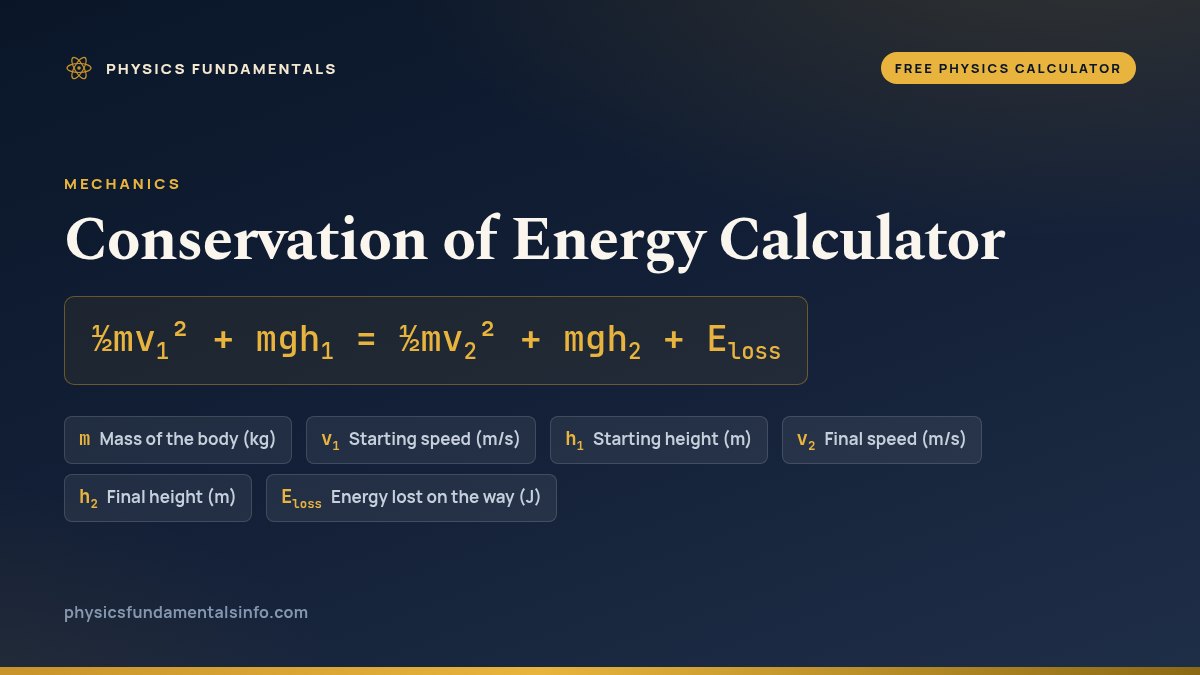
Conservation of energy says that the kinetic and potential energy a body has at one point, added together, is the same total it has at any later point once anything lost on the way is counted. Written out for two states that is ½mv1² + mgh1 = ½mv2² + mgh2 + Eloss. This free conservation of energy calculator solves that balance six ways — for either speed, either height, the energy lost or the mass — and prints the kinetic, potential and total energy at both ends beside the answer.
Load a real drop, ramp or coaster
Each button puts the Solve for menu on the unknown that case is asking about, resets every unit menu to SI and fills the six remaining boxes. Whatever the widget then works out is read back into the line underneath, so nothing there is stored text.
Pick a case above, or type your own numbers.
What Is the Conservation of Energy Calculator?
The conservation of energy calculator is a free online tool for the energy balance between two points on a path: ½mv12 + mgh1 = ½mv22 + mgh2 + Eloss. Describe the body where it starts and where it ends, leave the loss at zero for a frictionless path or type in the joules that went to heat, and it returns whichever of the six quantities you left out — either speed, either height, the energy lost or the mass. Beside the answer it prints the kinetic, potential and total energy at both ends and the share of the starting total your loss accounts for.
| Symbol | Quantity | Default unit | Also accepts | Example value |
|---|---|---|---|---|
| m | Mass of the body | kg | g, t | 2 |
| v1 | Starting speed | m/s | km/h, mph | 0 |
| h1 | Starting height | m | cm, km, ft | 1.8 |
| v2 | Final speed | m/s | km/h, mph | 5 |
| h2 | Final height | m | cm, km, ft | 0 |
| Eloss | Energy lost on the way | J | kJ, Wh | 0 |
| g | Acceleration of free fall | m/s² | (one unit) | 9.81 |
How to use the conservation of energy calculator
- Choose the unknown. The Solve for menu opens on Final speed. The other five choices are Starting speed, Final height, Starting height, Energy lost and Mass, and whichever you pick vanishes from the boxes below.
- Describe both states. Fill in the speed and the height at the point the body starts from, then the speed and the height at the point you are asking about. Each box carries its own unit menu: speeds take m/s, km/h or mph, heights take m, cm, km or ft.
- Measure both heights from the same zero. Only the difference between them reaches the arithmetic, so the floor, the bench top or sea level all work equally well as long as you keep to one of them. A point below your zero goes in as a negative number.
- Set the energy lost. Leave it at 0 J for the frictionless textbook case. Put a figure in and it is taken out of the balance as heat, sound or deformation — and that is the entry, and the only one, that makes the mass matter.
- Check gravity. The box opens at 9.81 m/s2, which is the conventional Earth figure rounded to three significant figures rather than a measurement of your own location.
- Read the answer and the extras. The headline is the quantity you asked for, to four significant figures, with its unit printed beside it. The six chips underneath give the kinetic, potential and total energy at each end, and a seventh gives the share of the starting total your loss accounts for.
- If you want the answer in another unit, set that menu first. A quantity's unit menu disappears while it is the unknown, and the answer comes back in whatever that menu was last left on. Choose km/h for the final speed before you switch the menu to solve for it, and the same drop returns 21.39 km/h instead of 5.943 m/s.
- Open Show working. Each step is printed in SI whatever the menus say, with the operands to six significant figures, and the last line repeats the headline exactly.
The two terms in the balance each have a calculator of their own, and they are the right place to start if either one is unfamiliar. The kinetic energy calculator evaluates the ½mv2 half at a single instant, and the gravitational potential energy calculator does the same for mgh. Neither conserves anything; this page is what puts the two of them on opposite sides of an equals sign.
The height zero is the entry people get wrong most often, and it is worth a moment before you type. Heights here are measured from whatever level you choose, and because only h1 - h2 reaches the answer, the choice cannot change the result as long as you use the same level twice. The guide to potential energy works through why a potential energy has no absolute value, only a difference.
The second common slip is expecting a speed when the body cannot get there at all. Ask for the speed at a point higher than the body can reach on the energy it started with and the square root turns negative, so the tool reports that the combination has no valid solution rather than printing a number. That message is an answer in itself, and the primer on what energy is is the background if it is not obvious why.
Worked example: change one thing at a time
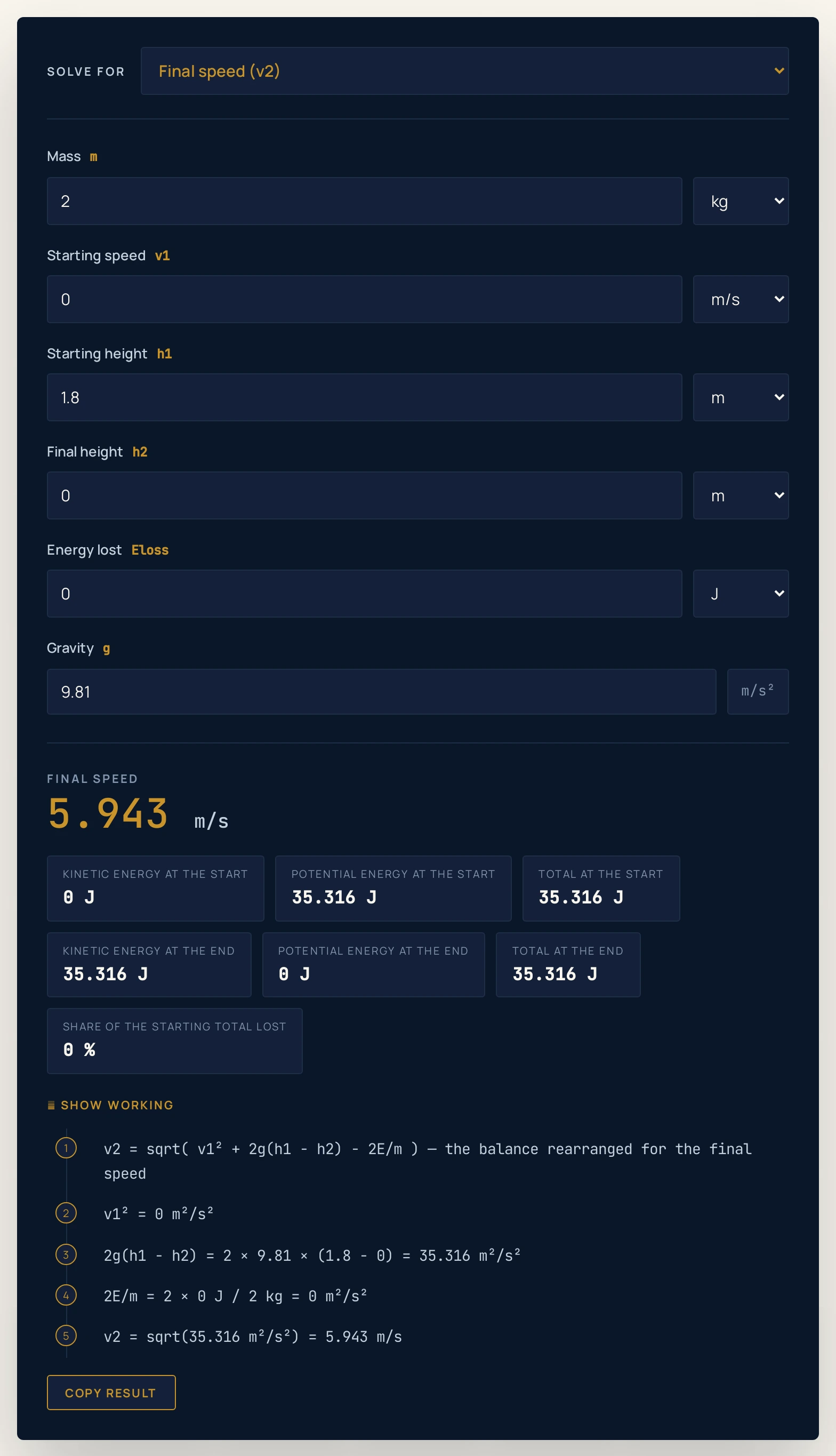
The table starts at the defaults and moves one thing at a time: the mass, then the unit, then the loss, then which quantity is the unknown. Every Result and Total cell was read out of the running widget rather than worked out by hand, so where a cell and the tool ever part company, believe the tool. The input columns are simply what you type.
| Step | Solving for | Mass | Starts | Ends | Energy lost | Result | Total at the start | Total at the end |
|---|---|---|---|---|---|---|---|---|
| The page as it opens | Final speed | 2.00 kg | 0 m/s at 1.80 m | to 0 m | 0 J | 5.943 m/s | 35.316 J | 35.316 J |
| Make the body four times lighter | Final speed | 0.50 kg | 0 m/s at 1.80 m | to 0 m | 0 J | 5.943 m/s | 8.829 J | 8.829 J |
| Now a thousand times heavier again | Final speed | 500 kg | 0 m/s at 1.80 m | to 0 m | 0 J | 5.943 m/s | 8829 J | 8829 J |
| Retype the same height as 180 cm | Final speed | 2.00 kg | 0 m/s at 180 cm | to 0 m | 0 J | 5.943 m/s | 35.316 J | 35.316 J |
| Give 3.00 J of it to drag | Final speed | 2.00 kg | 0 m/s at 1.80 m | to 0 m | 3.00 J | 5.685 m/s | 35.316 J | 32.316 J |
| The same drag on twice the mass | Final speed | 4.00 kg | 0 m/s at 1.80 m | to 0 m | 3.00 J | 5.815 m/s | 70.632 J | 67.632 J |
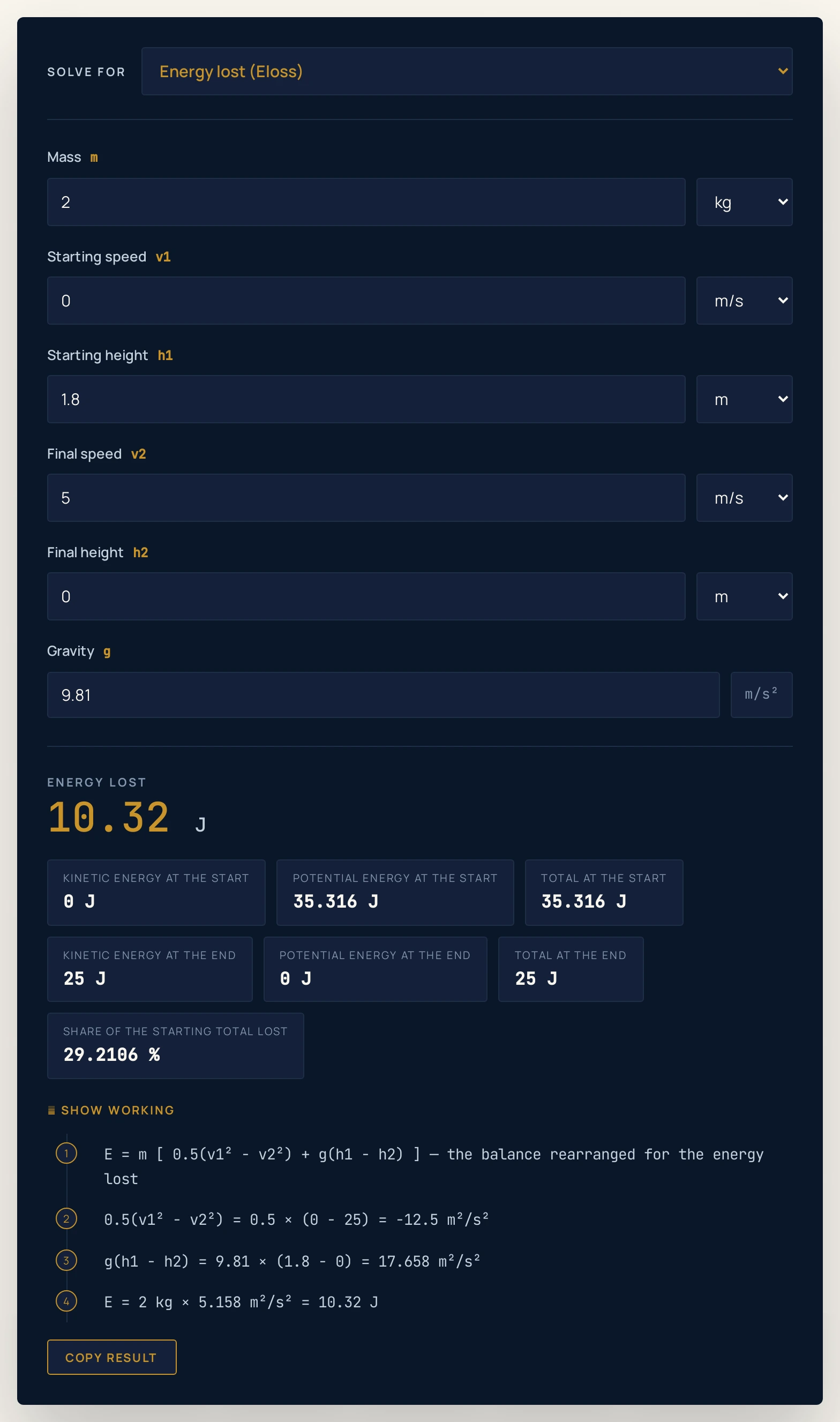
| Ask how much a 5.00 m/s arrival lost | Energy lost | 2.00 kg | 0 m/s at 1.80 m | 5.00 m/s at 0 m | asked | 10.32 J | 35.316 J | 25 J |
| Ask which mass mislays exactly 3.00 J | Mass | asked | 0 m/s at 1.80 m | 5.685 m/s at 0 m | 3.00 J | 2.002 kg | 35.354 J | 32.354 J |
| Take that same loss back to zero | Mass | asked | 0 m/s at 1.80 m | 5.685 m/s at 0 m | 0 J | no answer | — | — |
| Ask what height it fell from | Starting height | 2.00 kg | 0 m/s, height asked | 5.943 m/s at 0 m | 0 J | 1.8 m | 35.3192 J | 35.3192 J |
| Throw it straight up instead | Starting speed | 2.00 kg | speed asked, at 0 m | 0 m/s at 1.80 m | 0 J | 5.943 m/s | 35.316 J | 35.316 J |
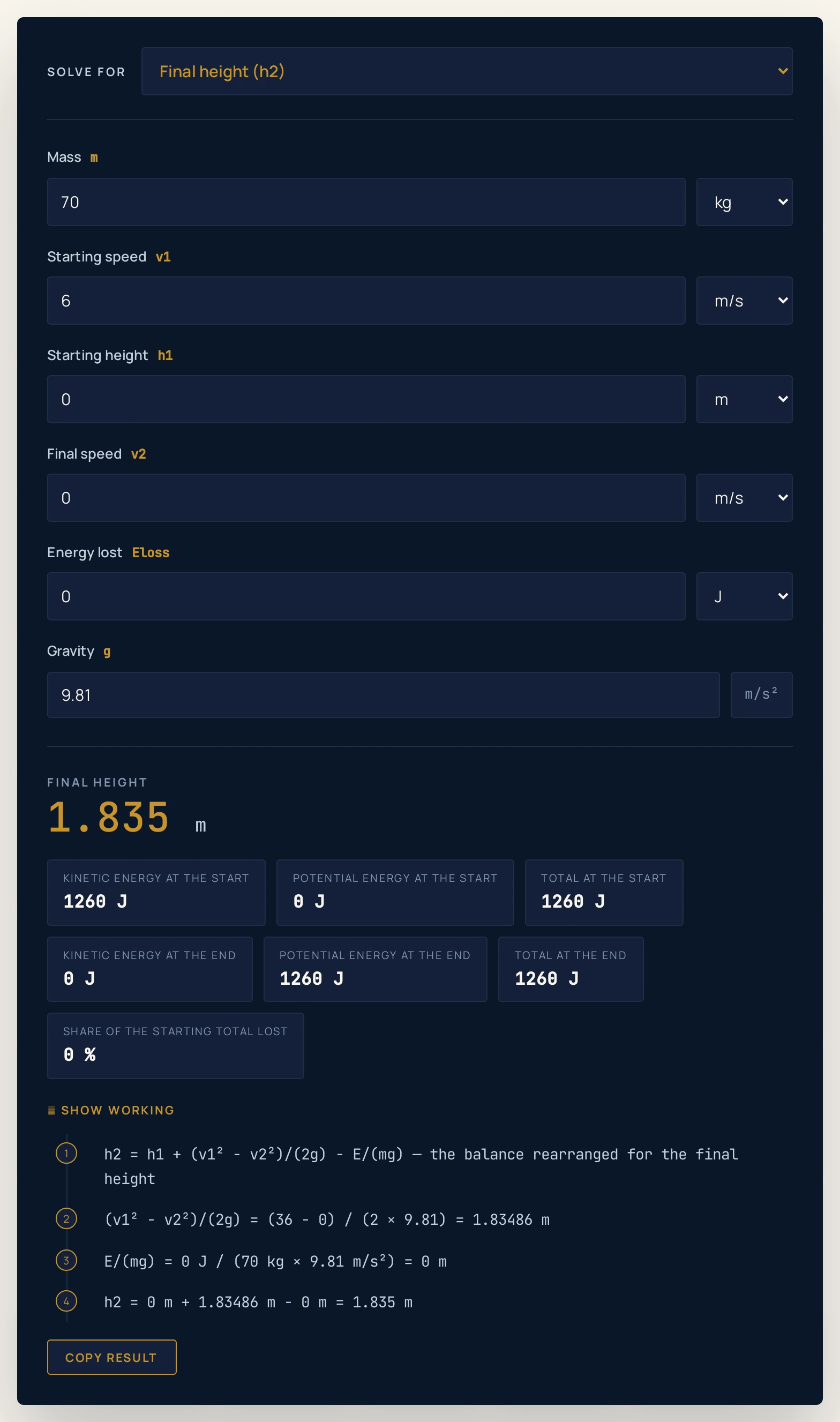
| Send a 70 kg skater up a ramp | Final height | 70 kg | 6.00 m/s at 0 m | to rest | 0 J | 1.835 m | 1260 J | 1260 J |
| Drop a coaster train 17.0 m | Final speed | 450 kg | 4.00 m/s at 25.0 m | to 8.0 m | 0 J | 18.7 m/s | 113963 J | 113963 J |
Rows 1 to 3 are the demonstration this page exists for. The same drop at 0.50 kg, 2.00 kg and 500 kg returns 5.943 m/s three times, character for character, while the Total chip beside it runs 8.829 J, 35.316 J and 8829 J. The energy scales with the mass exactly; the speed does not depend on it at all.
Row 4 retypes 1.80 m as 180 cm and nothing moves, because the menu converts before the arithmetic starts. Rows 5 and 6 then break the cancellation: with 3.00 J going to drag the 2.00 kg body arrives at 5.685 m/s and the 4.00 kg body at 5.815 m/s. The heavier one is faster because 3.00 J out of the 70.632 J it set off with leaves more of the journey intact than 3.00 J out of 35.316 J does.
Rows 7 and 8 run the question backwards. A 2.00 kg body that should have arrived at 5.943 m/s but only managed 5.00 m/s has mislaid 10.32 J, and asking which mass would mislay exactly 3.00 J over that drop while arriving at 5.685 m/s gives 2.002 kg. It is 2.002 rather than 2.000 because 5.685 is itself a rounded figure; feeding a printed answer back in is a good habit, and it shows you how much the rounding was worth.
Row 9 is the guard, and it is physics rather than a limitation. Take that same loss back to zero and every trace of the mass disappears from the equation, so no mass is the answer and the tool says so; if you want the mass, a real energy loss has to be part of the question.
Rows 10 and 11 run the drop backwards in the two remaining directions. Asking what height a 5.943 m/s arrival fell from returns 1.8 m — still four significant figures, with 1.800 shown without its trailing zeros — and asking how fast the ball would have to be thrown upwards to just reach 1.80 m returns the same 5.943 m/s, because the balance cannot tell which way the film is running. Rows 12 and 13 then leave the shelf behind for a skater rolling 1.835 m up a ramp and a coaster train reaching 18.7 m/s, neither of which the SUVAT calculator could touch, because neither question hands it a path length or an acceleration to work along — only a change in height.
Formula and symbol reference
The calculator uses one relation in six arrangements. In full it is ½mv12 + mgh1 = ½mv22 + mgh2 + Eloss, and the six closed forms are v2 = sqrt(v12 + 2g(h1-h2) - 2E/m), v1 = sqrt(v22 + 2g(h2-h1) + 2E/m), h2 = h1 + (v12-v22)/2g - E/mg, h1 = h2 + (v22-v12)/2g + E/mg, E = m[½(v12-v22) + g(h1-h2)] and m = E / [½(v12-v22) + g(h1-h2)]. No measured constant of nature appears in any of them.
Gravity is an input rather than a fixed number for a reason. The 9.81 m/s2 the box opens on is the standard value 9.80665 m/s2 rounded to three figures, and that standard value is fixed by definition rather than measured. Real local gravity runs from roughly 9.78 to 9.83 m/s2 depending on latitude and altitude, so if a problem gives you a local figure, type it.
| Symbol | Meaning | SI unit | Values used on this page |
|---|---|---|---|
| m | The mass of the one body the balance is written for. It cancels exactly when nothing is lost, and only then | kilogram, kg | Boxes take kg, g or t: 2.00 by default, 0.50 and 500 in the rows that show the cancellation, 450 for a coaster train. |
| v1 | Its speed at the point it starts from. A magnitude, so the direction of travel never enters it | metre per second, m/s | Boxes take m/s, km/h or mph: 0 for a body released from rest, 6.00 for the skater, 4.00 for the coaster train. |
| h1 | Its height at that same starting point, measured from a zero you choose | metre, m | Boxes take m, cm, km or ft: 1.80 for the shelf drop, 0 for the skater at the foot of the ramp, 25.0 for the coaster. |
| v2 | Its speed at the point you are asking about. The default unknown | metre per second, m/s | Boxes take m/s, km/h or mph: 5.00 by default, 0 where the body comes to rest at the top of a ramp. |
| h2 | Its height at that second point, from the same zero. Only h1 minus h2 ever enters the answer | metre, m | Boxes take m, cm, km or ft: 0 for the floor in most rows here, 8.0 for the bottom of the coaster drop. |
| Eloss | Energy taken out of the balance by friction, drag or a bounce. Never negative | joule, J | Boxes take J, kJ or Wh: 0 for the frictionless case, 3.00 for the drag rows, 10.32 where the tool works it out. |
| g | The acceleration of free fall where the body is. An input, not a constant baked into the page | metre per second squared, m/s2 | One box, in m/s2: 9.81 by default; 1.62 and 3.72 are the nominal values usually quoted for the Moon and Mars. |
The physics: why the mass cancels, and when it stops
Write the balance out and every single term carries a factor of m: ½mv12, mgh1, ½mv22 and mgh2. Divide the whole equation by m and it vanishes, leaving ½v12 + gh1 = ½v22 + gh2. That is why rows 1 to 3 of the table give one answer for three masses a thousand times apart, and why a heavy ball and a light one hit the ground together when the air is taken out of the question.
The loss term is the exception, because it is an energy in joules and not a mass times anything. Divide through by m and Eloss becomes Eloss/m, which is still there and still depends on the mass. Give the same 1.80 m drop the same 3.00 J to lose and the 2.00 kg body lands at 5.685 m/s against the 4.00 kg body's 5.815 m/s.
That is worth saying the other way round, because it is the sentence most explanations leave out. The heavier body arrives faster, not slower, because a fixed loss is a smaller fraction of a bigger starting total. It follows that "mass never matters in energy problems" is only true of the frictionless idealisation, and this page's own arithmetic disproves it the moment you use the Energy lost box.
Nothing in the balance mentions the path, and that is its real advantage over kinematics. A vertical drop, a straight ramp at any angle and a curved slide from the same height to the same floor all deliver the same speed at the bottom, because only h1 - h2 appears. The free fall calculator will match it on the vertical case and also give you the time, which energy alone cannot; on the curved slide it has no single acceleration to work with, and this balance still has one answer.
The interactive lab for this topic is the same statement in moving form: a 1 kg ball on a frictionless valley with gravity fixed at 9.81, where the Total Energy readout holds still while the kinetic and potential bars trade places. Released from the default 3.0 m it shows a total of 29.4 J and reaches 7.7 m/s at the valley floor. Those readouts are rounded to one decimal place, and the valley, the fixed mass and the absence of friction are a model at the model's own scale, not a measurement of a real ball.
One last distinction, because the names invite it. Conservation of energy and conservation of momentum are different statements about different quantities: energy is a scalar in joules and survives being turned into heat, while momentum is a vector in kilogram metres per second and is conserved in a collision that destroys a great deal of kinetic energy. A problem can need both, and neither one implies the other.
Where the conservation of energy calculator breaks down
The arithmetic is four lines long and hard to get wrong. What fails is the model being squeezed onto a situation it does not cover, or an expectation the balance was never making.
- Any energy store the balance has no term for
- There are exactly two terms here, kinetic and gravitational. A compressed spring, a spinning flywheel, a battery or a chemical reaction all hold energy this page cannot see, so a problem containing one of them needs that part doing separately. For the spring case, work out the elastic energy with the Hooke's law calculator first and bring the resulting speed here.
- Symptom: a total that does not match what you know went in.
- A body that is rolling rather than sliding
- A rolling ball or wheel puts some of its energy into spinning, and
½mv2only counts the part that moves it along. A solid sphere rolling without slipping carries two-sevenths of its kinetic energy in the rotation, so this balance overstates the speed at the bottom of a ramp for anything that rolls. - Friction entered as a force rather than as an energy
- The Energy lost box wants joules, not newtons. A constant friction force needs multiplying by the distance it acted over before it comes here, which is what the work and power calculator is for, and the guide to work done sets out that force-times-distance step. The distance to use is the length of the path rather than the height dropped.
- Expecting a time, or a trajectory
- Energy relates speeds to heights and nothing else. It cannot tell you how long the journey took, where the body was halfway through or what direction it was moving in when it arrived. Those need kinematics, and on a straight constant-acceleration path the free fall tool covers the ground this one does not.
- Asking for a point the body cannot reach
- Ask for the speed at a height above what the starting energy pays for, or for a starting speed that cannot produce the arrival you typed, and the square root goes negative. The tool returns no number at all in that case, which is correct: there is no real speed, not a small one.
- Asking for the mass with nothing lost
- With
Elossat zero the mass cancels out of the equation completely, so it has no determined value and the tool declines to print one. This is the same fact as rows 1 to 3 of the table seen from the other side, and it is the one guard on this page that is teaching something rather than catching an error. - Speeds and heights far outside everyday scales
- Two assumptions are buried in
mgh: that gravity is uniform over the height involved, and that the speeds are small compared with light. Neither survives a satellite orbit or a particle accelerator, and no figure on this page should be read as covering them. - Rounded figures in, rounded figures out
- The headline is four significant figures while the working prints six, so re-multiplying the printed operands can differ from the printed answer in the last digit. Row 8 of the table shows the same thing from the input side: typing back a rounded 5.685 m/s returns 2.002 kg rather than the 2.00 kg it came from.
Where the energy balance is actually used
- Roller coasters and gravity rides
- A coaster train is lifted once and then spends the rest of the ride trading height for speed, which is exactly the two-state question this page answers. The row above takes a 450 kg train from 25.0 m to 8.0 m and gets 18.7 m/s; a real designer would put a loss figure in, because a real track has wheels, bearings and air in the way.
- Pumped storage and hydroelectric schemes
- Water pumped uphill overnight is potential energy banked, and released downhill it becomes kinetic energy and then electricity. The same
mghthat gives a ball its speed gives a reservoir its stored energy, and what comes back out is the starting total less everything the pumps, the turbines and the pipework took. It is not a niche arrangement: the US Department of Energy puts pumped storage at 88 per cent of all utility-scale energy storage in the United States, spread over 43 plants, though the round trip's efficiency is still whatever the loss term leaves behind. - Pendulums, swings and anything that oscillates
- A pendulum bob is at its fastest at the bottom and momentarily still at each end, so the balance between those two states gives the speed without any need for the swing's equation of motion. The pendulum period calculator handles the timing side, which energy cannot reach.
- Bounce tests and drop tests
- Drop something from a known height, measure how high it comes back, and the difference in
mghis the energy the bounce destroyed. That is a standard way of characterising a ball, a floor or a packaging material, and it is one of the few everyday measurements where the loss term is the thing being measured rather than a nuisance. - Braking, run-off ramps and stopping distances
- A vehicle's kinetic energy has to go somewhere, and a truck escape ramp turns it into height plus friction on purpose. Enter the speed at the bottom, zero at the top and a starting height of zero, and the tool returns the climb the vehicle buys: an arrival at 30 m/s, which is 108 km/h, needs 45.87 m of frictionless rise to come to rest, and the mass makes no difference to that. Add the friction as a loss and that climb comes out smaller, which is why a gravel arrester bed stops a truck in less rise than a smooth slope would need.
- Classroom ramp and trolley experiments
- The standard practical releases a trolley from a measured height and times it through a gate at the bottom. Compare the measured speed with the frictionless figure from this page and the shortfall, converted back through the Energy lost menu, is the energy the track and the axles took — a measurement of the apparatus, not a failure of the physics.
Where to go next
For the concept in full, with eight worked problems and the diagrams that go with them, read Conservation of Energy Explained. Take one state at a time to the kinetic energy calculator or the gravitational potential energy calculator, a spring to the spring constant calculator, or a straight vertical drop to the free fall calculator when you need the time as well. The whole physics lab library is open beside them if you would rather watch the trade happen than type it.
Frequently asked questions
What is the conservation of energy formula?
For one body moving between two points it is ½mv1² + mgh1 = ½mv2² + mgh2 + E_loss. The left-hand side is the kinetic plus potential energy at the start, the right-hand side is the same pair at the end plus whatever was lost on the way. With nothing lost the two totals are equal, which is the form most textbooks quote as KE + PE = constant.
Why does the mass not change the answer?
When E_loss is zero every term in the balance carries a factor of m, so the m divides out and the speeds and heights are all that is left. Run the same 1.80 m drop at 0.50 kg, at 2.00 kg and at 500 kg and the tool returns 5.943 m/s every time, to the last digit. The moment you put a number in the Energy lost box the cancellation stops, because that term has no m in it.
Why can the calculator not solve for the mass when nothing is lost?
Because with E_loss at zero the balance collapses to m times a bracket equals zero. If the bracket is not zero no mass satisfies it, and if it is zero every mass does, so there is no single answer to return. The tool says the combination has no valid solution rather than inventing one, and that message is the clearest demonstration on the page that the mass really does cancel.
What counts as height zero?
Whatever you decide, as long as both heights are measured from it. Only the difference h1 minus h2 appears in the arithmetic, so a ball dropped from 1.80 m to 0 m and the same ball dropped from 100 m to 98.2 m give the same answer. Negative heights are accepted for the same reason: a point below your zero is simply a negative number.
Why did it say the combination has no valid solution?
Something you asked for has no real answer, and the tool declines rather than inventing one. The usual causes are a square root that comes out negative, which means the body never reaches the second point; a requested energy loss that comes out negative, which would mean the two states you typed create energy; a mass or a gravity of zero or less; a speed or a loss entered as a negative number, neither of which is a quantity that can be negative; and asking for the mass when nothing was lost. Nothing is printed in any of those cases, because no number would be honest.
Does this work on a curved ramp, a pendulum or a loop?
Yes, and that is the point of using energy rather than kinematics. The balance never asks which path the body took or what its acceleration was, so a straight drop, a curved slide and a swinging pendulum with the same height difference all give the same speed. What it does assume is that gravity is the only force doing work, apart from whatever you have entered as a loss.
Can it handle a spring, a rotating wheel or an electric motor?
Not on its own. The balance carries a kinetic term and a gravitational term only, so elastic energy, rotational energy and electrical input each need adding by hand or working out with a separate tool. A spring launch, for instance, is two sums: the elastic energy first, then this balance for what happens afterwards.
Can I get the answer in km/h, or in feet?
Yes, but set the menu before you solve for that quantity. Each box carries its own unit menu, and the menu disappears while that quantity is the unknown, so the answer is returned in whatever unit the menu was last left on. Choose km/h for the final speed first and the 1.80 m drop comes back as 21.39 km/h instead of 5.943 m/s; the unit is always printed beside the number, so it is never ambiguous, and reloading the page puts every menu back to SI.
Is the answer affected by air resistance?
Only if you tell it so. Leaving Energy lost at zero models a frictionless, drag-free path, which overstates the real final speed of anything light or fast. If you know how much energy the drag removed, type it in; if you know the real final speed instead, switch the menu to Energy lost and the tool works out how much went missing.
References & formula source
- Halliday, Resnick & Walker — Fundamentals of Physics, the chapters on kinetic energy and work, and on the conservation of energy.
- Young & Freedman — University Physics, the chapter on potential energy and energy conservation.
- Kleppner & Kolenkow — An Introduction to Mechanics, the chapter on work and energy.
- BIPM — The International System of Units (SI brochure): the joule, and the conventional standard acceleration of free fall, 9.80665 m/s².
- US Department of Energy, Hydropower and Hydrokinetic Office — Pumped Storage Hydropower, energy.gov: the source of the 88 per cent share of US utility-scale energy storage and the 43-plant count quoted above, both attributed there to the 2024 Hydropower Market Report.
- Further reading: Conservation of energy — Wikipedia