The work-energy theorem ties a force and a distance to a speed: the total work every force does, signs and all, is the kinetic energy gained or lost — Wnet = ½mv22 − ½mv12. This lab puts a block on a level floor and lets you shove it horizontally against kinetic friction, from rest or at a speed you pick. Five sliders set the mass, the push, the coefficient, the distance and that speed; four cards report the work your push does, the work friction takes, their sum and the final speed. The ledger under the drawing draws the net work and the change in kinetic energy as two bars that finish level.
The Work-Energy Theorem: Net Work Is the Change in Kinetic Energy
A block on a level floor. You push it horizontally with a force F over a distance d, against kinetic friction μ, and it may already be moving at v1. Every force gets its own work term and friction's term is negative; add them and you have the net work. The bars show that the net work and the change in kinetic energy are one bar drawn twice — that is the theorem, and it holds just as well when the net work is negative and the block ends up slower than it started. Because the push is horizontal the normal force is exactly m·g, so friction is μ·m·g; angle the push and none of these numbers survives.
KE at the start0.0 J
KE at the end122.3 J
Change in KE122.3 J
Friction force μmg19.6 N
Net force F − μmg20.4 N
What happensNet work 122.3 J, change in kinetic energy 122.3 J.
The push is horizontal, so the normal force is exactly m·g and friction is μ·m·g. One coefficient of friction is used for the sliding block, so the “nothing moves” case is a statement about this model and not about a real floor, which needs a larger force to break a body loose than to keep it sliding.
Work by your push Wpush = F · d
240.0 J
Work by friction Wfric = -μmg · d
-117.7 J
Net work Wnet = Wpush + Wfric
122.3 J
Final speed v2 = sqrt(v12 + 2Wnet/m)
5.53 m/s
Mass · m8.0 kg
Your push · F40 N
Friction coefficient · μ0.25
Push distance · d6.0 m
Starting speed · v10.0 m/s
Gravity is fixed at g = 9.81 m/s2, the standard value rounded to three significant figures. It is defined, not measured; real local gravity spans about 9.78 to 9.83 m/s2.
Load a real push
The first button presses the lab's own Reset; the other eight write all five sliders at once. Watch two things as you move between them. Net work and Change in KE carry the same figure on every single one, and the last three buttons show that this stays true when the net work is negative, when the block stops halfway, and when it never moves at all.
Pick a push above, or drag the sliders yourself.
What Is the Work Energy Theorem Simulator?
The work energy theorem simulator is a free interactive physics lab that runs in your browser — nothing to install and no sign-up. A block sits on a level floor and you push it horizontally: set the mass from 0.5 to 50.0 kg, the push from 0 to 200 N, the coefficient of kinetic friction from 0.00 to 1.00, the push distance from 0.5 to 20.0 m and the speed it already has from 0.0 to 20.0 m/s.
The panel answers with the work your push does, the work friction takes, the net work Wnet and the final speed, and an energy ledger draws the net work and the change in kinetic energy as one bar twice. That equality is the theorem, and it holds just as well when the net work is negative.
| Control | Range | Step |
|---|---|---|
| Mass of the block | 0.5 to 50.0 kg | 0.5 kg |
| Your push | 0 to 200 N | 1 N |
| Friction coefficient | 0.00 to 1.00 | 0.01 |
| Push distance | 0.5 to 20.0 m | 0.5 m |
| Starting speed | 0.0 to 20.0 m/s | 0.1 m/s |
| Run the push | replays the motion | one button |
How to use the work energy theorem simulator
- Start from the opening setting, or load one above. Reset puts the sliders back to 8.0 kg, 40 N, a coefficient of 0.25, 6.0 m and a starting speed of 0.0 m/s, and redraws the finished push. Nothing in the panel is stored text: every figure is worked out again the moment a slider moves.
- Set the mass. Mass · m runs from 0.5 to 50.0 kg in 0.5 kg steps and reads back as “8.0 kg”. It pulls in two directions at once — a heavier block needs more energy for the same speed, and it also presses harder on the floor, so friction takes more.
- Set your push. Your push · F covers 0 to 200 N in 1 N steps. This is your force alone and not the net force, which is the distinction the whole topic turns on; the panel does the adding up for you and prints the result in the Net force stat.
- Choose how rough the floor is. Friction coefficient · μ covers 0.00 to 1.00 in steps of 0.01. It is a number you pick rather than a measurement of lino or concrete; the primer on friction explains what a coefficient actually represents, and the friction calculator will give you a force from one if you would rather work in newtons.
- Set how far you push. Push distance · d runs 0.5 to 20.0 m in 0.5 m steps. Remember it is what you intend: if the block runs out of energy first, every work figure switches to the distance actually covered and the status line names it.
- Give it a running start, or do not. Starting speed · v1 covers 0.0 to 20.0 m/s in 0.1 m/s steps. Raising it lifts KE at the start and KE at the end by the same amount and leaves Net work exactly where it was, which is worth doing once just to watch.
- Read the four cards, then the five stats. The cards give Work by your push, Work by friction, Net work and Final speed; the strip under the drawing adds the energy before, the energy after, the difference, the friction force and the net force. Joules and newtons are printed to one decimal place and speeds to two.
- Read the What happens line. It says one of three things: that the net work and the change in kinetic energy agree, that the block ran out of energy and stopped short, or that nothing moved because the push could not beat the friction.
- Press Run the push to watch it happen. The block travels under the real motion of a constant net force, but the clock is stretched or squeezed to fit a watchable 0.8 to 3.0 seconds, and a caption says which of the three it is doing. Use it to see the motion, never to time it.
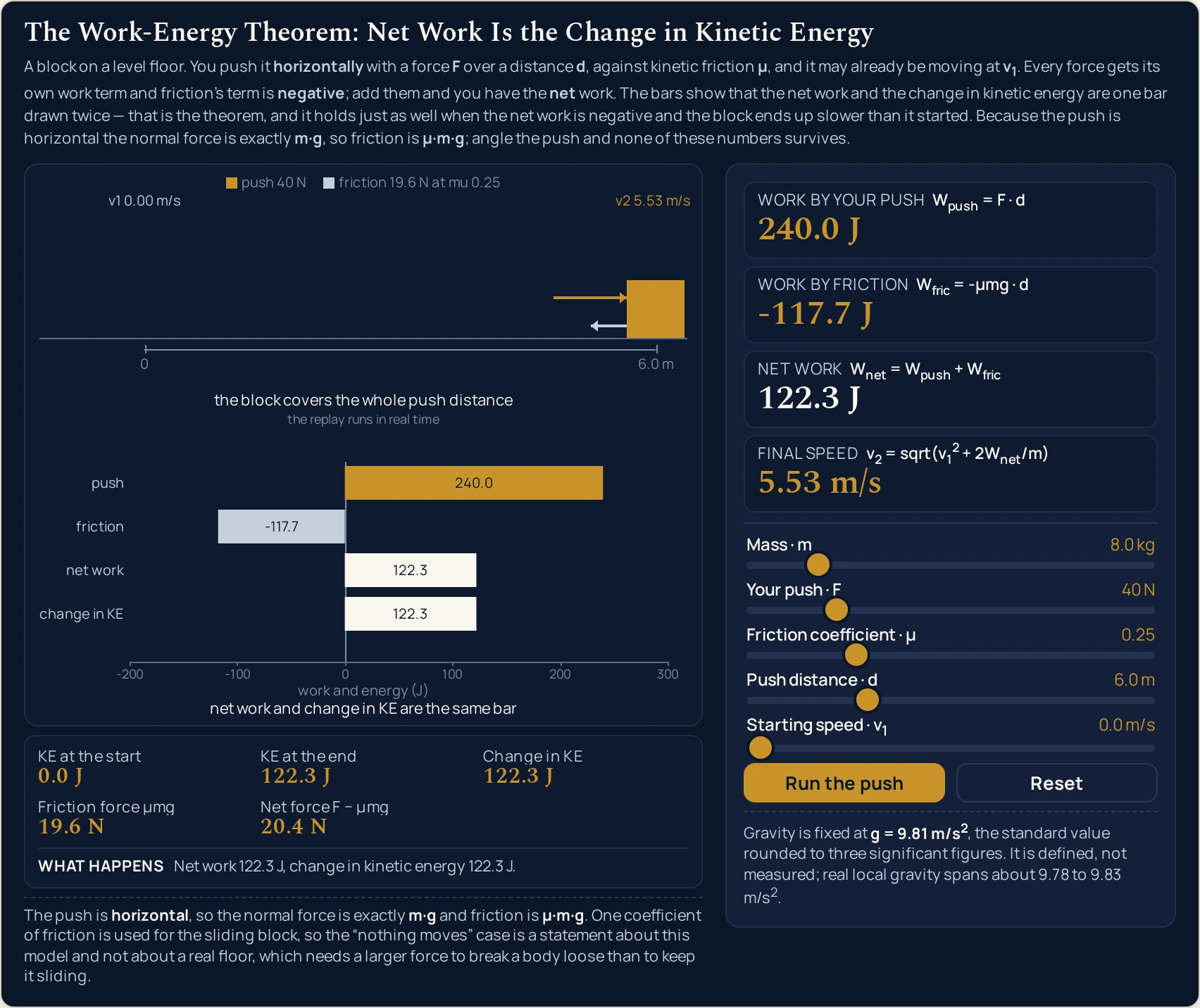
-117.7 J out of the 240.0 J your push puts in, leaving Net work at 122.3 J and the block doing 5.53 m/s. In the ledger the last two bars end at the same pixel.Worked example: change one thing at a time
Every row below is one setting of the five sliders, and every cell is a string the running lab printed there. Rows 2 to 6 move exactly one control away from the opening push; the rest go looking for the awkward cases. Where a cell and the lab ever disagree, believe the lab.
| Setting | Mass, push, friction, distance, start | Work by your push | Work by friction | Net work | KE at the start | KE at the end | Change in KE | Final speed |
|---|---|---|---|---|---|---|---|---|
| The opening push | 8.0 kg · 40 N · μ 0.25 · 6.0 m · from rest | 240.0 J | -117.7 J | 122.3 J | 0.0 J | 122.3 J | 122.3 J | 5.53 m/s |
| Take the friction away | 8.0 kg · 40 N · μ 0.00 · 6.0 m · from rest | 240.0 J | 0.0 J | 240.0 J | 0.0 J | 240.0 J | 240.0 J | 7.75 m/s |
| Double the mass | 16.0 kg · 40 N · μ 0.25 · 6.0 m · from rest | 240.0 J | -235.4 J | 4.6 J | 0.0 J | 4.6 J | 4.6 J | 0.75 m/s |
| Push twice as far | 8.0 kg · 40 N · μ 0.25 · 12.0 m · from rest | 480.0 J | -235.4 J | 244.6 J | 0.0 J | 244.6 J | 244.6 J | 7.82 m/s |
| Push twice as hard | 8.0 kg · 80 N · μ 0.25 · 6.0 m · from rest | 480.0 J | -117.7 J | 362.3 J | 0.0 J | 362.3 J | 362.3 J | 9.52 m/s |
| Already moving | 8.0 kg · 40 N · μ 0.25 · 6.0 m · 3.0 m/s | 240.0 J | -117.7 J | 122.3 J | 36.0 J | 158.3 J | 122.3 J | 6.29 m/s |
| A rougher floor | 8.0 kg · 80 N · μ 0.60 · 6.0 m · from rest | 480.0 J | -282.5 J | 197.5 J | 0.0 J | 197.5 J | 197.5 J | 7.03 m/s |
| Let go, left to coast | 8.0 kg · 0 N · μ 0.25 · 6.0 m · 4.0 m/s | 0.0 J | -64.0 J | -64.0 J | 64.0 J | 0.0 J | -64.0 J | 0.00 m/s |
| Coasting on a rough floor | 8.0 kg · 0 N · μ 0.50 · 6.0 m · 3.0 m/s | 0.0 J | -36.0 J | -36.0 J | 36.0 J | 0.0 J | -36.0 J | 0.00 m/s |
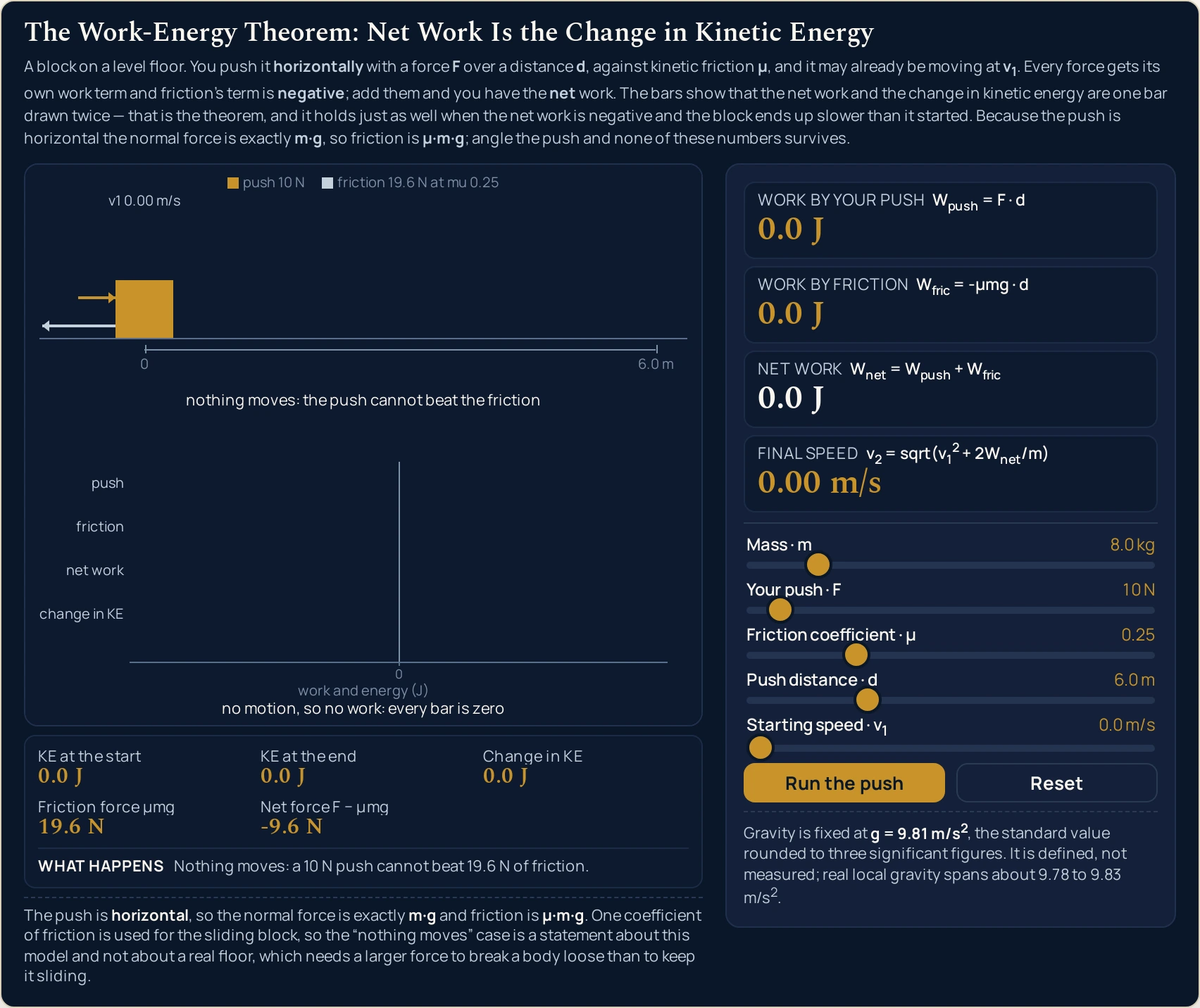
| Nothing moves | 8.0 kg · 10 N · μ 0.25 · 6.0 m · from rest | 0.0 J | 0.0 J | 0.0 J | 0.0 J | 0.0 J | 0.0 J | 0.00 m/s |
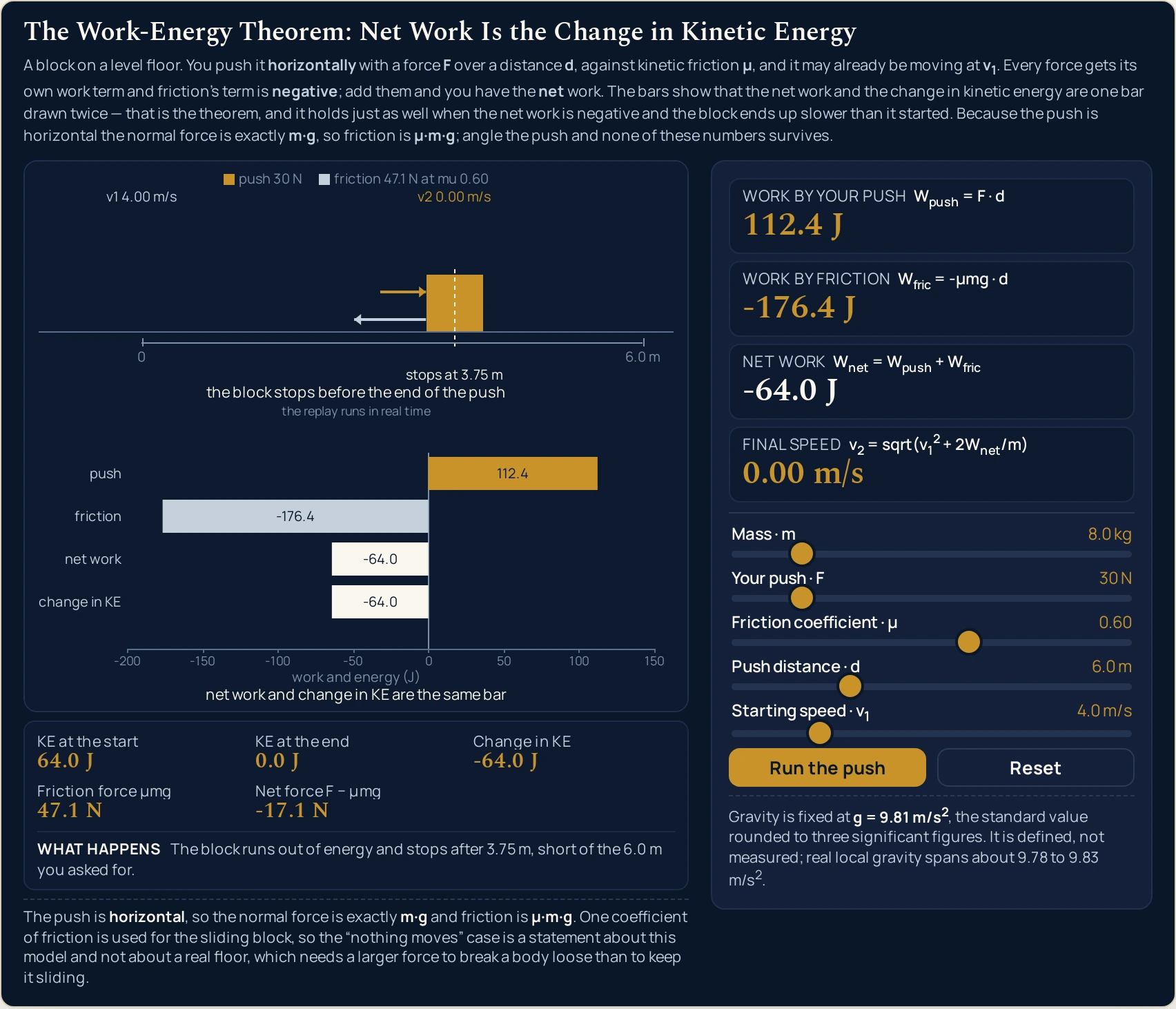
| A push that still loses | 8.0 kg · 30 N · μ 0.60 · 6.0 m · 4.0 m/s | 112.4 J | -176.4 J | -64.0 J | 64.0 J | 0.0 J | -64.0 J | 0.00 m/s |
| The biggest push the panel allows | 50.0 kg · 200 N · μ 0.20 · 20.0 m · from rest | 4000.0 J | -1962.0 J | 2038.0 J | 0.0 J | 2038.0 J | 2038.0 J | 9.03 m/s |
The last two columns are the whole point. Net work and Change in KE carry the same figure in all twelve rows — positive, negative and zero — and they are not copies of one another. One is built from the forces and the distance, the other from the two speeds. Nothing in the lab makes them agree; the physics does.
Rows 3 and 5 make the same change and get opposite answers. Doubling the push to 80 N adds 240.0 J to the push work and leaves friction alone at -117.7 J, so the net work nearly triples. Doubling the mass to 16.0 kg leaves the push work at 240.0 J and doubles friction's bite to -235.4 J, and the net work collapses from 122.3 J to 4.6 J. The speed goes with it: 0.75 m/s instead of 5.53.
Row 6 separates the two halves of the equation. Starting at 3.0 m/s instead of rest changes neither work figure, so Net work stays at 122.3 J; what moves is the energy either side of it, from 36.0 J to 158.3 J instead of 0.0 J to 122.3 J. The theorem is about the change, and it never cared what the block was doing beforehand. If you want the standing value of ½mv2 at one instant rather than a change in it, that is the kinetic energy calculator's job.
Rows 8, 9 and 11 are the ones worth dwelling on. Take the push away and let an 8.0 kg block coast at 4.0 m/s and friction does all the work: -64.0 J, exactly the 64.0 J the block had, and it stops after 3.26 m. Row 11 keeps a 30 N push on a coefficient of 0.60 and the block still loses, stopping after 3.7453 m, which the status line rounds to 3.75 m — and Work by your push then reads 112.4 J, because 30 N only acted over that distance and not the 6.0 m asked for.
Row 10 is the case with no motion in it. A 10 N push against 19.6 N of friction moves the block nowhere, so no force covers any distance and every work figure is 0.0 J. The Net force stat still reads -9.6 N, because that stat is always the raw subtraction; here it is the size of the shortfall rather than anything acting. It has not stopped, it has not started.
Formula and symbol reference
The lab works left to right. It multiplies your push by the distance covered, multiplies the coefficient by the weight and then by the same distance to get friction's negative term, adds the two, and turns the answer into a speed with v2 = sqrt(v12 + 2Wnet/m). Because the push is horizontal the normal force is exactly the weight, which is what makes friction μmg and nothing more complicated.
| Symbol | Meaning | SI unit | In this lab |
|---|---|---|---|
| m | Mass of the block. It does not cancel here, because your push is a number you set rather than something that grows with the mass | kilogram, kg | 0.5 to 50.0 in steps of 0.5, reading back as “8.0 kg” after Reset. At 0.5 kg the opening push gives “232.6 J” of net work and “30.51 m/s”; at 50.0 kg it gives “0.0 J”, because 40 N cannot beat “122.6 N” of friction. |
| F | Your push. One force, horizontal, and constant over the whole distance — not the net force | newton, N | 0 to 200 in steps of 1; “40 N” after Reset. Taken to 200 N on the opening block and floor it does “1200.0 J” of work for a net “1082.3 J” and a final “16.45 m/s”. |
| μ | Coefficient of kinetic friction between the block and the floor. A number you choose, never a measured property of a named surface | none — it is a ratio | 0.00 to 1.00 in steps of 0.01; “0.25” after Reset. At 0.00 the friction card reads “0.0 J” and the push keeps everything it does; at 1.00 the friction force is “78.5 N” and a 40 N push shifts nothing at all. |
| d | Push distance: how far you mean to push, which is not always how far the block gets | metre, m | 0.5 to 20.0 in steps of 0.5; “6.0 m” after Reset. At 20.0 m the opening push does “800.0 J” against “-392.4 J” of friction, for a net “407.6 J”. |
| v1 | Starting speed: what the block is already doing when the push begins. A magnitude, so it is never negative | metre per second, m/s | 0.0 to 20.0 in steps of 0.1; “0.0 m/s” after Reset. It moves both energy stats together and leaves the net work alone: at 20.0 m/s they read “1600.0 J” and “1722.3 J” while Net work is still “122.3 J”. |
| v2 | Final speed. Worked out from the kinetic energy at the end rather than set by you | metre per second, m/s | Two decimals: “5.53 m/s” after Reset, “30.51 m/s” for a 0.5 kg block under the same push, and “0.00 m/s” whenever the block stops early or never starts. |
| Wpush | Work your push does: the push multiplied by the distance the block actually covers | joule, J | One decimal: “240.0 J” after Reset and “4000.0 J” at the panel's largest setting. When a 30 N push over a nominal 6.0 m stops the block early, the figure is worked out over the 3.7453 m it actually covered, so it reads “112.4 J” and not 180.0 J. |
| Wfric | Work friction takes. Never positive, because sliding friction always opposes the motion | joule, J | “-117.7 J” after Reset, exactly “0.0 J” with the coefficient at zero or on a block that never starts, and “-1962.0 J” at the largest setting. |
| Wnet | Net work — the two figures above added, and the left-hand side of the theorem | joule, J | “122.3 J” after Reset, “-64.0 J” where the block ends slower than it started. The lab computes it from the net force and the distance covered, so it can sit a tenth of a joule from the two work cards added by eye. |
| ΔKE | Change in kinetic energy: the energy at the end minus the energy at the start | joule, J | “122.3 J” after Reset, matching Net work. It comes from the two speeds rather than from subtracting the two rounded energy stats, which is why those two can disagree with it in the last decimal. |
| f | Friction force: the coefficient multiplied by the weight, because the push is horizontal | newton, N | “19.6 N” after Reset, “0.0 N” with the coefficient at zero, and “122.6 N” under a 50.0 kg block on the opening floor. |
| F − f | Net force, printed raw at every setting the panel can reach — including the ones where the block never moves | newton, N | “20.4 N” after Reset and “-9.6 N” for a 10 N push on a block that stays put. In that second case it is how far the push falls short, not a force doing anything. |
| g | Standard acceleration of free fall. Fixed text under the sliders, not a control | metre per second squared, m/s2 | Fixed at 9.81, which is the defined 9.80665 rounded to three significant figures. Real local gravity spans roughly 9.78 to 9.83, and nothing here is a claim about a particular place. |
Two of those rows are worth reading together. Wpush on its own is the quantity the guide to work done in physics covers, including the angled push this lab deliberately leaves out, and ½mv2 on its own is taken apart in the kinetic energy formula explained. Neither page joins them up. That joining is what the Net work card and the ledger under the drawing do.
The lab writes its equations without Greek on the canvas, so the ledger's bars are labelled push, friction, net work and change in KE in plain words, over a scale captioned “work and energy (J)”. In the panel the cards carry their formula lines properly typeset. The units are ordinary: a joule is a newton metre, and a newton is a kilogram metre per second squared.
The physics: why the two ledger bars always finish level
Push a block with a constant net force and it accelerates steadily, so the extra speed it gains depends on how far the force acts rather than on how long. Multiply that net force by the distance and you have the net work; the quantity it changes is ½mv2. That is the whole theorem, and it is why a force and a distance are enough to give you a speed with no clock anywhere in the argument.
The lab makes the bookkeeping visible rather than asserting it. Your push contributes F·d, positive because it points the way the block is going. Friction contributes −μmgd, negative because it points the other way, and the minus sign is not decoration — it is the reason the third bar is shorter than the first.
Watch the opening setting as an audit. Your 40 N push over 6.0 m delivers 240.0 J; friction at 19.62 N over the same 6.0 m removes 117.7 J of it; 122.3 J is what the block is left holding, and 5.53 m/s is what 122.3 J looks like on 8.0 kg. The Friction force stat prints that force as 19.6 N. The missing 117.7 J has not vanished — it has gone into heating the block and the floor, which is energy the block no longer has.
The fourth bar is drawn from different numbers on purpose. Net work comes from the forces and the distance; Change in KE comes from the two speeds. They are computed by separate routes and end on the same pixel, which is the demonstration rather than a drawing convention. The full guide to the work-energy theorem works the method through on eight problems, from a crate on a floor to a car under braking.
Negative net work is the case people expect least and meet most. Load A push that still loses: 30 N is pushing, friction at 47.1 N is winning, and the net work is -64.0 J, exactly the kinetic energy the block had. It ends at rest, and the theorem has told you that without any mention of how long the slide took.
There is a partner equation worth knowing about here. Swap the force and the distance for a height and the same trade appears as gravitational potential energy turning into kinetic energy, which is what the conservation of energy calculator is built around. A problem that hands you a slope and a distance belongs on this page; one that hands you a drop belongs on that one.
Where the work energy theorem simulator breaks down
The lab solves its own model exactly, so nothing on screen ever fails. Everything below is a limit of that model, of the situation it stands for, or of the way numbers are printed, and each item says what the lab does about it.
- The push is horizontal, and that is load-bearing
- Because your force is level with the floor, it cannot change how hard the block presses down, so the normal force is exactly the weight and friction is exactly the coefficient times it. Tilt the push and neither statement survives: part of it lifts or loads the block, the friction changes, and only the component along the floor does any work. That case has its own tool in the work done simulator, which puts an angle slider beside the force and the distance.
- One coefficient of friction, so no threshold to break
- A real surface usually resists starting a body sliding more than it resists keeping it going, and this lab has no second number for that. The fixed note under the drawing says so in the lab's own words. So the nothing moves branch is a statement about this model: on a real floor a push the lab calls just sufficient might still shift nothing, and one it calls insufficient will certainly shift nothing.
- A rigid block that slides and cannot spin
- Everything here counts the energy of moving along and nothing else. A cylinder that rolls, a wheel that spins or a box that tips would each carry kinetic energy this model cannot see, and the speed the lab reports would be too high for all three. The block also cannot deform, so none of the push goes into crushing it.
- The two work cards do not always add up on screen
- They add up exactly as quantities. Each is rounded to one decimal place on its own, though, and Net work is computed from the net force rather than from the two rounded figures, so the display can disagree by a tenth of a joule. Set 0.5 kg, 137 N, a coefficient of 0.50 and 20.0 m and you get 2740.0 J and -49.1 J against a net of 2691.0 J. Read the card rather than adding the other two.
- Subtracting the two energy stats is not a proof either
- The same rounding bites the other pair. At 0.5 kg, no push, a coefficient of 0.05, 0.5 m and 3.0 m/s the stats read 2.3 J and 2.1 J, a gap of 0.2 J, while Change in KE and Net work both read -0.1 J. The theorem holds exactly in the quantities; it is the printing that is lossy, and the lab gives you a Change in KE stat so you never have to do that subtraction.
- The net force stat is raw, even when nothing is happening
- It is your push minus the friction force at every setting the sliders can reach, which means it can read a negative number beside a block that is standing still — -9.6 N under a 10 N push on the opening floor. In that branch it is the amount by which the push falls short, and treating it as a force that acts would predict an acceleration backwards that never occurs.
- The replay is a picture, not a measurement
- A real push at these settings can take half a minute or a few milliseconds, so the replay's clock is stretched or squeezed to land between 0.8 and 3.0 seconds and the canvas says which of the three it is doing. The theorem gives you a speed and a distance and nothing else — no time, no direction. When you do need the timing, a constant acceleration is what the SUVAT equations want, and they hand you a duration this page cannot.
- Gravity is a convention here, not a measurement
- The panel fixes it at 9.81 metres per second squared, the defined value rounded to three significant figures, and real local gravity runs from roughly 9.78 to 9.83. That spread moves the friction force by about half a percent, which is invisible at the lab's one decimal place on most settings. No figure here belongs to a named place.
- Every number is a setting, not an observation
- The mass, the push, the coefficient, the distance and the starting speed are all things you typed in, and nothing in the lab has measured a crate, a floor or a warehouse. The panel will happily hold a 50.0 kg block under a 200 N shove for 20.0 m; whether anybody could do that is a separate question the arithmetic has no view on.
Where the work energy theorem is actually used
- Shifting something heavy across a floor
- A wardrobe, a pallet or a full filing cabinet is exactly this lab's scene, and the question is always the same: will the shove I can manage get the thing where I want it. The lab prices both halves — the energy you put in and the share friction takes straight back out — and the Nothing moves case is the one everybody has met in a doorway.
- Chutes, slides and roller conveyors
- A parcel released at the top of a run has a fixed amount of energy and a rough surface taking it away at a steady rate, so whether it reaches the end is a work sum rather than a timing one. Design for the worst case and you want the coasting rows: a light parcel with a low starting speed on a rough section stops short, and the status line tells you how short.
- Working out how far something will slide before it stops
- Take the push to zero, give the block a speed and the lab becomes a stopping-distance tool: 8.0 kg at 4.0 m/s on a coefficient of 0.25 travels 3.26 m, and on 0.50 from 3.0 m/s it manages 0.92 m. The same reasoning is how a skid length is turned back into a speed, and it is why the distance climbs with the square of the speed rather than in step with it.
- Checking that a drive is strong enough before anything moves
- Conveyors, winches, sliding doors and linear actuators all have to beat friction before they do anything at all, and a specification that ignores it produces a machine that hums and sits still. The Friction force stat is the number to beat; the friction calculator works it out from a coefficient and a normal force for cases this lab's sliders do not reach.
- Sliding games, from curling to shuffleboard
- Every one of them is a body given some kinetic energy once and then allowed to lose it to a surface, and the players are estimating this equation by feel. Drop the coefficient towards the bottom of its range to see why ice lets a stone run so far, and why sweeping in front of it is worth doing at all.
- The school practical with a block, a spring balance and a metre rule
- Pull a block along a bench with a steady measured force over a measured distance, then compare the speed you observe against the one energy predicts. The shortfall is friction, and this lab is that experiment with the shortfall shown as its own card. A tilted bench changes the sum, which is what the friction on an incline lab and the inclined plane calculator are for.
- Costing the energy a process actually wastes
- The ledger is an energy audit in miniature: of the 240.0 J your push delivers at the opening setting, 117.7 J never reaches the block as motion. Scaled up, that is the argument for wheels, rollers, bearings and lubricant. Rate rather than total is a different question, and it belongs to the work and power calculator.
Where to go next
For the method itself — list the forces, work out each one's term with its sign, add them, set the sum equal to the change in kinetic energy — with eight worked problems of rising difficulty, read The Work-Energy Theorem. The two halves it joins each have a page of their own: what work done in physics means, with the work and power calculator and the work done simulator for the angled case, and the kinetic energy formula explained, with the kinetic energy calculator beside it.
From here the natural next steps are sideways. Heights instead of forces are the conservation of energy calculator and the conservation of energy simulator; a slope instead of a level floor is the friction on an incline lab; a time instead of a distance is momentum and impulse, with the impulse calculator. The rest of the collection is in the library of physics simulations and on the blog.
Frequently asked questions
Why do the two work boxes sometimes not add up to the net work?
Because each box is rounded to one decimal place on its own, while the lab works the net work out from the net force rather than by adding the two rounded figures. Set 0.5 kg, a 137 N push, a coefficient of 0.50 and 20.0 m: the boxes read 2740.0 J and -49.1 J, which sum to 2690.9 J, while Net work reads 2691.0 J. The quantities add exactly; the printed figures need not.
Can I check the theorem by subtracting the two kinetic-energy stats?
Not reliably, which is why the lab gives you a Change in KE stat instead. Try 0.5 kg, no push at all, a coefficient of 0.05, 0.5 m and a starting speed of 3.0 m/s: KE at the start reads 2.3 J and KE at the end 2.1 J, a difference of 0.2 J, while Change in KE and Net work both read -0.1 J. Read the stat, not the subtraction.
Why does the net force show a negative number while nothing is moving?
Because that stat is always the raw push minus the friction force, at every setting the panel can reach. With 8.0 kg, a 10 N push and a coefficient of 0.25 it reads -9.6 N while the block sits perfectly still, so it is the amount the push falls short by rather than a force that acts. The status line says the same thing in words: nothing moves, because 10 N cannot beat 19.6 N of friction.
Does Run the push tell me how long the push takes?
No, and it should never be read as a stopwatch. The replay uses the real motion of a constant net force, but the clock is stretched or squeezed to land between 0.8 and 3.0 seconds of screen time, and a caption says whether it is running in real time, sped up to fit, or slowed down to be watchable. The theorem itself hands you a speed and never a duration.
What happens when the block stops before the end of the push?
Every work figure is then worked out over the distance actually covered, not the distance you asked for. With 8.0 kg, a 30 N push, a coefficient of 0.60, 6.0 m and a starting speed of 4.0 m/s the block stops after 3.7453 m, which the status line rounds to 3.75 m, and Work by your push reads 112.4 J rather than the 180.0 J that a full 6.0 m would suggest. The block ends at rest.
Why is the friction force always the coefficient times the weight here?
Because the push in this lab is horizontal, so nothing you set changes how hard the block presses on the floor. The normal force is the weight, and the friction force is the coefficient multiplied by it. Angle the push even slightly and that stops being true, because part of it then lifts or loads the block, and every figure on the panel moves as a result.
Does doubling the push distance always double the net work on screen?
The quantity doubles every time; the printed figure does not always follow. From the opening setting, going from 0.5 m to 1.0 m gives 10.2 J and 20.4 J, and going from 6.0 m to 12.0 m gives 122.3 J and 244.6 J, both exactly double. Go from 3.0 m to 6.0 m instead and you get 61.1 J and 122.3 J, a tenth of a joule adrift, purely from rounding.
Does the lab model the extra force needed to break a block loose?
No. One coefficient of friction is used throughout, so there is no separate static threshold anywhere in the model. A real floor usually demands more force to start a body sliding than to keep it going, so a push this lab calls just enough might shift nothing in practice. Treat the nothing-moves case as a statement about the model rather than about a floor.
References & formula source
- Halliday, Resnick and Walker, Fundamentals of Physics: Kinetic Energy and Work, for the work a constant force does along a straight path and the sign convention that makes a friction term negative.
- Young and Freedman, University Physics: Work and Kinetic Energy, for the theorem stated as a NET quantity, and for why it is the tool of choice when the time taken is neither known nor wanted.
- Serway and Jewett, Physics for Scientists and Engineers: Energy of a System, for a block sliding on a rough horizontal surface worked through as an energy balance rather than as a force diagram.
- Kleppner and Kolenkow, An Introduction to Mechanics: Work and Energy, for the derivation from the equation of motion and for a careful account of what the result does not tell you.
- Gravity in this lab is the standard acceleration of free fall, 9.81 metres per second squared, which is the defined value 9.80665 rounded to three significant figures. It is a convention rather than a measurement, real local gravity spans roughly 9.78 to 9.83, and no figure on this page describes a particular floor, block, surface or place. Verify against your own apparatus before use.
- Further reading: Work (physics) — Wikipedia