The Newton’s third law simulator is a free interactive lab built round one identity, F_12 = -F_21, read here as the force on body 1 exerted by body 2. Three sliders set the mass of A, the mass of B and the single pair force between them; four cards answer, and one of those four will not move however far you drag either mass. That refusal is the half of the law most people skip.
Newton's Third Law: One Interaction, Two Bodies
A and B are in contact on a frictionless track. Set both masses and the one pair force, and watch what does not change: F_12 = -F_21, so the pair force is a single magnitude felt by each body, and moving either mass cannot move it. Throughout this lab F_12 means the force ON body 1 exerted BY body 2 — the first subscript is the body that feels the force — and every force is named "on X by Y". The two forces never cancel, because they act on different bodies. What the masses do change is the accelerations: a_A = F / m_A and a_B = F / m_B, so a_A : a_B = m_B : m_A. Computed figures are given to four significant figures.
Load a real pair of bodies
Each button writes the three sliders and nothing else, which is exactly what your own hand would do. They are arranged as a ladder: the mass ratio widens from equal to a thousand to one as you go down, and the column of readings that moves tells you what the masses are responsible for.
Press them in order and watch two things at once. The Ratio card walks 1.000, 1.600, 4.000, 40.00, 1000 — and the two product rows in the stats block stay welded to the Pair force card in every one of the five. None of the buttons touches the motion, so the drift carries on through the whole sequence.
Pick one of the five cases above, or drag the three sliders yourself.
What Is the Newton's Third Law Simulator?
The Newton's third law simulator is a free interactive physics lab that runs in your browser, with nothing to install and no sign-up. Two bodies, A in gold and B in cream, touch at a single contact point on a frictionless horizontal track. Three sliders set the mass of each body and the one pair force acting between them, and four cards answer: the pair force itself, the acceleration of each body, and the ratio of those two accelerations.
The convention is fixed once and printed three times rather than assumed. F_12 here means the force on body 1 exerted by body 2, so the first subscript names the body that feels the push. It appears on the Pair force F card's sub-line as the same on both bodies — F_12 = -F_21, in the first sentence strip under the drawing, and again in the fixed definition line below it. Textbooks genuinely split on which subscript comes first, so a reader who takes the other order from somewhere else would differ from this lab by a sign.
One card is the point of the whole panel, and it is the one that refuses to move. Hold the force slider at 40 N and drag Mass of B from 2.0 kg all the way to 2,000.0 kg: Pair force F reads 40.00 N at every step, while Ratio a_A : a_B climbs from 1.000 : 1 through 4.000 : 1 and 40.00 : 1 to 1000 : 1. A pair force belongs to the interaction, not to either mass, and a thousandfold change in one body cannot touch it.
Move the force slider instead and the opposite happens. On the opening trolleys, taking it from 40 N to 400 N takes Acceleration of A a_A from 20.00 m/s2 to 200.0 m/s2 and Acceleration of B a_B from 5.000 m/s2 to 50.00 m/s2, and leaves the ratio card sitting at 4.000 : 1 in both states. One slider owns how large the two accelerations are; the other two own how they divide.
Four more rows sit under the cards, and two of them carry the argument people usually get wrong. m_A a_A and m_B a_B are equal to each other and to the pair force at every setting the sliders reach. Then Sum over the pair reads 0.000 N and Sum on A alone reads the whole force, 40.00 N at the opening setting, at the same instant. Those are sums over different things, which is exactly why two equal and opposite forces on two different bodies never cancel.
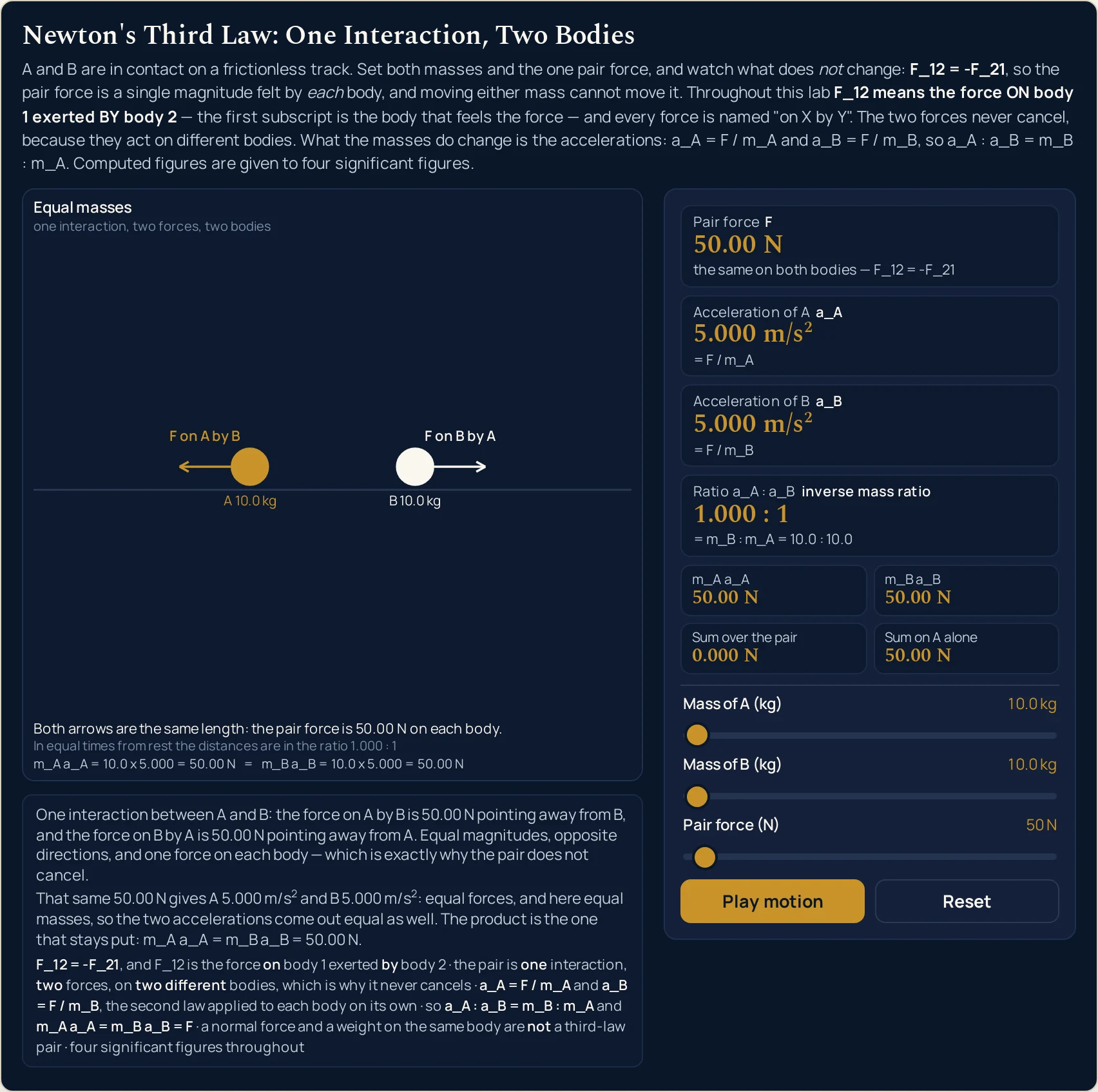
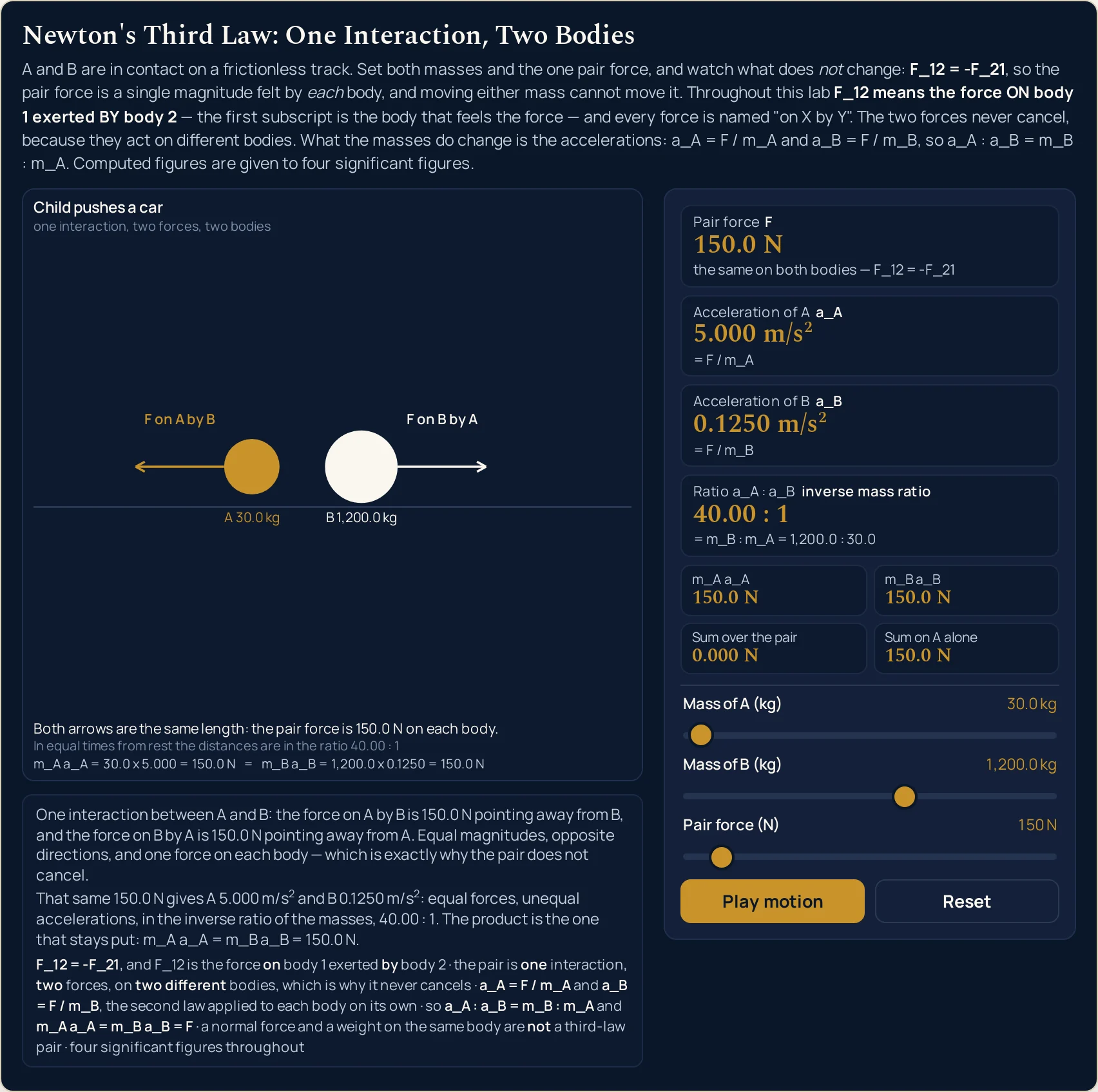
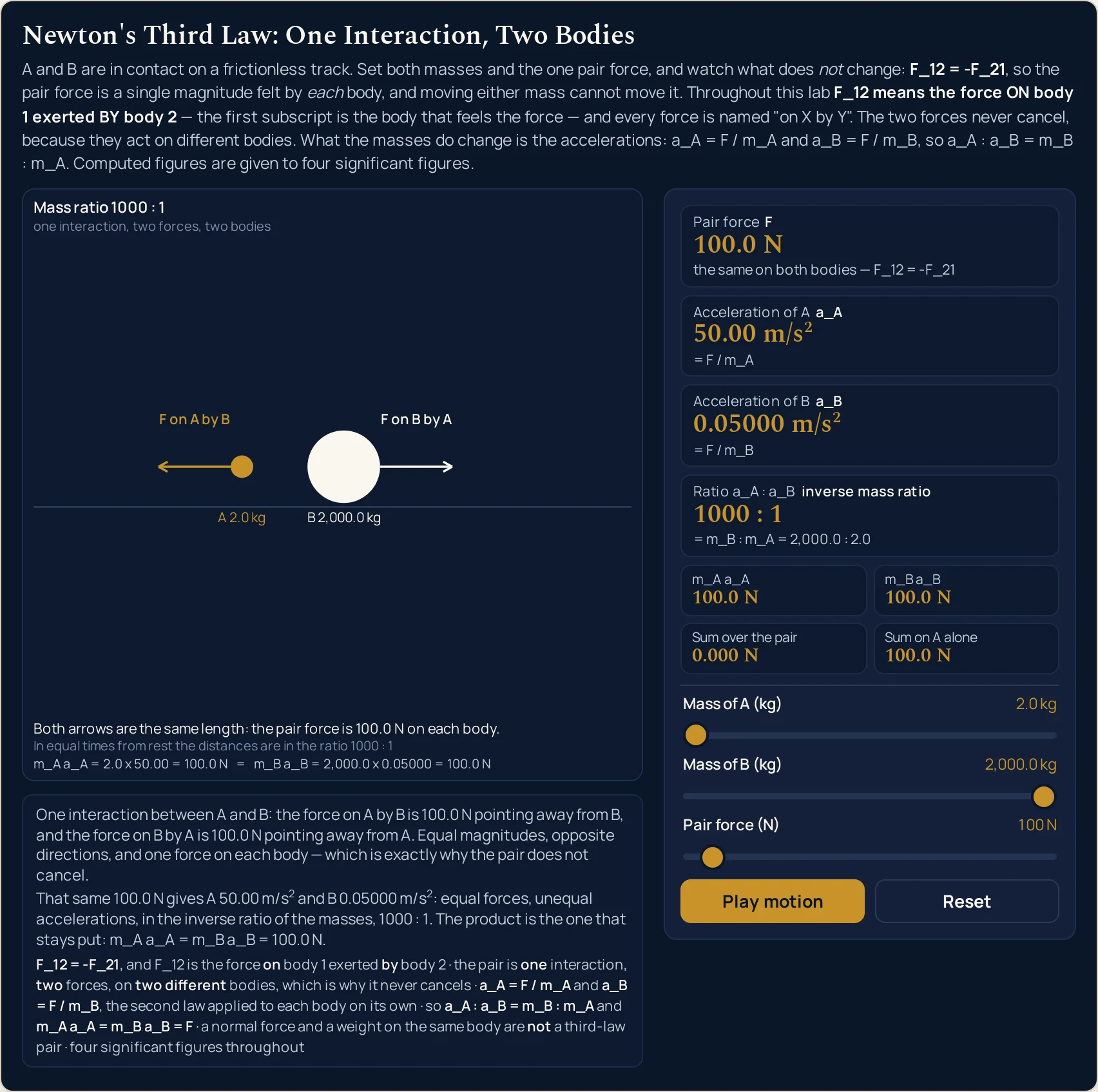
Five preset cases are the only settings that give the scene a name, and they widen the mass ratio as you go down: equal masses at 10.0 kg each, two students pushing off at 50.0 against 80.0 kg, the opening trolleys at 2.0 against 8.0 kg, a child pushing a car at 30.0 against 1,200.0 kg, and a thousand-to-one pair at 2.0 against 2,000.0 kg. Nudge any slider off one of those value sets and the lab stops claiming a case and titles the scene plainly instead, which is a refusal rather than a fault.
Two sentences under the drawing do the work a card cannot. The first names both halves of the pair with both bodies attached; the second turns the one force into the two accelerations, and it rewrites itself when the masses match, reporting equal forces, and here equal masses, so the two accelerations come out equal as well where every other case reports the inverse ratio. A fixed line below those two gives the six relations the lab uses and states outright that a normal force and a weight on one body are not a third-law pair.
The drawing is a side view rather than a plot and it has no axes. One arrow is drawn on each body, pointing away from the other, and the two are always the same length, because one interaction has one magnitude. That length grows with the square root of the pair force rather than in proportion to it, so an arrow is never a scale reading of a force.
The body radii are compressed and clamped in the same way, and when that clamp ties two unequal masses the scene tries to say so in words. Where the note will not fit, the mass printed under each body is what tells the two apart, and a pane too small to draw any text at all claims nothing. By one of those three routes the picture never suggests that two different masses are alike.
The two bodies drift apart in the ratio of their accelerations from the moment the lab loads, and the Motion button pauses that drift. Nothing the drift touches reaches a readout, and every computed figure is given to four significant figures with the trailing zeros kept.
| Control | Range | Step, default and what it moves |
|---|---|---|
| Mass of A | 0.1 to 2,000 kg | step 0.1 kg; opens at 2.0 kg. A is the gold body on the left of the drawing, and this slider moves its acceleration and the ratio card but never the pair force. The chip takes a thousands separator from 1,000 upwards, so the top of the slider reads 2,000.0 kg |
| Mass of B | 0.1 to 2,000 kg | step 0.1 kg; opens at 8.0 kg. B is the cream body on the right, and this is the slider worth dragging on its own first: it walks the ratio card from 1.000 : 1 to 1000 : 1 while the pair force card stays at 40.00 N |
| Pair force | 1 to 2,000 N | step 1 N; opens at 40 N. The single magnitude both bodies feel in full. It scales both accelerations together and leaves the ratio card untouched. The chip reads 2,000 N at the top while the card reads 2000 N, because a card is four significant figures and a chip echoes the setting |
| Motion | Pause motion / Play motion | one button, and the drift is already running when the lab loads, so the button starts out reading Pause motion. Pressing it freezes the frame. Nothing the drift touches reaches any readout, so pausing changes no reading at all |
| Reset | back to the opening setting | one button; it restores all three sliders to 2.0 kg, 8.0 kg and 40 N and leaves the drift running |
How to use the Newton’s third law simulator
- Read the four cards before you touch anything. They are already answering for a light trolley pushing a heavier one: Pair force F 40.00 N, Acceleration of A a_A 20.00 m/s2, Acceleration of B a_B 5.000 m/s2 and Ratio a_A : a_B inverse mass ratio 4.000 : 1. The three sliders stand at
2.0 kg,8.0 kgand40 N. - Check which body each subscript belongs to before you read a sign. The first card’s sub-line puts the convention in front of you,
the same on both bodies — F_12 = -F_21, and the lab takes the first subscript to be the body that feels the force. The Newton’s third law examples guide is where that habit of naming both bodies is argued out and applied to seven everyday cases; this panel only ever shows one. - Now drag Mass of B and nothing else, and keep your eye on the first card. Take it to
80.0 kgand the Ratio card reads 40.00 : 1; take it to2,000.0 kgand it reads 1000 : 1. Through both of those the Pair force card has not moved off 40.00 N, and neither has either product row. - Then move the Pair force slider instead, and watch the opposite happen. From
40 Nto400 Non the trolleys, a_A goes 20.00 to 200.0 m/s2 and a_B goes 5.000 to 50.00 m/s2 — and the Ratio card sits there reading 4.000 : 1 in both states. One slider owns the ratio; the other owns the size. - Read the four stats rows under the cards, bottom two first. Sum over the pair is 0.000 N and Sum on A alone is 40.00 N, at the same instant, on the same setting. Those are different sums over different things, and the gap between them is the whole of the do-they-cancel question. The guide to common physics misconceptions takes that one apart with a figure.
- Read the two sentence strips below the canvas, not just the cards. The first names both forces with both bodies attached; the second turns the one force into the two accelerations. The second one rewrites itself when the masses match: press Equal masses and it reports equal forces, and here equal masses, so the two accelerations come out equal as well, where every other preset reports the inverse ratio instead.
- Watch the drawing for a few seconds. Two arrows leave the contact point in opposite directions, drawn to the same length whatever the masses are, and the bodies themselves slide apart in the ratio the fourth card reports. The drift is already running when the page loads; the button beside Reset reads Pause motion, so press it when you would rather have a still frame to read.
- Press Reset to get back to a known state. It returns all three sliders to
2.0 kg,8.0 kgand40 Nand leaves the drift running. Nothing on the panel is stored between visits, so a reset is the fastest way to undo a drag you have lost track of.
Dragging is the right way to find out which reading a control is allowed to move, and a poor way to hit an exact figure — the mass sliders step in tenths of a kilogram and the force slider in whole newtons. When you already know the pair force and want one acceleration typed out, the Newton’s second law calculator does that step on one body at a time. Run it twice, once per body; it has no second mass box and no ratio, which are the two things this panel adds.
Worked example: change one mass at a time
Nothing in the two tables below was worked out here. Each row is a setting the lab was put into and then read back from, cell by cell, so every string in them is the panel’s own. The first table moves exactly one slider between consecutive rows; the second holds the five preset cases side by side.
| Mass chip, A | Mass chip, B | Force chip | Pair force card | Acceleration of A | Acceleration of B | Ratio card | Mass of A times its acceleration | Mass of B times its acceleration |
|---|---|---|---|---|---|---|---|---|
| 2.0 kg | 2.0 kg | 40 N | 40.00 N | 20.00 m/s2 | 20.00 m/s2 | 1.000 : 1 | 40.00 N | 40.00 N |
| 2.0 kg | 8.0 kg | 40 N | 40.00 N | 20.00 m/s2 | 5.000 m/s2 | 4.000 : 1 | 40.00 N | 40.00 N |
| 2.0 kg | 80.0 kg | 40 N | 40.00 N | 20.00 m/s2 | 0.5000 m/s2 | 40.00 : 1 | 40.00 N | 40.00 N |
| 2.0 kg | 2,000.0 kg | 40 N | 40.00 N | 20.00 m/s2 | 0.02000 m/s2 | 1000 : 1 | 40.00 N | 40.00 N |
| 0.1 kg | 2,000.0 kg | 40 N | 40.00 N | 400.0 m/s2 | 0.02000 m/s2 | 2.000e+4 : 1 | 40.00 N | 40.00 N |
| 0.1 kg | 2,000.0 kg | 2,000 N | 2000 N | 2.000e+4 m/s2 | 1.000 m/s2 | 2.000e+4 : 1 | 2000 N | 2000 N |
| 0.1 kg | 2,000.0 kg | 1 N | 1.000 N | 10.00 m/s2 | 0.0005000 m/s2 | 2.000e+4 : 1 | 1.000 N | 1.000 N |
| 0.1 kg | 0.1 kg | 1 N | 1.000 N | 10.00 m/s2 | 10.00 m/s2 | 1.000 : 1 | 1.000 N | 1.000 N |
| 2,000.0 kg | 0.1 kg | 1 N | 1.000 N | 0.0005000 m/s2 | 10.00 m/s2 | 5.000e-5 : 1 | 1.000 N | 1.000 N |
| 2.0 kg | 8.0 kg | 1 N | 1.000 N | 0.5000 m/s2 | 0.1250 m/s2 | 4.000 : 1 | 1.000 N | 1.000 N |
| 2.0 kg | 8.0 kg | 400 N | 400.0 N | 200.0 m/s2 | 50.00 m/s2 | 4.000 : 1 | 400.0 N | 400.0 N |
| 2.0 kg | 8.0 kg | 2,000 N | 2000 N | 1000 m/s2 | 250.0 m/s2 | 4.000 : 1 | 2000 N | 2000 N |
Rows one to four are the walk the page is built on. Only Mass of B moves, from 2.0 kg to 2,000.0 kg, and the Ratio card goes 1.000, 4.000, 40.00, 1000 : 1. The Pair force card reads 40.00 N in all four, and so do both product columns. A thousandfold change in one mass, and the force between the two bodies has not budged.
Rows five to seven do it the other way round and settle the point. Both masses are now pinned at the slider ends, 0.1 kg against 2,000.0 kg, and only the force moves: 40 N, then 2,000 N, then 1 N. Every acceleration in those three rows is different, and the Ratio card reads 2.000e+4 : 1 in all three. The force sets the size of both accelerations; the masses alone set how they divide.
Rows eight and nine are the same pair of masses exchanged. At 0.1 kg each the two accelerations are both 10.00 m/s2; swap 2,000.0 kg into A and the ratio inverts to 5.000e-5 : 1 while Sum over the pair stays at 0.000 N. The label on a body is a choice; the pair force is not.
The last three rows are the force slider swept with the trolleys left alone. At 1 N, 400 N and 2,000 N the two product columns read 1.000, 400.0 and 2000 N — equal to each other and to the card in every row. That is m_A a_A = m_B a_B = F read off the panel rather than derived, and it is the arithmetic the Newton’s second law calculator does one body at a time.
The five preset cases side by side
These are the only five settings that give the scene a title. The last column is the tail of the second sentence strip, and the top row has its own wording because the lab rewrites that sentence when the two masses match.
| Preset | Mass of A | Mass of B | Pair force card | Acceleration of A | Acceleration of B | Ratio card | Sum over the pair | Sum on A alone | What the second sentence strip says |
|---|---|---|---|---|---|---|---|---|---|
| Equal masses | 10.0 kg | 10.0 kg | 50.00 N | 5.000 m/s2 | 5.000 m/s2 | 1.000 : 1 | 0.000 N | 50.00 N | equal forces, and here equal masses, so the two accelerations come out equal as well |
| Two students push off | 50.0 kg | 80.0 kg | 120.0 N | 2.400 m/s2 | 1.500 m/s2 | 1.600 : 1 | 0.000 N | 120.0 N | equal forces, unequal accelerations, in the inverse ratio of the masses, 1.600 : 1 |
| Trolley pushes trolley | 2.0 kg | 8.0 kg | 40.00 N | 20.00 m/s2 | 5.000 m/s2 | 4.000 : 1 | 0.000 N | 40.00 N | equal forces, unequal accelerations, in the inverse ratio of the masses, 4.000 : 1 |
| Child pushes a car | 30.0 kg | 1,200.0 kg | 150.0 N | 5.000 m/s2 | 0.1250 m/s2 | 40.00 : 1 | 0.000 N | 150.0 N | equal forces, unequal accelerations, in the inverse ratio of the masses, 40.00 : 1 |
| Mass ratio 1000 : 1 | 2.0 kg | 2,000.0 kg | 100.0 N | 50.00 m/s2 | 0.05000 m/s2 | 1000 : 1 | 0.000 N | 100.0 N | equal forces, unequal accelerations, in the inverse ratio of the masses, 1000 : 1 |
Read the two sum columns down the page. Sum over the pair is 0.000 N in all five cases and Sum on A alone is the full pair force in all five. The first column is why people think a pair cancels; the second is why nothing of the sort happens to A. Both are on screen at once, which is the only reason this panel can settle the question instead of asserting an answer.
Formula and symbol reference
The lab prints its own relations under the canvas, in the fixed definition line. Written out in the plain-digit form the panel uses, with every subscript as an underscore:
F_12 = -F_21, where F_12 is the force on body 1 exerted by body 2. Then a_A = F / m_A and a_B = F / m_B, the second law applied to each body on its own, from which a_A : a_B = m_B : m_A and m_A a_A = m_B a_B = F. No modulus bars appear anywhere on this page, because a bar either side of a symbol draws as a capital letter I in the site’s fonts.
The condition this panel cannot test for you is the one about force types. Both halves of a pair have to be the same kind of force, and the only kind on this track is contact between two touching bodies — there is no friction, no weight and no normal force to confuse it with. The guide to types of forces sorts those out, and the centrifugal force guide deals with the candidate that fails on a different condition altogether.
Ten rows follow and only three of them are something you drag. The rest are cards, stats rows or quantities the panel names without giving you a control for. For the sliders the right-hand column gives the end stops and the step; for everything else it gives the strings the lab prints and the span it prints them over.
| Symbol or card | Meaning | SI unit | In this lab |
|---|---|---|---|
| F_12 | The force on body 1 exerted by body 2. The first subscript names the body that feels the push, and the lab says so three times rather than leaving it to be guessed | newton | the identity F_12 = -F_21 is printed on the Pair force card’s sub-line, in the first sentence strip and in the fixed definition line. It is not a quantity you can set: there is one force slider and both halves read off it. |
| F | The single magnitude the pair shares, felt in full by each body. The third slider, and the only control that moves both accelerations at once | newton | 1 to 2,000 N in steps of 1, opening at 40 N. The chip above the slider prints 1 N and 2,000 N at the ends; the Pair force card prints the same settings as 1.000 N and 2000 N, because a card is four significant figures and a chip is the setting you chose. |
| m_A | Mass of body A, the gold body on the left of the drawing. The first slider | kilogram | 0.1 to 2,000 kg in steps of 0.1, opening at 2.0 kg. The chip takes a thousands separator from 1,000 upwards, so the top of the slider reads 2,000.0 kg and never 2000.0 kg. |
| m_B | Mass of body B, the cream body on the right. The second slider, and the one worth dragging on its own first | kilogram | the same 0.1 to 2,000 kg in steps of 0.1, opening at 8.0 kg. Dragging it alone from 2.0 kg to 2,000.0 kg walks the Ratio card from 1.000 : 1 through 4.000 : 1 and 40.00 : 1 to 1000 : 1, and leaves the Pair force card at 40.00 N throughout. |
| a_A | The acceleration the pair force alone gives A. The second card, with the sub-line = F / m_A |
metre per second squared | the widest span the grid allows is 0.0005000 m/s2 at the bottom (2,000.0 kg with 1 N) to 2.000e+4 m/s2 at the top (0.1 kg with 2,000 N). Four significant figures throughout, with the exponent form taking over once the figure leaves that window. |
| a_B | The acceleration the same pair force gives B. The third card, with the sub-line = F / m_B |
metre per second squared | the same span, because the two sliders have the same ends. Reading the two cards together is the point: at 0.1 kg against 2,000.0 kg with 1 N they read 10.00 m/s2 and 0.0005000 m/s2 from one and the same force. |
| Ratio of the two | The fourth card, labelled Ratio a_A : a_B inverse mass ratio, with the masses themselves printed underneath it |
a ratio, so no unit | from 5.000e-5 : 1 to 2.000e+4 : 1 across the slider ends, with 1.000 : 1, 1.600 : 1, 4.000 : 1, 40.00 : 1 and 1000 : 1 among the five presets. The sub-line shows the masses that produced it the other way round, for instance = m_B : m_A = 1,200.0 : 30.0. |
| Products | The first two stats rows, m_A a_A and m_B a_B — the second law run backwards on each body in turn |
newton | they are equal to each other and to the Pair force card at every setting in both tables above: 40.00 N, 120.0 N, 1.000 N, 2000 N. The product band at the foot of the canvas shows the same two multiplications written out. |
| Sum over the pair | The third stats row: the two halves of the pair added together, which is a sum over two bodies and not over one | newton | 0.000 N at every setting the three sliders can reach, and nothing on the panel can make it anything else. It is the half of the cancelling question that people remember. |
| Sum on A alone | The fourth stats row: the forces on body A added together, which is the sum that actually decides what A does | newton | the whole pair force, every time — 40.00 N at the opening setting, 150.0 N on Child pushes a car. It is the half of the cancelling question that gets forgotten, and the panel prints the two sums side by side, stacking them only on the narrowest screens, so the difference is hard to miss. |
If you read one row twice, make it the pair of stats rows at the bottom. They are the only two readings on the panel that are deliberately about each other, and a reader who has them side by side will not again be told that a third-law pair cancels out.
The physics: why the pair force ignores the masses
A pair force is a property of the interaction, and an interaction has one magnitude. Both bodies are in it, so both feel the whole of it; nothing is halved and nothing is shared. The panel makes that checkable rather than merely stating it: hold the force slider still, sweep either mass over its full four-decade range, and the first card never moves.
What the masses do change is what each body does with that force, and the second law decides that one body at a time — the guide to Newton’s laws of motion sets the three laws out together. Divide the two accelerations and the force cancels, leaving the masses the other way round; multiply each back and the one force reappears. Both of those are on the panel simultaneously — the fourth card and the two product rows — which is why no step of the argument has to be taken on trust here.
The two forces never cancel, and the reason is arithmetic rather than rhetoric. Cancelling is what forces do inside one body’s own sum, and these two are never in the same sum. Sum over the pair and Sum on A alone are the two sums printed side by side, reading 0.000 N and the whole pair force at the same instant. The free-body diagram guide is where choosing which body to sum over becomes a drawing habit.
This is also where the third law stops being a curiosity and starts being useful. Equal and opposite forces acting for the same time on two bodies change their momenta by equal and opposite amounts, which is why an isolated pair keeps the momentum it started with — the conservation of momentum guide works that through. This panel stops at forces and accelerations: it has no clock and reports no velocity.
Where the Newton’s third law readings break down
Every slider position this lab can reach is answered, and the arithmetic is not where it can let you down. The drawing is, and so is the number formatter. Seven limits sit under the readings on this page, and six of them are choices the lab makes on purpose rather than failures; the seventh is a boundary in the law itself rather than in this panel.
- An arrow length is not a force reading, and the drawing never claims it is
- The two arrows are equal to each other at every setting, and that equality is the physics. Their length grows with the square root of the pair force rather than in proportion to it, at 5.6 pixels per square root of a newton, with an 18 pixel floor and a ceiling set by the room the scene has left, because the slider spans 1 N to 2,000 N. On a 612 pixel canvas that gives arrows of 18.0, 35.4, 56.0, 112.0, 177.1 and 205.2 pixels at 1, 40, 100, 400, 1000 and 2,000 N. Read the force off the card.
- Nor is a body’s drawn size a mass reading, and the scene says so when it has to
- A radius grows with the cube root of the mass and is then held between a floor and a ceiling that scale with the canvas, 9 and 34 pixels at full width, so that a twenty-thousand to one ratio still shows two visible bodies instead of one dot and one wall. When that clamp ties the two radii while the masses differ, the scene tries to say so in words, and where the note will not fit the mass labels under the bodies carry the reading on their own. Those labels, and the chips above the sliders that agree with them, are the honest reading of a mass — never the drawn size.
- A chip and a card print the same setting differently, and neither is wrong
- Push the force slider to the top and the chip reads
2,000 Nwhile the Pair force card reads 2000 N. The chip echoes a setting and takes a thousands separator from 1,000 upwards; the cards print computed figures at four significant figures, and 2000 already carries four. The same split shows on the masses, where the chip reads2,000.0 kgand the ratio sub-line repeats it as= m_B : m_A = 2,000.0 : 2.0. - Four significant figures is the ceiling, and past it the readings switch to exponent form
- Every input here is an exact value you chose on a slider, so there is no measurement uncertainty to propagate and nothing in the physics fixes the number of digits. The lab stops at four with the trailing zeros kept, which is why an acceleration reads 5.000 m/s2 rather than 5. Outside that window the same formatter writes 2.000e+4 : 1 and 0.0005000 m/s2, which are readings rather than overflows.
- Zero mass and zero force are off the grid on purpose, so no reading is ever undefined
- The mass sliders stop at
0.1 kgand the force slider at1 N. That is what keeps dividing the force by a mass from being a division by zero, and keeps the ratio of the two accelerations from being zero over zero. There is no setting on this panel at which a card has to refuse, which is unusual for a lab here and is a consequence of where the sliders end rather than of anything clever in the arithmetic. - The track is deliberately bare, and three forces you might expect are simply absent
- No gravity, no normal force and no friction are modelled in this panel: two bodies touch on a frictionless horizontal track and one contact pair acts between them. The track is drawn, but no force from it enters the arithmetic, which is why a weight and a normal force never appear on either body, and why the lab’s own fixed line says outright that those two are not a third-law pair. For which arrows belong on a single body at all, the free body diagram lab is the panel built for the question.
- The pair statement itself has a boundary, and it is well outside anything here
- As written, the pair statement covers two kinds of force: contact between touching bodies, and Newtonian gravity. Between them those account for every setting this panel can reach. Once two charges are moving past one another the field between them carries momentum of its own, which has to go on the books before the two forces balance, and what survives in general is the conservation of momentum rather than the force pair by itself. The Wikipedia article in the references below is the source for that boundary; no figure on this page depends on it.
Where Newton’s third law is actually used
- Aerodynamics, where the whole subject leans on the pair
- NASA’s Glenn Research Center sets out three cases on its beginner’s guide page on Newton’s laws of motion: a jet engine throwing gas backwards and being pushed forwards, a spinning ball deflecting air to one side and curving to the other, and a wing deflecting air downwards and being pushed up in return. Each is one interaction with two named bodies, which is the shape this panel draws; a wing is the one of the three with an argument of its own behind it.
- Two people pushing off, which is the case the panel models most exactly
- Press Two students push off: 50.0 kg against 80.0 kg with a 120.0 N pair force between them gives 2.400 and 1.500 m/s2, a ratio of 1.600 : 1. Both of them really do accelerate, in opposite directions, from one push. On wheeled chairs there is almost nothing else acting horizontally, which is exactly the frictionless track this lab draws.
- Rolling stock and trolleys, where the contact pair is the whole of the engineering
- A coupling or a buffer carries one force with two ends, and the design question is what each end does to the vehicle behind it. Trolley pushes trolley is the arithmetic in miniature: 40.00 N on each of a 2.0 kg and an 8.0 kg body, giving 20.00 and 5.000 m/s2. The light vehicle is the one that gets thrown about, and the force on it is not the reason why.
- Anything a person pushes that is far heavier than they are
- Child pushes a car is the everyday version: 30.0 kg and 1,200.0 kg with 150.0 N between them, giving 5.000 against 0.1250 m/s2 and a ratio of 40.00 : 1. The car moves, and at a fortieth of the rate. This is the setting that makes the law look false in daily life, and the one where the Pair force card is most worth staring at.
- Recoil and separation problems, once a clock is added
- Give the pair a duration and the equal and opposite forces become equal and opposite changes of momentum, which is how a rocket, a gun or a pair of skaters is actually analysed. This panel has no clock, reports no velocity and does none of that: the conservation of momentum guide is where the time interval comes in. What the panel contributes is the step before it, with both bodies named.
Where to go next
A panel can show you which readings a control is allowed to move, and that is the end of what a panel is for. Newton’s Third Law: Examples is where the subject itself is written out: the three-condition pair test, seven everyday cases with both bodies named, the book on the table and the lift that separates its weight from the table’s push, the tug of war, the horse and cart, and eight worked problems. The calculator that finishes the arithmetic one body at a time heads the related tools below.
For the law in its place among the other two, the guide to Newton’s laws of motion is the overview, and the Newton’s laws of motion lab puts all three in one panel. The Newton’s second law lab is the single-body version of the step this one runs twice.
Nearer the questions this panel raises, the guide to common physics misconceptions is where the cancelling claim is taken apart, the free-body diagram guide is which arrows belong on one body, the guide to types of forces is the force-type condition, and the centrifugal force guide settles the candidate that fails on the different-bodies condition.
Further out, the conservation of momentum guide is what the pair becomes once a time interval is involved. Beyond that there is the simulation library to work through, an index of calculators for when typing beats dragging, and the blog for everything written out at length.
Frequently asked questions
Why does the Pair force card never move when I drag a mass slider?
Because the pair force belongs to the interaction rather than to either body. Hold the force slider at 40 N and drag Mass of B from 2.0 kg up to 2,000.0 kg: the Pair force card reads 40.00 N at every step of the way, while the Ratio card climbs from 1.000 : 1 to 1000 : 1. The masses decide the two accelerations and nothing else.
Why are the two arrows the same length when one body is far heavier than the other?
Because one interaction has one magnitude, and the drawing refuses to pretend otherwise. Press Mass ratio 1000 : 1, where A is 2.0 kg against 2,000.0 kg for B, and the two force arrows are still drawn to exactly the same length. What differs is underneath them: the Ratio card reads 1000 : 1, and the bodies drift apart in that ratio.
The arrows barely grow when I push the force slider up. Is the drawing wrong?
No, and the lab states the reason in its own accessible description of the canvas. Arrow length grows with the square root of the pair force rather than in proportion to it, because the slider spans 1 N to 2,000 N and a proportional arrow would be invisible at one end and off the canvas at the other. Read a force off the Pair force card, never off an arrow.
What are the Sum over the pair and Sum on A alone rows for?
They answer the cancelling question in numbers rather than in words. Sum over the pair reads 0.000 N at every setting the three sliders can reach, because the two halves are equal and opposite. Sum on A alone reads the whole pair force, 40.00 N at the opening setting, because only one of the two halves acts on A. Two different sums, two different answers.
Why does the scene title change to Two bodies in contact when I drag a slider?
Because the lab names a case only when all three controls match one of its five stored value sets. Nudge any slider off one of them and it stops claiming a case and prints the plain title instead. That is a refusal rather than a fault: every card carries on answering exactly as before, and the title is telling you honestly that no named case is loaded.
What does a Ratio card reading of 2.000e+4 : 1 mean?
It is twenty thousand to one, written in exponent form because the figure has left the four-significant-figure window the lab prints inside. Put Mass of A at 0.1 kg and Mass of B at 2,000.0 kg, the two ends of the mass slider, and that is the largest ratio the grid reaches. Exchange the two masses and the same card reads 5.000e-5 : 1 instead.
Do the two bodies drift on their own, and does that motion change any reading?
The drift runs from the moment the lab loads, and it changes nothing at all on the panel. The button beside Reset reads Pause motion, so a single press freezes the frame whenever you would rather read than watch. Every card, every stats row and both sentence strips are worked out from the two masses and the one force alone.
Why does a mass chip read 2,000.0 kg while the Pair force card reads 2000 N?
Because the two are formatted for different jobs. The chip above a slider echoes the setting you chose and takes a thousands separator once it reaches 1,000, so 2,000.0 kg and 1,200.0 kg both carry a comma. The cards print computed figures to four significant figures with the trailing zeros kept, and 2000 already carries four of them.
Which body does F_12 act on in this lab?
Body 1, the first subscript. The lab fixes one convention and repeats it three times: on the Pair force card sub-line, in the first sentence strip under the canvas and in the fixed definition line below that. F_12 is the force on body 1 exerted by body 2, so the first subscript names the body that feels the push. Textbooks genuinely split on this, so check any other source before trusting a sign.
References & formula source
- Every figure on this panel comes out of three numbers a reader chooses and three lines of algebra, with nothing fitted and nothing measured. The lab prints those lines on itself, in the fixed definition strip under the canvas: the pair identity F_12 = -F_21, the second law applied to each body on its own as a_A = F / m_A and a_B = F / m_B, and the two consequences a_A : a_B = m_B : m_A and m_A a_A = m_B a_B = F.
- The reading of the subscripts is a convention and this lab states it rather than assuming it. F_12 is the force on body 1 exerted by body 2, so the first subscript names the body that feels the force. Textbooks genuinely split on which subscript comes first, which is why the convention is printed on the Pair force card, in the first sentence strip and in the fixed definition line rather than once in passing. A page that silently used the other order would differ from this one by a sign.
- Four significant figures with the trailing zeros kept is the ceiling on every computed reading, and it is a house choice rather than a limit of the data. All three inputs are exact values chosen on a slider, so there is no measurement uncertainty to propagate and nothing in the physics decides the number of digits. Past that window the same formatter switches to the exponent form, which is why a ratio can read 2.000e+4 : 1 and an acceleration 0.0005000 m/s2.
- A slider chip and a reading card are formatted differently on purpose, and a reader comparing them will see it. A chip echoes the setting chosen and takes a thousands separator from 1,000 upwards, so the force slider at its top reads 2,000 N and the mass slider at its top reads 2,000.0 kg. The cards print the same settings as computed figures at four significant figures: 2000 N, and 2,000.0 kg is never a card reading at all.
- The two force arrows are drawn to exactly the same length, and that equality is the only claim the drawing makes about them. Their length grows with the square root of the pair force rather than in proportion to it, with 5.6 pixels per square root of a newton and an 18 pixel floor, because the force slider spans a two-thousand to one range and a proportional arrow is either invisible at 1 N or off the canvas at 2,000 N. Measured on a 612 pixel canvas at 1, 10, 40, 100, 400, 1000 and 2000 N the arrows are 18.0, 18.0, 35.4, 56.0, 112.0, 177.1 and 205.2 pixels long. The equality itself is asserted to 1.137e-13 pixels over 2880 drawn scenes.
- The body radii are also drawn to a compressed scale and clamped at both ends: the radius grows with the cube root of the mass and is then held between a floor and a ceiling, both of which scale with the canvas and are 9 and 34 pixels at full width, so that even a twenty-thousand to one mass ratio still shows two visible bodies.
- That clamp can therefore draw two unequal masses at the same size, and the scene is built not to let it pass in silence. It tries to say so in words, shortening the note as the space narrows; where no wording fits, the mass labels under the bodies carry the real figures instead, and a scene too small to draw any text at all makes no claim about the sizes. The note itself fitted in 2,630 of the 4,304 tied scenes the harness drew, and one of those three is true in every one of them.
- Two readings the panel cannot produce are worth naming, because the grid refuses them rather than the arithmetic failing. A mass of zero is off the slider, whose minimum is 0.1 kg, so dividing the force by a mass is never a division by zero; and a force of zero is off its slider, whose minimum is 1 N, so the ratio of the two accelerations is never zero over zero. Both ends were swept rather than assumed, and the ratio is finite and positive at every sampled point.
- The drift animation is illustrative in the strict sense that nothing it touches reaches a readout. It runs from the moment the lab loads, loops on a 2.6 second cycle and can be paused with the button beside Reset, and every card, every stats row and both sentence strips are pure functions of the two masses and the one force. That was asserted directly rather than argued: the rendered strings were compared before and after a run of the animation at every width tested and none of them moved.
- Two kinds of force are inside the statement this lab implements: contact between touching bodies, and Newtonian gravity. They are also the only two kinds the three sliders can set up. Push the law out to charges in relative motion and the field between them has momentum of its own that has to be counted, after which the surviving general statement is the conservation of momentum rather than the force pair; the Wikipedia article linked below is the source for that boundary, and no figure on this page depends on it.
- Two engines were compared reading by reading rather than assumed to agree: five slider settings were put side by side in Chrome and in Firefox at four widths and every readout string compared, with 19 assertions passed and 0 failed. There is a hole in that, and it is Safari. The WebKit build on this machine will not start without system access it has not been given, so Safari was never exercised here and nothing on this page is evidence about it.
- Every reading quoted on this page is a string this simulation printed for the slider positions named beside it, read back out of the running lab in a browser rather than worked out by hand. The arrow and radius figures in the two paragraphs above are drawing measurements rather than readouts, and are named as such where they appear. Where a figure here and the lab part company, believe the lab, and verify anything you rely on before using it.
- Further reading: Reaction (physics) — Wikipedia