Classical Mechanics

Newton’s Third Law: Examples

Definition

Newtons third law examples all share one shape: two bodies, one interaction, and two forces equal in magnitude and opposite in direction, written F_12 = -F_21. The pair acts on different bodies, one force on each, so the two can never cancel. Equal forces on unequal masses give unequal accelerations.

Lean on a wall and the wall leans back on you, with exactly the force you used. Lean harder and it pushes harder. That is why nothing dramatic happens to either of you.

Now push a shopping trolley instead. The trolley shoves your hands backwards just as hard as you shove it forwards, and yet off it goes. Both halves of that are true at once, and the moment you see why, the third law stops being a slogan you recite and becomes a tool for naming forces you would otherwise walk straight past.

What Is Newton’s Third Law?

Newton’s third law says that when two bodies interact, each exerts a force on the other that is equal in magnitude and opposite in direction. One interaction, two forces, two bodies. The two forces together are called a third-law pair, or an action-reaction pair.

It is the third of the three laws Newton’s laws of motion sets out, and the only one most students can quote word for word and still misapply. “Equal and opposite” is half a sentence. The half that does the work is the rest of it: equal and opposite, on different bodies.

Name every force “on X by Y”

Here is the habit that turns the law into a method. Never write “the force of friction” or “the tension”; write the force on the body that feels it, by the body that applies it. One push, named twice, from two points of view.

This page fixes one convention and never departs from it: F_12 means the force on body 1 exerted by body 2. The first subscript is the body that feels the force. The second is the body doing the pushing or the pulling.

Textbooks genuinely split on which subscript comes first, so check any source before you trust a sign in somebody else’s working. Read the pair the other way round and you have F_21, the force on body 2 by body 1 – the same size, the opposite direction.

One sentence on the question every class asks, because it is answered properly elsewhere: the two halves of a pair never cancel, because cancelling is something forces do when they act on the same body, and these two never do – common physics misconceptions takes that apart with a figure.

The pair statement as written holds for contact forces and for Newtonian gravity, which covers every example on this page. For forces between moving charges it needs the momentum carried by the field itself counted in as well, and the general law is then the conservation of momentum rather than the force pair alone, a boundary set out in Reaction (physics) – Wikipedia.

The Newton’s Third Law Formula and What Each Symbol Means

The third law is an identity, not an equation you solve for an unknown. One magnitude, two directions, two bodies.

F_12 = -F_21

Read it aloud as a sentence: the force on body 1 by body 2 is equal in size and opposite in direction to the force on body 2 by body 1. The minus sign carries the direction and nothing else. Strip it away and what is left is a single magnitude, which this page calls F, felt by each body – never shared out between them and never doubled.

Every number on this topic then comes from the second law, applied to one body of the pair at a time. That is the only arithmetic there is, and it is the same arithmetic twice.

a_1 = F / m_1 and a_2 = F / m_2

Divide those two lines by one another and the masses swap sides. Multiply them out instead and the two products come back to the one force you started with.

a_1 / a_2 = m_2 / m_1 and m_1 a_1 = m_2 a_2 = F
  • F_12 – the force on body 1 exerted by body 2. Unit: newton (N).
  • F_21 – the force on body 2 exerted by body 1, equal in magnitude to F_12 and opposite in direction. Unit: newton (N).
  • F – the single magnitude both halves of the pair share, felt in full by each body. Unit: newton (N).
  • m_1, m_2 – the masses of the two interacting bodies. Unit: kilogram (kg).
  • a_1, a_2 – the acceleration the pair force alone gives each body. Unit: metre per second squared (m/s2).
  • g – gravitational field strength at the Earth’s surface, taken as 9.81 m/s2 throughout this page. Unit: metre per second squared (m/s2), which for a field strength is the same thing as the newton per kilogram (N/kg).

Because step two is just the second law one body at a time, our Newton’s Second Law calculator finishes it: feed it the pair force with the first mass, read off a_1, then feed it the same force with the second mass and read off a_2. Run it twice, once per body – never once for “the pair”, which has no mass of its own.

Put numbers on that. A 40 N pair force between a 2.0 kg trolley and an 8.0 kg trolley gives 40 / 2.0 = 20.00 m/s2 for the light one and 40 / 8.0 = 5.000 m/s2 for the heavy one. Multiply each back and the force reappears: 2.0 × 20.00 = 40.00 N and 8.0 × 5.000 = 40.00 N. One force, two accelerations, one product.

How to Find the Pair: Name Both Bodies

To find a third-law pair, name the two bodies in the interaction, then write the two forces as “on X by Y” and “on Y by X”. If you cannot name both bodies, you have not found a pair – you have found one force and guessed at its partner.

The three-condition test

  1. The two forces arise from one interaction between exactly two bodies.
  2. They act on different bodies – one force on each.
  3. They are the same type of force: both gravitational, or both normal contact, or both friction, or both tension. If you are hazy on which type is which, types of forces sorts them out.

All three conditions are required, and failing any single one is enough to disqualify a candidate. Condition 3 is the quiet one. Two forces can be equal, opposite and on different bodies and still not be a pair, if they came from two different interactions.

Candidate pairVerdictWhich condition decides it
The book’s weight W (on the book by the Earth) and W’ (on the Earth by the book)A pairAll three hold: one gravitational interaction, two bodies, both forces gravitational
The normal force N (on the book by the table) and N’ (on the table by the book)A pairAll three hold: one contact interaction, two bodies, both forces normal contact
The book’s weight W and the table’s normal force NNot a pairAll three fail: two separate interactions, both forces act on the book, and one is gravitational while the other is contact
Team A’s pull on the rope and the rope’s pull on team AA pairAll three hold: one grip, two bodies, both forces tension
The centripetal pull on a cornering car and the “centrifugal force” its driver feelsNot a pairCondition 2 fails – both are placed on the same body; centrifugal force settles this one properly
The horse’s pull on the cart and the cart’s pull back on the horseA pairAll three hold: one harness, two bodies, both forces tension
The horse’s pull on the cart and the ground’s push on the horseNot a pairConditions 1 and 3 fail – two separate interactions, and one is tension while the other is friction

One related habit worth picking up while you are here: a force’s third-law partner never belongs on the same diagram as the force itself, because the partner acts on the other body – free-body diagrams sets out which arrows do belong.

Newton’s Third Law Examples, With Both Bodies Named

Every everyday example of the third law is the same move twice: find the two bodies, then name the two forces. The table below does it for seven of them, and the column that usually surprises people is the last one.

Situation and the two bodiesOne half of the pairThe other halfWhich body visibly accelerates
You walk: your shoe and the pavementOn the pavement by the shoe: friction, backwardsOn the shoe by the pavement: friction, forwardsYou do. The Earth’s share is far too small to notice
Swimming: a hand and the waterOn the water by the hand: backwardsOn the hand by the water: forwardsBoth, and you can see both – the swimmer glides, the water swirls astern
A jet engine and its exhaust gasOn the gas by the engine: backwardsOn the engine by the gas: forwards, which is the thrustBoth. The gas violently, the aircraft steadily
A spinning ball and the air it flies throughOn the air by the ball: deflected to one sideOn the ball by the air: pushed the other wayThe ball. Its flight curves away from the straight line
Two students push off on wheeled chairsOn student A by B’s hands: away from BOn student B by A’s hands: away from ABoth, in opposite directions, and the lighter one faster
Tug of war: team A and the ropeOn the rope by team A: towards AOn team A by the rope: towards the ropeNeither, while the pull is steady. The ground decides this one
A horse and a cart, through the harnessOn the cart by the horse: forwardsOn the horse by the cart: backwardsBoth, together, at 1.000 m/s2 on the numbers worked below

Aerodynamics leans on this law constantly, and NASA Glenn Research Center’s page on Newton’s laws of motion gives three cases of its own. A jet engine throws exhaust gas out of the back and is pushed forwards; a spinning ball deflects air to one side and curves the other way; and a wing deflects air downwards and in reaction is pushed upwards.

Notice what every row has in common. The two forces are the same size, so the interesting question is never “which force is bigger” but “which body was easier to move”.

The Book on the Table: the Pair That Is Not One

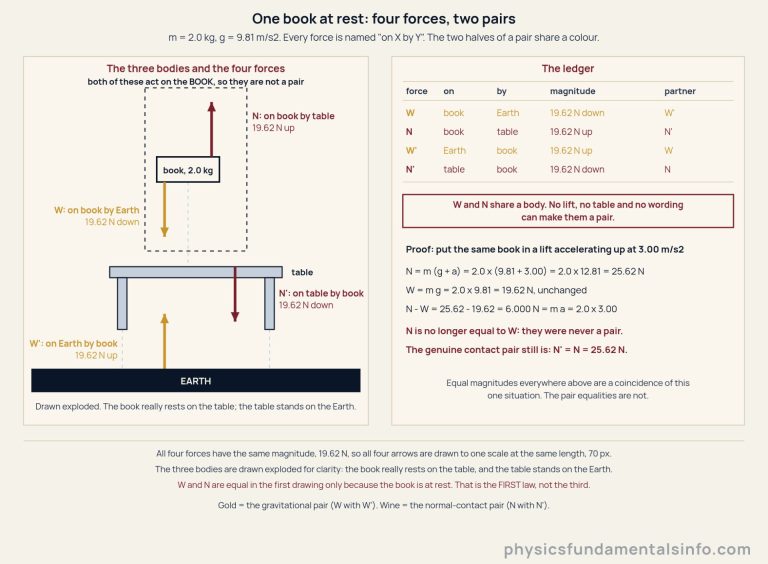
A book’s weight and the table’s normal force are not a third-law pair. They act on the same body – the book – so they fail condition 2 outright, and they are not even the same type of force. They are equal here for a completely different reason.

Take a 2.0 kg book sitting still on a table, with g = 9.81 m/s2. There are four forces in play and two pairs, and all four happen to have the same magnitude: 2.0 × 9.81 = 19.62 N.

  • W, on the book by the Earth: 19.62 N down. Its partner is W’.
  • W’, on the Earth by the book: 19.62 N up. Its partner is W.
  • N, on the book by the table: 19.62 N up. Its partner is N’.
  • N’, on the table by the book: 19.62 N down. Its partner is N.

Read the “on” column and the whole confusion dissolves. W and N both act on the book. W’ acts on the Earth and N’ acts on the table, which is exactly why they are the partners and the other two are not.

So why are W and N equal? Because the book is not accelerating, which is the first law talking, not the third. That distinction sounds academic until you move the table.
A two-panel diagram of a 2.0 kilogram book at rest on a table, with the three bodies drawn exploded one above the other on the left and a written ledger of the four forces on the right. In the left panel, headed the three bodies and the four forces, a cream book rectangle labelled book, 2.0 kilograms sits at the top, a grey table with a flat top and two legs is drawn well below it, and a dark navy band labelled EARTH runs along the bottom; thin dashed guide lines join the book down to the table top and the table legs down to the Earth band to show where the two contacts really are. Four straight arrows are drawn, all of them exactly 70 pixels long because all four forces have the same magnitude of 19.62 newtons. Two gold arrows form the gravitational pair: W points downward from the underside of the book, labelled W, on book by Earth, 19.62 newtons down, and W prime points upward from the Earth band, labelled W prime, on Earth by book, 19.62 newtons up. Two wine-red arrows form the contact pair: N points upward from the top of the book, labelled N, on book by table, 19.62 newtons up, and N prime points downward from the top surface of the table, labelled N prime, on table by book, 19.62 newtons down. A dashed dark bracket encloses the book and both the W and the N arrows in full, labelled both of these act on the BOOK, so they are not a pair. In the right panel, headed the ledger, a five-column written table lists force, on, by, magnitude and partner for all four forces: W on book by Earth 19.62 newtons down partner W prime, in gold; N on book by table 19.62 newtons up partner N prime, in wine; W prime on Earth by book 19.62 newtons up partner W, in gold; and N prime on table by book 19.62 newtons down partner N, in wine. Below the ledger a wine-bordered box reads W and N share a body, so no lift, no table and no wording can make them a pair. Under that box, five lines headed proof, put the same book in a lift accelerating upward at 3.00 metres per second squared read N equals m times open bracket g plus a close bracket equals 2.0 times open bracket 9.81 plus 3.00 close bracket equals 2.0 times 12.81 equals 25.62 newtons; W equals m g equals 2.0 times 9.81 equals 19.62 newtons, unchanged; N minus W equals 25.62 minus 19.62 equals 6.000 newtons, which equals m a equals 2.0 times 3.00; so N is no longer equal to W, and they were never a pair; and the genuine contact pair is still equal, N prime equals N equals 25.62 newtons. Three footnotes state that all four forces have the same magnitude of 19.62 newtons so all four arrows are drawn to one scale at the same 70 pixel length, that the three bodies are drawn exploded for clarity because the book really rests on the table and the table stands on the Earth, and that W and N are equal in the first drawing only because the book is at rest, which is the first law and not the third.
Figure 1: the book’s four forces, colour-coded into the two pairs. Gold is gravitational, wine is contact, and all four are 19.62 N, so all four arrows are drawn the same length. W and N sit on the same body, which is why they are not a pair – and the lift on the right proves it by pulling them apart.

The lift settles it

Put the same book in a lift accelerating upwards at 3.00 m/s2. The table in the lift now has to do more than hold the book up; it has to accelerate it, so N = m(g + a) = 2.0 × (9.81 + 3.00) = 2.0 × 12.81 = 25.62 N.

Nothing at all has happened to the weight: W = 2.0 × 9.81 = 19.62 N, because neither the mass nor g changed. The gap between the two is the net force doing the accelerating, N – W = 25.62 – 19.62 = 6.000 N, which is exactly m a = 2.0 × 3.00.

So W and N are not equal in the lift. A third-law pair is equal in every circumstance whatsoever, which is enough on its own to rule these two out – and the real contact pair obliges: N’ = N = 25.62 N, the book pressing on the table precisely as hard as the table presses on the book. In practice this is the quickest check a student can run on any suspected pair: imagine a situation that changes one of them, and see whether the other follows.

Equal Forces, Unequal Accelerations

Because the pair force is one magnitude felt by two different masses, the accelerations it produces are in the inverse ratio of those masses: a_1 / a_2 = m_2 / m_1. The force is symmetric. The result almost never is.

That is the whole reason the third law looks false in daily life. Lean on a parked van and nothing moves but you; lean on a supermarket trolley with the same effort and it sails off down the aisle. Each one returns exactly the force you gave it, and the only thing that changed was the mass on the other end.

The simulator below is built for exactly this. Set two masses and one pair force, and watch the two arrows stay the same length while the two accelerations pull apart – the Newton’s Third Law Simulator also has a page of its own if you would rather open it full-screen.

Newton's Third Law Lab

Here is the same identity at two very different scales. A 150 N shove between a 30 kg child and a 1200 kg car gives 150 / 30 = 5.000 m/s2 and 150 / 1200 = 0.1250 m/s2, a ratio of 1200 / 30 = 40.00. Stretch it to a 100 N pair between a 2.0 kg body and a 2000 kg one and you get 50.00 m/s2 against 0.05000 m/s2 – a ratio of 2000 / 2.0 = 1000, with the pair force not having budged a newton.

Scale it up once more and the arithmetic stops being polite. A car driving away on a 4800 N friction push from the road presses back on the road with the same 4800 N, which gives the 1200 kg car 4800 / 1200 = 4.000 m/s2 and gives the Earth 4800 / (5.972 × 1024) = 8.038 × 10⁻²² m/s2. The mass ratio 5.972 × 1024 / 1200 = 4.977 × 10²¹ is the ratio of those two accelerations. Nobody has ever felt the Earth’s half, and the force is the same size all the same.
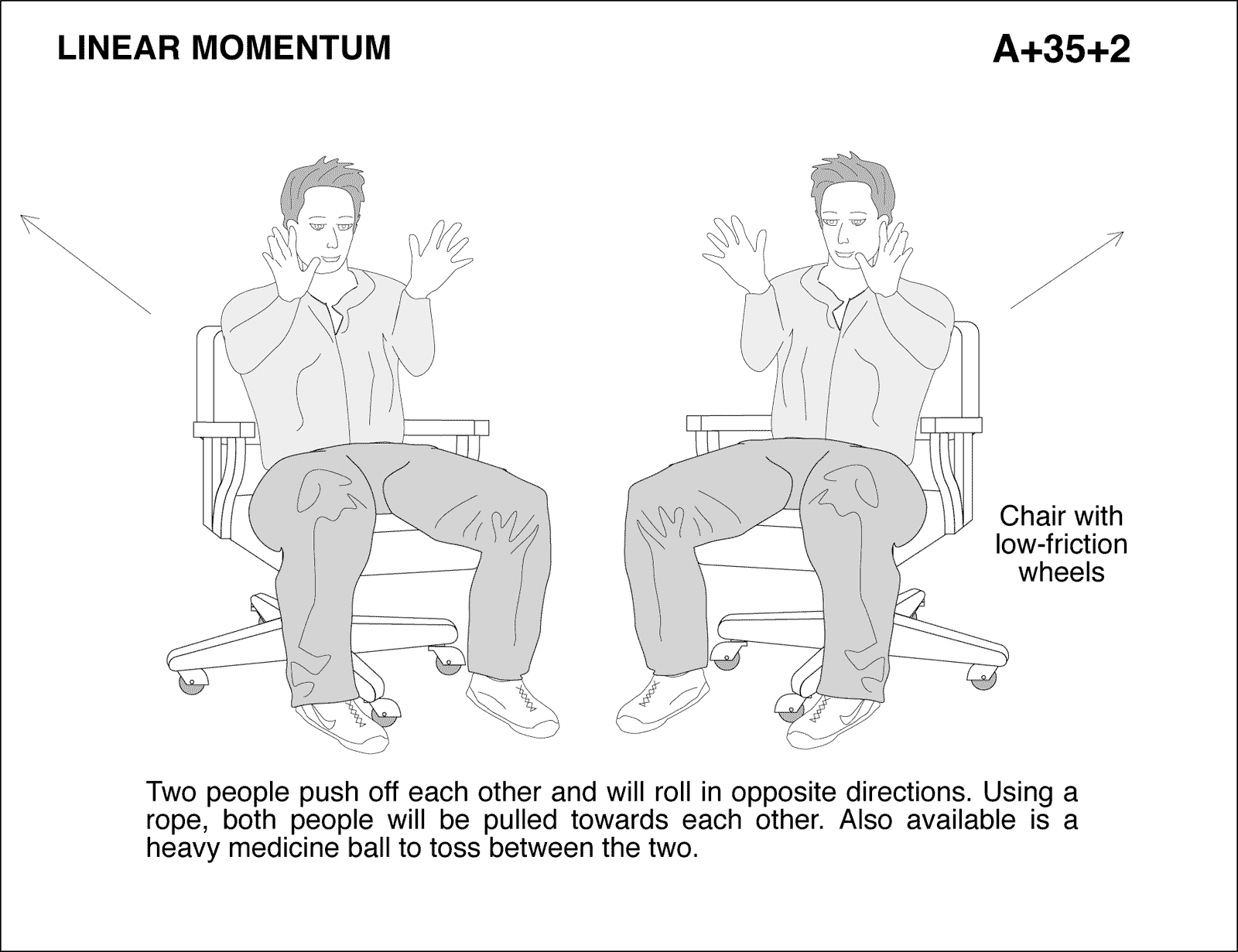
One of the clearest newtons third law examples: two people push against each other and move apart in opposite directions
One push, two bodies: each feels the same force and each moves away from the other.

Tug of War, Horse and Cart: Where the Law Looks Wrong

The law looks wrong in a tug of war and in a horse and cart because people add the two halves of a pair together, and the two halves are on different bodies, so they never belong in the same sum. Add forces on one body at a time and both puzzles evaporate.

If the rope pulls both teams equally, how does anyone win?

The rope’s tension really is the same both ways – team A pulls the rope with 600 N and the rope pulls team A back with 600.0 N, and the same holds at the other end. The rope cannot possibly decide the contest.

Something else does. Look at team A alone and the rope is only one of two horizontal forces on it; the other is friction from the ground. Standing still or sliding at a steady pace, that friction matches the rope exactly at 600.0 N. To accelerate the 240 kg team forwards at 0.50 m/s2, the ground has to push 240 × 0.50 = 120.0 N harder than the rope pulls, so it must supply 600 + 120.0 = 720.0 N.

A tug of war is won at the feet, not on the rope. That is the honest resolution, and it is why boots and body weight matter so much more than arm strength.

The horse and cart

The classic objection runs: if the cart pulls back on the horse as hard as the horse pulls the cart, how does the pair ever move? Because that pair is two forces on two bodies, and neither body’s own sum contains both of them.

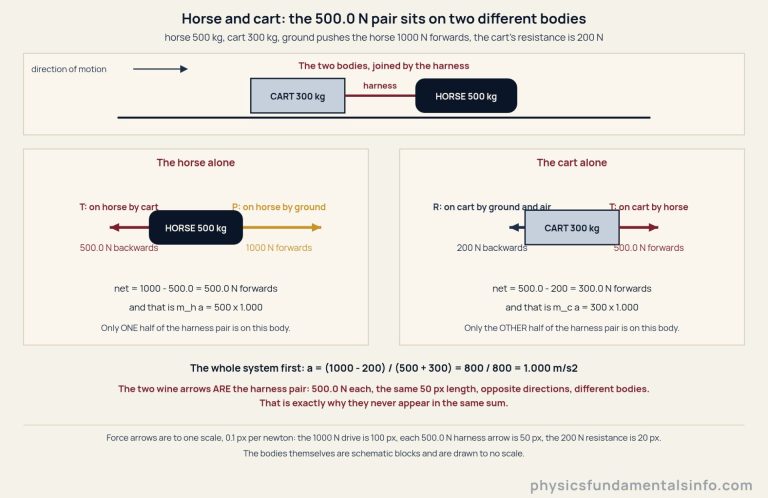
Give the horse 500 kg and the cart 300 kg. The ground pushes the horse forwards with 1000 N and the cart drags with 200 N of resistance. Treat the pair as one 800 kg object and (1000 – 200) / (500 + 300) = 800 / 800 = 1.000 m/s2.

Now split them. The cart needs T = 200 + 300 × 1.000 = 500.0 N of harness tension to accelerate at that rate, and the horse feels the same 500.0 N backwards, leaving it 1000 – 500.0 = 500.0 N of net force – which is 500 × 1.000, as it has to be. Both bodies accelerate at 1.000 m/s2 and the harness pair never shows up twice in one calculation.
A free-body diagram splitting a horse and cart into two separate bodies, with a small scene strip at the top and two panels below. The scene strip shows a rectangular block labelled CART 300 kilograms on the left joined by a short wine-red line labelled harness to a rounded navy block labelled HORSE 500 kilograms on the right, both standing on a dark ground line, with an arrow marking the direction of motion to the right. The left panel, headed the horse alone, shows the horse block with two horizontal arrows drawn to one scale of 0.1 pixels per newton: a gold arrow 100 pixels long pointing right out of the block, labelled P, on horse by ground, 1000 newtons forward, and a wine-red arrow 50 pixels long pointing left out of the block, labelled T, on horse by cart, 500.0 newtons backward. Two lines below read net equals 1000 minus 500.0 equals 500.0 newtons forward, and that equals m sub h times a equals 500 times 1.000. The right panel, headed the cart alone, shows the cart block with a wine-red arrow 50 pixels long pointing right out of the block, labelled T, on cart by horse, 500.0 newtons forward, and a dark navy arrow 20 pixels long pointing left out of the block, labelled R, on cart by ground and air, 200 newtons backward. Two lines below read net equals 500.0 minus 200 equals 300.0 newtons forward, and that equals m sub c times a equals 300 times 1.000. A band across the bottom reads the whole system first, a equals open bracket 1000 minus 200 close bracket divided by open bracket 500 plus 300 close bracket equals 800 divided by 800 equals 1.000 metres per second squared, and then states that the two wine arrows are the harness pair, 500.0 newtons each, drawn the same 50 pixel length, pointing opposite ways and sitting on different bodies, which is exactly why they never appear in the same sum. Two footnotes state that the force arrows are to one scale of 0.1 pixels per newton so the 1000 newton drive is 100 pixels, each 500.0 newton harness arrow is 50 pixels and the 200 newton resistance is 20 pixels, and that the bodies themselves are schematic blocks drawn to no scale.
Figure 2: the horse and the cart drawn as two separate bodies. The two wine arrows are the harness pair – 500.0 N each, drawn the same length, pointing opposite ways – and each panel contains exactly one of them. The nets are 500.0 N and 300.0 N, which are 500 × 1.000 and 300 × 1.000.

And the result that surprises everyone

Two blocks in contact, pushed along as one, raise a sharper question: how hard do they press on each other? Take a 3.0 kg block A and a 5.0 kg block B side by side on a smooth floor, with 24 N applied to the whole arrangement. The acceleration is 24 / (3.0 + 5.0) = 3.000 m/s2 however you push.

Push on B so that B drives A, and the only force on A is the contact push, so it must be 3.0 × 3.000 = 9.000 N. Turn the whole thing round and push A instead: now the only force on B is the contact push, which must be 5.0 × 3.000 = 15.00 N.

Same applied force, same acceleration, and an internal pair that differs by 15.00 – 9.000 = 6.000 N depending on which end your hand is at. Problem 8 works both cases in full, because this is the single result on this page most worth keeping.
Worked Problems

Problem 1
Trolley A has a mass of 2.0 kg and trolley B a mass of 8.0 kg. They are in contact on a frictionless horizontal track, and B pushes A with a pair force of 40 N. State the force on each trolley and find each trolley's acceleration.
Show Solution
Solution: Step 1: name the pair before touching a calculator. The interaction is the contact between the two trolleys, so one force is on A by B and the other is on B by A, and the third law makes them equal in magnitude: F_12 = -F_21. Step 2: read off the magnitudes. The force on A by B is 40.00 N, and the force on B by A is 40.00 N. The 40 N is not shared out between them; each trolley feels the whole of it. Step 3: apply the second law to one trolley at a time. a_A = F / m_A = 40 / 2.0 = 20.00 m/s2, and a_B = F / m_B = 40 / 8.0 = 5.000 m/s2. Step 4: check both ways. The ratio is 20.00 / 5.000 = 4.000, which is m_B / m_A = 8.0 / 2.0 = 4.000; and the products agree, 2.0 x 20.00 = 40.00 N and 8.0 x 5.000 = 40.00 N. Answer: 40.00 N on each trolley, with a_A = 20.00 m/s2 and a_B = 5.000 m/s2. One force, two accelerations in the ratio 4.000 – and the lighter trolley gets the bigger one.
Problem 2
A 2.0 kg book rests on a table. Take g = 9.81 m/s2. Name all four forces involved, say which body each one acts on, give its magnitude, and sort them into their two third-law pairs.
Show Solution
Solution: Step 1: find the interactions, not the forces. The book interacts with exactly two things: the Earth, gravitationally, and the table, by contact. Two interactions means two pairs, which means four forces. Step 2: name each force “on X by Y” and give it a magnitude. W is on the book by the Earth, 19.62 N down, since 2.0 x 9.81 = 19.62. W’ is on the Earth by the book, 19.62 N up. N is on the book by the table, 19.62 N up, because the book is not accelerating. N’ is on the table by the book, 19.62 N down. Step 3: pair them by interaction. The gravitational pair is W with W’; the contact pair is N with N’. Now look at the “on” column: W and N both act on the book, so they are not a pair – they are two forces on one body that happen to balance. Answer: four forces, all of magnitude 19.62 N; the pairs are (W, W’) and (N, N’). W and N share a body, so they can never be a third-law pair however equal they look.
Problem 3
The same 2.0 kg book now sits on a table inside a lift that is accelerating upwards at 3.00 m/s2. Find the normal force on the book, compare it with the book's weight, and say what that comparison proves about the two forces.
Show Solution
Solution: Step 1: write the second law for the book alone, taking up as positive. The only two forces on it are N up and W down, so N – W = m a. Step 2: substitute and solve for N. N = m (g + a) = 2.0 x (9.81 + 3.00) = 2.0 x 12.81 = 25.62 N. Step 3: compare with the weight, which has not changed, because neither the mass nor g has. W = m g = 2.0 x 9.81 = 19.62 N, so N – W = 25.62 – 19.62 = 6.000 N, and that is m a = 2.0 x 3.00 = 6.000 N. Step 4: draw the conclusion. N and W differ by 6.000 N here, while a third-law pair is equal in every circumstance – so N and W were never a pair, not even when the lift was still. The genuine contact pair does stay equal: N’ = N = 25.62 N. Answer: N = 25.62 N against W = 19.62 N, a difference of 6.000 N. One situation in which they come apart is enough to prove they were never partners.
Problem 4
Student A has a mass of 50 kg and student B a mass of 80 kg. Sitting on wheeled chairs, they push off from each other with a pair force of 120 N. Find each student's acceleration and the ratio between them.
Show Solution
Solution: Step 1: identify the pair. One interaction, hands on hands, so the force on A by B and the force on B by A are both 120 N – the heavier student does not get a bigger share. Step 2: apply the second law to each student separately. a_A = 120 / 50 = 2.400 m/s2 and a_B = 120 / 80 = 1.500 m/s2. Step 3: take the ratio and check it against the masses. 2.400 / 1.500 = 1.600, and m_B / m_A = 80 / 50 = 1.600, so the accelerations are in the inverse ratio of the masses, as a_1 / a_2 = m_2 / m_1 requires. Step 4: confirm the one force two ways. 50 x 2.400 = 120.0 N and 80 x 1.500 = 120.0 N. Answer: a_A = 2.400 m/s2, a_B = 1.500 m/s2, a ratio of 1.600. The lighter student leaves faster, and neither student was pushed harder than the other.
Problem 5
A 60 kg swimmer pushes backwards on a parcel of water, taken as 2.0 kg, with a force of 90 N. Find the acceleration of the swimmer and of that parcel of water, and the ratio of the two.
Show Solution
Solution: Step 1: name the pair. The force on the water by the swimmer’s hands is 90 N backwards; the force on the swimmer by the water is 90 N forwards. Same interaction, same magnitude, different bodies. Step 2: accelerate the swimmer. a_swimmer = 90 / 60 = 1.500 m/s2 forwards. Step 3: accelerate the water. a_water = 90 / 2.0 = 45.00 m/s2 backwards. Step 4: compare, and sanity-check the products. The ratio is 45.00 / 1.500 = 30.00, matching the mass ratio 60 / 2.0 = 30.00; and 60 x 1.500 = 90.00 N while 2.0 x 45.00 = 90.00 N. Answer: the swimmer at 1.500 m/s2, the water at 45.00 m/s2, a ratio of 30.00. The 2.0 kg is an assumption about how much water a stroke actually grips, so treat the water’s figure as the consequence of that assumption rather than a measurement.
Problem 6
In a tug of war, team A pulls on the rope with 600 N. (a) What force does the rope exert on team A? (b) Team A is sliding at a steady speed: what friction force does the ground give it? (c) The 240 kg team now accelerates forwards at 0.50 m/s2 instead: what friction force does the ground have to supply?
Show Solution
Solution: Step 1: do part (a) with the third law alone. The grip between team A and the rope is one interaction, so the force on the rope by team A and the force on team A by the rope have the same magnitude: 600.0 N, directed towards the rope. Step 2: do part (b) with the first law, looking at team A alone. At a steady speed the forces on the team sum to zero, and the only two horizontal ones are the rope pulling with 600.0 N and friction from the ground. Friction is therefore 600.0 N, pointing the other way. Step 3: do part (c) with the second law. The team now needs a net force of m a = 240 x 0.50 = 120.0 N, so the ground must beat the rope by that much: friction = 600 + 120.0 = 720.0 N. Step 4: check it. The net force is 720.0 – 600 = 120.0 N, and 120.0 / 240 = 0.5000 m/s2, which is the acceleration asked for. Answer: (a) 600.0 N, (b) 600.0 N, (c) 720.0 N. The rope’s tension is identical for both teams, so it cannot decide the contest – the ground can, which is why a tug of war is won at the feet.
Problem 7
A 500 kg horse pulls a 300 kg cart. The ground pushes the horse forwards with 1000 N, and the cart meets 200 N of resistance. Find the acceleration, find the tension in the harness, and explain why the equal and opposite harness pair does not forbid the motion.
Show Solution
Solution: Step 1: take horse and cart together as one 800 kg body. The harness pair is internal to that body, so both halves drop out and only the external forces are left: a = (P – R) / (m_h + m_c) = (1000 – 200) / (500 + 300) = 800 / 800 = 1.000 m/s2. Step 2: now look at the cart alone, where the harness tension T pulls forwards and the 200 N resistance pulls back. T – R = m_c a, so T = R + m_c a = 200 + 300 x 1.000 = 500.0 N. Step 3: check it on the horse alone, which feels 1000 N forwards from the ground and the harness pulling back with the same 500.0 N. The net is 1000 – 500.0 = 500.0 N, and m_h a = 500 x 1.000 = 500.0 N, so the two agree. Step 4: answer the paradox. The pair is 500.0 N on the cart by the horse and 500.0 N on the horse by the cart, and those two forces sit on two different bodies – so no single body’s sum ever contains both. The cart’s own net is 500.0 – 200 = 300.0 N, and 300.0 / 300 = 1.000 m/s2, exactly as the system calculation said. Answer: a = 1.000 m/s2 and the harness tension is 500.0 N. Nothing cancels, because cancellation needs two forces on one body and this pair never offers that.
Problem 8
Block A has a mass of 3.0 kg and block B a mass of 5.0 kg. They are in contact on a smooth horizontal floor and a steady 24 N is applied to the pair. Find the contact force between the blocks when the 24 N is applied to B, then when the same 24 N is applied to A instead.
Show Solution
Solution: Step 1: get the acceleration from the whole arrangement, since the blocks stay in contact and so share it. a = F / (m_A + m_B) = 24 / (3.0 + 5.0) = 24 / 8.0 = 3.000 m/s2, and that figure does not depend on which block you push. Step 2: push B, and look at A alone. The applied force is nowhere near A; the only horizontal force on it is the contact push from B. So the contact force must supply all of A’s acceleration: contact = m_A a = 3.0 x 3.000 = 9.000 N. Step 3: check that on B. B feels the applied 24 N forwards and, by the third law, A pushes back on B with the same 9.000 N. The net is 24 – 9.000 = 15.00 N, and m_B a = 5.0 x 3.000 = 15.00 N, so B accelerates at 3.000 m/s2 too. Step 4: now push A instead and repeat. The only horizontal force on B is now the contact push from A, so contact = m_B a = 5.0 x 3.000 = 15.00 N; and checking on A, 24 – 15.00 = 9.000 N = m_A a = 3.0 x 3.000. Answer: 9.000 N when the 24 N is applied to B, and 15.00 N when the same 24 N is applied to A. Same applied force, same 3.000 m/s2, and an internal pair that differs by 15.00 – 9.000 = 6.000 N purely because of which end your hand is at.

Frequently Asked Questions

What is Newton's third law?
Newton’s third law says that when two bodies interact, each exerts a force on the other that is equal in magnitude and opposite in direction, written F_12 = -F_21. The two forces are a third-law pair. They arise from one interaction, they act on different bodies, and they are always the same type of force as each other.
What are examples of Newton's third law?
Walking, swimming, a jet engine, a spinning ball in flight, two people pushing off on wheeled chairs, a tug-of-war rope and a horse pulling a cart are all third-law pairs. In each case name the two bodies first: your shoe and the pavement, a hand and the water, an engine and its exhaust gas. The two forces are always equal, and the two accelerations usually are not.
How do you identify a Newton's third law pair?
Check three conditions, all of which must hold. The two forces must come from one interaction between exactly two bodies, they must act on different bodies with one force on each, and they must be the same type of force – both gravitational, both normal contact, both friction or both tension. Failing any single condition is enough to disqualify the candidate.
Are a book's weight and the table's normal force a third-law pair?
No. Both act on the book, so they fail the different-bodies condition, and one is gravitational while the other is contact. They are equal for a 2.0 kg book at rest only because the book is not accelerating, which is the first law. Put the whole thing in a lift accelerating up at 3.00 m/s2 and the normal force becomes 25.62 N while the weight stays 19.62 N.
If the two forces are equal, why does only one object seem to move?
Because equal forces on unequal masses give unequal accelerations: a_1 / a_2 = m_2 / m_1. A 150 N shove between a 30 kg child and a 1200 kg car gives the child 5.000 m/s2 and the car 0.1250 m/s2, a factor of 40.00 apart. Both bodies really do accelerate. Only one of the two accelerations is big enough to notice.
How can a horse pull a cart if the cart pulls back just as hard?
Because those two forces act on two different bodies, so no single body’s force sum contains both of them. For a 500 kg horse and a 300 kg cart, with 1000 N from the ground and 200 N of resistance, the harness tension is 500.0 N and both bodies accelerate at 1.000 m/s2. The horse is moved by the ground, not by the cart.
Does the size of the pair force depend on the two masses?
No. The pair force is set by the interaction, and both bodies feel exactly the same magnitude however lopsided the masses are. What the masses decide is the acceleration each body gets from that one force, through a_1 = F / m_1 and a_2 = F / m_2. Change a mass and the two accelerations move; the pair force does not.
P

Written by PhysicsFundamentals Editorial Team

Articles on PhysicsFundamentalsinfo.com are researched, written, and fact-checked by our editorial team. Every piece is reviewed for accuracy before publishing, with formulas and worked examples checked against standard physics references.

View All Authors →